The Problem Hiding in Plain Sight

Screenshot PDF fraud is one of the most underreported risks in financial onboarding today.

Industry estimates suggest that manipulated documents appear in over 25% of financial fraud cases and fraudsters use screenshot PDFs as one of their most common tools to carry out that manipulation. Despite this, many compliance teams still rely on visual document review as their main defence.

How It Unfolds in Practice

Consider a typical scenario. An analyst reviews a document. It looks clean the text is readable, the logo is present, and the layout matches what you would expect. Something feels off, however, and the team cannot explain what. Under time pressure, they approve it anyway. Weeks later, that document resurfaces during an audit as a manipulated file that should never have cleared review.

In practice, screenshot PDF fraud moves through onboarding queues without triggering alerts, passes visual checks, and satisfies surface level requirements. And yet, these files cannot support what compliance actually demands: proven authenticity, traceable origin, and tamper evident document integrity.

Why This Is a KYC-Level Risk

For any organisation running KYC verification at scale whether in banking, lending, insurance, or fintech screenshot PDFs represent a documented and underestimated gap in document trust. This blog explains why that gap exists, how bad actors exploit it, and what your team should do to close it.


What Exactly Is a Screenshot PDF?

A screenshot PDF is not a genuine digital document. Specifically, it tends to be:

  • A screenshot captured from a phone screen, browser, or desktop application
  • Converted or printed into a PDF format
  • Submitted to a compliance or onboarding workflow as a legitimate document

The Structural Difference That Matters

The key distinction is structural. A true digital document an issuer generated PDF from a bank portal, a government-issued identity file, or a digitally signed income certificate carries embedded metadata, structural layers, and traceable properties. A screenshot PDF, by contrast, is simply an image wrapped inside a PDF container.

On screen, it may look identical to a genuine document. Under closer inspection, however, it behaves entirely differently and that gap is exactly where screenshot PDF fraud lives.


Why Screenshot PDF Fraud Breaks KYC Verification at the Root

KYC verification rests on one core question: can you prove this document is authentic?

Screenshot PDF fraud directly attacks that question at multiple levels.

No Proof of Origin

Genuine documents contain metadata creation timestamps, issuer details, and software signatures that trace a file back to its source. Screenshot PDFs strip all of this completely. Consequently, when regulators or internal reviewers ask where a document came from, the file offers no answer at all.

No Digital Signature Trail

By design, digitally signed documents resist tampering. Any change made after signing breaks the signature chain immediately. Without a signature chain, however, nothing flags your system when someone edits the file before submission and screenshot PDFs carry no such chain.

Broken Chain of Custody

In digital onboarding compliance, chain of custody means knowing where a file came from, who handled it, and whether anything changed during submission. All three elements disappear with a screenshot PDF. This is not a minor inconvenience it is a core failure of the documentation standard that regulators expect.

OCR Dependency Compounds the Risk

Because screenshot PDFs are image-based, teams must rely on OCR to extract any data. Unfortunately, OCR introduces its own errors misread characters, formatting distortion, and outputs that vary across attempts. In an online KYC verification workflow, these gaps produce unreliable data fields and drive up both false positives and costly rework.


How Fraudsters Exploit the Screenshot PDF Gap

Modern document fraud is not crude. It is deliberate, structured, and built to pass human review.

Today’s fraudsters do not submit files with obvious errors. Instead, they submit files that clear visual checks cleanly and screenshot PDF fraud makes this simple to execute.

Editing Requires Minimal Skill

Anyone can manipulate a screenshot PDF using freely available software. Fraudsters alter text layers, adjust income figures, change names, and modify transaction dates all before converting the image back into a PDF. The result looks clean because the fraudster controls exactly what the screenshot captures before submission.

For context, a change as significant as inflating a bank balance from ₹80,000 to ₹8,00,000 leaves no visual trace when the font and layout remain unchanged. Manual review simply cannot detect this.

Metadata Is Absent by Design

Since screenshot PDFs contain no original metadata, fraud detection tools that normally flag anomalies mismatched creation dates, unrecognised editor software, structural markers from unfamiliar applications have nothing to analyse. The absence of data is, in this case, the problem itself.

Visual Review Is the Wrong Defence

Compliance analysts scan for visual cues: does this look right? Fraudsters design screenshot PDFs specifically to pass that test. The fraud is not in how the document appears it is in what the document cannot prove about itself. Taken together, these factors mean that screenshot PDF fraud increases fraudulent document volume in onboarding pipelines while simultaneously removing the signals that fraud detection tools rely on.


The Operational Cost Your Team Is Already Paying

Beyond fraud risk, screenshot PDFs impose a measurable operational cost that teams rarely track correctly.

The Review Burden Adds Up Fast

Each image-based PDF entering your workflow demands extra handling steps that native digital documents do not require. Analysts manually verify what automated systems cannot confirm, check OCR outputs for accuracy, follow up on document gaps with customers, re-request files, and often still approve submissions under time pressure.

At low volume, this creates friction. At scale, however, it becomes a genuine resource drain.

The Numbers Make the Case

Research by compliance operations teams suggests that manually reviewing image-based documents takes three to five times longer than reviewing native digital files. Teams running online KYC verification across thousands of daily submissions cannot treat each screenshot PDF as a one-off review task. The economics break down fast.

What looks like a document format issue is, in practice, a capacity issue, an accuracy issue, and a risk management issue all at once.


What “Looks Fine” Actually Means in Document Review

Many compliance teams particularly those working under volume pressure operate with an informal standard: if a document looks fine, it passes.

The Problem With That Standard

This approach is not written down anywhere. Moreover, it is not defensible in any audit. And it is precisely what makes screenshot PDF fraud so difficult to address through process changes alone.

“Looks fine” measures appearance. Compliance, however, requires proof. These are not the same thing, and mixing them up creates exactly the gap that bad actors exploit.

Why Fraud Targets Visual Review

Modern document fraud targets human visual review specifically. It does not look rushed or inconsistent. Instead, it looks professional, complete, and entirely plausible. The manipulation lives in the data, not the design. No amount of careful visual checking will catch a balance figure changed from ₹80,000 to ₹8,00,000 when the font, spacing, and layout remain identical.

This is precisely why automated fraud detection tools and structural document analysis matter. Rather than replacing human judgment, they create the reliable verification baseline that makes human judgment meaningful and defensible.


What To Accept Instead: A Practical Framework

Reducing screenshot PDF fraud in your workflow does not mean rejecting every imperfect submission. Instead, it means building a tiered approach to document trust.

Tier 1: Issuer-Generated Native PDFs

Documents downloaded directly from the source — bank portals, Aadhaar verification systems, GST portals, or government identity platforms carry full metadata, structural integrity, and often digital signatures. These should form the default expectation in any digital onboarding workflow, because they offer the strongest and most verifiable base of trust.

Tier 2: Digitally Signed Documents

Digitally signed PDFs provide proven origin and built-in tamper evidence. A valid digital signature confirms that the document has not changed since the issuer signed it. In a KYC verification workflow, this is far more reliable than any unsigned alternative.

Tier 3: Structured Verifiable Files

Where direct issuer downloads are not available, structured files with traceable properties creation metadata, consistent font embedding, and a clean layer structure are preferable to image-only submissions.

Screenshot PDFs: Use as a Risk Signal

Blanket rejection of screenshot PDFs may not be practical in every regulatory context. A more useful approach is to treat them as a risk signal: automatically detect image-only PDFs, flag missing or inconsistent metadata, and route high-risk cases to step up verification. This makes the risk measurable and actionable without adding friction for lower-risk customers.


How Compliance Automation Closes This Gap at Scale

Manual document review cannot keep pace with the volume and complexity of modern compliance demands. As a result, compliance automation is how teams eliminate screenshot PDF fraud without proportionally increasing headcount.

BeFiSc TamperProof: Built for This Problem

Tools like BeFiSc TamperProof detect screenshot PDFs, metadata anomalies, hidden edits, and structural manipulation automatically before a document ever reaches a human reviewer. This combination of digital KYC verification and automated analysis separates teams that control document fraud from teams that simply react to it.

What Effective Automation Covers

More broadly, strong compliance automation for document verification addresses several areas:

Structural document classification. Automated systems determine whether a file is image-based or native digital within milliseconds. This step alone enables smart triage routing image-only submissions to enhanced review before they reach an analyst.

Metadata verification. Automated checks identify missing metadata, inconsistent creation dates, editor software anomalies, and structural flags that point to post-creation changes.

Tamper detection. Advanced document analysis surfaces hidden text layers, overlaid content, inconsistent font metrics, and structural anomalies all signs that someone changed the file after generation. Document tampering detection at this level is simply not achievable through visual review.

Risk-based routing. Rather than processing all documents in queue order, compliance automation enables priority workflows assigning documents to review queues based on actual risk profile, not arrival time.

Audit trail generation. Every automated check produces a logged, timestamped record. Regulators want to see exactly this: not just that a document looked fine, but that your team verified it through a consistent, documented process.


Screenshot PDF Risk Assessment Checklist

Use this list as an internal reference during document review:

  • Does the file contain no selectable text layer, making it an image-only PDF?
  • Are key metadata fields absent creation date, author, software, or modification history?
  • Has the issuing organisation provided no digital signature on this document?
  • Do OCR outputs vary or change across multiple extraction attempts?
  • Can you spot inconsistencies in font embedding, spacing, or layout alignment?
  • Do hidden layers, embedded objects, or unusual file structures appear in this document?
  • Does the document fail to link back to any verifiable issuing system?

If your workflow cannot reliably answer these questions, your team needs stronger fraud detection tools and a more structured document intake process.


Key Takeaways

  • Screenshot PDF fraud is a real, growing, and documented problem in financial onboarding — not a theoretical risk.
  • These files are image-only PDFs that carry no metadata, no digital signatures, and no structural proof of origin.
  • Because they pass visual review while failing structural checks, fraudsters rely on them as a standard manipulation tool.
  • KYC verification built on visual review alone is not defensible in an audit and fails against well-executed document fraud.
  • Online KYC verification at scale requires structural analysis, metadata validation, and automated tamper detection — not just readability checks.
  • Compliance automation allows teams to detect, triage, and route document risk systematically, without large increases in manual review capacity.
  • The real compliance standard is not “does this look fine” — it is “can we prove this is authentic.”

Conclusion

Screenshot PDF fraud persists in compliance workflows for the same reason most process gaps do: teams tolerate it because the consequences rarely appear immediately.

The Pattern Is Predictable

A document passes review. A case closes. Later, however during an audit, a credit loss, or a regulatory review the manipulated file resurfaces. By then, tracing it back to the original document decision is difficult and time consuming.

The Standard Is Provability, Not Appearance

The compliance standard for KYC verification is not how a document looks. It is whether your team can prove it is genuine. Is there evidence of where the document came from? Does your workflow show it has not been altered? Do your records capture a consistent, auditable account of how the verification happened?

Screenshot PDFs cannot support any of these requirements and no one designed them to.

Build the Right Foundation

Closing the screenshot PDF fraud gap requires more than updated policies. It requires automated structural analysis, metadata verification, and tamper detection built directly into the document intake process. Tools like BeFiSc TamperProof make this possible at the speed and scale that modern onboarding demands.

Trust is not what a document looks like. Trust is what you can prove.


Detect screenshot PDF fraud before it reaches your review queue. BeFiSc TamperProof automatically flags image-only PDFs, metadata anomalies, and structural manipulation — so your team focuses on real decisions, not document guesswork.

Explore BeFiSc TamperProof →

FAQs

What is screenshot PDF fraud and why is it difficult to detect?

Screenshot PDF fraud occurs when a legitimate document is captured as a screenshot, edited, and then submitted as a PDF. Because the file visually resembles a genuine document, manipulation can be difficult to detect without structural analysis.

Can screenshot PDFs ever be accepted in KYC workflows?

In lower-risk scenarios they may be accepted with additional verification. However, for primary identity or financial verification documents they should not be relied upon alone.

How do fraud detection tools identify manipulated screenshot PDFs?

They analyse document metadata, file structure, font patterns, text-image relationships, and other forensic indicators rather than relying on visual appearance.

How should companies request documents from customers?

Customers should be asked to upload PDFs downloaded directly from official portals such as bank platforms or government systems.

What is the difference between a native digital document and a screenshot PDF?

Native digital documents are generated directly by the issuing system and contain metadata, structural layers, and sometimes digital signatures. Screenshot PDFs are simply images placed inside a PDF container.
Write a Comment

Leave a Comment

Your email address will not be published. Required fields are marked *

Introduction

In India’s rapidly digitizing financial ecosystem, GST verification has become a crucial step in business onboarding, compliance, and fraud prevention. Verifying whether a business is legitimately registered under the Goods and Services Tax system ensures that platforms work only with valid entities. By performing GST verification, businesses can confirm whether a GST Identification Number (GSTIN) exists in official tax records and whether the registration is active.

For fintech platforms, marketplaces, payment aggregators, and lenders, verifying business identities manually through government portals is not scalable. Platforms that onboard merchants or vendors at scale need automated systems that can instantly perform a GST number check, retrieve business details, and confirm registration status.

This is where GST Verification APIs become valuable. These APIs allow platforms to perform automated GST number check operations within onboarding workflows, retrieve official business information, and reduce the risk of fraudulent registrations.

In this guide, we will explain how GST verification works, what information can be retrieved from GST records, and how developers can integrate a GST verification API into their systems.


What Is GST Verification?

GST verification is the process of validating a Goods and Services Tax Identification Number (GSTIN) and retrieving the official business details associated with that registration.

When businesses perform a GST number check, they confirm:

  • Whether the GSTIN exists in official records
  • Whether the registration is active, cancelled, or suspended
  • The legal name of the business
  • The registered address and jurisdiction

Businesses often perform this validation before onboarding vendors, merchants, or partners to ensure that the entity is legally registered under the GST framework.

While companies can manually perform a GST check status using the government portal, automation becomes necessary when verification needs to happen at scale.

For reference, GST registrations can also be verified manually through the official GST portal maintained by the government.


What Is a GST Verification API?

A GST Verification API allows businesses to automate the GST verification process through programmatic requests.

Instead of manually searching GST numbers on the GST portal, developers can send a GSTIN to an API endpoint and receive structured business data instantly.

The API performs gst no verification and returns information such as:

  • Legal name of the business
  • Trade name (if available)
  • Registration status
  • Registration date
  • Taxpayer type
  • Registered business address

The response is usually returned in JSON format, making it easy for developers to integrate GST verification into onboarding workflows, compliance checks, and fraud detection systems.


Why Businesses Use GST Verification APIs

Faster Merchant Onboarding

Platforms that onboard merchants digitally need to validate businesses quickly. Automated gst number check workflows allow businesses to confirm registrations instantly during signup.

Fraud Prevention

Fraudulent entities may attempt to register using fake or invalid GST numbers. Automated gst verification helps identify invalid registrations, suspended GSTINs, or mismatched business details.

Compliance Requirements

Many regulated sectors require businesses to verify vendor identities before onboarding them. Performing a gst check status ensures that businesses operate with legitimate partners.

Data Accuracy

Manual data entry often leads to incorrect GST numbers. Automated GST no. check ensures that the business information captured by the platform matches official GST records.


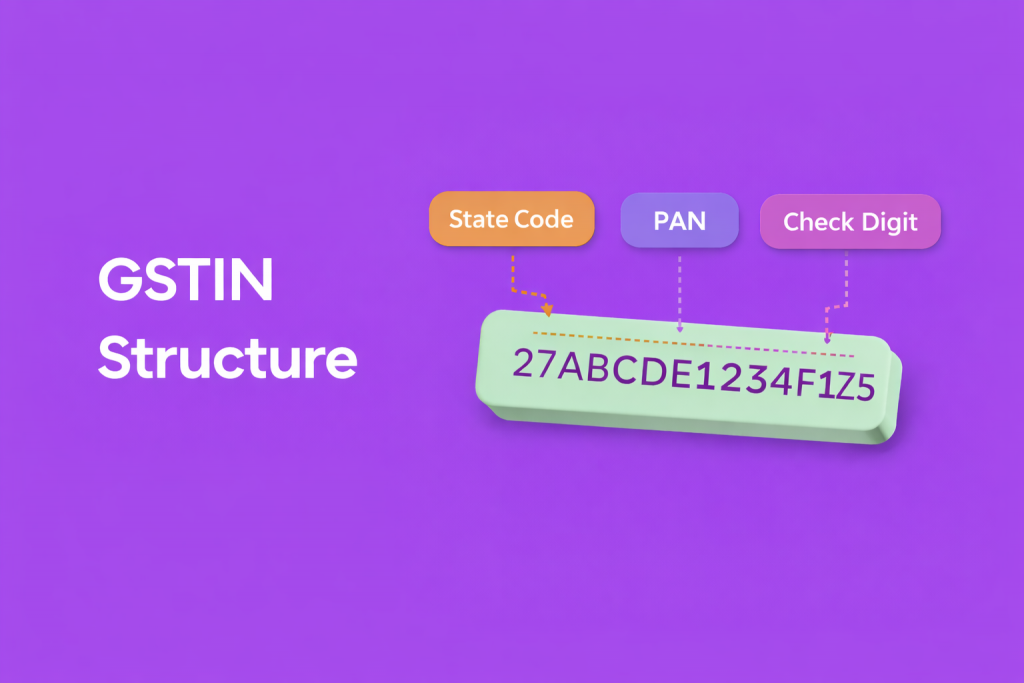
Understanding the Structure of a GSTIN

Before performing a gst number check, developers should understand how GST numbers are structured.

A GST Identification Number contains 15 characters.

Example:

27ABCDE1234F1Z5

Structure Breakdown

ComponentDescription
First 2 digitsState code
Next 10 charactersPAN of the business
13th digitEntity number under the PAN
14th digitDefault alphabet
15th digitChecksum digit

Because GSTIN contains PAN details, many fintech platforms combine PAN verification with GST verification during business onboarding.

For more information about the GSTIN structure, the government provides guidance on the GST portal.


What Information Does GST Verification Return?

A typical GST verification response includes multiple data points about the registered business.

Business Identity Details

  • Legal business name
  • Trade name
  • Constitution of business (proprietorship, partnership, company)

Registration Details

  • GSTIN
  • Registration date
  • Registration status
  • Taxpayer type

A gst check status confirms whether the GST registration is active, cancelled, or suspended.

Address Details

  • Registered address
  • State jurisdiction
  • Centre jurisdiction

These details help confirm whether the information provided by the user matches official records.


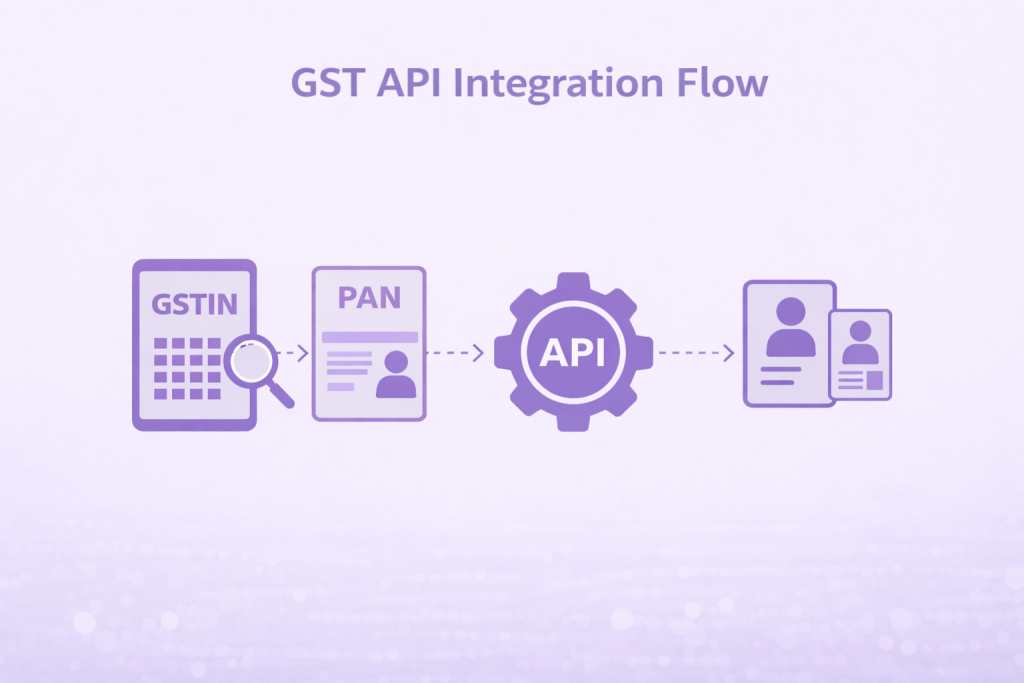
How GST Verification Works (Technical Flow)

Although GST verification appears simple to users, several processes occur behind the scenes.

Step 1: User Submits GSTIN

During onboarding, the user enters their GST number.

Example:

GSTIN: 27ABCDE1234F1Z5

The system performs a basic format validation before initiating the gst number check.


Step 2: API Request Is Sent

The platform sends the GST number to the verification API.

Example request:

POST /gst-verification
{
"gstin": "27ABCDE1234F1Z5"
}

API authentication credentials are included in the request headers.


Step 3: GST Data Is Retrieved

The API performs gst no verification by retrieving the corresponding registration details from GST records.


Step 4: API Response Is Returned

The API returns structured business data.

Example response:

{
"gstin": "27ABCDE1234F1Z5",
"legal_name": "ABC Trading Pvt Ltd",
"registration_status": "Active",
"taxpayer_type": "Regular",
"registration_date": "2018-07-01",
"state": "Maharashtra"
}

Step 5: Platform Uses Verified Data

The verified data can be used to:

  • Auto-fill business details
  • Perform identity checks
  • Trigger KYB workflows
  • Validate merchant information

The entire gst verification process typically takes only a few seconds.


Step-by-Step Guide to Integrating a GST Verification API


Step 1: Choose a GST Verification API Provider

Select a provider that offers reliable GST verification services. Important factors include response time, data accuracy, documentation quality, and request limits.

Step 2: Obtain API Credentials

API providers typically issue credentials such as:

  • API key
  • Secret key
  • Access token

These credentials authenticate your application during gst verification requests.

Step 3: Build the Verification Endpoint

Your backend service should include logic that accepts GSTIN input and performs a gst number check using the API.

Typical process:

  1. Accept GSTIN input
  2. Validate GST format
  3. Send a request to the API
  4. Receive response
  5. Display verified business details

Step 4: Handle Different API Responses

Your system should handle various verification outcomes.

Valid GSTIN
Return verified business information.

Invalid GSTIN
Prompt the user to re-enter the GST number.

Cancelled Registration
Flag the entity for manual review.

Step 5: Integrate With Onboarding Flow

GST verification should be embedded directly into onboarding.

Example flow:

  1. User enters GST number
  2. The platform performs gst no check
  3. Business details auto-populate
  4. User confirms details
  5. Onboarding continues

Best Practices for GST Verification Integration

Validate Format Before API Calls

Perform basic format validation before initiating a gst number check to reduce unnecessary API requests.

Cache Verified Results

Caching recently verified GST numbers can reduce API usage while ensuring the gst check status remains accurate.

Combine GST and PAN Verification

Many platforms combine gst verification with PAN validation to strengthen identity checks.

You can also integrate PAN verification APIs as part of your KYB workflow.

Monitor API Performance

Track API performance metrics such as response time, error rates, and request volumes to ensure verification workflows remain reliable.


Final Thoughts

As digital onboarding expands across India’s fintech and digital commerce ecosystem, automated business verification systems are becoming essential infrastructure.

Manual verification through government portals may work for small volumes, but platforms operating at scale need automated solutions that perform instant GST number check operations and retrieve official business information reliably.

By integrating a GST Verification API, businesses can perform GST number verification, automate onboarding workflows, reduce fraud risks, and maintain accurate compliance records.


Conclusion

If your platform needs reliable GST verification, integrating a secure API can simplify the process.

BeFiSc provides developer-friendly verification APIs that enable instant GST number check, automated GST check status, and scalable business identity verification for fintech platforms, marketplaces, lenders, and compliance teams.

ExploreBeFiSc’s GST Verification API to streamline onboarding and strengthen compliance workflows.


Frequently Asked Questions

1. What is GST verification, and why is it important?

GST verification is the process of validating a GST Identification Number (GSTIN) to confirm whether a business is registered under the GST system. Through GST verification, businesses can retrieve official details such as the legal name, registration status, and registered address. This process helps platforms ensure they are onboarding legitimate businesses and reduces the risk of fraud.

2. How can businesses perform a GST number check?

Businesses can perform a GST number check by entering a GSTIN on the official GST portal or by using a GST Verification API. While the government portal works for manual checks, platforms that onboard vendors at scale typically automate the process using APIs to perform instant GST verification.

3. What information can be retrieved during GST verification?

A GST verification process typically returns important business details such as the legal business name, trade name, GST registration status, registration date, taxpayer type, and registered business address. Performing a GST check status also helps confirm whether the GST registration is active, cancelled, or suspended.

4. What is a GST Verification API?

A GST Verification API is a developer-friendly service that allows businesses to automate GST verification through programmatic requests. Instead of manually searching GST numbers, systems can send a GSTIN to the API and instantly receive structured business data. This enables automated GST number verification within merchant onboarding, compliance checks, and fraud prevention workflows.

5. Why do fintech platforms automate GST verification?

Fintech platforms automate GST verification to speed up merchant onboarding, prevent fraudulent registrations, and maintain compliance with regulatory requirements. Automated GST number check systems allow platforms to instantly validate GST numbers, retrieve official business data, and confirm GST check status without relying on manual verification.

Write a Comment

Leave a Comment

Your email address will not be published. Required fields are marked *

Why Aadhaar API Integration Is No Longer Optional for Indian Fintechs

If you are building a financial product, lending platform, or any identity-dependent service in India, you already know that Aadhaar-based verification is not just a convenience — it is the most reliable government-backed identity infrastructure available at scale.

With over 1.38 billion Aadhaar enrollments and millions of daily verification requests, integrating Aadhaar into your onboarding stack can reduce KYC turnaround from days to seconds. Additionally, it cuts manual verification costs significantly and helps you meet regulatory requirements set by the RBI, SEBI, and IRDAI.

However, the integration is not plug-and-play. Because UIDAI enforces strict compliance prerequisites, consent frameworks, and data-handling restrictions, every product and engineering team must understand these rules before going live. This guide walks you through the entire process — from API fundamentals to a production-ready verification flow.


Understanding Aadhaar Verification at the API Level

Before writing a single line of code, your team needs to understand what an Aadhaar card check actually means in technical and legal terms.

An Aadhaar card check is not a simple database lookup. Instead, it is a structured authentication or eKYC process that connects your system to UIDAI’s central infrastructure. The method you choose directly determines what data your system receives, what compliance obligations apply, and how you architect the onboarding flow.

MethodReal-TimeData ReturnedCompliance Complexity
OTP-Based Aadhaar eKYCYesFull demographics + photoMedium
Offline Aadhaar XMLNoLocally validated signed dataLow
Aadhaar Card Number CheckYesBasic identity confirmationLow

OTP-Based Aadhaar eKYC is the most widely used flow in fintech onboarding. The user enters their Aadhaar number, UIDAI sends an OTP to the registered mobile, and on successful authentication, the system returns verified demographic data to your platform.

Offline XML Verification lets users download a digitally signed XML from the UIDAI portal and upload it directly to your platform. Because no live UIDAI call happens after upload, your backend validates the digital signature and parses the data locally.

Aadhaar Card Number Check via API Aggregators allows you to run a structured identity confirmation through UIDAI-authorized KUA and AUA providers. Since this approach avoids direct UIDAI connectivity, it remains the most practical entry point for most organizations.

Choosing the wrong method for your context creates downstream compliance and UX friction. Therefore, map your use case before you write a single API call.


Regulatory and Compliance Prerequisites

This is where most teams underestimate the groundwork. Since UIDAI does not permit arbitrary commercial entities to connect directly to its authentication infrastructure, every organization must operate within a defined legal framework.

AUA and KUA Registration: To run live Aadhaar authentication, your organization must hold Authentication User Agency status or operate as a sub-AUA under a licensed entity. Furthermore, for online Aadhaar eKYC that returns demographic data, KUA or sub-KUA status is required. Only regulated entities — banks, NBFCs, insurtechs — or their authorized technology partners can operate within this framework.

Sub-AUA Model: Because direct registration involves infrastructure audits and ongoing obligations, most fintechs integrate through a licensed API provider operating under an AUA or KUA license. This is the fastest, most audit-aligned route to production.

Consent Framework: UIDAI mandates that you capture explicit, informed user consent before any Aadhaar card check begins. Specifically, your platform must log the consent timestamp, link it to a transaction ID, and display UIDAI-prescribed consent language in a language the user understands. Since this becomes a compliance artifact during audits, treat it as critical infrastructure — not a UI checkbox.

Data Minimization and Retention: Aadhaar data cannot exceed what your operations strictly require. Additionally, biometric data must never enter your storage layer under any circumstances. Build these constraints into your architecture from the start because retrofitting them after a compliance review is expensive and disruptive.


Choosing the Right API Provider

This decision matters more than most teams realize. Because your provider determines your compliance posture, uptime reliability, and onboarding conversion rates, evaluating them carefully protects your business at every layer.

Most fintechs and NBFCs avoid pursuing direct AUA or KUA registration with UIDAI. Since the infrastructure requirements and ongoing audit obligations make direct registration impractical for all but the largest institutions, the smarter path is partnering with an authorized provider that absorbs regulatory complexity on your behalf.

When evaluating providers, focus on these four criteria:

UIDAI Authorization: First, confirm active AUA or KUA status. Any provider facilitating live Aadhaar eKYC without valid authorization exposes your business to regulatory risk — regardless of how polished their documentation looks.

Compliance Architecture: Additionally, look for providers that natively handle PID block encryption, consent logging, and audit trail generation. If you must build these compliance layers yourself, the provider is not enterprise-ready.

Uptime and Redundancy: Since UIDAI experiences both scheduled and unscheduled downtime, your provider must offer fallback mechanisms, failover logic, and transparent SLAs.

Data Handling Policies: Finally, confirm explicitly what your provider retains post-verification, for how long, and under what access controls. Providers who give vague answers here are providers to avoid.

This is precisely where BeFiSc is built differently. Because BeFiSc’s KYC API infrastructure is purpose-built for fintechs and NBFCs, it delivers fast, compliant, real-time identity verification without requiring your team to build regulatory infrastructure from scratch. From Aadhaar card check flows to multi-layered KYC orchestration, BeFiSc handles the compliance complexity so your engineering team can focus entirely on shipping product.


Step-by-Step Implementation Guide

Step 1: Define Your Verification Use Case

First, determine exactly what identity attributes you need and at what stage of your user journey. Because this decision shapes which API endpoints you call and what consent UI you build, map it out before opening a code editor.

Step 2: Set Up Your Development Environment

Register for a sandbox account with your chosen provider. Additionally, ensure your backend enforces HTTPS across all endpoints, uses TLS 1.2 or higher for outbound API calls, stores credentials securely via environment variables, and excludes raw Aadhaar numbers from all logs.

Step 3: Build the Consent Capture UI

Since UIDAI treats consent as a mandatory compliance artifact, your frontend must capture it before triggering any verification flow. Specifically, your system must log the consent timestamp, session ID, and approval transaction ID. Build this into your component library early — because retrofitting consent capture into a live product creates audit gaps that surface during regulatory reviews.

Step 4: Build the OTP Initiation Flow

Once a user submits their 12-digit Aadhaar number, your backend calls the provider’s initiation endpoint, which triggers OTP generation by UIDAI to the user’s registered mobile. A conceptual initiation request looks like this:

POST /aadhaar/initiate
{
  "aadhaar": "XXXXXXXXXXXX",
  "consent": true,
  "transaction_id": "txn_abc123"
}

Additionally, always mask the Aadhaar number after entry, implement rate limiting on this endpoint, and build clear handling for UIDAI-specific errors such as mobile not registered or OTP generation limits exceeded.

Step 5: Handle OTP Submission and Parse the Response

When the user submits the OTP, your backend calls the provider’s verification endpoint. A conceptual verification request:

POST /aadhaar/verify
{
  "aadhaar": "XXXXXXXXXXXX",
  "otp": "XXXXXX",
  "transaction_id": "txn_abc123"
}

On success, a signed payload returns demographic data in its Aadhaar-registered format, which often differs from what users enter manually. Therefore, normalize this data in your data layer before storing or displaying it. For full eKYC responses, the payload also includes a base64-encoded photo — store only what your business logic strictly requires.

Step 6: Validate the Digital Signature

For offline XML flows, validating UIDAI’s digital signature confirms that nobody has tampered with the document. Since UIDAI publishes its public keys, your backend must run this validation before trusting any data in the document. For online API responses, verify explicitly whether your provider handles signature validation at their layer or whether that responsibility falls to you.

Step 7: Build Structured Error Handling

Because Aadhaar card check API calls can fail for multiple reasons, you need a clear error taxonomy. Specifically, surface user-correctable errors like wrong or expired OTPs as actionable UI messages, trigger exponential backoff and ops alerts for system-level failures, and gracefully fall back to alternative KYC methods — such as DigiLocker or video KYC — for hard failures. Never expose raw UIDAI error codes directly to end users.

Step 8: Test End-to-End Before Going Live

Run complete tests covering successful eKYC verification, OTP failure and retry paths, consent capture and audit log validation, and load testing under concurrent volumes. Additionally, involve your compliance team in pre-production review — because catching gaps before launch is far cheaper than resolving them after.

Step 9: Monitor in Production

Once live, continuously track these metrics to keep your integration healthy:

MetricWhy It Matters
API success and failure rateSurfaces systemic issues early
Average response latencyDirect indicator of onboarding friction
OTP drop-off rateUX signal for funnel optimization
UIDAI error code frequencyIndicates saturation or misuse patterns

Set alerts for sudden failure spikes, because these often signal UIDAI downtime or emerging abuse patterns that require immediate attention.


Common Mistakes to Avoid

Teams that store raw Aadhaar numbers in application databases — even in encrypted form — create unnecessary regulatory exposure. Instead, use only masked versions or tokenized references throughout your system.

Many teams also ignore mobile-not-registered scenarios, which creates onboarding dead ends. Since a meaningful percentage of users — particularly in rural areas or older demographics — may not have their mobile linked to Aadhaar, your flow must offer an alternative path such as offline XML upload, DigiLocker verification, or video KYC.

Finally, failing to update consent language when UIDAI revises its guidelines is a recurring oversight that surfaces during audits. Therefore, subscribe to UIDAI circulars or your provider’s compliance update notifications so your team stays current without actively monitoring for changes.


Ready to Build a Faster, Compliant Onboarding Stack?

Your Aadhaar verification integration is only as strong as the API layer beneath it. If you are building for scale — reducing KYC drop-offs, cutting manual review costs, and staying ahead of UIDAI compliance requirements — the foundation you choose matters more than the features you build on top of it.

BeFiSc‘s KYC API is trusted by fintechs and NBFCs across India for real-time Aadhaar verification, online Aadhaar eKYC, and end-to-end identity checks that are secure, audit-ready, and built for production from day one.

Visit www.befisc.com to explore the API suite, sandbox documentation, and get your integration started today.


Frequently Asked Questions

1. What is the difference between Aadhaar authentication and Aadhaar eKYC?

Aadhaar authentication confirms that a given Aadhaar number and credentials are valid, but returns only a yes or no response. Aadhaar eKYC, however, goes further — it returns verified demographic data, including name, address, date of birth, and photo directly from UIDAI’s records. Because most fintech onboarding flows require verified identity attributes, full eKYC is typically the right choice over simple authentication.

2. Can any company integrate directly with UIDAI for an Aadhaar card check?

No. Direct integration requires formal AUA or KUA registration, which involves infrastructure audits, legal agreements, and ongoing compliance obligations. Since these requirements make direct registration impractical for most fintechs, integrating through a licensed API provider is the most efficient and compliant path available.

3. Is OTP-based online Aadhaar eKYC valid for RBI-mandated KYC compliance?

Yes, it is a UIDAI-supported and RBI-recognized verification method for eligible financial services. However, sector-specific rules apply. Therefore, always verify the applicable RBI circular for your product category before relying solely on eKYC as your compliance pathway.

4. What happens if a user’s mobile number is not linked to Aadhaar during the Aadhaar card number check?

Because the OTP goes to the UIDAI-registered mobile number, delivery fails if the number is not linked. As a result, your onboarding flow must offer alternative paths — such as offline XML upload, DigiLocker verification, or video KYC — to avoid drop-offs for this user segment.

5. How should Aadhaar data be stored after a successful verification?

Since UIDAI prohibits storing raw Aadhaar numbers, retain only data strictly necessary for your use case, in encrypted form, with access controls and audit logs in place. Additionally, biometric data must never enter your storage layer under any circumstances. Use tokenized or masked references for the Aadhaar number, and align your retention policy with both UIDAI guidelines and applicable data protection regulations.

Write a Comment

Leave a Comment

Your email address will not be published. Required fields are marked *

Introduction

Digital onboarding in India has fundamentally changed since UIDAI introduced Aadhaar-based eKYC. What once took days of paperwork, in-person visits, and manual document verification now completes in under two minutes — with a single, consent-driven Aadhaar card number check.

Yet despite widespread adoption, many businesses and developers still struggle to understand how Aadhaar eKYC actually works under the hood. The regulatory framework, the technical architecture, and the compliance obligations that come with accessing citizen identity data at scale all require careful attention.

This guide cuts through the noise. Whether you are a fintech startup building an onboarding flow, a bank evaluating digital verification options, or a developer integrating Aadhaar eKYC online into your stack, this article covers the full picture — from how the process works to what you need to get it right.


Table of Contents

  1. What is Aadhaar eKYC?
  2. How Aadhaar eKYC Works: The Technical Flow
  3. Types of Aadhaar eKYC Authentication
  4. Aadhaar Verification vs. Traditional KYC: A Practical Comparison
  5. Who Can Use Aadhaar eKYC? Regulatory Access Framework
  6. Integration for Developers: What the API Process Looks Like
  7. Aadhaar Card Number Check: What Gets Verified and What Does Not
  8. Compliance, Consent, and Data Handling Requirements
  9. Common Mistakes Businesses Make with Aadhaar eKYC
  10. Key Takeaways
  11. FAQs

1. What is Aadhaar eKYC?

Aadhaar eKYC (electronic Know Your Customer) is a paperless, digital identity verification service that UIDAI provides to authorized entities. It allows Authentication User Agencies (AUAs) or KYC User Agencies (KUAs) to verify a resident’s identity and fetch their demographic data directly from UIDAI’s Central Identities Data Repository (CIDR) in real time.

The key distinction between Aadhaar verification and a simple Aadhaar card number check lies in what each process returns. Basic authentication confirms whether the provided identity attributes match the UIDAI database. An eKYC transaction, however, goes further — it returns verified demographic data (name, address, date of birth, gender, photograph) in an encrypted XML file called the eKYC XML, signed by UIDAI.

Importantly, this output carries legal recognition under the Prevention of Money Laundering (Maintenance of Records) Rules, 2005. Consequently, regulators accept it as valid KYC documentation across banking, insurance, telecom, and securities sectors.


2. How Aadhaar eKYC Works: The Technical Flow

Understanding the data flow is essential for both business decisions and technical integration. Here is how a standard Aadhaar eKYC online transaction works from start to finish.

Step 1 — Resident Initiates Verification

The user provides their 12-digit Aadhaar number on the business’s onboarding interface. This action triggers the authentication request.

Step 2 — Consent Capture

Before the system fetches or transmits any data, it must capture explicit consent from the resident. UIDAI mandates that consent be informed, specific, and recorded. This step is not optional — it is a legal requirement.

Step 3 — Authentication Factor Submission

Depending on the authentication mode (OTP, biometric, or offline), the resident submits their authentication factor. In the most common implementation, UIDAI sends a one-time password to the mobile number the resident registered with Aadhaar.

Step 4 — Request Transmitted via AUA/KUA

Next, the business (or its technology partner) transmits the encrypted authentication request to UIDAI’s authentication server through the authorized AUA or KUA channel. The request includes the Aadhaar number, the authentication input, and the AUA’s digital signature.

Step 5 — UIDAI Validates and Returns eKYC Data

UIDAI then validates the authentication inputs against CIDR. On success, it returns an encrypted eKYC XML containing the resident’s demographic data, signed with UIDAI’s private key.

Step 6 — Business Decrypts and Processes Data

Finally, the KUA decrypts the XML using its session key and processes the identity data. The business can then use this data for account creation, credit assessment, or regulatory filing purposes.

The entire flow typically completes in under 5 seconds.


3. Types of Aadhaar eKYC Authentication

Not all Aadhaar eKYC online transactions work the same way. UIDAI supports multiple authentication modes, and each mode suits different use cases and risk profiles.

OTP-Based eKYC

This is the most widely deployed mode. UIDAI sends an OTP to the mobile number linked with the resident’s Aadhaar. However, this mode works only if the resident has a registered mobile number in UIDAI’s records. It is generally sufficient for low-to-medium risk onboarding in fintech, insurance, and NBFCs.

Biometric-Based eKYC

This mode uses a fingerprint or iris scan for authentication. As a result, it requires certified biometric capture devices and works best in high-security or assisted environments such as bank branches, Common Service Centres (CSCs), or telecom enrolment points. Biometric eKYC carries stronger legal weight because it confirms physical presence and liveness.

Offline KYC (Aadhaar XML / DigiLocker)

UIDAI introduced offline KYC as a privacy-preserving alternative. In this approach, the resident downloads a signed XML from the UIDAI portal or through DigiLocker. Crucially, no Aadhaar number passes to the requesting entity. This mode is increasingly preferred for non-regulated sectors or for entities that do not wish to become AUAs.

Face Authentication

Face authentication is a newer addition that uses AI-based liveness detection and facial comparison against UIDAI-stored photographs. It is gaining adoption in digital lending and account opening workflows where biometric hardware is unavailable.


4. Aadhaar Verification vs. Traditional KYC: A Practical Comparison

The business case for Aadhaar eKYC is well-established. Nevertheless, it helps to understand the specific advantages and limitations compared to document-based KYC.

Traditional KYC requires a business to collect physical or scanned identity documents, manually verify them against source databases (or via OCR), check for tampering, and cross-reference with address proofs. This process is labor-intensive, error-prone, and expensive at scale. In fact, the average cost per KYC in a traditional model ranges from INR 80 to INR 300, depending on the channel.

Aadhaar eKYC, by contrast, returns UIDAI-authenticated data directly. As a result, it eliminates document forgery risk entirely, reduces per-KYC costs to under INR 20 in most implementations, and compresses onboarding time from days to seconds.

That said, Aadhaar verification does not provide a complete identity picture. It does not validate PAN, income, creditworthiness, or criminal history. For regulated financial services, it satisfies the identity and address components of KYC — but businesses must supplement it with PAN verification for tax compliance and additional due diligence for high-risk customers under RBI’s Risk-Based Approach (RBA) guidelines.


5. Who Can Use Aadhaar eKYC? Regulatory Access Framework

This is where many businesses encounter compliance gaps. Aadhaar-based eKYC is not open to all organizations. Instead, access follows the Aadhaar (Authentication and Offline Verification) Regulations, 2021, and the Aadhaar Act, 2016 (as amended in 2019).

Authentication User Agencies (AUAs)

AUAs are entities that UIDAI licenses to use Aadhaar authentication services. They can verify identity attributes, but do not receive demographic data directly.

KYC User Agencies (KUAs)

KUAs are AUAs with additional authorization to receive eKYC data — meaning they can receive the full demographic XML from UIDAI. Banks, NBFCs, telecom operators, and insurance companies typically operate as KUAs.

Sub-AUAs

Entities that cannot obtain direct UIDAI licensing can still access Aadhaar authentication through a licensed AUA acting as an intermediary. Many fintech startups and SaaS platforms follow this path — they partner with licensed AUAs or KYC service providers to offer Aadhaar card number check and eKYC capabilities to their clients.

Important note: Since the Supreme Court’s 2018 Puttaswamy judgment, private entities cannot independently obtain AUA/KUA status unless a specific law explicitly permits it. Currently, private sector access works through UIDAI-approved exceptions under telecom and financial regulations, or via offline KYC methods.


6. Integration for Developers: What the API Process Looks Like

If you are building a product that uses Aadhaar eKYC online, here is a structured overview of the integration path.

Obtain Access Through a Licensed AUA or KUA

Unless your organization holds an AUA license, you will integrate through a UIDAI-approved third-party KYC service provider. These providers expose REST or SOAP APIs that abstract the underlying UIDAI XML-based interface.

Key API Parameters in a Typical eKYC Request

A standard Aadhaar authentication API request includes these parameters:

  • uid: The resident’s Aadhaar number (12 digits)
  • tid: Terminal ID of the requesting device
  • ac: AUA code
  • sa: Sub-AUA code (if applicable)
  • ver: API version
  • txn: Unique transaction ID for audit trail
  • lk: License key that UIDAI issues
  • Data: Encrypted PID block containing authentication input (OTP/biometric)
  • Hmac: HMAC of the PID block for integrity verification
  • Signature: Digital signature of the AUA

Response Handling

A successful eKYC response returns a ret=y flag along with the encrypted eKYC data. Developers must implement decryption logic using the session key in the response and must validate UIDAI’s digital signature on the eKYC XML before trusting or storing the output.

Test Environment

UIDAI provides a staging environment with test Aadhaar numbers for developer testing. However, production access requires a formal agreement, a security audit, and infrastructure compliance certification.

Rate Limiting and Error Codes

UIDAI enforces rate limits at the AUA level. Developers must map error codes carefully — for example, 100 signals invalid data and 540 indicates an invalid OTP — to user-facing messages that avoid exposing system internals.


7. Aadhaar Card Number Check: What Gets Verified and What Does Not

A common misconception is that an Aadhaar card number check confirms the “validity” of an Aadhaar card. In practice, UIDAI’s authentication confirms something more specific — and more limited — than most businesses assume.

What gets verified:

  • Whether the Aadhaar number exists in CIDR
  • Whether the authentication input (OTP or biometric) matches the record for that Aadhaar number
  • The demographic attributes associated with that number (name, DOB, gender, address, photo) — returned only on successful eKYC

What does NOT get verified:

  • Whether the person presenting the Aadhaar is the same person who enrolled (without biometric or face auth)
  • Whether the Aadhaar remains active in the sense of regular use
  • Criminal records, credit history, or financial status
  • Whether fraudulent activity has occurred on that Aadhaar elsewhere

For OTP-based flows specifically, the security assumption is that the person controls the mobile number registered with UIDAI. If the SIM has changed without updating UIDAI records, OTP delivery fails, and the eKYC cannot proceed.


8. Compliance, Consent, and Data Handling Requirements

Regulatory compliance around Aadhaar eKYC is non-negotiable. Violations carry both civil and criminal penalties under the Aadhaar Act. Therefore, businesses must operationalize the following requirements from day one.

Consent Architecture

UIDAI mandates that businesses capture consent before initiating any authentication request. The consent must clearly state the purpose of authentication, the data that the system will fetch, and the entity requesting it. Blanket or implied consent does not satisfy this requirement. Moreover, businesses must store consent records and produce them on regulatory request.

Data Minimization

Entities must not store eKYC data beyond what the stated purpose requires. Storing the raw eKYC XML for extended periods without a specific legal or regulatory requirement creates unnecessary compliance risk.

Audit Trails

Every Aadhaar authentication transaction must include a log with a timestamp, transaction ID, and terminal identifier. Under UIDAI regulations, businesses must maintain these logs for a minimum of 5 years. For regulated entities, PMLA guidelines extend this requirement to 10 years.

No Aadhaar Number Storage

This is one of the most common compliance failure points. Entities must not store the full 12-digit Aadhaar number. Instead, UIDAI mandates the use of a Virtual ID (VID) or masked Aadhaar in any stored record. Developers must, therefore, build VID generation and management into their systems from the start.

Third-Party Processor Contracts

If a business uses a third-party KYC service provider, it must ensure that the provider operates as a registered Sub-AUA or within a valid AUA agreement. Additionally, data processing agreements must explicitly cover all Aadhaar data handling obligations.


9. Common Mistakes Businesses Make with Aadhaar eKYC

Treating OTP eKYC as sufficient for all customers

For enhanced due diligence under RBI’s Customer Due Diligence (CDD) norms, OTP-based eKYC alone may not suffice. Businesses should layer in liveness checks or biometric authentication for higher-risk customer segments.

Skipping Virtual ID implementation

Many early implementations stored full Aadhaar numbers in their databases. This directly violates UIDAI regulations and creates significant legal exposure. Businesses must use VID as the identifier in all stored records — no exceptions.

Not validating the eKYC XML signature

Accepting eKYC data without verifying UIDAI’s digital signature on the response opens the door to man-in-the-middle attacks and data tampering. Signature validation is mandatory, not optional.

Mismanaging consent logs

Consent only holds legal weight if a business can prove it. Storing a checkbox state without a timestamped, user-linked audit record will not survive regulatory scrutiny.

Assuming Aadhaar eKYC replaces all KYC obligations

For regulated entities, Aadhaar eKYC satisfies identity and address verification. However, it does not replace PAN verification, nominee declaration, FATCA compliance, or other sectoral KYC requirements. Businesses should treat it as one component within a broader CDD framework.


Key Takeaways

  • Aadhaar eKYC is a UIDAI-provided service that returns verified demographic data in real time, enabling digital customer onboarding at scale.
  • Businesses typically access Aadhaar verification through licensed AUAs or KYC service providers, not directly from UIDAI.
  • The three primary modes — OTP, biometric, and offline — serve different use cases and carry different regulatory and technical implications.
  • An Aadhaar card number check confirms authentication against UIDAI’s database, but does not replace a full CDD framework for regulated entities.
  • Compliance obligations, including consent architecture, data minimization, VID usage, and audit trails, must be part of the product architecture from day one.
  • Developers should use UIDAI’s test environment for staging, implement HMAC verification and signature validation, and operate within the rate-limiting constraints of their AUA agreement.

If you are building a digital onboarding or compliance workflow that requires Aadhaar-based identity verification, the difference between a robust implementation and a regulatory liability often comes down to architecture decisions you make early in the process.

Work with a licensed, UIDAI-compliant KYC service provider who understands both the technical requirements and the regulatory nuances — not just the API endpoints. Reach out to our team for a technical consultation on integrating Aadhaar eKYC online into your platform in a way that is secure, compliant, and built to scale.

FAQs

What is the difference between Aadhaar authentication and Aadhaar eKYC?

Aadhaar authentication simply confirms whether the identity attributes you provide — Aadhaar number plus OTP or biometric — match what UIDAI stores in its database. The response is a yes/no result. Aadhaar eKYC, however, goes beyond that. On a successful authentication, UIDAI also returns the resident’s demographic data (name, address, date of birth, photograph) in a signed, encrypted XML file. Authorized entities can then use this data to complete KYC onboarding without requiring the resident to submit any documents.

Can private companies perform Aadhaar card number checks directly?

In most cases, private companies cannot do this independently. Following the Supreme Court’s 2018 judgment, private sector entities cannot obtain direct AUA/KUA licensing unless a specific law explicitly permits it. However, private companies in regulated sectors like fintech, insurance, and telecom can still access Aadhaar verification through licensed AUAs or KYC service providers acting as intermediaries. Additionally, offline Aadhaar KYC via digitally signed XML is available to a broader set of entities without requiring AUA status.

Is OTP-based Aadhaar eKYC valid for all types of KYC compliance?

Most regulators — including RBI, IRDAI, and SEBI — accept OTP-based eKYC as valid for standard customer onboarding. Nevertheless, certain regulatory requirements may demand more. For example, enhanced due diligence for high-risk customers under PMLA, or re-KYC verification for existing accounts, may require biometric authentication or additional documentation alongside eKYC. Always check the specific sectoral regulator’s KYC master directions for the applicable thresholds.

What happens if a customer’s mobile number is not linked to their Aadhaar?

If the resident has no mobile number registered with UIDAI, the OTP-based Aadhaar eKYC online cannot proceed — there is simply no delivery channel for the OTP. In such cases, businesses can offer biometric-based eKYC at an assisted onboarding point, offline KYC using a pre-downloaded Aadhaar XML, or a fallback to document-based KYC. Since a significant portion of Aadhaar holders still lack a registered mobile number, building robust fallback flows is a practical necessity.

How should businesses handle eKYC data after a successful verification?

After receiving the response, businesses must decrypt the eKYC XML using the session key in the API response and verify UIDAI’s digital signature before processing the data. They must not store the full Aadhaar number — only a Virtual ID (VID) or masked Aadhaar reference. Furthermore, businesses may only use the demographic data for the purpose they stated in the consent they obtained from the resident. Retention periods must align with UIDAI’s data minimization guidelines and any applicable sectoral regulation — for instance, PMLA requires financial records for a minimum of 5 years.

Write a Comment

Leave a Comment

Your email address will not be published. Required fields are marked *

KYC vs KYB vs AML is one of the most misunderstood areas of fintech compliance—and one of the most expensive. Many teams believe they “have it covered” simply because they run standard checks during onboarding. In reality, however, most compliance failures don’t happen due to missing checks, but because the wrong checks are applied at the wrong stage.

As fintech products scale faster, this confusion quietly widens gaps between KYC, KYB, and AML. Over time, those gaps become invisible entry points that fraudsters exploit long before regulators or risk teams notice.


Why Confusing KYC, KYB, and AML Is Costing Fintech Teams

Compliance failures rarely show up immediately.
Instead, they tend to surface later as operational damage, including:

  • Fraud slipping through “verified” users
  • Merchant abuse and mule businesses
  • Regulatory observations and audit pressure
  • Increased operational and credit risk

When KYC vs KYB vs AML are treated as interchangeable, fintech teams end up with surface-level compliance and deep, compounding exposure that is expensive to unwind.


KYC Explained: Why Identity Checks Alone Don’t Stop Fraud

KYC compliance is designed to verify individual users—not businesses, and not long-term behaviour.

At its core, KYC answers three questions:

  • Who is this person?
  • Is the identity genuine?
  • Are there immediate red flags?

Typically, KYC involves identity documents, address validation, and basic screening. However, many fintech teams overestimate what KYC actually protects them from.

KYC prevents obvious impersonation.
By contrast, it does not prevent organised fraud, account misuse, or post-onboarding abuse.

For this reason, KYC is necessary—but it only solves one layer of the overall risk puzzle.


KYB Verification: Where Most Fintech Compliance Fails in Practice

KYB verification applies when the customer is a business entity, not an individual. This is also where many fintechs are most exposed.

KYB focuses on:

  • Business legitimacy
  • Ownership and control
  • Directors and beneficial owners
  • Shell or mule business indicators

In practice, however, most KYB failures don’t happen because documents are missing. They happen because:

  • Ownership structures aren’t analysed deeply
  • Proxy directors are reused across multiple entities
  • Businesses are verified in isolation, not in an ecosystem context

As a result, mule businesses often pass onboarding, operate briefly, and disappear—frequently before AML systems raise meaningful alerts.

Treating KYB as “KYC + company documents” remains one of the most costly compliance mistakes fintech teams make.


AML Compliance: Why Monitoring Alone Isn’t Enough

AML compliance is not a one-time check.
Instead, it is a continuous monitoring framework.

AML focuses on:

  • Transaction behaviour
  • Pattern deviations
  • Suspicious activity over time

While KYC and KYB establish who the customer is, AML evaluates how they behave after onboarding. As a result, this is where most real-world fraud detection eventually occurs.

That said, most AML failures aren’t caused by weak monitoring. They happen because poor KYC or KYB creates a weak context. When onboarding checks are shallow, AML alerts arrive late—often after damage has already been done.


KYC vs KYB vs AML: The Practical Difference Fintech Teams Miss

FrameworkApplies ToPrimary Role
KYCIndividualsIdentity verification
KYBBusinessesOwnership & legitimacy
AMLAll customersOngoing behaviour monitoring

The mistake fintech teams make is treating these as parallel checks.
In reality, KYC and KYB set the context, while AML tests that context over time.

Understanding KYC vs KYB vs AML correctly allows teams to place controls where they actually matter.


How These Gaps Increase Fraud and Credit Risk

Fraud doesn’t exploit systems randomly.
Instead, it targets gaps between processes.

  • Weak KYC compliance lets fake individuals enter
  • Shallow KYB verification enables mule businesses
  • Poor AML compliance allows abuse to continue unnoticed

Together, these failures compound fraud exposure and long-term credit risk, especially for lending-led fintechs and NBFCs where losses surface post-disbursal.


What Fintech Teams Actually Need to Do Differently

Therefore, for fintech teams, the goal isn’t to “run all checks.”
It’s to apply the right framework to the right customer type at the right moment.

Teams should ask:

  • Are we applying KYC only where individuals are involved?
  • Is KYB deep enough for our merchant or lending risk?
  • Is AML monitoring continuous, or merely reactive?

Ultimately, modern fintech compliance is about orchestration—not checklists.


Where BeFiSc Fits In

At BeFiSc, KYC, KYB, and AML are treated as connected risk layers, not isolated steps.

BeFiSc helps fintech teams:

  • Apply KYC and KYB based on customer type
  • Surface risk signals early—before they become AML alerts
  • Strengthen fraud detection without adding onboarding friction

The focus remains clarity, not complexity.


Final Takeaway

KYC vs KYB vs AML is not about choosing one framework over another.
It’s about knowing when, where, and how to use each correctly.

When applied properly, as a result:

  • Compliance becomes easier to manage
  • Fraud becomes harder to hide
  • Credit and operational risks have reduced significantly

Compliance gaps don’t fail loudly. They fail quietly—and at scale.

If your fintech relies on fast onboarding, merchant activation, or lending decisions, understanding how KYC, KYB, and AML work together is critical.

Explore how BeFiSc helps fintech teams apply smarter, risk-aware verification


FAQs

What is the difference between KYC and KYB in fintech?

KYC applies to individuals, while KYB verification applies to businesses and focuses on ownership, control, and legitimacy.

Is AML required even after KYC and KYB?

Yes. AML compliance is ongoing and monitors behaviour after onboarding to detect suspicious activity.

Can fintechs skip KYB for small or low-volume merchants?

No. Even small businesses can be used as mule entities, making KYB essential regardless of size.

How do KYC, KYB, and AML work together in practice?

KYC and KYB establish identity and context at onboarding, while AML continuously monitors behaviour to detect fraud and money-laundering risks.

Write a Comment

Leave a Comment

Your email address will not be published. Required fields are marked *

KYC Know Your Client checks are the foundation of digital onboarding across fintechs, lenders, and regulated platforms. However, despite mandatory (KYC Know Your Customer) processes, identity fraud continues to slip through traditional verification systems.

This happens because legacy Know Your Client frameworks focus on document submission rather than fraud detection, allowing manipulated identities to pass onboarding checks unnoticed.

This happens because traditional Know Your Client processes focus on verifying documents, not detecting fraud. As identity fraud becomes more sophisticated, businesses that rely only on basic identity verification services expose themselves to onboarding risk, financial loss, and compliance challenges.

So why does identity fraud still pass checks that are designed to prevent it?


How KYC Know Your Client Checks Work in Practice

KYC (Know Your Customer) frameworks exist to confirm whether a customer’s claimed identity matches official records. In theory, Know Your Client verification should prevent impersonation, fake identities, and misuse of financial systems.

Most KYC verification companies follow a similar approach:

  • Government-issued identity documents
  • Basic identity verification
  • OTP or selfie confirmation
  • Manual or rule-based approval

As a result, these steps help businesses meet regulatory requirements. However, compliance does not automatically translate into fraud prevention.


Why Traditional KYC Know Your Client Checks Fail Against Identity Fraud

Identity fraud has evolved faster than KYC (Know Your Customer) systems.

Today, fraudsters use:

  • Edited or re-exported identity documents
  • Reused credentials across platforms
  • AI-assisted document manipulation
  • Synthetic identities that pass surface checks

Meanwhile, many KYC verification companies still validate whether a document exists, not whether it has been altered. Because of this, identity verification services often approve identities that appear valid but carry hidden risk.

Therefore, identity fraud blends into legitimate onboarding flows without triggering alerts.


Limitations of KYC Know Your Client Verification Today

1. KYC Verifies Data, Not Document Integrity

Traditional KYC Know Your Client checks confirm names, numbers, and formats. However, they do not verify whether documents have been edited or manipulated.

As a result, identity fraud passes checks that were never designed to detect tampering.

2. Identity Verification Is Often Single-Layered

Most identity verification services rely on one or two signals, such as:

  • Document + OTP
  • Document + selfie

In contrast, modern identity fraud uses multiple coordinated signals. Therefore, single-layer Know Your Client verification creates blind spots.

3. Fraud Detection Is Not Embedded in KYC

Many KYC workflows operate without real-time fraud detection.

They fail to detect:

  • Document manipulation
  • Metadata inconsistencies
  • Cross-signal mismatches

Without embedded fraud detection, KYC Know Your Client becomes a checklist rather than a risk assessment.

4. Manual Reviews Do Not Scale

Manual reviews are slow onboarding and still miss subtle fraud patterns. Meanwhile, good users face delays while risky identities slip through.

Because of this, KYC verification companies alone can no longer handle modern fraud challenges.


Why “Verified” Does Not Always Mean “Trustworthy”

A completed Know Your Client check only confirms that documents were submitted and matched. It does not assess intent, manipulation, or behavioral risk.

Therefore, identity fraud continues even after KYC Know Your Client compliance is achieved.


Where BeFiSc Fits In

BeFiSc strengthens traditional KYC by embedding fraud detection directly into identity verification workflows.

Instead of treating KYC as a one-time compliance step, BeFiSc enhances identity verification services by:

  • Combining multiple identity signals
  • Detecting document manipulation beyond visual checks
  • Adding real-time fraud detection during onboarding
  • Enabling API-based verification for scalable risk assessment

The goal is not to replace Know Your Client checks.
Instead, it is to make them fraud-resistant.


The Shift From KYC Compliance to Risk-Aware Verification

Businesses must move from asking:

“Is KYC completed?”

To asking:

“Is this identity trustworthy?”

Modern identity verification services and KYC verification companies must combine compliance with intelligence. Otherwise, identity fraud will continue to slip through traditional systems.

What This Means for Businesses

Identity fraud does not announce itself.
Instead, it passes quietly through weak checks.

If your onboarding depends only on KYC Know Your Client without layered fraud detection, risk may already be inside your system.


FAQs


What is KYC, Know Your Client?

KYC ( Know Your Customer) is a regulatory process used to verify customer identities through documents and basic identity verification checks before onboarding.

Why does identity fraud still pass KYC checks?

Because traditional Know Your Client systems verify data presence, not document integrity or fraud patterns.

Are KYC verification companies enough to prevent fraud?

KYC verification companies ensure compliance, but without embedded fraud detection, sophisticated identity fraud can still pass.

How can businesses improve identity verification?

By using identity verification services that combine multiple signals, real-time fraud detection, and document integrity checks.

Write a Comment

Leave a Comment

Your email address will not be published. Required fields are marked *

The Union Budget 2026 India, presented on 1st February 2026 by Finance Minister Smt. Nirmala Sitharaman marks her ninth consecutive budget. At first glance, the budget 2026 speaks the familiar language of economic stability, infrastructure expansion, MSME growth, manufacturing, railways, ease of living, and emerging sectors such as artificial intelligence and semiconductors.

However, beyond these announcements lies a more structural shift.
Rather than rewriting compliance laws overnight, union budget 2026 quietly changes how trust, verification, and risk are expected to operate in a faster, more digitised economy. As a result, the real budget 2026 impact is not immediately visible in headlines—but becomes evident in execution.


The deeper theme behind Budget 2026

Across tax reforms, MSME initiatives, banking changes, GST amendments, and large-scale infrastructure investments, one direction is unmistakable.

India is moving toward structured, traceable growth.

Because of this shift, growth is no longer judged only by scale. Instead, it is increasingly measured by the quality of identities, businesses, and records that participate in the system. Consequently, ease of compliance does not mean lower scrutiny. In practice, it often signals the opposite.


Budget 2026 highlights that it will quietly reshape risk

Easier compliance, but far less tolerance for error

Several budget 2026 highlights simplify processes for taxpayers and businesses. These include extended ITR due dates for non-audit cases, revised return filings allowed until 31st March, electronic submission of Form 15G and 15H, and streamlined TDS and procedural requirements.

At the same time, digitisation removes ambiguity. Once filings, declarations, and certificates become system-driven, inconsistencies surface faster. Therefore, while compliance becomes easier to complete, it becomes harder to defend if the data does not align.

Budget 2026 impact:
Compliance friction reduces, but accountability increases sharply.


MSME growth turns KYB into a pressure point

The ₹10,000 crore SME Growth Fund, the top-up to the Self-Reliant India Fund, and reforms to TReDS are designed to improve MSME liquidity and formal participation. On paper, this is a strong push toward inclusion.

In reality, a familiar pattern tends to emerge. Whenever access to capital improves, incentives to appear legitimate rise alongside genuine participation.

Budget 2026 impact:

  • MSME onboarding volumes rise across platforms
  • KYB workloads increase for lenders and marketplaces
  • Exposure to shell entities, proxy businesses, and invoice misuse grows

Without strong business verification, MSME expansion can quietly translate into risk accumulation.


Banking and NBFC reforms compress decision windows

Proposals such as the High-Level Committee on Banking for Viksit Bharat, NBFC restructuring, and efforts to deepen corporate and municipal bond markets indicate faster capital movement.

As capital flows accelerate, decision timelines shrink. Meanwhile, manual review capacity struggles to keep pace.

Budget 2026 impact:
Weak onboarding processes surface earlier in the lifecycle, often before disbursement, rather than after losses occur. Consequently, systems—not judgment calls—become the primary line of defence.


GST and customs: fewer headlines, stronger systems

Unlike previous years, the budget 2026 avoids headline GST rate changes. Instead, it strengthens the system beneath through tighter invoice and credit-note linkage, improved refund mechanisms, stronger advance ruling resolution, and clearer valuation and classification under customs law.

In parallel, customs reforms align enforcement with India’s manufacturing and supply-chain localisation goals.

Budget 2026 impact:
Invoices, trade documents, and contracts become the first point of scrutiny. When enforcement becomes quieter, document authenticity matters more than ever.


Infrastructure, manufacturing, and emerging sectors at scale

With public capital expenditure increasing to ₹12.2 lakh crore and renewed focus on rail corridors, energy storage, semiconductors, defence manufacturing, and AI, scale becomes unavoidable.

Large-scale programmes introduce layered vendor networks, complex contracts, and document-heavy workflows. As complexity increases, so does third-party risk.

Budget 2026 impact:
Verification failures deep in the supply chain become harder to detect once scale sets in, making early controls essential.


How most Budget 2026 coverage approached these changes

Much of the February commentary around Budget 2026 highlights focused on listing announcements, tax amendments, and sector-wise benefits. Some articles, meanwhile, discussed digitisation and economic growth at a conceptual level.

What remained largely unanswered was a practical question that matters most to regulated businesses:

What should compliance and risk teams actually change after Budget 2026?

Because policy direction creates value only when it is translated into execution.


Budget 2026 impact: what regulated teams should do next

For KYC teams

To begin with, shift the focus from document collection to identity verification. Additionally, adopt risk-based onboarding rather than uniform friction. Over time, reduce dependency on manual and visual checks wherever possible.

For KYB and MSME onboarding

Instead of treating business verification as a one-time formality, manage it as a lifecycle. Moreover, validate ownership structures, linkages, and activity patterns. Importantly, continue monitoring even after onboarding is complete.

For document-driven decisions

Before extracting or processing data, verify document integrity. At the same time, flag suspicious or altered files early in the workflow. Most importantly, preserve evidence trails for audits and disputes.

For compliance and reporting owners

Ensure decisions are traceable and explainable. Meanwhile, reduce exception-heavy workflows. Going forward, prepare for continuous scrutiny rather than annual reviews.

This is where the budget 2026 impact shifts from theory to day-to-day operations.


The simplest way to understand the Union Budget 2026 in India

On the surface, the budget 2026 accelerates growth. Beneath that surface, it also accelerates scrutiny.

Therefore, growth without verification increases risk. In contrast, growth supported by strong trust systems scales safely.

The organisations that succeed after the Union Budget 2026 in India will not be those reacting to enforcement later. Instead, they will be the ones strengthening verification and compliance foundations early.


Final takeaway

The Union Budget 2026 is not a compliance shock. Rather, it is a trust test.

Budgets rarely break businesses.
Weak verification does.


FAQs

1. What is the real impact of the Union Budget 2026 on compliance and risk teams?

The real impact of the Union Budget 2026 India lies in execution rather than legislation. While the budget simplifies processes and promotes digitisation, it also increases scrutiny through system-driven checks. As a result, inconsistencies in data, documents, and onboarding surface faster, making strong verification and traceability essential for compliance and risk teams.

2. How does Budget 2026 impact MSME onboarding and KYB processes?

The budget 2026 impact on MSMEs is twofold. On one hand, increased funding and liquidity initiatives boost formal participation. On the other hand, they raise the risk of shell entities and proxy businesses entering the ecosystem. Consequently, KYB processes must evolve from one-time checks to continuous business verification and monitoring.

3. Why does Budget 2026 increase the importance of document verification?

Although the budget 2026 highlights avoiding aggressive enforcement headlines, GST and customs reforms strengthen backend systems. This makes invoices, contracts, and trade documents primary scrutiny points. Therefore, document authenticity and integrity become critical, as even minor inconsistencies can trigger compliance or audit challenges.

4. What should regulated businesses change after Budget 2026?

After the budget 2026, regulated businesses should shift from manual, reactive compliance to proactive, system-led verification. This includes adopting risk-based onboarding, strengthening KYC and KYB controls, verifying documents before processing, and maintaining clear audit trails. In short, trust infrastructure must scale alongside growth.

Write a Comment

Leave a Comment

Your email address will not be published. Required fields are marked *

Digital Public Infrastructure at a Turning Point in India

Digital public infrastructure has already transformed how India manages identity, payments, and access to services. However, despite this progress, asset ownership and value creation still operate largely outside trusted digital systems. As a result, real estate and other assets remain difficult to verify, monetise, and use efficiently.

This gap has created the need for a new layer of digital public infrastructure—one that brings assets into the digital economy. Finternet emerges precisely at this moment. By combining tokenisation of real estate with artificial intelligence in finance, Finternet extends digital public infrastructure beyond transactions into ownership and credit.


From Payments to Assets: Why Digital Public Infrastructure Must Evolve

India did not build digital public infrastructure only to move money faster. Instead, it built it to establish trust at population scale. Yet today, while payments are instant, assets remain slow.

For example:

  • Property verification takes weeks
  • Lending relies on manual checks
  • Asset trust remains fragmented

Therefore, digital public infrastructure must evolve from transaction rails to value rails. Finternet does exactly that by enabling tokenisation real estate within a regulated, interoperable framework.


What Is Finternet in the Context of Digital Public Infrastructure?

Finternet is a regulated financial infrastructure designed to support real-world asset tokenisation. Unlike speculative platforms, it prioritises compliance, interoperability, and institutional adoption.

More importantly, Finternet extends digital public infrastructure by integrating:

  • Verified asset records
  • Interoperable financial ledgers
  • Smart contracts
  • AI-driven decision systems

Because of this architecture, tokenisation of real estate becomes practical, scalable, and trustworthy.


Tokenisation of Real Estate as a Core Digital Public Infrastructure Use Case

Tokenisation of real estate converts physical property into verified digital tokens that represent ownership or economic rights. These tokens rely on trusted documentation and structured verification.

Through tokenisation real estate, users can:

  • Unlock property-backed credit
  • Reduce verification delays
  • Improve valuation transparency
  • Enable faster lending decisions

Since Finternet integrates with existing digital public infrastructure, verification becomes faster and more reliable. Consequently, tokenisation of real estate moves from experimental pilots to real financial workflows.


AI in Finance Strengthening Digital Public Infrastructure

While tokenisation brings assets into digital form, AI in finance makes these systems usable at scale.

Finternet applies finance AI to:

  • Analyse asset and behavioural data
  • Detect inconsistencies early
  • Support credit and investment decisions
  • Improve risk assessment accuracy

Through artificial intelligence in finance, systems move beyond static rules. Instead, AI and finance work together to apply judgement, adapt to risk, and improve outcomes.

As a result, digital public infrastructure becomes not just programmable—but intelligent.


How AI and Finance Enable Trust at Scale

Trust does not scale through manual checks. It scales through intelligence.

By combining AI and finance, Finternet ensures that:

  • Asset data remains auditable
  • Decisions rely on verified inputs
  • Risk adapts dynamically

This intelligence layer allows digital public infrastructure to support asset-backed finance without compromising speed or compliance.


Why Digital Public Infrastructure with Finternet Matters for India

India has already demonstrated how population-scale infrastructure can reshape finance. Finternet builds on that foundation by addressing asset ownership and credit access.

With Finternet:

  • Assets become usable without liquidation
  • Credit becomes faster and more inclusive
  • Digital public infrastructure evolves into a complete financial ecosystem

By combining tokenisation of real estate, finance AI, and regulated infrastructure, Finternet reshapes how value moves across the economy.


Where BeFiSc Fits into Digital Public Infrastructure Expansion

As digital public infrastructure expands into assets, trust becomes non-negotiable. Asset-backed systems are only as reliable as the documents and data behind them.

This is where BeFiSc fits naturally.

BeFiSc strengthens digital public infrastructure by:

  • Verifying asset-linked documents
  • Detecting tampering or inconsistencies
  • Providing risk signals that support AI-driven decisions

As AI in finance and tokenisation real estate scale, BeFiSc ensures systems act on trustworthy inputs—before decisions are made.


A Thought to Leave With

The next wave of finance is not about faster transactions.
It is about intelligent assets, trustworthy systems, and informed decisions.

As Finternet brings digital public infrastructure, artificial intelligence in finance, and tokenisation of real estate together, the real opportunity lies in building systems that earn trust before they scale.


FAQs

1. What is Finternet?

Finternet is a regulated platform that extends digital public infrastructure by enabling asset tokenisation and AI-driven financial workflows.

2. How does tokenisation of real estate work?

Tokenisation of real estate converts property into verified digital tokens that support lending, valuation, and investment within regulated systems.

3. What role does AI play in finance on Finternet?

AI in finance analyses risk, improves verification, and assists decision-making. Finance AI enables scalable, intelligent asset-backed systems.

4. Why is digital public infrastructure critical for asset tokenisation?

Digital public infrastructure provides trust, interoperability, and scale—essential for secure tokenisation real estate and AI-driven finance.

Write a Comment

Leave a Comment

Your email address will not be published. Required fields are marked *

For decades, Indian households have treated silver as a safe store of value. It sits quietly in lockers, cupboards, and family vaults.
However, until now, that silver rarely helped people access formal credit.

That is about to change.

Loan against silver is now set to become a regulated borrowing option in India. From April 1, 2026, the Reserve Bank of India (RBI) will allow banks and NBFCs to offer loans by accepting silver ornaments and coins as collateral, bringing silver-backed lending under formal RBI rules.

So, if you have ever searched for “loan against silver near me” or wondered whether banks offer silver loans, the answer is now yes — under RBI oversight.

What Is a Loan Against Silver?

A loan against silver is a secured loan where a borrower pledges silver ornaments or silver coins to a regulated lender in exchange for funds.

Under the new silver loan RBI framework, lenders can issue a silver collateral loan with defined rules around:

  • Valuation
  • Loan-to-value (LTV) limits
  • Collateral storage
  • Borrower rights

In other words, silver loans will now function much like gold loans — but with clearer compliance guardrails.

Why RBI Introduced Silver Collateral Loans

Until now, gold dominated the secured lending space. Meanwhile, silver-backed borrowing largely remained informal.
As a result, borrowers often faced unclear valuation, higher risk, and weak protections.

Therefore, RBI stepped in.

The RBI silver loan guidelines aim to:

  • Expand access to formal credit
  • Reduce dependence on informal lenders
  • Standardise silver valuation
  • Improve transparency and borrower safety

Most importantly, RBI wants silver-backed credit to become regulated, auditable, and fair.

When Will Loan Against Silver Start?

📅 Effective from April 1, 2026

Between now and then, banks and NBFCs must:

  • Set up valuation and assaying processes
  • Arrange secure vault storage
  • Train staff on silver handling
  • Upgrade audit and compliance systems

Consequently, borrowers will see more reliable and standardised silver loan offerings.

Who Can Offer a Silver Collateral Loan?

According to RBI, the following institutions can provide a loan against silver:

  • Commercial banks
  • Small finance banks
  • Regional rural banks
  • Urban and rural co-operative banks
  • NBFCs
  • Housing finance companies

So, when people search for loan against silver near me, most regulated lenders will soon qualify to offer it.

Who Is Eligible to Borrow?

Any individual who personally owns silver ornaments or silver coins can apply for a silver collateral loan.

However, RBI clearly prohibits lending against:

  • Silver bullion or bars
  • Silver-backed ETFs or financial products
  • Re-pledged or disputed assets

Simply put, the borrower must prove clear ownership.

What Type of Silver Qualifies?

Allowed

  • Silver ornaments
  • Silver coins

Not allowed

  • Raw silver or bullion
  • Financial instruments linked to silver
  • Assets with unclear ownership

Because of this clarity, silver loans become safer for both borrowers and lenders.

RBI-Defined Weight Limits

To prevent excessive exposure, RBI has fixed strict caps:

Importantly, these limits apply per borrower across all lenders.

Loan-to-Value (LTV) Ratio for Silver Loans

Under the silver loan RBI rules, lenders must follow tiered LTV limits:

For example, if your silver collateral loan is valued at ₹1 lakh, you may receive up to ₹85,000 depending on the loan slab.

How Will Silver Be Valued?

To avoid manipulation, RBI has standardised valuation.

Lenders must use the lower of:

  • Average closing price of the last 30 days
  • Previous day’s closing price

Prices must come from:

  • IBJA, or
  • A SEBI-regulated commodity exchange

Additionally, lenders can only consider the intrinsic metal value. They cannot add premiums for design or craftsmanship.

Transparency and Borrower Protection

RBI has strengthened borrower rights. Therefore:

  • Borrowers must remain present during valuation
  • Lenders must issue a valuation certificate
  • Loan agreements must clearly disclose fees, auction rules, and timelines
  • Communication must happen in the borrower’s preferred language

As a result, silver collateral loans become far more transparent than informal alternatives.

What Happens After Full Repayment?

Once the borrower repays the loan:

  • The lender must return the silver on the same day, or
  • Within 7 working days

If the lender delays due to internal reasons, they must pay ₹5,000 per day as compensation.
Because of this clause, borrower confidence increases significantly.

What If the Borrower Defaults?

RBI allows auctions, but only under strict conditions:

  • Lenders must issue prior notice
  • If the borrower remains untraceable, lenders must publish a public notice
  • The reserve price must be at least 90% of current value
  • Only after two failed auctions can it drop to 85%

Thus, RBI ensures fairness even during recovery.

Where BeFiSc Fits In

As loan against silver products enter formal lending, documentation quality becomes critical.

BeFiSc supports lenders by:

  • Detecting tampered valuation reports and loan PDFs
  • Verifying collateral-related documents
  • Maintaining audit-ready trails for RBI inspections
  • Reducing fraud without slowing lending workflows

In secured lending, verified documents matter as much as verified collateral.

Final Takeaway

The RBI’s decision to allow a loan against silver brings silver into India’s regulated credit system.

From April 2026 onward, borrowers searching for loan against silver near me can expect safer, more transparent silver collateral loans. At the same time, lenders gain a new asset class backed by clear compliance rules.

If you are building or scaling silver collateral loan products, now is the right time to strengthen verification and compliance.
Explore how BeFiSc helps lenders stay RBI-ready without adding friction.


FAQs

1. Is loan against silver allowed in India?

Yes. RBI has allowed loans against silver under its 2025 guidelines, effective from April 1, 2026.

2. Can I get a loan against silver near me?

From April 2026, banks and NBFCs across India can offer loans against silver ornaments and coins.

3. What is the maximum LTV for a silver collateral loan?

RBI allows up to 85% LTV for loans up to ₹2.5 lakh.

4. Does RBI allow silver bullion for loans?

No. RBI permits only silver ornaments and coins, not bullion or bars.

Write a Comment

Leave a Comment

Your email address will not be published. Required fields are marked *

NBFC account aggregator frameworks are emerging as a critical pillar of the RBI financial inclusion strategy. At the Global Fintech Fest 2025, RBI Governor Sanjay Malhotra explained how NBFC account aggregators and the unified lending interface RBI are together reshaping credit delivery by enabling secure data sharing and interoperable lending systems.

According to the Governor, these platforms can help banks and NBFCs reach borrowers who remain outside the formal system, while still maintaining trust, consent, and regulatory oversight.

Why This Matters in the RBI Financial Inclusion Strategy

India’s digital financial ecosystem has already transformed payments and identity. Now, the focus is shifting toward credit access, which remains uneven across large sections of the population.

As part of the RBI financial inclusion strategy, the central bank is encouraging the use of NBFC account aggregator models and the unified lending interface RBI to reduce information gaps in lending. Together, these systems allow lenders to assess borrowers more accurately and design credit products that are both inclusive and responsible.

Importantly, the goal is not just faster lending, but fairer and more transparent credit delivery.

NBFC Account Aggregator Framework: Strengthening Data-Driven Lending

The NBFC account aggregator framework enables secure, consent-based sharing of financial data between users and lenders. Under this model, NBFC account aggregators act as regulated intermediaries that help move financial information safely and efficiently.

According to the RBI Governor, strengthening NBFC account aggregator standards is essential to:

  • Improve onboarding experiences
  • Enhance data security and consent transparency
  • Enable interoperability across aggregators

Without interoperability, lenders would need to integrate separately with multiple NBFC account aggregators, which limits scalability. Therefore, RBI is actively pushing for a more connected ecosystem aligned with its broader RBI financial inclusion strategy.

At scale, this approach can significantly improve credit decision-making for NBFCs and fintech lenders.

Unified Lending Interface RBI: A Digital Public Infrastructure for Credit

Alongside Account Aggregators, the unified lending interface RBI initiative represents a major step toward standardised digital lending.

The unified lending interface RBI is designed as a Digital Public Infrastructure (DPI) that allows lenders to:

  • Access verified data sources
  • Build alternative credit assessment models
  • Standardise loan origination and servicing

Governor Malhotra described credit as the “lifeblood of inclusive growth” and noted that the unified lending interface RBI can help bridge unmet demand, especially among borrowers without traditional credit histories.

By working in tandem with NBFC account aggregator systems, ULI strengthens the overall credit ecosystem.

How NBFC Account Aggregators and ULI Work Together

When NBFC account aggregators and the unified lending interface RBI operate together, lenders benefit from both trusted data access and standardised lending workflows.

This combination directly supports the RBI financial inclusion strategy by:

  • Reducing reliance on informal credit
  • Enabling data-backed lending decisions
  • Improving reach into under-served segments

As a result, NBFCs can scale responsibly without compromising compliance or borrower trust.

What This Means for NBFCs and Fintech Lenders

The RBI’s message is clear:

  • NBFC account aggregator adoption will become central to credit assessment
  • NBFC account aggregators will play a larger role in consent-based data sharing
  • The unified lending interface RBI will shape the future of digital lending
  • Data integrity and audit trails will be non-negotiable under the RBI financial inclusion strategy

Lenders who balance speed with trust will gain the most.

Where BeFiSc Fits In

As NBFC account aggregators and the unified lending interface RBI scale, the accuracy and integrity of data inputs become critical.

BeFiSc helps NBFCs and fintechs:

  • Detect tampered or altered financial documents
  • Validate data used in credit assessment
  • Maintain audit-ready verification trails aligned with the RBI financial inclusion strategy

In a data-driven lending ecosystem, trust in data matters as much as access to data.

Final Takeaway

At Global Fintech Fest 2025, RBI Governor Sanjay Malhotra outlined a future where NBFC account aggregators and the unified lending interface RBI act as foundational layers of India’s credit infrastructure.

Together, these platforms advance the RBI financial inclusion strategy by ensuring that credit reaches more people — safely, transparently, and at scale.

If you’re building lending products using NBFC account aggregators or the unified lending interface RBI, now is the right time to strengthen your verification and compliance layers.
Explore how BeFiSc supports trust-first, RBI-aligned credit workflows.


FAQ

1. What is an NBFC account aggregator?

An NBFC account aggregator enables consent-based sharing of financial data between users and lenders under RBI regulation.

2. How does the unified lending interface RBI help lenders?

The unified lending interface RBI standardises lending workflows and enables data-driven credit assessment.

3. Why are NBFC account aggregators important for financial inclusion?

NBFC account aggregators reduce data gaps, making credit access easier for under-served borrowers.

4. How do these initiatives fit into the RBI financial inclusion strategy?

Both NBFC account aggregators and ULI are core components of the RBI financial inclusion strategy to expand formal credit access.

Write a Comment

Leave a Comment

Your email address will not be published. Required fields are marked *