
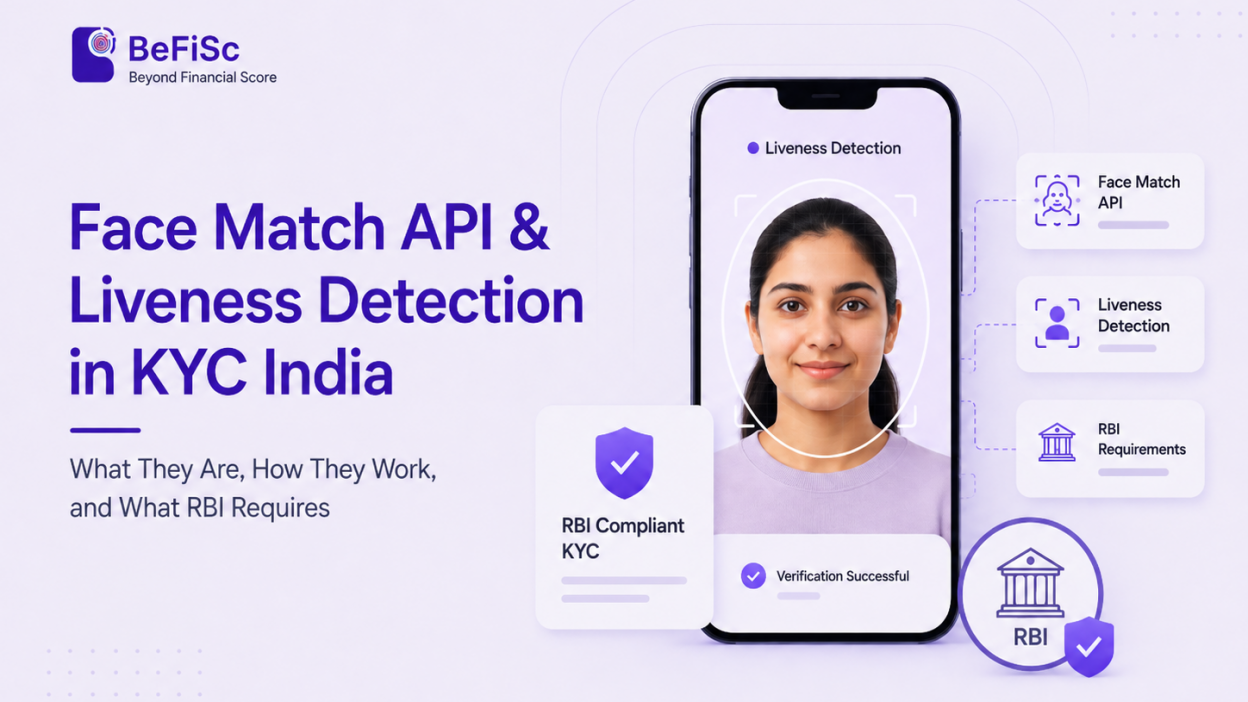
Face verification in KYC has two distinct functions that are often confused: face match (comparing a captured selfie to the photograph on an identity document) and liveness detection (confirming that the selfie was captured from a real, physically present person rather than a photograph or deepfake). Both are necessary. Neither alone is sufficient. In India’s rapidly digitising financial services landscape, where the RBI has made liveness detection a requirement for Video KYC and where deepfake-enabled identity fraud is a documented and growing threat, the technical details of how face match and liveness detection work and how to choose between implementations matter operationally. This guide explains the mechanics, the regulatory requirements, and the evaluation criteria for selecting a face match API and liveness detection solution.
Face Match vs Liveness Detection: The Critical Distinction
Face match and liveness detection are complementary but distinct operations. Face match answers the question: Is this the same person as the one on the identity document? Liveness detection answers a different question: Is this a live person actually present at the time of capture, or a spoof?
A KYC system with face match but no liveness detection is vulnerable to a simple attack: a fraudster holds a printed photograph or displays a video of the target individual to the camera. The face match returns a high confidence score because the captured image matches the document photograph, but no live person is present.
A KYC system with liveness detection but poor face match accuracy is vulnerable to a different attack: a real person presents themselves live, but is not the person named on the identity document they submitted. The liveness check confirms biological presence, but the identity claim is fraudulent.
Both checks must be present and well-calibrated. Neither is a substitute for the other.
How Face Match API Works in KYC
A face match API takes two images as inputs: a reference image (extracted from an identity document, either via OCR or from a database like Aadhaar) and a probe image (a selfie captured during the verification session) and returns a similarity score. A score above a defined threshold is treated as a match; below the threshold, as a mismatch.
The quality of a face match API is determined by its False Match Rate (FMR) and False Non-Match Rate (FNMR). FMR is the proportion of non-identical pairs that the system incorrectly accepts as a match relevant for fraud prevention (a high FMR means fraudsters can get through). FNMR is the proportion of genuine matches that the system rejects, relevant for user experience and conversion (a high FNMR means genuine customers fail verification and abandon).
The threshold setting is a policy decision, not purely a technical one: a lower threshold reduces FNMR (fewer genuine customers rejected) but increases FMR (more fraudsters accepted). The appropriate threshold depends on the risk tolerance of the use case. A high-value lending product requires a different threshold setting than a low-value account opening. Face match API providers that allow threshold configuration are more flexible for diverse use cases than those with fixed thresholds.
Liveness Detection: Active vs Passive Approaches
Active liveness detection prompts the user to perform a randomised action: blink, turn their head, smile, read a number and analyses whether the response is consistent with a genuinely present human being. The randomisation is the key security property: a fixed challenge can be prepared for, but a randomly selected challenge from a large set is much harder to defeat with pre-recorded footage.
Passive liveness detection analyses a single image or short video clip for signals that indicate a non-live presentation: texture anomalies (consistent with printed photographs), depth signals (a flat screen has different reflective properties from a human face), micro-motion characteristics inconsistent with static images, and, in advanced implementations, photoplethysmography signals (subtle colour changes caused by blood flow, detectable in certain lighting conditions).
The practical difference for user experience: active liveness adds a challenge step that some users find confusing, or that fails in low-light or low-camera-quality environments. Passive liveness is invisible to the user; they simply look at the camera. The best 2025-era passive systems have substantially closed the security gap versus active systems for most threat profiles, making a passive-default, active-escalation approach both user-friendly and secure.
Deepfake Threats to Liveness Detection and How to Counter Them
The most sophisticated current attacks against liveness detection use AI-generated synthetic faces deepfakes to defeat both active and passive liveness checks. A face swap applied in real-time to a live video feed can present a synthetic face that moves naturally, responds to challenges, and presents biological motion signals that fool naive liveness detectors.
Counter-measures against deepfake-enabled liveness attacks include: texture and frequency analysis of the image signal, looking for the subtle compression and rendering artefacts characteristic of AI-generated faces; temporal consistency analysis across video frames, looking for the micro-artefacts that deepfake generation introduces when processing motion sequences; and model adversarial training the liveness detection model is continuously updated against the latest deepfake generation techniques, requiring an ongoing model development and deployment cycle.
The RBI’s explicit 2025 requirement for deepfake-resistant liveness reflects awareness that static liveness detection models become obsolete as deepfake tools improve. A liveness detection solution whose model has not been updated since 2023 may not provide meaningful protection against current deepfake attack tools.
RBI Compliance Requirements for Biometric Verification
The RBI’s V-CIP (Video KYC) guidelines and the KYC Master Directions set out the biometric verification requirements applicable to Regulated Entities. Key requirements: liveness detection must be implemented for any video- or image-based identity verification; the 2025 guidelines explicitly require deepfake resistance as a baseline capability; face match must be conducted between the live capture and the identity document photograph; verification sessions must be recorded and stored for at least five years; and geolocation of the session must be confirmed for resident customer onboarding.
For NBFCs and fintechs using third-party technology for V-CIP, the RBI has clarified that the technology may be provided by a third party, but the verification decision on whether the KYC is approved cannot be entirely outsourced. A trained official of the Regulated Entity must be involved in or monitoring the V-CIP interaction. The technology platform automates the biometric checks; the entity takes responsibility for the overall KYC decision.
Evaluating Face Match API and Liveness Solutions
Evaluating a face match API or liveness detection solution for Indian KYC deployment requires attention to six factors. First, accuracy metrics: what are the published FMR and FNMR rates, under what test conditions, and against what demographic datasets? Performance on Indian facial data, which differs in distribution from the datasets used to train many global models, matters. Second, deepfake resistance: what deepfake attack types has the model been tested against, and when was the model last updated against new generation techniques?
Third, regulatory certification: Is the solution certified for RBI V-CIP compliance? Has it been audited by any recognised third-party assessment body? Fourth, threshold configurability: can the match threshold be adjusted to balance FMR and FNMR for the specific risk tolerance of the use case? Fifth, integration format: is the API RESTful, well-documented, and available with a sandbox environment for testing? Sixth, model update frequency: how often is the underlying model retrained and deployed? A model that updates quarterly provides more sustained deepfake protection than one updated annually.
Implementation Checklist: Deploying Face Match and Liveness in Production
Moving from sandbox testing to production deployment of face match and liveness detection requires attention to several operational details that are not always covered in API documentation. Organisations that have gone through this process and experienced post-launch issues typically identify the same set of gaps.
The first gap is demographic calibration. A face match model that was tested in a sandbox with a limited image dataset may perform differently in production with a real and diverse user base. Indian facial data has specific demographic characteristics, skin tone distribution, facial structure variation, and common photographic conditions that affect both face match accuracy and liveness detection performance. Organisations should run a controlled production pilot on a representative subsample before full rollout, measuring false rejection rates across demographic segments to identify any performance gaps.
The second gap is failure mode design. What happens when the face match API returns an error, a low-confidence result, or a timeout? Many production systems have not defined the failure path: should the user be prompted to retry? Should they be routed to a manual review queue? Should the session be suspended pending human verification? Without a clearly designed failure path, a production API error results in an inconsistent user experience and potentially a compliance gap.
The third gap is audit trail completeness. Each face match and liveness detection event must be logged with sufficient detail for post-incident review: the timestamp, the input images (or a hash thereof), the match score, the liveness confidence score, and the decision outcome. This log is the evidence required for regulatory defence if a fraudulent onboarding is later discovered, and the question is asked: what verification was performed, and what did it return?
The fourth gap is threshold calibration for the specific use case. The default threshold settings in most face match APIs are calibrated for general use; they are not necessarily optimal for a high-risk lending product, a low-risk wallet account, or an account operated by elderly users who may have lower biometric consistency with their stored reference image. Threshold calibration tested against real data from the specific use case is an implementation step, not a post-deployment optimisation.
Key Takeaways
- Face match and liveness detection are complementary checks. Face match confirms identity (same person as document); liveness confirms presence (real person, not a spoof); both are required.
- Active liveness (challenge-response) provides high assurance but adds friction; passive liveness (single-image analysis) is invisible to the user and competitive in security for most threat profiles.
- The RBI’s 2025 V-CIP guidelines explicitly require deepfake-resistant liveness; a model not updated against current deepfake tools does not meet this requirement.
- Face match API quality is defined by FMR (fraud through) and FNMR (genuine customers rejected). The threshold setting is a policy decision balancing fraud risk and conversion rate.
- Evaluate liveness solutions on: accuracy on Indian facial data, deepfake resistance update frequency, V-CIP regulatory certification, and threshold configurability.
Frequently Asked Questions
How should businesses choose a face match API for KYC?
Businesses should evaluate FMR and FNMR accuracy, performance on Indian facial data, deepfake resistance, RBI V-CIP compliance, threshold configurability, API integration, and model update frequency.
How does deepfake technology affect liveness detection in KYC?
Deepfakes can bypass weak liveness systems by creating synthetic faces that move naturally and respond to challenges. Financial institutions should use deepfake-resistant models with regular updates and testing.
What is the difference between active and passive liveness detection?
Active liveness requires the user to perform a randomised action (blink, turn head) and analyses the response for genuine human presence — high security, more friction. Passive liveness analyses a single selfie or short clip for artefacts indicating a non-live presentation — minimal user friction, competitive security in best-in-class 2025-era systems. A hybrid approach (passive default, active for high-risk sessions) balances security and experience.
What is liveness detection and is it required in India?
Liveness detection confirms that the person being photographed or filmed during biometric verification is genuinely present — not a photograph, video replay, or deepfake. It is required by the RBI’s Video KYC (V-CIP) guidelines. The 2025 guidelines explicitly require deepfake-resistant liveness, making it a regulatory baseline for any V-CIP compliant onboarding.
What is a face match API and how is it used in KYC?
A face match API compares two images — a reference photo from an identity document and a selfie captured during verification — and returns a similarity score. If the score exceeds the configured threshold, the faces are considered a match. In KYC, face match confirms that the person presenting the identity document is its genuine holder. It must be combined with liveness detection to prevent spoofing
Conclusion
Face match and liveness detection are the biometric layer of the identity verification stack and the layer that is most actively being attacked by deepfake fraud tools. The organisations that maintain robust biometric verification are those that treat liveness as an ongoing technical challenge, not a solved problem. Model updates, deepfake resistance testing, and threshold calibration to local demographic and fraud patterns are not set-and-forget configurations; they require active management. The regulatory requirement for deepfake-resistant liveness is a recognition of this reality.

[…] unassisted digital journeys, a live selfie face-matched against the captured card photo with [liveness detection] binds the credential to the person, since the electoral registry query itself returns demographic […]