

Introduction
Every fintech, NBFC, and digital lending platform in India eventually runs into the same wall: manual identity verification cannot scale. The moment you start processing hundreds or thousands of onboarding requests daily, any process that requires a human to look at an Aadhaar card and cross-check a selfie becomes your biggest bottleneck. KYC APIs eliminate that bottleneck entirely.
This guide explains exactly how KYC APIs work, what compliance features they must carry under RBI’s Master Directions on KYC (2016, updated 2023), how to evaluate them as a developer or product team, and where they fit in a production-grade onboarding stack. If you are building or scaling a verification workflow, this is your technical and strategic foundation.
What Is a KYC API and Why Does It Matter for Fintechs?
A KYC (Know Your Customer) API is a programmatic interface that allows a platform to verify the identity of a user, typically by validating government-issued identity documents, cross-referencing official databases, and confirming biometric or OTP-based consent without manual intervention.
Under RBI’s Master Directions on KYC, every regulated entity must perform customer due diligence before establishing a business relationship. For digital-first fintechs, this means KYC must happen online, in real time, and with a full audit trail. That requirement is what makes KYC APIs not just useful, but legally necessary.
The Core Components of a KYC API
- Document verification: Validates Aadhaar, PAN, driving licence, passport, and voter ID against government databases or using OCR and AI-based authenticity checks.
- Database lookup: Cross-references extracted identity data against UIDAI, NSDL, or DigiLocker records to confirm the document belongs to the submitting individual.
- Liveness and face match: Confirms the person presenting the document matches the document photo using AI-based liveness detection to prevent spoofing.
- OTP-based consent: For Aadhaar-based verification, the user’s consent via OTP ensures the verification is voluntary and UIDAI-compliant.
- Audit trail and response: Every verification call returns a structured JSON response with verification status, extracted fields, confidence scores, and a timestamped audit log.
How KYC APIs Work: A Technical Walkthrough
The verification flow in a production KYC API typically follows this sequence. First, the user submits their identity document either by upload or camera capture through the platform’s frontend. The API receives the document image or a reference number (such as an Aadhaar number or PAN). It then validates authenticity through document forensics or database lookup. Where liveness is required, a second API call or embedded SDK triggers a face capture and comparison. The API returns a response object containing verification outcome, extracted data fields, and a confidence score. The platform stores the response as the CDD audit record.
The entire flow from document submission to verification response should complete in under three seconds in a well-architected implementation. Any API with latency above five seconds in normal conditions will create a drop-off in your onboarding funnel.
RBI Compliance Requirements Every KYC API Must Satisfy
This is where many platforms make critical errors. Not every KYC API is RBI-compliant by default. Under the Master Directions on KYC 2016 (updated November 2023), regulated entities must meet specific standards.
- Officially Valid Document (OVD): The verification must use documents listed as OVDs: Aadhaar, PAN, passport, voter ID, driving licence, NREGA job card, or any document notified by the Central Government.
- Aadhaar-based KYC requires UIDAI authorisation: Any entity pulling Aadhaar data for verification must be a licensed KUA (KYC User Agency) or work through an authorised partner.
- Video KYC alternative: RBI permits Video KYC as an alternative to physical KYC for new account opening, requiring the API to support VKYC-compliant flows with live agent or AI-led sessions.
- Data localisation: All KYC data of Indian residents must be stored in India. Any API solution used must confirm server infrastructure compliance with data localisation norms.
- Consent management: Clear, purpose-limited, revocable user consent must be documented before any biometric data is processed.
How to Evaluate a KYC API: 7 Non-Negotiable Criteria
When evaluating KYC API providers for your stack, generic feature lists are not enough. Here is what actually determines whether an API will perform in production.
1. Database Coverage and Freshness
The API must connect to live government databases, not cached copies. Stale data creates false negatives and compliance risk. Confirm whether the provider connects directly to UIDAI, NSDL, and MCA or uses intermediary data that could be outdated by hours or days.
2. Response Structure and Field Completeness
A compliance-grade KYC API response must return: verification status (verified/failed/inconclusive), all extracted document fields, confidence scores per field, the source database matched, a unique transaction ID, and a timestamp. Incomplete responses require your team to build workarounds, which creates fragility.
3. Latency Under Load
Test the API at 100 concurrent requests, not just single calls. Many providers perform well in the sandbox but degrade under production volume. Acceptable P95 latency for identity verification is under four seconds for Aadhaar OTP-based verification and under two seconds for PAN and database lookups.
4. Uptime SLA and Fallback Handling
Government APIs UIDAI, NSDL, and MCA experience downtime. A mature KYC API provider must have fallback logic: alternate database paths, graceful degradation, and queuing mechanisms so your onboarding does not break when a government endpoint is slow.
5. Audit Trail Completeness
Every KYC call must generate an immutable audit record that can be produced during a regulatory inspection. The audit trail must capture: the user consent timestamp, the document type submitted, the verification outcome, the API’s response payload, and the operator performing the check.
6. Webhook and Async Support
High-volume fintechs cannot block a user session waiting for synchronous API responses. The provider must support webhook callbacks for asynchronous verification completion, particularly for Video KYC and liveness checks that require human-in-the-loop stages.
7. Sandbox Environment Quality
A well-maintained sandbox is a signal of operational maturity. It should reflect real response structures, allow testing of edge cases (expired documents, name mismatches, liveness failures), and be updated in sync with production.
KYC API Integration: Common Implementation Mistakes
- Treating sandbox performance as production performance: Government database APIs throttle differently in production. Always load-test before go-live.
- Skipping consent architecture: Some teams integrate KYC APIs without building a proper consent capture layer. This creates DPDP Act 2023 compliance risk for every user record in your database.
- Not handling inconclusive responses: KYC APIs do not always return binary yes/no. Inconclusive responses where a document cannot be fully verified require a defined fallback workflow (manual review queue, alternate document request).
- Single-point API dependency: Relying on one KYC API for all verification types creates a single point of failure. The architecture should allow routing between providers based on document type, availability, and cost.
Where BeFiSc Fits in Your KYC Stack
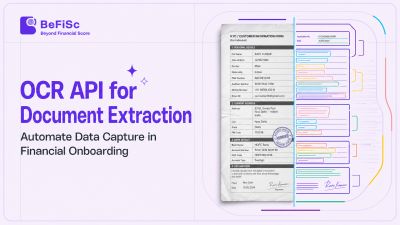
BeFiSc provides a unified KYC API suite covering Aadhaar verification, PAN verification, document OCR, face match, and liveness detection through a single integration. For fintechs building compliant onboarding, BeFiSc’s API returns structured JSON responses with full audit fields, supports webhook-based async verification, and maintains UIDAI authorisation for Aadhaar-based checks. Product teams integrating BeFiSc report a reduction in onboarding time from manual review workflows of 48+ hours to automated verification in under 60 seconds.
Key Takeaways
A unified KYC API like BeFiSc reduces integration complexity while maintaining compliance-grade verification across multiple document types.
KYC APIs automate identity verification across Aadhaar, PAN, biometrics, and government databases, eliminating manual review bottlenecks.
RBI compliance requires verified OVDs, UIDAI authorization for Aadhaar, data localization, and complete consent and audit trail documentation.
Evaluation criteria that matter: database freshness, response completeness, latency under load, uptime SLA, and audit trail quality.
Implementation errors around consent architecture and inconclusive response handling are the most common production failures.
Frequently Asked Questions
What happens when a KYC API returns an inconclusive result?
Platforms must define a fallback workflow for inconclusive responses. Common approaches include routing to a manual review queue, requesting an alternate document type from the user, or escalating to a Video KYC session. The choice depends on the customer’s risk profile and the platform’s onboarding requirements.
How long does a KYC API verification typically take?
PAN and database lookup verifications typically complete in under two seconds. Aadhaar OTP-based verification, which involves a user action, completes in under 30 seconds, assuming prompt OTP entry. Liveness and face match add another two to five seconds, depending on image quality.
What documents can a KYC API verify in India?
A well-built KYC API covers all RBI-recognized Officially Valid Documents: Aadhaar, PAN, passport, voter ID, driving licence, and NREGA job card. Some providers also support CIN, GSTIN, and professional certificates for business KYC.
Is Aadhaar-based KYC API legally permitted in India?
Yes, under the Aadhaar Act and the RBI’s Master Directions on KYC. However, entities must use UIDAI-authorized channels either as licensed KYC User Agencies or through authorised KYC API providers and must obtain explicit user consent before any Aadhaar-based verification.
What is a KYC API and how does it differ from manual KYC?
A KYC API automates the identity verification process by connecting to government databases and performing document, biometric, and liveness checks programmatically. Manual KYC requires human agents to review documents, which is slower, prone to inconsistency, and impossible to scale for high-volume onboarding.
Conclusion
KYC APIs help fintechs, NBFCs, and digital lending platforms automate identity verification, accelerate onboarding, and reduce manual effort. The right KYC API should combine RBI compliance, UIDAI-authorized verification, data security, accurate results, low latency, and reliable audit trails. By choosing a scalable, unified KYC solution like BeFiSc, businesses can build faster, safer, and more compliant digital onboarding.


[…] The lender’s system submits the PDF to the bank statement analysis API endpoint via an authenticated REST call. […]
[…] and new risks around who delivers financial services and how they are regulated. It rests on the [API banking] and infrastructure this series has explored, and it raises distinctive compliance and fraud […]
[…] major KYC API provider in India publishes public pricing; “transparent pricing” in marketing copy […]