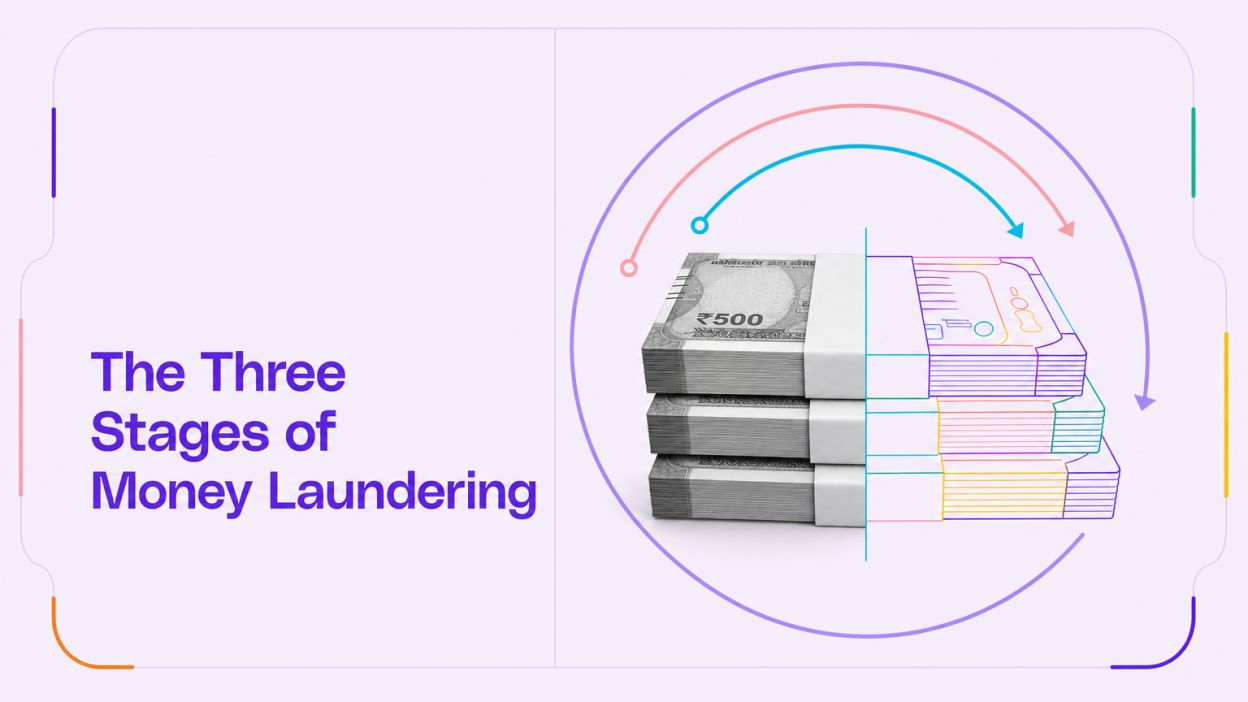
The three stages of money laundering are placement, layering, and integration. Placement moves illicit cash or funds into the financial system. Layering hides their origin through a chain of transfers and transactions. Integration returns the funds to the launderer as apparently legitimate wealth, such as property, business income, or investments.
The model simplifies reality. Schemes skip stages, run them in parallel, or start with funds already in a bank account, as with most cyber fraud proceeds.
Still, the three stages of money laundering remain the most useful lens for designing controls, because each stage leaves different traces. This guide explains each stage with Indian typologies, sets out the PMLA framework and reporting duties, and lists red flags lenders and fintechs can act on.
Why the Three Stages of Money Laundering Still Matter
FATF’s Mutual Evaluation Report on India, published on 19 September 2024, identified India’s main money laundering threats as fraud (including cyber-enabled fraud), corruption and drug trafficking. India was placed in “regular follow-up”, with its next report due in three years.
Those threats generate proceeds in very different forms. Corruption and drug proceeds often begin as cash. Cyber fraud proceeds begin as digital credits in a victim-adjacent account. The three stages of money laundering help a risk team ask the right question for each: where does the money enter, how is it moved, and where does it settle?
Stage 1: Placement
The first of the three stages of money laundering, placement is the point at which criminal proceeds first enter the formal financial system. It is the stage where launderers are most exposed, because the money is still close to the crime.
Indian placement typologies
- Cash deposits through mule accounts: many accounts, often opened with borrowed or purchased identities, each taking deposits below internal alert levels.
- Structuring: splitting cash into amounts designed to stay under reporting thresholds, which PML Rules address by also covering integrally connected cash transactions within a month.
- Cash-intensive businesses: mixing illicit cash with genuine takings at restaurants, retail outlets or traders.
- Direct digital placement: fraud proceeds landing first in mule accounts or wallets, a pattern our guide covers in detail.
What placement looks like on a statement
Frequent cash deposits inconsistent with declared income, deposits at many branches or cash deposit machines, and sudden activity in a previously dormant account.
Stage 2: Layering
The second of the three stages of money laundering, layering separates proceeds from their source through transactions designed to break the audit trail. It is where most of the complexity sits, and where most investigative effort goes.
Indian layering typologies
- Rapid pass-through transfers: funds arrive and leave within hours across chains of accounts, often via IMPS and UPI.
- Shell companies: entities with no real operations exchanging invoices, loans, and share capital to justify flows.
- Trade-based laundering: over- or under-invoicing of imports and exports, or invoices for goods never shipped.
- Crypto and virtual assets: conversion to virtual assets and movement across platforms or wallets; FATF noted India’s VASP supervision was at an early stage of implementation.
- Merchant fronts: payments routed through merchant accounts selling nothing real, described in our explainer.
What layering looks like on a statement
Round-amount credits followed by near-identical debits, round-tripping where funds return to the originating account through intermediaries, and counterparties with no logical link to the customer’s stated business.
Stage 3: Integration
The last of the three stages of money laundering, integration is where laundered funds re-enter the legitimate economy, giving the launderer usable wealth with a plausible explanation.
Indian integration typologies
- Real estate: property purchases, often with a mix of declared and undeclared consideration.
- Gold and precious metals: FATF’s 2024 report flagged the precious metals and stones sector as needing stronger cash controls.
- Business income: proceeds booked as revenue or loans in a business the launderer controls.
- Investments and loans: securities purchases, or “loans” from related entities that are never repaid.
Why integration matters to lenders
Integrated funds often surface as down payments, margin money, or business turnover in a loan application. A lender who cannot explain the source of a borrower’s contribution may be financing the final stage.
Where BeFiSc fits: Finnalyzer analyses bank statements in 100+ formats and can help credit and EDD teams spot statement-level patterns linked to layering, such as rapid in-and-out flows, round-tripping, round-amount credits, and unusual cash deposits. It supports underwriting and enhanced due diligence; it is not a transaction monitoring or AML screening system. Book a demo to see these signals on sample statements.
Money Laundering Under PMLA: The Legal Frame
The Prevention of Money Laundering Act, 2002 (PMLA) is India’s principal anti-money laundering law. It does not name the three stages of money laundering, but its definition captures all of them.
Section 3: the offence
Section 3 makes a person guilty of money laundering if they directly or indirectly attempt to indulge, knowingly assist, are knowingly a party to, or are actually involved in “any process or activity connected with the proceeds of crime including its concealment, possession, acquisition or use and projecting or claiming it as untainted property”. The Explanation treats the offence as a continuing activity for as long as a person enjoys the proceeds.
Mapped to the three stages of money laundering: possession and acquisition cover placement, concealment covers layering, and use and projecting as untainted covers integration.
Section 4: Punishment
Rigorous imprisonment of not less than three years, extendable to seven years, plus a fine. Where the predicate offence falls under paragraph 2 of Part A of the Schedule (NDPS Act offences), the maximum rises to ten years.
Section 12: records
Reporting entities must keep records that allow individual transactions to be reconstructed, along with client identity records, for five years after the transaction or the end of the relationship, as applicable.
Reporting Duties: CTR, STR, CCR and NTR
Rule 3 of the PML (Maintenance of Records) Rules, 2005 defines what reporting entities record and report to the Financial Intelligence Unit-India (FIU-IND):
| Report | Full form | What triggers it | Timeline |
|---|---|---|---|
| CTR | Cash Transaction Report | Cash transactions above Rs 10 lakh, or integrally connected cash transactions within a month aggregating above Rs 10 lakh | By the 15th of the following month |
| STR | Suspicious Transaction Report | Any transaction, including attempted, that gives rise to suspicion | Within seven working days of being satisfied it is suspicious |
| CCR | Counterfeit Currency Report | Cash transactions using forged or counterfeit notes, or forged valuable security or document | By the 15th of the following month |
| NTR | Non-Profit Organisation Transaction Report | Receipts by non-profit organisations above Rs 10 lakh | By the 15th of the following month |
FIU-IND’s FAQs add the Cross Border Wire Transfer Report for transfers above Rs 5 lakh where the origin or destination is in India. Detection that feeds STRs usually sits in systems; our guide covers the tool market.
Red Flags by Stage for Lenders and Fintechs
| Stage | Red flags in onboarding and statements |
|---|---|
| Placement | Cash deposits out of line with income; deposits across many branches or CDMs; new or dormant accounts suddenly active; customer reluctant to explain source of cash |
| Layering | Credits followed by same-day debits of similar value; many unrelated counterparties; circular flows back to the origin; business turnover with no matching expenses, GST or payroll |
| Integration | Large down payment with unclear source; loan prepaid soon after disbursal from unrelated accounts; property or gold purchases inconsistent with profile; related-party “loans” funding the borrower’s contribution |
None of these proves laundering. Each is a reason to ask for an explanation, apply enhanced due diligence and, where suspicion remains, escalate to the principal officer for an STR decision.
Key Takeaways
- The three stages of money laundering are placement, layering and integration; real schemes often overlap or skip stages.
- FATF’s 2024 evaluation named fraud (including cyber-enabled fraud), corruption and drug trafficking as India’s main laundering threats.
- PMLA section 3 covers concealment, possession, acquisition, use and projection as untainted, which maps to all three stages.
- Reporting entities file CTRs, CCRs, and NTRs monthly by the 15th, and STRs within seven working days of forming suspicion.
- Lenders see laundering most clearly in bank statements: cash placement, rapid pass-through, and unexplained sources of contribution.
Frequently Asked Questions
What is the punishment for money laundering in India?
Under section 4 of PMLA, money laundering is punishable with rigorous imprisonment of three to seven years and a fine. Where the proceeds relate to specified NDPS Act offences, imprisonment can extend to ten years.
What is the full form of STR in banking?
STR stands for Suspicious Transaction Report. Reporting entities under PMLA must file an STR with FIU-IND within seven working days of being satisfied that a transaction, including an attempted one, is suspicious. Unlike CTRs, STRs have no monetary threshold.
Which stage of money laundering is hardest to detect?
Layering is generally the hardest, because it is designed to break the audit trail through many transfers, entities, and jurisdictions. Placement is often the most detectable, since illicit funds are closest to their source and frequently involve cash.
What are the three stages of money laundering?
The three stages of money laundering are placement, layering, and integration. Placement puts illicit funds into the financial system, layering obscures their origin through complex transactions, and integration brings them back as apparently legitimate assets or income. Some schemes skip or merge stages.
Conclusion
The three stages of money laundering are an old model, but they remain the clearest way to think about where controls belong. Placement is caught at onboarding and in cash behaviour, layering in the shape of flows, and integration in the source of funds behind a purchase or a loan contribution.
For lenders and fintechs, the practical lesson is that the evidence often already sits in the bank statements they collect for underwriting. Reading those statements for flow patterns as well as income makes credit and EDD teams a stronger first line against laundering.