
Introduction
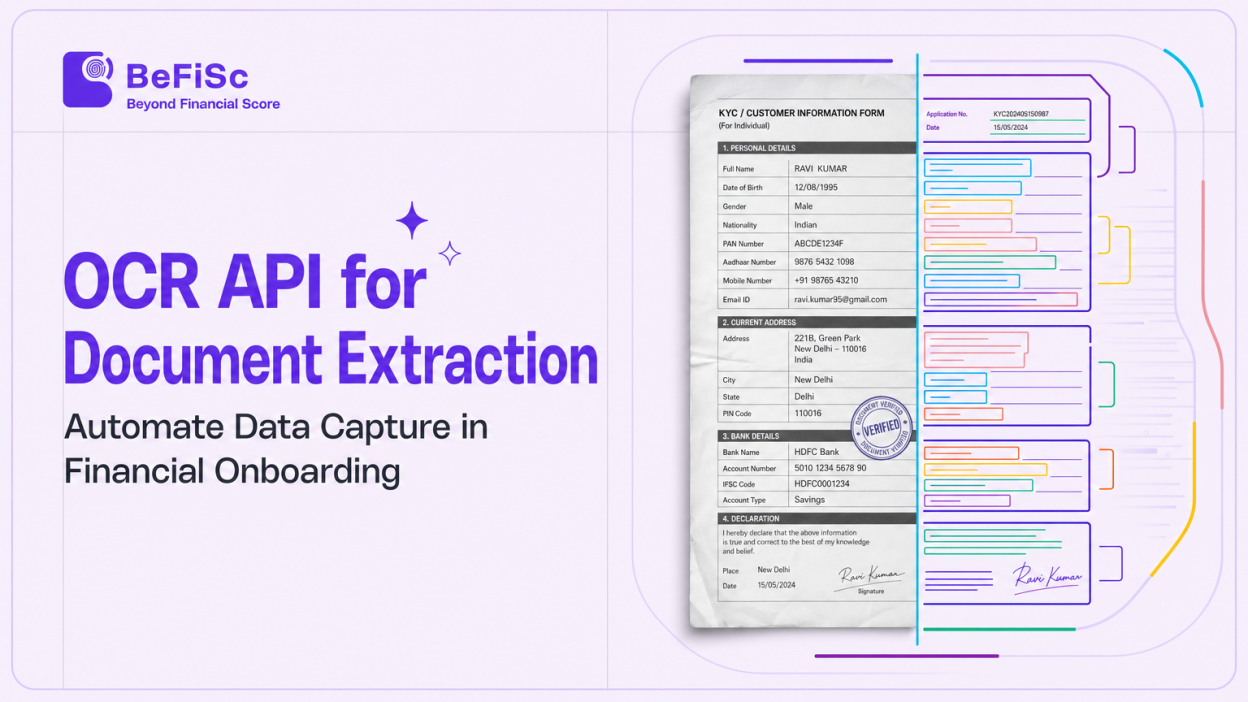
An OCR API for document extraction helps financial institutions convert identity documents and financial records into structured, machine-readable data without manual data entry. Manual transcription during onboarding is slow, expensive, and prone to errors, especially when teams process Aadhaar cards, PAN cards, bank statements, and other financial documents at scale. OCR APIs automate this process by extracting structured information from document images within seconds, making digital onboarding faster and more scalable.
For fintechs and lending platforms, OCR APIs are more than a convenience. They provide the data infrastructure needed to automate document processing, reduce manual intervention, and support efficient financial onboarding workflows.
What Is an OCR API and How Does It Work?
Optical Character Recognition (OCR) is the technology that converts images of text, photographs, scans, or camera captures of documents into machine-readable text strings. An OCR API exposes this capability through a standard REST interface: submit a document image, receive structured extracted data.
Modern financial document OCR APIs go significantly beyond generic text recognition. They are trained specifically on the document types they process, understanding the structured layouts of Aadhaar cards, PAN cards, bank statements, and ITRs and extract data as named fields.
(name, date of birth, document number, address, account number) rather than undifferentiated text strings.
OCR vs IDP: The Critical Distinction
Intelligent Document Processing (IDP) is the next generation beyond basic OCR. Where OCR extracts text from a known document structure, IDP applies machine learning to understand document structure dynamically, handling variable layouts (bank statements from different banks have different formats), handwritten annotations alongside printed text, multi-page documents with different field locations, and tables within documents (transaction rows in bank statements).
For financial services, the distinction matters: Aadhaar card OCR is a solved problem — the document has a consistent structure. Bank statement OCR is
an IDP problem — the structure varies across hundreds of banks and statement formats. API providers must support both capabilities.
Key Document Types for Financial OCR
Identity Documents
Aadhaar (front and back), PAN card, passport (data page and MRZ), driving license (state- specific format variations), voter ID, and NREGA job card. For Aadhaar, the QR code data provides a digitally signed XML payload that can be directly verified against extracted text —cross- referencing the QR data with the printed text detects tampering.
Financial Documents
Bank statements — the most complex OCR challenge in financial onboarding. Statement formats vary by bank, account type, and statement period. Production-grade bank statement OCR must handle: table extraction for transaction rows, multi-page statement collation, identification of key summary fields (opening balance, closing balance, credits, debits), and
categorization of transaction descriptions.
Business Documents
GST registration certificate, MSME/Udyam registration certificate, FSSAI license, incorporation certificate, and balance sheets/profit and loss statements. For business document OCR, the extracted data feeds KYB
verification and credit underwriting directly.
Accuracy, Confidence Scores, and Edge Case Handling
OCR accuracy is not binary — it is a probability distribution across extracted fields. A production OCR API returns confidence scores for each extracted field, allowing downstream logic to:
automatically process high-confidence extractions, route medium-confidence fields for spot-check review, and reject or request re-capture
for low-confidence fields.
Common accuracy challenges in Indian document OCR: degraded print quality on older documents, regional language fields mixed with English text, handwritten corrections on printed documents, photographs of documents rather than scans (introducing perspective and lighting variability), and laminated or glossy documents causing glare artifacts.
OCR API Integration Architecture
A well-architected OCR integration includes: image pre-processing (perspective correction, contrast enhancement, resolution normalization) before the OCR API call; structured response parsing with field-specific confidence threshold handling; validation rules applied to extracted data (date format validation, document number format check, name character validation); cross-referencing extracted data against user-submitted form data to catch input errors; and audit logging of the complete extraction result for compliance record-keeping.
Where BeFiSc Fits
BeFiSc’s OCR API supports all major Indian identity documents and financial documents — with IDP capabilities for bank statement extraction, multi-format business document processing, and regional script support. Extracted data is returned in structured JSON with confidence scores,
document type classification, and tamper detection signals. For onboarding platforms, BeFiSc’s OCR API reduces manual data entry to zero for straight-through processing of standard documents.
Key Takeaways
- Financial document OCR APIs extract structured, named field data — not undifferentiated text strings.
- Bank statement processing requires IDP capabilities, not just basic OCR; format variability across banks demands adaptive models.
- Confidence scores enable tiered processing:g auto-approve, spot-check, or re-capture based on extraction confidence.
- OCR and database verification are complementary: OCR extracts; verification confirms.
Frequently Asked Questions
Can OCR detect fake or tampered financial documents?
OCR alone does not prove that a document is genuine. However, when combined with tamper detection, database verification, QR-code validation, and other KYC checks, it can help identify inconsistencies and potential document fraud.
What are the key benefits of using OCR APIs in financial onboarding?
OCR APIs automate document data extraction, reduce manual data-entry errors, speed up onboarding, and enable straight-through processing. Moreover, confidence scores and validation rules help financial institutions identify uncertain data and route it for review.
What accuracy rates are realistic for financial document OCR?
For standard identity documents under good imaging conditions, accuracy rates of 95–99% per field are achievable. For bank statements and variable-format documents, field-level accuracy of 90-97% is realistic. Accuracy below 90% at field level typically indicates poor image quality rather than model limitations.
How does bank statement OCR handle different bank formats?
IDP-based bank statement OCR uses machine learning models trained on large datasets of bank statements from multiple banks, learning to adapt to format variations. Most production systems maintain format-specific models for major banks and a generic adaptive models for systems maintain format- specific models for major banks and a generic adaptive model for uncommon formats.
What is the difference between OCR and database verification in KYC?
OCR extracts data from a document image. Database verification checks that data against government records (UIDAI, NSDL, GSTN). Both are required for complete KYC: OCR extracts what the document says; database verification confirms it is true.
Conclusion
OCR APIs have become a critical part of modern financial onboarding because they turn document images into structured, usable data at scale. While basic OCR works well for standardized identity documents, financial institutions need IDP capabilities to handle complex documents such as bank statements and business records.
Furthermore, combining OCR with confidence scoring, validation rules, database verification, and tamper detection creates a more reliable verification workflow. As a result, fintechs and lenders can reduce manual effort, improve data accuracy, accelerate onboarding, and build scalable digital KYC processes.
For businesses looking to automate document verification and extraction, BeFiSc’s OCR API provides structured data extraction, confidence scores, document classification, and tamper detection for financial onboarding workflows.
Automate document verification with BeFiSc today!