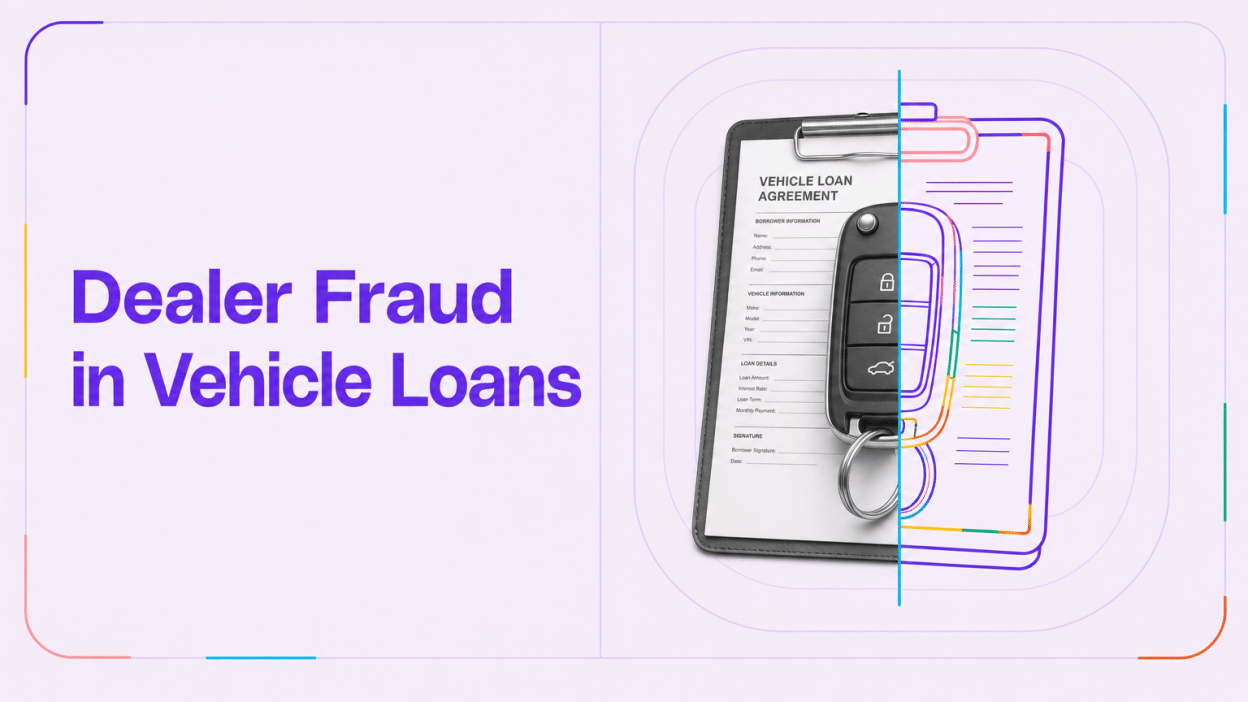
Dealer fraud in vehicle finance is fraud that originates at, or passes through, the dealership that sources the loan. It covers ghost borrowers, inflated invoices, vehicles never delivered, hypothecation not marked on the RC, the same chassis financed twice, and misuse of trade advances. Lenders control it by verifying dealers like borrowers and monitoring them continuously.
In car, two-wheeler, and commercial vehicle lending, the dealer is the lender’s most important partner and its most concentrated risk. The dealer meets the customer, collects documents, raises the invoice, and often handles insurance and registration. Each step is a place where dealer fraud can enter.
Generic dealer verification covers who a dealer is. This guide covers what dealer fraud does to a vehicle loan book: auto-specific patterns, reported cases, a dealer risk scorecard, and a monitoring checklist.
Why Dealers Sit at the Centre of Vehicle Loan Fraud
Vehicle loans are fast: a two-wheeler loan is often approved at the showroom within an hour, and money goes to the dealer, not the borrower. That means:
- The dealer receives the money, so the lender relies on the dealer to deliver the vehicle.
- The dealer issues the invoice that sets the loan amount.
- The lender’s security (hypothecation on the RC) depends on registration paperwork the dealer often files.
- DSAs and field executives are paid per disbursal, and their incentives align with the dealer’s rather than the credit team’s.
When a dealer is stressed or colluding, these dependencies become the route for dealer fraud.
How Dealer Fraud Works in Vehicle Finance
Ghost borrowers and identity misuse
Loans are booked for people who never bought a vehicle, using borrowed or forged KYC, often with a DSA or sales executive staging the customer meeting.
Inflated invoices and on-road price padding
The dealer raises an invoice above the real price, or pads the on-road price with accessories and warranties never delivered. LTV looks normal on paper while the real LTV exceeds 100%.
Vehicle not delivered, or delivered late.
The dealer delays delivery and uses disbursed funds as working capital. If the dealer collapses, the lender has a loan and no asset.
Hypothecation not marked, or fake RC
If hypothecation in favour of the lender is never endorsed on the registration certificate, the vehicle can be sold or refinanced freely. Forged RC copies showing a hypothecation that does not exist in the transport database are a known variant.
Duplicate financing of the same chassis
The same vehicle, identified by chassis and engine number, is financed by two lenders through two invoices. This is most common where registration is delayed, and lenders rely on invoices instead of the registration record.
Dealer trade advance and inventory funding misuse
Lenders that fund dealer inventory or extend trade advances face a different risk: the dealer sells vehicles but does not repay the lender (sold out of trust), or diverts funds to other businesses.
Insurance and registration delays
Delayed insurance or registration is often the first symptom of dealer stress, and leaves the collateral unprotected.
Reported Cases From India
The cases below are as reported in the press; the allegations have not been proven in court.
- IDBI Bank and a Guwahati dealer (2021): On 1 June 2021, the CBI announced a case against Guwahati-based Ghosh Brothers Automobiles and its promoter-directors on a complaint by IDBI Bank. The company allegedly obtained a term loan and cash credit facility using false documents and diverted funds. The bank’s loss was put at Rs 168.62 crore as of 31 January 2021. It shows how dealer-level credit exposure can become a large-ticket fraud.
- Canara Bank vehicle loans in Assam (2026): On 6 October 2026, Assam CID arrested a Guwahati man over five vehicle loans totalling Rs 40 lakh disbursed between February and June 2023. The applications were allegedly supported by forged vehicle quotations, RC copies and insurance documents. The fraud surfaced only after the accounts turned NPA. Note that the report does not allege the dealer named on the quotations was involved.
- Financed cars pledged and resold in Bengaluru (2026): Police in Bengaluru arrested a car dealer on 30 August 2026 who allegedly took loan-financed vehicles from owners as collateral at low prices and pledged or sold them onward, without clearing the loans. Twenty-three vehicles worth about Rs 1.51 crore were seized.
A Delhi Crime Branch case reported on 12 January 2026 showed a related pattern: a syndicate allegedly used forged Aadhaar, PAN and ITR documents to obtain vehicle loans, then re-registered vehicles in other states. The common thread: documents passed at origination, and the asset trail was not verified against registries.
Hypothecation, RC and Vahan: Where Controls Break
Under the Motor Vehicles Act, 1988 (Section 51), a vehicle under a hire-purchase, lease, or hypothecation agreement carries the financier’s interest on the registration record. In practice:
- Hypothecation is endorsed on the RC through Form 34 at registration or later.
- It is removed through Form 35, with the financier’s NOC, once the loan is closed.
- The registration record, including financier details, is held in the Vahan database.
Controls fail when lenders accept an RC copy instead of checking the registration record, when registration is pending for weeks after disbursal, or when nobody reconciles chassis numbers across the loan book. An RC check against the source record, matched to the invoice chassis and engine numbers, closes most of these gaps. See [internal link: vehicle RC verification -> /fintechsherlock/vehicle-rc-verification-api-guide/].
Dealer Risk Scorecard
An illustrative scorecard for ranking dealers. Weights should be calibrated on your own loss data.
| Risk factor | Low risk | Medium risk | High risk | Illustrative weight |
|---|---|---|---|---|
| Business vintage (GST, MCA) | Over 5 years | 2 to 5 years | Under 2 years | 10% |
| GST status and filing | Active, regular filing | Occasional delays | Cancelled, suspended or long gaps | 15% |
| OEM authorisation | Verified with OEM | Pending confirmation | Not verifiable | 10% |
| Early default rate (first 3 EMIs) | Below portfolio average | 1 to 2 times average | Over 2 times average | 20% |
| RC with hypothecation within 30 days | Over 95% | 85 to 95% | Under 85% | 15% |
| Invoice-to-ex-showroom variance | Within model norms | Some outliers | Systematic padding | 10% |
| Concentration of a single DSA or executive | Diversified | Moderate | Most files from one source | 10% |
| Adverse media and litigation | None | Minor | Fraud or recovery cases | 10% |
Dealers in the high-risk band on two or more heavyweight factors should move to pre-disbursal checks on every file.
Onboarding and Ongoing Monitoring Checklist
At onboarding
- Verify the dealership entity: PAN, GSTIN status, MCA or LLP record, Udyam where relevant.
- Confirm OEM dealership or sub-dealer status directly with the OEM.
- Match promoters across GST, MCA, and the dealer agreement; screen them for adverse media.
- Verify the showroom address with a site visit and geotagged photos.
- Verify the dealer’s settlement bank account by penny drop and name match.
- Collect 12 months of the dealer’s bank statements and GST filing history.
Ongoing
- Re-check GST and MCA status quarterly. See [internal link: GSTIN verification -> /fintechsherlock/gst-verification-gstin/].
- Track RC and hypothecation endorsement turnaround for every disbursal.
- Reconcile chassis and engine numbers across your book to catch duplicates.
- Monitor early defaults and first-payment defaults by dealer, DSA, and executive.
- Run surprise audits on delivery: random customer calls and doorstep vehicle checks.
- Review dealer bank statements semi-annually where you have trade exposure.
Reading a Dealer’s Bank Statements for Stress
Dealers rarely fail suddenly. Their statements usually show stress months before fraud surfaces:
- Falling average balances and frequent overdrawn days on the operating account.
- Cheque or ECS returns to OEMs or financiers.
- Disbursal credits from lenders moving out within a day to unrelated accounts.
- Rising transfers to promoters’ personal or group accounts.
- Gaps between disbursal credits and payments to the OEM, suggesting vehicles are not being bought against the funds.
Lenders analysing these at scale typically use a bank statement analysis tool such as BeFiSc’s Finnalyzer, which handles 100+ statement formats, alongside their own rules.
Verifying Your Dealer Network at Scale
Lenders work with hundreds or thousands of dealers. Verification at onboarding followed by nothing is where dealer fraud hides. A registry-backed check on every active dealer, refreshed on a schedule, flags a cancelled GSTIN or struck-off company early.
Where BeFiSc fits: BizCheck produces a business risk report in about 60 seconds from GST, MCA, Udyam, and digital footprint data, so you can verify dealers at onboarding and re-check them across your network. It does not verify RC or hypothecation records, OEM authorisation or vehicle delivery; those need separate checks. Start with a free BizCheck report on a dealer in your network.
Key Takeaways
- Dealer fraud in vehicle loans exploits the fact that the dealer receives funds, issues the invoice, and often handles registration.
- Core patterns: ghost borrowers, inflated invoices, undelivered vehicles, missing hypothecation, duplicate chassis financing, and trade advance misuse.
- Recent Indian cases in 2026 show forged quotations, RCs, and insurance passing origination checks.
- Verify hypothecation on the registration record, not an RC copy, and reconcile chassis numbers across the book.
- Score dealers on registry status, RC turnaround, early defaults, and source concentration, and re-check them regularly.
Frequently Asked Questions
Should dealers be re-verified after onboarding?
Yes. GST cancellation, strike-off, and cash-flow stress happen after onboarding; quarterly registry checks and monthly portfolio metrics catch them early.
How is hypothecation recorded on an RC?
The financier’s interest is endorsed on the registration certificate, typically through Form 34, and removed through Form 35 with the financier’s NOC after the loan is repaid.
What is a dealer trade advance?
Funding a lender provides to a dealer against inventory or expected sales. The main risk is vehicles sold without repayment, or diverted funds.
How can lenders detect two-wheeler loan fraud by dealers?
Track early defaults by dealer, verify RC and hypothecation against registration records, check invoice values against model prices, and watch for files concentrated through one DSA or executive.
What is dealer fraud in vehicle loans?
Dealer fraud is fraud originating at the dealership: ghost borrowers, inflated invoices, undelivered vehicles, unmarked hypothecation, or double financing.
Conclusion
Dealer fraud persists because lenders treat dealers as a sales channel and borrowers as the risk. The safer view: the dealer is a counterparty with access to your funds and collateral.
Treat dealer verification as continuous KYB, link every loan to a verified vehicle record, and measure dealers on the outcomes of the loans they source. Fraud that starts at the showroom is far cheaper to stop there than in collections.