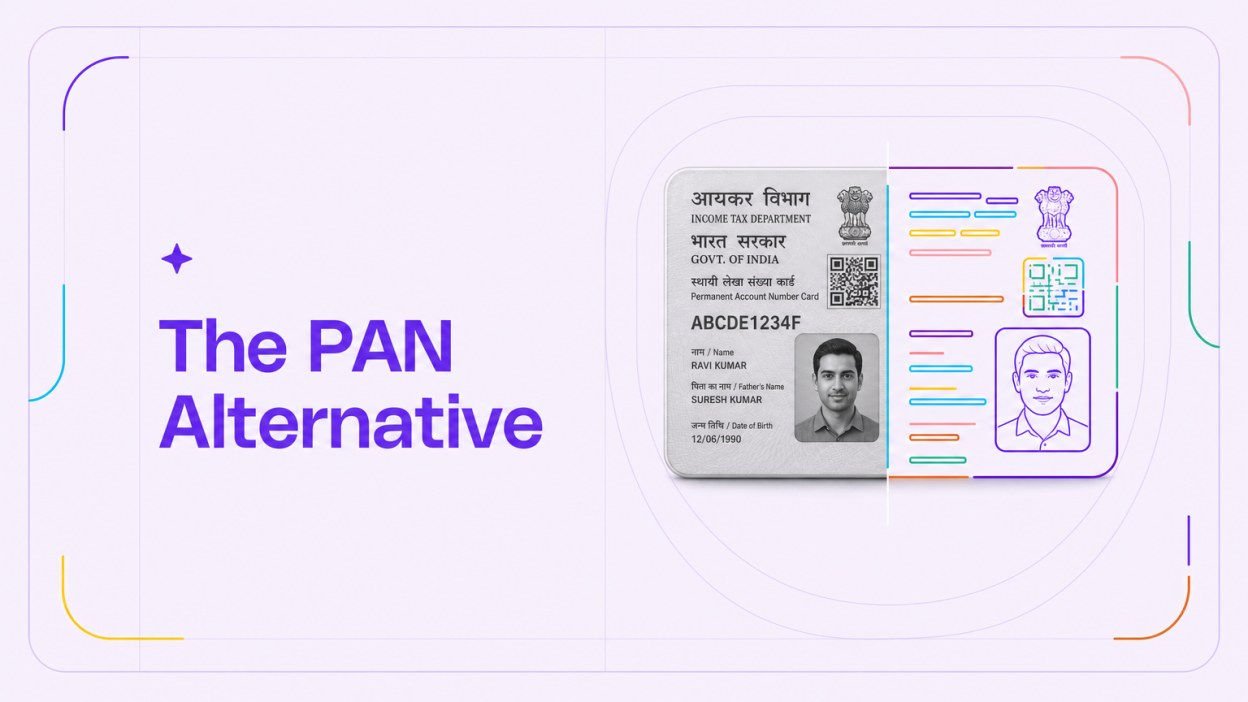
Form 60 is the declaration a person without a Permanent Account Number (PAN) files when entering a transaction that otherwise requires PAN, such as opening a bank account. Under the Income-tax Rules, 2026, in force from 1 April 2026, Form 60 has been replaced by Form No. 97, and Rule 114B by Rule 159.
Customers look for it when a bank asks for a PAN they do not have. Compliance teams look for it when an auditor asks why part of a portfolio has no PAN on file.
The 2026 rules changed the form’s number, narrowed where it can be used, and raised several PAN thresholds. This guide covers what changed, what RBI still requires, and how to verify and monitor no-PAN customers.
What Form 60 Is, and Why It Is Now Form 97
Form 60 was a declaration under the second proviso to Rule 114B of the Income-tax Rules, 1962. It let a non-corporate person without PAN complete a specified transaction by giving identity, address, and income details instead.
The Income-tax Act, 2025 and the Income-tax Rules, 2026 took effect on 1 April 2026 and renumbered most forms. The Income Tax Department’s rule pages and forms FAQ confirm this mapping:
| Legacy (Rules, 1962) | Current (Rules, 2026) | Purpose |
|---|---|---|
| Rule 114B | Rule 159 | Transactions where PAN must be quoted |
| Form 60 | Form No. 97 | Declaration by a person without PAN |
| Rule 114D | Rule 160 | Reporting of declarations received |
| Form 61 | Form No. 98 | Statement of declarations received |
Rule 159 sits under section 262 of the Income-tax Act, 2025, which replaced section 139A. Customers will keep asking for “Form 60 instead of PAN”, so SOPs should say Form 97 with “formerly Form 60” alongside.
One caution: RBI’s KYC Directions, as updated on 18 September 2026, still refer to “Form No. 60 as defined in Income-tax Rules, 1962”. Until RBI aligns the wording, document how your policy maps it to Form 97.
Transactions That Need PAN or a Declaration
Rule 159 lists 16 transactions where PAN must be quoted. The key change: a Form 97 declaration is accepted for only six of them (serial numbers 11 to 16). For the other ten, a person without PAN must apply for one.
PAN mandatory, no declaration route
- Credit card applications and demat account opening, for all transactions.
- Cash deposits or withdrawals aggregating Rs 10 lakh or more in a financial year with a bank or post office.
- Mutual fund units, RBI bonds, debentures or bonds above Rs 50,000; securities contracts and unlisted shares above Rs 1 lakh; vehicles above Rs 5 lakh.
Declaration still accepted
- Opening a bank account (other than a time deposit), and time deposits above Rs 50,000 or Rs 5 lakh in aggregate in a year.
- Insurance premium above Rs 50,000 in a year.
- Cash payments above Rs 1 lakh to a hotel, restaurant or event venue, and goods or services above Rs 2 lakh per transaction.
- Immovable property above Rs 20 lakh. Above Rs 45 lakh, the person must apply for PAN.
Thresholds rose from the legacy table. Khaitan & Co’s April 2026 analysis notes the hotel bill trigger moved from Rs 50,000 to Rs 1 lakh, and property from Rs 10 lakh to Rs 20 lakh.
Who Can File the Declaration and What It Contains
Rule 159 allows the declaration from “any person, not being a company or a firm” without PAN. That covers individuals, HUFs, trusts, associations of persons, local authorities and certain foreign companies. Minors without taxable income quote a parent’s or guardian’s PAN instead.
Form 97 asks for more than Form 60 did. It runs in six parts: the coded nature of the transaction; a declaration of PAN status and whether income exceeds the taxable limit; identity and address details including a masked Aadhaar number; transaction value, cash component and payment mode (UPI now has its own code); supporting documents for identity, address and date of birth with document numbers; and a signed verification acknowledging prosecution for false statements.
Customers searching “form 60 pdf” should use incometax.gov.in or the bank’s branch copy.
Form 61 and Form 98: Reporting Duties for Recipients
Rule 160 requires specified recipients to report what they collect:
- Declarations received from April to September are reported in Form No. 98 by 31 October.
- Declarations received from October to March are reported by 30 April of the next financial year.
- Statements go online to the Director of Income-tax (Intelligence and Criminal Investigation).
- Declarations must be retained for six years from the end of the financial year of the transaction.
Banks should confirm that reporting systems match the Form 98 schema and that retention reads six years, longer than the five-year PMLA horizon.
Form 60 in Banking KYC: What RBI Requires
For individuals, paragraph 23 of RBI’s KYC Directions requires “PAN or the equivalent e-document thereof or Form No. 60” alongside proof of identity and address. The declaration is therefore a lawful alternative at onboarding, not a gap in KYC.
Paragraph 43 covers existing customers. A bank must obtain PAN, its e-equivalent, or Form 60 by a date the Central Government notifies. If the customer does not comply, the bank temporarily ceases operations in the account until PAN is submitted. The Directions add guardrails:
- Customers get accessible notice and a reasonable opportunity to be heard before suspension.
- Policy should relax the requirement for customers unable to provide PAN due to age-related infirmity, with enhanced monitoring.
- If a customer declines in writing, the bank closes the account after settling obligations.
These rules sit within the wider For NBFCs, the parallel Directions follow the same logic, covered in our note on.
Where BeFiSc fits: IDProof lets a lender verify PAN when one exists and, when a customer files a no-PAN declaration, check the identity and address documents behind it through Aadhaar routes, DigiLocker, face match, and name match. Book a PAN and Form 60 verification workflow demo to see the flow end to end.
Where No-PAN Declarations Are Misused
Most filers are legitimate: students, homemakers, agricultural earners, and new-to-credit customers. The risk sits in a minority of declarations used to keep activity out of view:
- A customer who holds PAN files the declaration anyway, so a deposit does not attach to their PAN record.
- One person files declarations at several institutions, splitting activity that would otherwise cross a PAN trigger.
- The declared income is “below taxable limit” while account turnover says otherwise.
- Mule accounts are opened without PAN using borrowed identity documents, then used to receive fraud proceeds.
PANs not linked with Aadhaar by 30 June 2023 became inoperative (Ministry of Finance press release, 28 March 2023), and some of those holders present a no-PAN declaration instead. That is not a valid substitute for a PAN the person already holds. Checking separates “has no PAN” from “has a PAN that needs fixing”.
Verifying This at Scale for Your Business
A no-PAN declaration should route a customer into a defined workflow, not a manual exception queue:
- Attempt PAN discovery first, and run a check on any number offered.
- Confirm the product falls in Rule 159 serials 11 to 16; if not, the declaration route is closed.
- Verify the Part E documents at source through Aadhaar-based e-KYC, DigiLocker, or OVD checks, with name match across them.
- Test the income declaration against the product. A high-limit account with “below taxable income” deserves review.
- Tag the account as no-PAN so monitoring rules, Form 98 reporting, and periodic updation pick it up.
- Prompt for PAN at triggers such as limit increases, cash activity approaching Rs 10 lakh in aggregate, or periodic KYC updation.
No-PAN accounts with rising cash or rapid pass-through flows belong on your enhanced list.
Key Takeaways
- Form 60 is now Form No. 97 and Rule 114B is now Rule 159 under the Income-tax Rules, 2026, effective 1 April 2026.
- The declaration route covers six transaction types, including bank account opening; credit cards, demat accounts, and large cash activity need PAN.
- Recipients report declarations in Form No. 98 by 31 October and 30 April and keep them for six years.
- RBI’s KYC Directions still accept “PAN or Form No. 60” for individuals, with the legacy reference awaiting alignment.
- Treat no-PAN customers as a monitored segment and prompt for PAN at risk triggers.
Frequently Asked Questions
Where can I download Form 60 or Form 97?
Use the forms section of the official income tax portal (incometax.gov.in or incometaxindia.gov.in) or ask your bank branch for its current copy. Unofficial downloads often show the old Rule 114B reference.
What is the difference between Form 60 and Form 61?
Form 60 was filed by the customer without a PAN. Form 61 was the statement that the recipient, such as a bank, filed with the Income Tax Department listing the declarations received. They are now Form No. 97 and Form No. 98.
Can I open a bank account with Form 60 instead of PAN?
Yes. Bank account opening is one of six transactions where a person without PAN may file the declaration, now Form 97. RBI’s KYC Directions also accept PAN or Form 60 for individuals. You still need identity and address proof, and the bank may ask for PAN later.
Is Form 60 still valid after 1 April 2026?
For transactions from 1 April 2026, the declaration is Form No. 97 under Rule 159 of the Income-tax Rules, 2026. Form 60 was its equivalent under the 1962 Rules. Many people still use the old name, but the current form and transaction list come from Rule 159.
Conclusion
The move from Form 60 to Form 97 is more than a renumbering. By pushing credit cards, demat accounts, and large cash activity into PAN-only territory, the 2026 Rules shrink the space where a declaration can stand in for PAN.
For regulated entities, the response is operational: update forms and SOPs, map RBI’s legacy wording, and treat every no-PAN relationship as a verified, tagged, and monitored segment. Done well, these customers become easy to serve and hard to misuse.