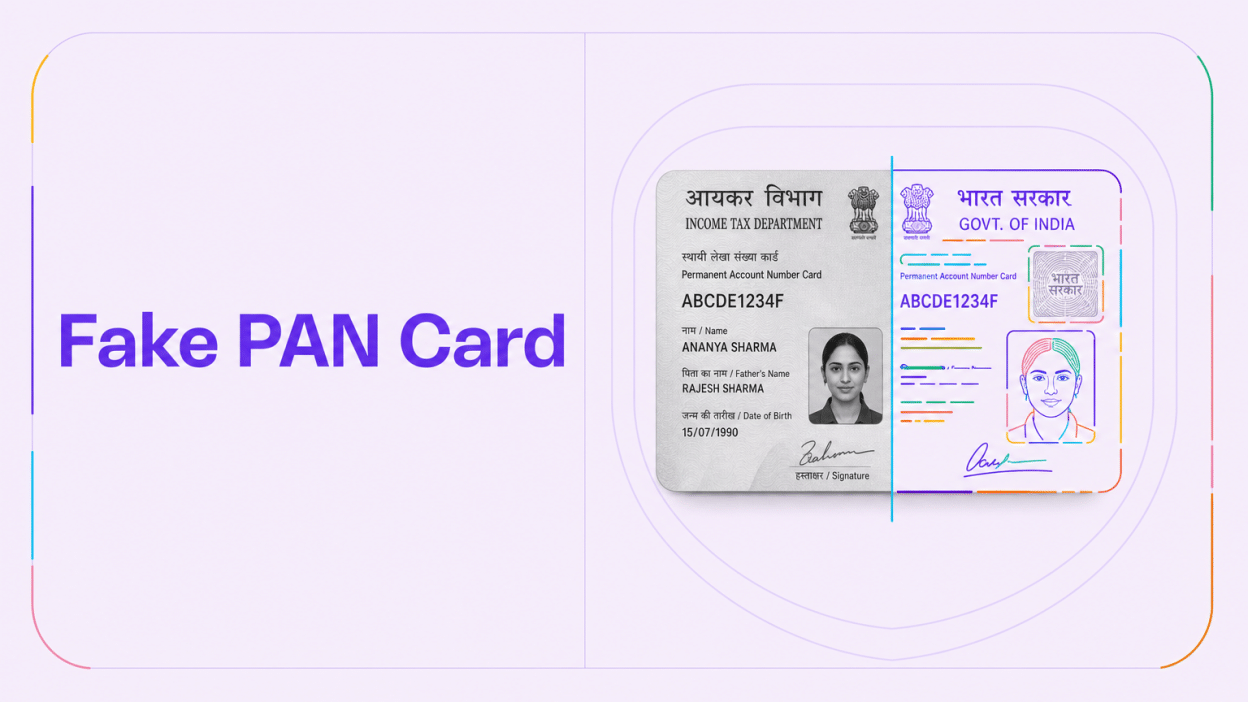
To check whether a PAN card is fake, verify the PAN, name, and date of birth on the Income Tax e-Filing portal’s “Verify Your PAN” service, scan the card’s QR code and compare it with the printed details, and check the PAN format. A genuine-looking card that fails any of these checks should be treated as suspect.
A fake PAN card rarely looks fake. Most are built from real PAN numbers belonging to someone else, with a new photo, a changed date of birth, or an edited name. The number passes a format check, and the card passes a glance.
That is why PAN fraud keeps showing up in loan files. In July 2026, Business Today, citing The Indian Express, reported an alleged Delhi case in which loans of about Rs 18 crore were raised in a widow’s name using a PAN card copy that carried her name but another person’s photo.
This guide covers how to spot a fake PAN card yourself, the fake PAN card patterns lenders see, what PAN 2.0 changes, and how to verify PAN at volume.
How to check if a PAN card is real or fake
Use these steps to check for a fake PAN card. The portal check is the only one that confirms the PAN against the Income Tax Department’s database.
- Go to the Income Tax e-Filing portal and choose “Verify Your PAN” under Quick Links.
- Enter the PAN, full name, and date of birth exactly as printed, plus a mobile number you can access.
- Enter the six-digit OTP sent to that mobile number. It is valid for 15 minutes, with three attempts.
- Read the result. The portal shows whether the PAN is active and whether the name and date of birth you entered match its records.
- Scan the QR code on the card with a reader and compare the decoded details with what is printed.
- Check the structure of the number, especially the fourth and fifth characters, against the holder’s status and name.
Two cautions apply. The portal confirms the data, not the person: a real PAN with someone else’s photo still passes step 4. And an inoperative PAN, for example, one not linked to Aadhaar where linking is required, is a real PAN with restricted use, not a fake one.
Reading the PAN number: what each character tells you
A PAN is a 10-character alphanumeric code. According to the Income Tax Department, its structure is fixed:
| Position | Meaning | What to check |
|---|---|---|
| 1 to 3 | Alphabetic series, AAA to ZZZ | Letters only |
| 4 | Holder status | Must match the type of holder |
| 5 | First letter of surname (individuals) or name (others) | Should match the name on the card |
| 6 to 9 | Sequential number, 0001 to 9999 | Digits only |
| 10 | Alphabetic check character | Letter only |
The fourth character codes are: P (individual), C (company), H (HUF), F (firm or LLP), A (association of persons), B (body of individuals), T (trust), L (local authority), J (artificial juridical person), and G (government agency).
This gives quick red flags. A “proprietor” presenting a PAN with C in the fourth place is presenting a company PAN. An individual named Sharma whose PAN has K in the fifth place deserves a second look, though surname conventions vary. A format check only proves a number could exist, not that it belongs to the applicant.
PAN QR code and e-PAN: what to check
PIB’s PAN 2.0 backgrounder states that QR codes have been part of PAN cards since 2017-18. Under PAN 2.0, the QR code is to be enhanced into a dynamic code that displays the latest data from the PAN database. Older cards without a QR code remain valid.
When checking a card with a QR code: – Decode it and compare the name, father’s name, date of birth, and photo with the printed card. – Treat a QR code that will not decode, or decodes to different details, as a strong red flag. – A QR code copied from a genuine card can be pasted onto a fake PAN card, so match the decoded photo to the person.
An e-PAN is a digitally signed PAN in electronic format. The Income Tax Department issues an e-PAN free of charge to individuals with a valid Aadhaar and a linked mobile number. For an e-PAN PDF, check that the digital signature is valid and that the file has not been edited after signing.
Common fake PAN card patterns in lending
Lenders tend to see five fake PAN card patterns. Only the first uses a fabricated number.
| Pattern | How it is built | Which check catches it |
|---|---|---|
| Fabricated number | Random valid-format PAN | Database verification (no record found) |
| Borrowed identity | Real PAN of a namesake or victim, attacker’s photo | Face match against a trusted photo source, name and DOB match |
| Edited details | Real PAN, altered DOB or name | DOB and name match against the database |
| Photo swap on genuine copy | Real card image with replaced photo | Face match, QR decode, tamper checks |
| Synthetic identity | Real PAN combined with other people’s documents | Cross-document consistency, bank account name match |
The Delhi case reported by Business Today fits the second pattern: police said the accused sourced the PAN of an unrelated woman with the same name from Odisha. A database check would have returned a match on name. Only a link between the PAN and the actual person would have caught it.
What PAN 2.0 changes
The Cabinet Committee on Economic Affairs approved PAN 2.0 on 25 November 2024 with an outlay of Rs 1,435 crore. The project is meant to re-engineer PAN and TAN services through technology.
For fraud teams, the relevant points from PIB’s backgrounder are: – Existing valid PAN cards remain fully operational; holders do not need to apply for a new PAN. – All PAN and TAN services are to move to a single unified portal of the Income Tax Department. – The QR code is to become dynamic, showing current data from the PAN database. – Allotment, updation, and correction are free, with a fee only for a physical card.
PAN 2.0 will make checking cards easier. It will not end the fake PAN card problem, because a real PAN tied to the wrong face is still a real PAN.
Verifying this at scale for your business
A credit officer can check one applicant on the portal. A lender screening thousands of applications a day for fake PAN card risk cannot rely on OTPs to the holder or screenshots.
At scale, PAN verification usually combines: – An API call that confirms PAN status and returns or matches the registered name. – A name match score between the PAN name and the name on bank, Aadhaar, and application records. – A date of birth match where the route supports it. – A face match between the applicant’s live selfie and a trusted photo, with liveness to stop photo-of-photo attacks. – Bank account verification so the disbursal account holder matches the PAN holder.
Where BeFiSc fits: IDProof brings PAN verification together with name match, face match, liveness, and bank account verification, so a lender can confirm the PAN is real and belongs to the applicant. BeFiSc serves 250+ businesses with 150+ APIs at an average response time of about 3 seconds. Book an IDProof demo to test it on your onboarding flow.
Real-world scenarios
These scenarios are illustrative.
A personal loan app receives an application where the PAN, name, and date of birth all verify. The selfie fails face match against the Aadhaar-sourced photo. Review shows the applicant used a relative’s PAN. The loan is declined before disbursal.
An MSME lender receives a PAN for a “sole proprietor” whose fourth character is F. The applicant is applying personally but using a partnership firm’s PAN. The file is routed to business verification.
Key Takeaways
- Most fake PAN cards use real PAN numbers with altered photos or details, so a format check is not enough.
- The Income Tax “Verify Your PAN” service confirms PAN status and whether the name and date of birth match, but not who is holding the card.
- The fourth character shows holder type, and the fifth reflects the surname or name; mismatches are red flags, not proof.
- QR codes have appeared on PAN cards since 2017-18, and PAN 2.0 plans a dynamic QR code; existing PANs stay valid.
- Lenders need to link the PAN to the person through face match, liveness, and bank account name match.
Frequently Asked Questions
Is using a fake PAN card a crime?
Yes. Forging or using a forged identity document can attract criminal liability, and holding or quoting a false PAN can attract penalties under income tax law. Report suspected misuse of your PAN to the police and the Income Tax Department.
What does the fourth character of a PAN mean?
It shows the holder’s status: P for individual, C for company, H for HUF, F for firm or LLP, T for trust, and other letters for associations, bodies of individuals, local authorities, government agencies, and artificial juridical persons.
Does a valid PAN number mean the card is genuine?
No. A valid number confirms that the PAN exists. A forged card can carry a real PAN with a different photo. You still need to confirm that the person presenting it is the holder.
How can I check if a PAN card is fake online?
Use the “Verify Your PAN” service on the Income Tax e-Filing portal. Enter the PAN, name, date of birth, and a mobile number, validate the OTP, and the portal shows whether the PAN is active and the details match.
Conclusion
Spotting a fake PAN card is mostly about refusing to trust the card itself. The number may be real, the format correct, and the QR code genuine, while the face belongs to someone else.
For individuals, the Income Tax portal and a QR scan cover most cases. Lenders need more: confirm the PAN, then the person, then that the bank account belongs to the same person before money moves.