
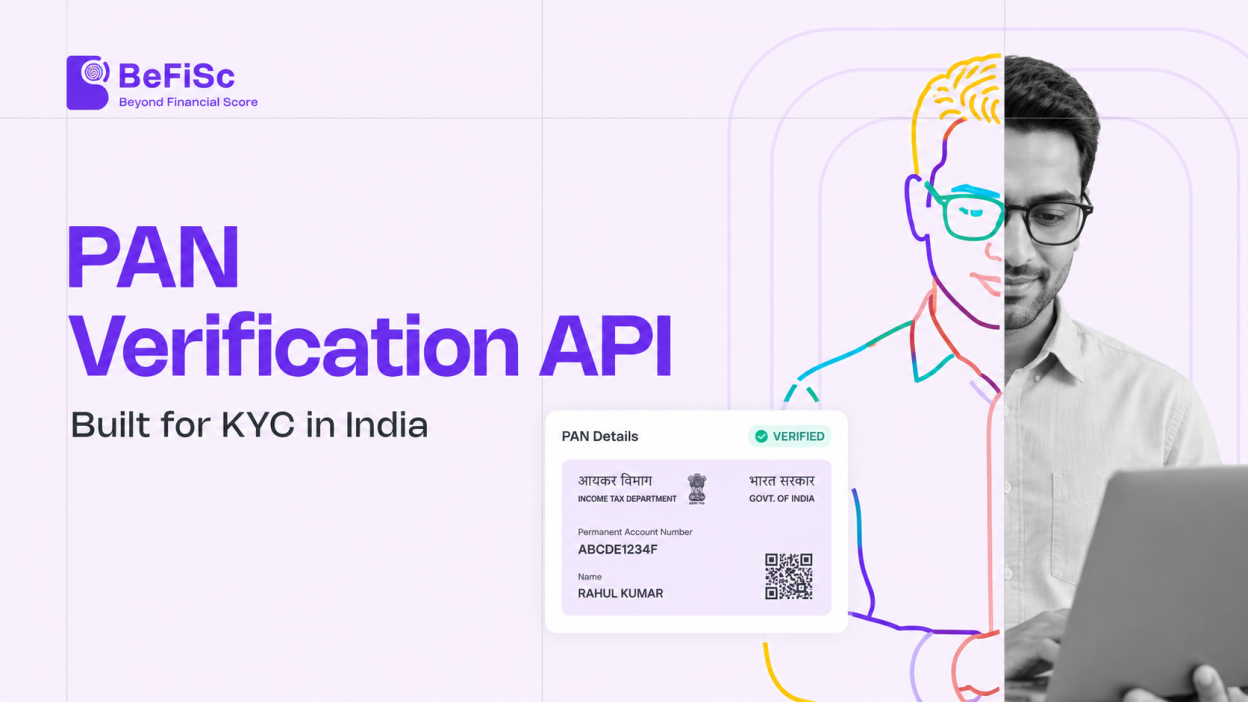
Introduction
PAN, the Permanent Account Number, is the most universally required identity document in Indian financial services. Every bank account opening, loan application, mutual fund investment, and insurance policy requires PAN. For fintechs and digital financial platforms, verifying PAN correctly is both a regulatory requirement and the single most important identity data point in the customer onboarding process.
The PAN Verification API automates this check, validating a PAN number against the Income Tax Department’s database and returning structured entity data in under two seconds. This guide covers everything developers and product teams need to know: how the API works, what it returns, how to integrate it correctly, and what compliance requirements shape its use.
What Is the PAN Verification API?
The PAN Verification API is a programmatic service that validates a Permanent Account Number against the Income Tax Department’s NSDL or UTI databases and returns the associated entity details. Unlike manual PAN verification, which requires visiting the Income Tax portal, the API delivers machine-readable JSON responses containing the PAN holder’s name, PAN status, and entity type.
For individual KYC, PAN is often verified alongside Aadhaar to create a dual-layer identity confirmation. For business KYC, the company PAN links the legal entity to its tax identity and enables director-level verification through linked PAN records.
What Data Does a PAN Verification API Return?
- PAN number: Confirmed as the validated identifier.
- Name on PAN: The registered name of the individual or entity, critical for name-match against application data.
- PAN status: Active, inactive, deleted, or fake the most important flag for compliance decisions.
- Entity type: Individual, company, firm, HUF (Hindu Undivided Family), or other entity categories.
- Date of birth (individual): For individual PAN holders, the date of birth as registered — allows age verification.
- Aadhaar linkage status: Under the mandatory Aadhaar-PAN linking requirement (deadline extended multiple times by the Income Tax Department), the API can indicate whether the PAN is linked to an Aadhaar — an important compliance check for regulated entities.
PAN Verification in the KYC Compliance Context
Under RBI’s Master Directions on KYC, PAN is classified as an Officially Valid Document for identity proof. For regulated entities such as banks, NBFCs, payment aggregators, and stockbrokers, collecting and verifying PAN is mandatory for accounts and transactions above defined thresholds.
Specifically, PAN verification is required for: cash transactions above ₹50,000; all bank account openings; loan disbursements; and investment accounts under SEBI regulations. For high-value transactions above ₹10 lakh, Form 60 is required in lieu of PAN only if the individual genuinely does not have one which means verifying whether a submitted PAN is real and active is always the first check.
The Aadhaar-PAN Link Compliance Requirement
The Income Tax Department’s Aadhaar-PAN linking mandate has significant implications for KYC. As per current directives, unlinked PANs are treated as inoperative,ive meaning financial transactions linked to inoperative PANs face processing restrictions. Lenders and fintechs must build the PAN linkage status check into their verification workflow to avoid disbursing credit to customers operating with inoperative PANs.
PAN Verification API: Integration Architecture
Single-Step PAN Lookup
The simplest integration: the user submits their PAN number and date of birth (for individuals) via the platform’s frontend. The backend makes a single API call with these parameters, receives the verification response, and proceeds with onboarding if the PAN status is active and the name matches the application.
PAN + Aadhaar Dual Verification
Higher-risk use cases, such as lending, payment accounts, high-value transactions require both PAN and Aadhaar verification. We make the PAN API call first because it has lower latency and requires no OTP. Then, we initiate the Aadhaar OTP flow. The combination provides cross-validated identity confirmation.
Bulk PAN Verification for Portfolio Management
NBFCs and banks managing large loan portfolios use bulk PAN verification to periodically audit active customer PAN status checking for PANs that have become inactive since onboarding. This is particularly relevant as the Aadhaar-PAN linking policy evolves.
Critical Implementation Considerations
Name Normalization and Fuzzy Matching
PAN records often contain names with minor spelling variations from application form submissions truncated middle names, initials vs full names, transliteration differences. A robust PAN API integration must implement fuzzy name-matching logic (Levenshtein distance or phonetic algorithms) rather than requiring exact string matches, which can create false negatives for legitimate customers.
Handling Inactive PAN Status
When a PAN returns as inactive or inoperative, the platform must not automatically reject the customer. The correct workflow is to flag for manual review, request an alternative identity document, and validate the reason for PAN inactivity (non-filing, pending dues, etc.) before making a final onboarding decision.
Entity Type Validation for Business KYC
When onboarding businesses, verifying the company PAN and confirming the entity type (private limited, LLP, sole proprietorship) allows automatic routing to the correct KYB workflow. A sole proprietor PAN triggers individual KYC; a company PAN triggers director verification and MCA cross-check.
Where BeFiSc Fits
BeFiSc’s PAN Verification API connects to the NSDL database with live, non-cached connectivity. The response includes PAN status, name, entity type, date of birth, and Aadhaar linkage status all fields required for compliant KYC. BeFiSc supports both individual PAN calls and bulk verification endpoints, with sandbox access available for development and testing.
Key Takeaways
- Bulk PAN verification is necessary for portfolio management and periodic customer data audits.
- PAN Verification API connects to NSDL/UTI databases and returns name, status, entity type, and Aadhaar linkage status.
- Aadhaar-PAN linkage status is now a compliance-critical check for regulated financial entities.
- Fuzzy name matching is essential in production exact string matching creates false negatives.
Frequently Asked Questions
Is PAN verification mandatory for all financial transactions?
PAN verification requirements depend on the transaction type, amount, and applicable regulatory rules. Banks, NBFCs, fintechs, and other regulated entities should apply the requirements relevant to their specific products and customer workflows.
How long does PAN verification take through an API?
A PAN Verification API typically returns results within seconds, depending on the provider and source database availability. Real-time verification helps fintechs complete KYC without manual checks.
What is an inoperative PAN and how should it be handled in onboarding?
An inoperative PAN results from failure to link Aadhaar as required by the Income Tax Department. Inoperative PANs cannot be used for financial transactions until linked. Platforms should flag these during onboarding and request alternate documentation or linkage completion before proceeding.
Can a PAN Verification API detect fake or forged PAN cards?
The API validates the PAN number against the Income Tax Department’s database. If the number does not exist in the database or belongs to a different entity than claimed, the API returns a mismatch or invalid status — effectively detecting most PAN fraud scenarios.
What information do I need to call a PAN Verification API?
At minimum, the PAN number. For individual verification with name matching, the date of birth is also required. Some providers support verification using PAN + name combination for business entity lookups where date of birth is unavailable.
Conclusion
PAN verification is a critical step in secure and compliant financial onboarding. A PAN Verification API helps banks, NBFCs, fintechs, and other platforms validate PAN details in real time while checking status, name, entity type, and other relevant data.
With automated verification, fuzzy name matching, inactive PAN handling, and Aadhaar-PAN status checks, businesses can reduce manual effort and prevent identity fraud. For organisations managing large customer portfolios, bulk PAN verification also supports ongoing KYC audits and compliance monitoring.
As digital financial services continue to scale, integrating reliable PAN verification into the KYC workflow helps businesses improve onboarding speed, accuracy, and regulatory compliance.
[…] charge the KYC API provider a wholesale fee per query, which gets passed through with a margin. PAN verification against NSDL/Protean, for instance, carries a different wholesale cost structure than Aadhaar […]
[…] registered mobile numbers after due verification when a revoked number is found; […]
[…] updates. Route changes through Aadhaar OTP e-KYC, DigiLocker documents, face match and PAN verification, and send higher-risk cases to […]