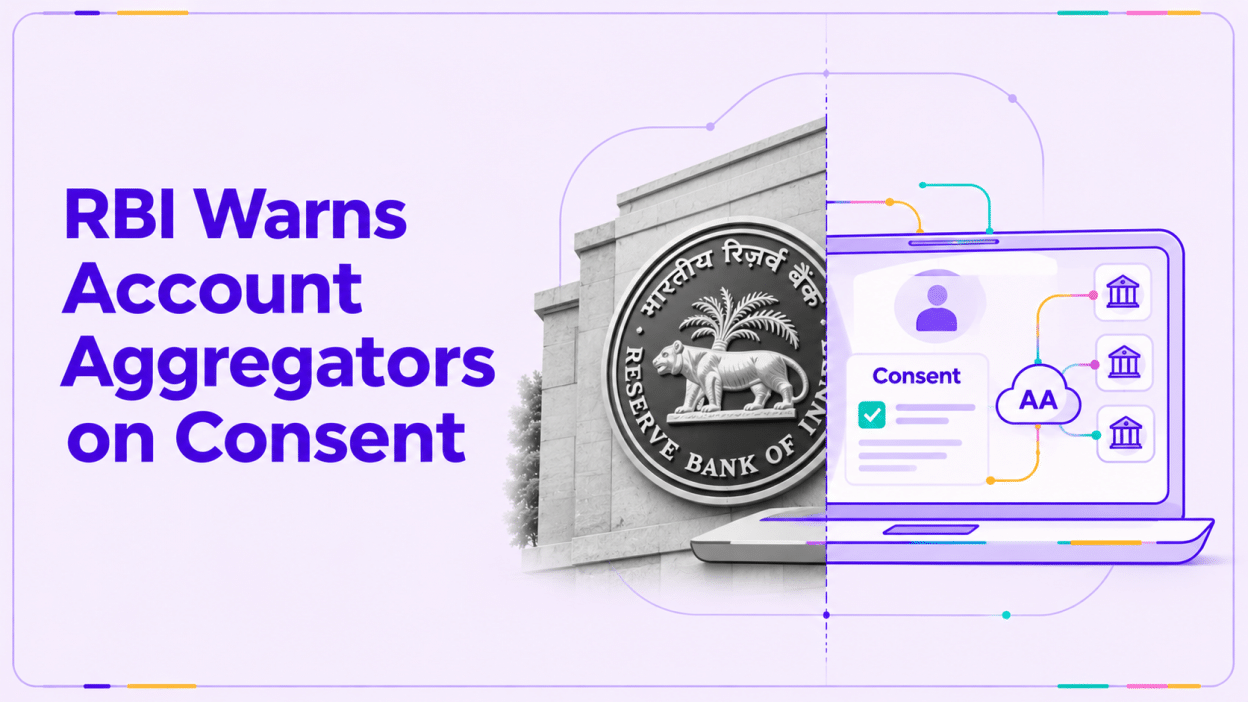
On 15 October 2026, RBI Executive Director Kesavan Ramachandran told the account aggregator ecosystem that customer data must not be monetised or used beyond what the customer consented to. These were conference remarks, not a new circular. For lenders acting as financial information users, the message is to tighten purpose, retention and reciprocity controls now.
The remarks came at SamvAAd 2026, the annual event hosted by Sahamati, the industry alliance for the account aggregator (AA) network. They landed one week after RBI’s 7 October policy statement announced interoperability among NBFC-AAs by 31 December 2026.
RBI wants the AA rails to scale, and it wants account aggregator consent to remain the only gateway to the data on them. Below: what was said, what the rules already require, and a checklist for lenders.
What RBI’s Executive Director actually said
According to reports by Whalesbook and NewsBytes on 15 October 2026, Ramachandran made five points that matter to regulated entities.
- No monetisation. Customer financial data passing through the network “must remain untainted by monetization efforts.” Aggregators cannot use it beyond the purpose the customer approved.
- Data-blind architecture. He described the AA design as data-blind: aggregators route encrypted data and may not store or decrypt it.
- Standardisation. RBI is working with ReBIT and Sahamati to convert more than 19 active financial information categories into uniform formats.
- Fourth pillar of DPI. He called the AA network the fourth pillar of India’s digital public infrastructure, alongside the JAM trinity, UPI and the Unified Lending Interface.
- Reciprocity. Institutions that consume financial information should also contribute data as providers.
Why the status of these remarks matters
A speech by an Executive Director is not a direction and creates no new legal obligation. It is still a strong indicator of supervisory focus, so treat it as an early warning.
The rules that already govern account aggregator consent
Most of what Ramachandran said is already written into law. Three instruments do the work.
The NBFC-AA Master Direction
The Master Direction on NBFC-Account Aggregators (RBI/DNBR/2016-17/46, issued 2 September 2016 and last updated 6 September 2024) is the core text. Per the RBI-hosted version, it sets out the following.
- The consent artefact is standardised and must capture customer identity, the type of financial information, the purpose, recipients, a notification address, and creation and expiry dates, signed by the AA.
- Customers can revoke consent, including partially, and artefacts must be capable of being logged and audited.
- Financial information accessed through the AA must not reside with the aggregator, and it is not the AA’s property to use for other purposes.
- The FIU may use or disclose the information only as the consent artefact specifies.
That last obligation is often underestimated: account aggregator consent travels with the data into your systems.
The October 2026 policy statement
RBI’s Statement on Developmental and Regulatory Policies of 7 October 2026 (Press Release 2026-2027/1265) announced two measures, both expected by 31 December 2026:
- Interoperability among NBFC-AAs, so a customer can reach data across providers through any AA of their choice.
- Enabling SEBI-regulated depositories to include bank deposit information in the Consolidated Account Statement through NBFC-AAs.
The DPDP Act and Rules
The Digital Personal Data Protection Act, 2023 requires purpose-specific consent, and its storage limitation principle means data should not outlive its purpose. MeitY notified the DPDP Rules on 14 November 2025 with an 18-month window for phased compliance. A lender pulling AA data is a data fiduciary for it.
RBI’s Digital Lending Directions, 2025 (8 May 2025) add a lending-specific layer: data collection must be need-based, backed by prior explicit consent with an audit trail, and borrowers can ask for their data to be deleted.
What this means for lenders acting as FIUs
The practical question is not whether your AA partner is compliant. It is whether your own use of AA data stays inside each customer’s account aggregator consent. Here is a working checklist.
- Store the consent artefact with the data. Every dataset fetched should be linked to its consent ID, purpose code, FI types, date range and expiry. If an auditor picks a loan file, you should be able to show which artefact authorised which data.
- Map purpose to downstream use. A consent for underwriting a specific loan does not automatically cover cross-sell models, marketing segmentation or sharing with a co-lending partner. Each new use needs its own basis.
- Respect frequency and fetch type. A one-time fetch for underwriting is different from periodic fetches for monitoring. Do not schedule repeat pulls that the artefact does not permit.
- Set retention by purpose. Define how long raw FI data, derived features and credit decisions are kept, and delete raw data once the purpose and any regulatory retention period have run.
- Handle revocation in real time. A revoked or expired consent should stop future fetches and trigger your deletion workflow where no other legal basis applies.
- Control vendors. If an analytics vendor processes AA data on your behalf, the contract should bind them to the same purpose, storage-in-India and deletion terms.
AA data versus uploaded bank statement PDFs
Many lenders run two channels side by side: AA-fetched bank data and customer-uploaded PDF statements. Both are personal data, but they carry different risk profiles.
| Factor | AA-fetched data | Uploaded PDF statement |
|---|---|---|
| Source authenticity | Comes directly from the FIP, signed and encrypted | Depends on the customer; can be edited or fabricated |
| Consent record | Machine-readable consent artefact | Usually a checkbox or loan application consent |
| Purpose binding | Explicit in the artefact | Defined by your own consent notice |
| Coverage | Only FIPs live on the network | Any bank, any format |
| Tampering risk | Low | Material; needs forensic checks |
AA data reduces document fraud but does not replace PDF analysis. Coverage gaps and consent-journey drop-offs still push lenders toward uploaded statements, so keep one consistent analytics layer for both.
Where BeFiSc fits: Finnalyzer is BeFiSc’s bank statement analysis product, built to read statements across 100+ bank formats and turn them into credit-ready insights such as income patterns, obligations and bounce behaviour. Lenders running a mixed AA and PDF pipeline can use a Finnalyzer trial to benchmark how their statement-based underwriting performs on real files. Confirm with our team how Finnalyzer fits alongside your AA data flow.
Reciprocity: when your FIU must also become an FIP
Ramachandran’s reciprocity comment is not new policy. The Master Direction already expects an FIU that holds specified financial information to join the network as a financial information provider as well.
Many lenders consume far more AA data than they supply, even though their loan and repayment data is exactly what other FIUs want. Expect this gap to attract attention as interoperability goes live. Assess which FI categories you hold, which ReBIT specifications apply, and what work is needed to go live as an FIP.
Use cases and real-world scenarios
Scenario 1 (illustrative): the cross-sell model. An NBFC fetches six months of bank data through an AA to underwrite a personal loan. Its marketing team later wants the same data to build a credit card propensity model. Under the original account aggregator consent, that purpose was not approved. The compliant route is a fresh consent, or excluding AA-sourced data from the model.
Scenario 2 (illustrative): the expired artefact. A lender’s scheduler keeps attempting monthly pulls on an MSME borrower after the consent has expired. The AA rejects them, but the lender’s logs now show attempted access without valid consent.
Key Takeaways
- RBI’s 15 October 2026 remarks are guidance from a senior official, not a circular, but they signal where supervision is heading on account aggregator consent.
- The NBFC-AA Master Direction already binds FIUs to use data only as the consent artefact specifies. – DPDP purpose limitation and the Digital Lending Directions’ deletion rights add a second, overlapping obligation on lenders.
- Interoperability by 31 December 2026 will increase the volume of consent artefacts lenders must govern. – Reciprocity is an existing expectation, and AA data and uploaded statements should feed one analytics layer with clear provenance.
Frequently Asked Questions
Do NBFCs have to become FIPs on the AA network?
The Master Direction expects an FIU that holds specified financial information to also participate as an FIP. RBI’s recent remarks on reciprocity suggest closer attention to this expectation. NBFCs should review which data categories they hold and plan onboarding with legal input.
Can a lender reuse AA data for marketing or other products?
Only if the customer’s consent covers that purpose or another lawful basis applies. Account aggregator consent is purpose-bound, and the DPDP Act reinforces purpose limitation. Reuse for unrelated cross-sell or model training without fresh consent creates regulatory and reputational risk.
What does data-blind mean for account aggregators?
Data-blind means the aggregator transfers encrypted financial information between provider and user without being able to read or retain it. The Master Direction states that accessed data must not reside with the AA. This shifts responsibility for safe use and retention to the FIU that decrypts it.
What is a consent artefact in the AA framework?
A consent artefact is the standardised, digitally signed record of a customer’s permission. It specifies who the customer is, what financial information can be shared, the purpose, the recipient, and the validity period. The FIU must use the data only within those terms, and the customer can revoke it.
Did RBI issue a new circular on account aggregator consent in October 2026?
No. The 15 October 2026 statements were remarks by Executive Director Kesavan Ramachandran at Sahamati’s SamvAAd 2026. The binding rules remain the NBFC-AA Master Direction, the Digital Lending Directions, 2025 and the DPDP Act. The related formal measure is the 7 October 2026 policy statement on NBFC-AA interoperability, expected by 31 December 2026.
Conclusion
The October 2026 remarks do not change the rulebook, but they change the tone. RBI is expanding the AA network through interoperability and new data categories while warning every participant that consent is the boundary, not a formality.
For lenders, the work sits inside their own systems: linking every dataset to its artefact, binding downstream use to purpose, deleting on schedule and preparing to give data back as an FIP. Teams that build these controls now will be ready when the supervisory questions arrive.
Strong consent governance and strong statement analytics go together. If you want to see how your bank data analysis holds up on real files, start with a trial.