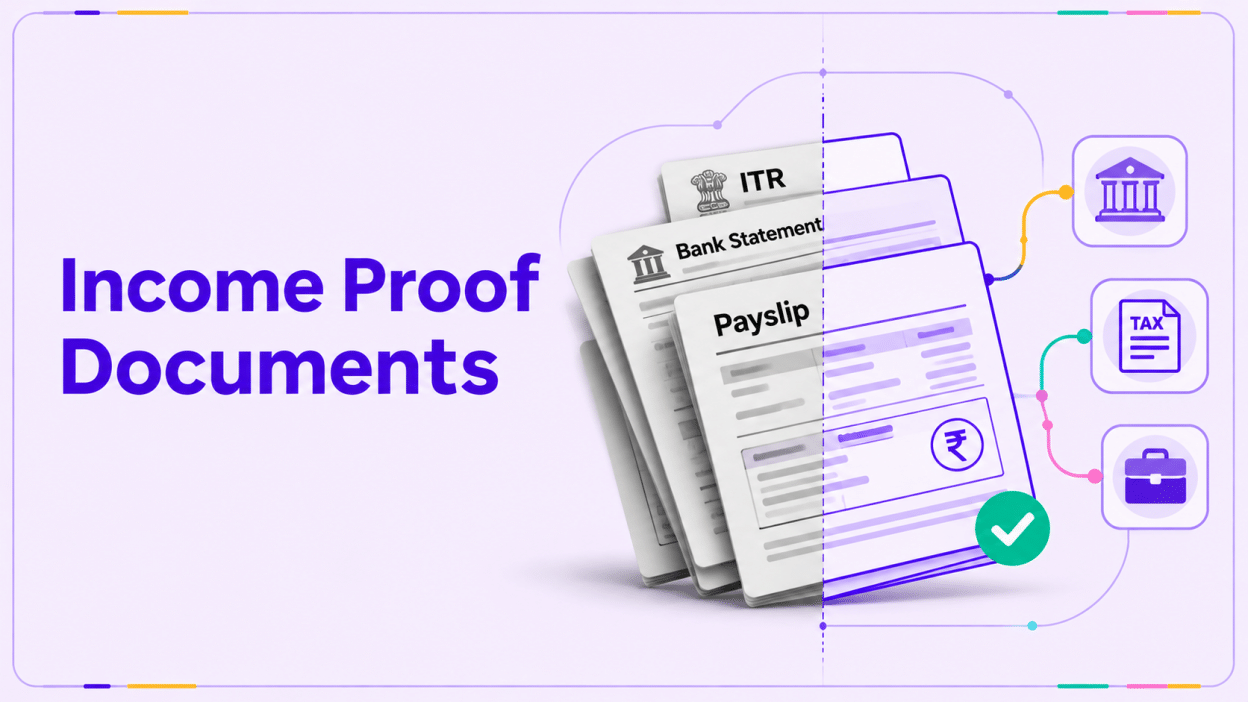
Income proof is any document that shows how much a borrower earns and how regularly. Salaried applicants usually submit salary slips, Form 16 (now Form 130) and bank statements. Self-employed applicants submit ITRs, GST returns, Form 131 TDS certificates and bank statements. Lenders verify each against an independent source before trusting it.
Every loan file in India starts with the same question: can this person repay? RBI’s Digital Lending Directions, 2025 put it in writing, requiring lenders to capture at least age, occupation and income before lending digitally.
The documents that answer that question vary by borrower type, and each one has blind spots. This guide maps the common income proof documents, explains how credit teams verify them, flags where fraud tends to enter, and covers the tax form changes that took effect on 1 April 2026.
Why income proof matters to lenders
Income verification is not just a credit preference. Paragraph 7(i) of RBI’s Digital Lending Directions, 2025 (RBI/2025-26/36, 8 May 2025) requires regulated entities to obtain information on the borrower’s economic profile, covering at least age, occupation and income, and to keep it on record for audit.
For NBFCs, the Fair Practices Code in RBI’s NBFC Responsible Business Conduct Directions, 2025 (28 November 2025) sets out loan appraisal and sanction-term requirements, which presuppose a documented assessment of what the borrower submitted.
In practice, these documents drive three decisions: whether to lend, how much (through FOIR or debt-service limits), and at what price. A weak document can distort all three.
Income proof for salaried applicants
Salaried borrowers have the most standardised paper trail, but also the most commonly forged.
| Document | What it shows | How lenders verify | Main weakness |
|---|---|---|---|
| Salary slips (last 3 months) | Gross pay, deductions, net pay | Match net pay to bank credits; check employer details | Easy to fabricate with templates |
| Form 16 / Form 130 | Annual salary and TDS by employer | Cross-check TAN, PAN and TDS with tax credit statement | Annual, so it lags current income |
| Bank statements (3 to 6 months) | Actual salary credits and spending | Statement analysis, credit pattern checks | Can be edited if uploaded as PDF |
| Employment verification | Current employer and tenure | EPFO/UAN checks, HR confirmation | Confirms job, not exact pay |
| ITR / ITR-V | Declared total income | Verify filing status and acknowledgement | Self-declared figures |
Salary slips
A salary slip is the employer’s monthly record of pay. It is the quickest document to collect and the easiest to fake. Template tools can produce convincing slips, which is why our guide to recommends never accepting a slip without matching it to bank credits.
Form 16 and Form 130
Form 16 is the TDS certificate an employer issues for salary. Under the Income-tax Act, 2025, it has been replaced by Form 130, issued under Rule 215 of the Income-tax Rules, 2026. Form 16 remains valid for FY 2025-26 salaries, so lenders will see both formats during 2026 and 2027.
Employment checks
An income figure is only as reliable as the job behind it. An can confirm current employer and tenure through EPFO data, closing the gap that slips leave open.
Income proof for self-employed applicants and MSMEs
Verifying self-employed borrowers is harder because there is no employer to vouch for the numbers. Lenders combine several weaker signals into one view.
- ITR with computation of income. Two to three years of returns show declared income and its trend. The acknowledgement (ITR-V) confirms filing; confirms the return exists and matches what was submitted.
- Tax credit statement and AIS. Form 26AS and the Annual Information Statement on the e-filing portal show TDS credits and reported transactions. They help test whether declared turnover matches what third parties reported.
- Form 131 (earlier Form 16A). Professionals and contractors receive Form 131, the TDS certificate for non-salary payments under section 395(4)(a) of the Income-tax Act, 2025. It shows who paid the borrower and how much.
- GST returns. For GST-registered businesses, GSTR-3B and GSTR-1 filings show declared turnover and filing discipline.
- Audited financials. Larger MSMEs provide balance sheets and profit and loss statements, ideally with a CA’s UDIN.
- Bank statements (6 to 12 months). Current account statements show real inflows, concentration of buyers and cash behaviour.
The main weakness across this set is that most figures are self-declared or lagged. ITRs can be filed to support a loan, and GST turnover can be inflated through circular invoicing. For eligibility rules beyond income, see our guide on.
The Income-tax Act, 2025 transition: what changes on the documents
The Income-tax Act, 2025 came into force on 1 April 2026, replacing the 1961 Act, according to a CBDT press release of the same date. The Income-tax Rules, 2026 were notified on 20 March 2026.
For lenders, three practical changes matter:
- New form numbers. Form 16 becomes Form 130 and Form 16A becomes Form 131. Update document checklists, OCR templates and rejection reasons so valid new forms are not flagged as unknown.
- “Tax Year” replaces FY and AY. Form 130 uses a single Tax Year reference instead of Financial Year and Assessment Year. Credit policies that refer to “AY” should be reworded.
- Dual formats during transition. Applications in 2026 and 2027 will mix old-Act documents for FY 2025-26 with new-Act documents for later years. Verification rules must accept both.
Why bank statements anchor income verification
Every other document is a statement about money. A bank statement is the record of money actually received. That is why most credit policies treat it as the anchor and test other documents against it.
How lenders verify income from a bank statement
- Confirm authenticity. Check that the statement has not been edited, through metadata checks or by sourcing data directly from the bank or AA.
- Identify regular income. Find recurring salary credits or business inflows and their dates.
- Separate genuine income from noise. Exclude self-transfers, loan disbursals, refunds and round-tripped funds.
- Measure obligations. Detect EMIs, cheque bounces and recurring debits that reduce repayment capacity.
- Reconcile with other documents. Compare statement income with salary slips, Form 130 or ITR figures and investigate gaps.
Manual review of six to twelve months of transactions is slow and inconsistent across analysts. Our explainer on covers the signals in more depth.
Where BeFiSc fits: Finnalyzer is BeFiSc’s bank statement analysis product. It reads statements across 100+ bank formats and turns them into structured transactions and credit insights such as income patterns, obligations and bounces, so analysts can reconcile stated income with actual credits. A Finnalyzer trial lets your credit team test it on real applicant files.
Use cases and real-world scenarios
Scenario 1 (illustrative): the salaried mismatch. An applicant submits three salary slips showing Rs 85,000 net pay. The bank statement shows monthly credits of Rs 52,000 from the same employer. The lender sizes the loan on the lower figure and requests the employer’s confirmation before disbursal.
Scenario 2 (illustrative): the seasonal trader. A self-employed trader’s ITR declares Rs 9 lakh annual income. Twelve months of current account data show strong inflows only between October and February. The lender structures a repayment schedule around the seasonal pattern rather than rejecting the file.
Scenario 3 (illustrative): the new form. A borrower in mid-2027 submits Form 130 instead of Form 16. An outdated document checklist rejects it as invalid. Updating the checklist removes a false rejection that would otherwise hurt conversion.
Key Takeaways
- RBI’s Digital Lending Directions, 2025 require lenders to capture borrower income, along with age and occupation, before digital loans.
- For salaried borrowers, verification centres on slips, Form 16 or Form 130, and bank statements; each must be cross-checked.
- Self-employed files combine ITRs, Form 131, tax credit data, GST returns and bank statements.
- From 1 April 2026, new form numbers and the Tax Year concept require updates to checklists and OCR templates.
- Bank statements are the anchor document because they record actual credits rather than declared figures.
Frequently Asked Questions
How do lenders detect fake income documents?
They cross-check documents against independent sources: salary slips against bank credits, ITRs against filing records, and employment against EPFO data. They also run tamper checks on uploaded PDFs and look for inconsistencies in dates, fonts, employer details and transaction patterns.
Has Form 16 been replaced?
Under the Income-tax Act, 2025, which came into force on 1 April 2026, Form 16 is replaced by Form 130 and Form 16A by Form 131. Form 16 still applies to salary for FY 2025-26, so lenders will see both during the transition.
Is ITR valid as income proof?
Yes, an ITR is widely accepted, especially for self-employed applicants. Its weakness is that income figures are self-declared, so lenders verify the filing and compare declared income with bank credits and tax credit data before relying on it.
What is the best income proof for self-employed applicants?
There is no single document. Lenders usually ask for two to three years of ITRs plus six to twelve months of bank statements, and GST returns for registered businesses. Bank statements carry the most weight because they show real inflows rather than declared income.
Which documents are accepted as income proof for a loan?
Lenders typically accept salary slips, Form 16 or Form 130, ITRs with computation of income, Form 131 TDS certificates, GST returns, audited financials and bank statements. The exact list depends on the lender’s credit policy and whether the borrower is salaried or self-employed.
Conclusion
No single income proof tells the full story. Salary slips are quick but easy to forge, tax documents are reliable but lagged, and GST data reflects declared turnover. Each document answers part of the question.
The lenders that assess income well treat the bank statement as the record of truth and test everything else against it. With the 2026 tax form changes now in effect, it is also a good moment to update checklists and verification rules.
If your team still reconciles income by hand, test a structured approach on real files.