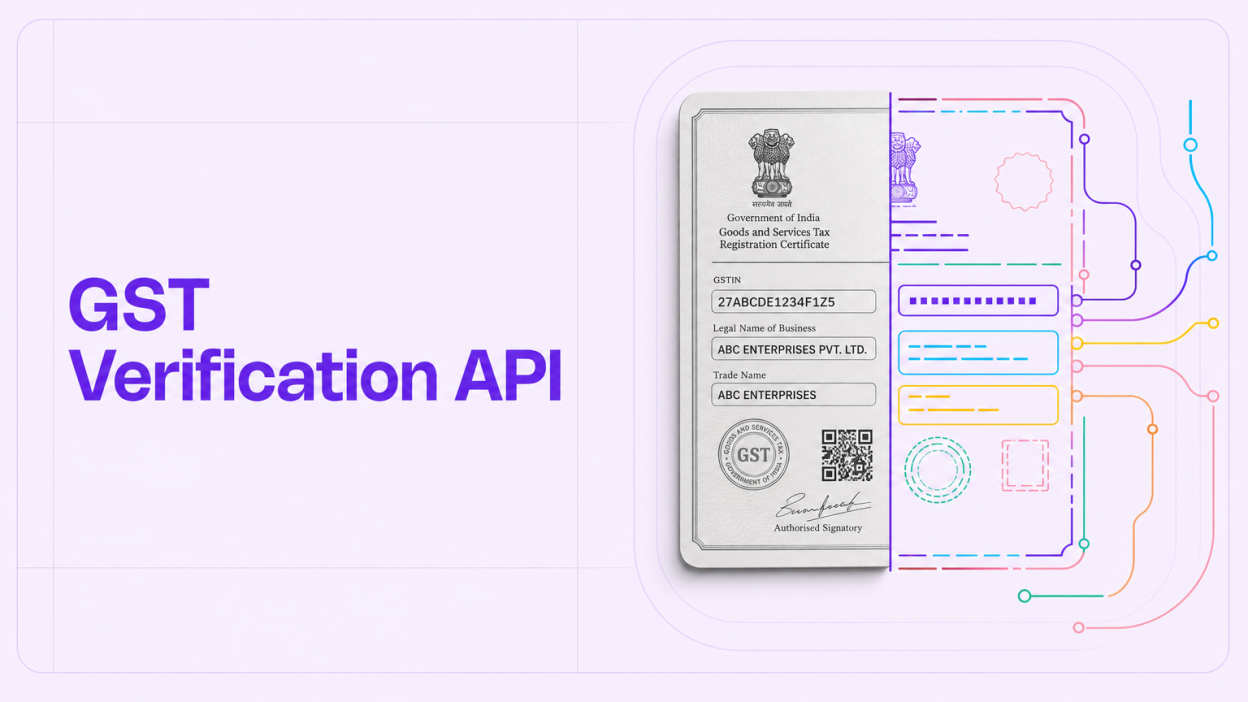
A GST verification API helps NBFCs and lenders verify whether a business’s GSTIN is valid, active, and linked to the applicant. For fintechs underwriting merchants, small businesses, or B2B borrowers, automating this verification can reduce manual GST portal checks and make business onboarding more scalable.
This guide explains what a GST verification API actually checks, how GSTIN structure encodes information a lender can use directly, and where this fits into a broader business KYC (KYB) workflow.
What a GST Verification API Confirms
At its core, a GST verification API queries the GST Network (GSTN) either directly through the government’s GST Developer Portal or through a licensed intermediary and returns structured data about a given GSTIN: the legal name and trade name registered against it, registration status (active, cancelled, suspended), the business’s registered address, the date of registration, and the taxpayer type (regular, composition scheme, and so on).
For a lender, the immediately actionable signals are registration status and name-match. A GSTIN that returns as cancelled or suspended is an immediate red flag: either the business has stopped operating in a compliant capacity or is attempting to use an invalid number. A mismatch between the legal name on the GST registration and the name the applicant has provided elsewhere in the loan application (PAN, bank account, Udyam registration) is one of the more reliable early signals of either error or attempted fraud.
More sophisticated implementations go further, pulling filing history (whether GST returns have been filed on schedule) as a proxy for operational health. A business that has stopped filing returns regularly is often a business in financial distress, which is directly relevant to a credit decision even before formal financial statement analysis begins.
Reading a GSTIN: What the Number Itself Tells You
A GSTIN’s structure is not arbitrary, and a verification API that surfaces this structure (rather than treating the GSTIN as an opaque string) gives an underwriting team useful information at a glance.
The first two digits encode the state code, which should be consistent with the business’s stated operating location; a mismatch here (a GSTIN registered in a state far from the applicant’s stated address, with no clear business reason) is worth a closer look. The next ten characters correspond to the business’s PAN, which means a GST verification step can cross-validate against a separately submitted PAN without an additional API call, catching cases where an applicant has submitted inconsistent identity documents across different parts of an application. The remaining digits encode the entity number (for businesses with multiple registrations under one PAN in a state), a default check character, and a checksum digit used to validate the number’s format before any live query is even made.
This last point matters operationally: a well-built GST verification API validates GSTIN format and checksum client-side before making a live GSTN query, catching typos and malformed entries without consuming a billable API call a detail that affects both cost and user experience during data entry.
GST Verification as Part of a Broader KYB Workflow
GST verification rarely stands alone in a production underwriting flow. It typically sits alongside MCA (Ministry of Corporate Affairs) verification for registered companies, Udyam/MSME registration checks for eligible small businesses, PAN verification, and increasingly, bank statement or financial data analysis for creditworthiness.
The sequencing matters: GST and PAN cross-validation is cheap and fast, so it belongs early in the funnel as a gate before more expensive steps (financial statement analysis, credit bureau pulls) are triggered. A well-designed onboarding flow rejects or flags GSTIN mismatches before spending on downstream verification steps that a fraudulent or erroneous application would fail anyway.
Use Cases Specific to NBFC and Fintech Lending
Merchant onboarding for embedded lending. Payment aggregators and platforms offering embedded working-capital loans to merchants on their platform use GST verification as a near-instant eligibility gate, since a merchant’s GST filing history often correlates with the transaction-volume claims they make in a loan application.
Supply chain and invoice financing. Lenders financing invoices between two GST-registered businesses need to verify both parties’ GSTIN status and, often, cross-check that the invoice itself corresponds to a plausible transaction pattern given each party’s registered business category a use case where GST data becomes an input to fraud detection, not just onboarding.
Co-lending and priority-sector lending verification. Banks partnering with NBFCs on co-lending arrangements for MSME credit frequently require independent GST and Udyam verification as part of the due diligence a bank partner expects before capital is deployed through the arrangement, since regulatory priority-sector lending classifications depend on accurate business categorization.
What to Evaluate in a GST Verification API Provider
- Direct GSTN connectivity versus intermediary layers affects both latency and the freshness of registration-status data, since cancelled or suspended registrations should reflect promptly.
- Filing history and compliance-rating data, if available; not all providers surface this, and it adds meaningful underwriting signal beyond a basic active/inactive check.
- Bulk verification support: ways to verify large applicant batches, relevant for lenders processing supply-chain financing or marketplace-embedded lending at volume.
- Cross-validation with PAN and Udyam data in a single workflow, reducing the number of separate API integrations a lending platform needs to maintain.
Key Takeaways
- A GST verification API confirms registration status, legal/trade name, and registered address against the GST Network. Registration status and name-match are the two highest-value signals for a lender.
- A GSTIN’s structure encodes the state code and the associated PAN, enabling cross-validation against separately submitted PAN data without an additional API call.
- GST filing history can serve as a proxy for a business’s operational and financial health, ahead of and complementary to formal financial statement analysis.
- GST verification belongs early in an underwriting funnel, as a low-cost gate before more expensive verification and credit-assessment steps are triggered.
- Bulk verification and filing-history depth vary meaningfully across providers and matter more for lending use cases than for simple one-off business registration checks.
Frequently Asked Questions
Is GST verification required by RBI for all NBFC lending?
RBI’s KYC and due diligence expectations require appropriate verification proportionate to risk, and for business borrowers this generally includes confirming business registration and tax status, though the specific mandated checks depend on the loan category, borrower type, and the entity’s own risk-based policies under RBI’s Master Direction.
Does GST verification confirm the business address is genuine?
It confirms the address as registered with GSTN, which is a meaningful signal but not independent physical verification. Lenders requiring higher assurance often pair this with a separate address-verification or field-visit process for larger exposures.
How current is the registration status returned by a GST verification API?
This depends on how directly the provider connects to GST. Aa direct connection generally reflects near-real-time status, while an intermediary with a cached or batch-updated dataset may lag behind actual GSTN records, which matters for time-sensitive underwriting decisions.
Can a business have a valid GSTIN but still be a lending risk?
Yes. A valid, active GSTIN confirms tax registration, not creditworthiness or fraud-free inte;nt it is one input among several (financial statement analysis, credit bureau data, banking behavior) that together inform a credit decision.
What is the difference between GST verification and Udyam/MSME verification?
Far, far away, behind the word mountains, far from the countries Vokalia and Consonantia, there live the blind texts. Separated, they live in Bookmarksgrove right at the coast of the Semantics, a large language ocean.
Conclusion
GST verification has moved from a compliance checkbox to a genuine underwriting signal as lenders have learned to read more out of registration status, filing consistency, and cross-validated business identity than a simple valid/invalid check provides. For any NBFC or fintech lending to businesses at meaningful volume, the question isn’t whether to automate this step; manual GST portal checks don’t scale past a trivial applicant count, but whether the chosen provider surfaces enough structured signal to make the check useful for risk decisions, not just for satisfying a compliance requirement on paper.