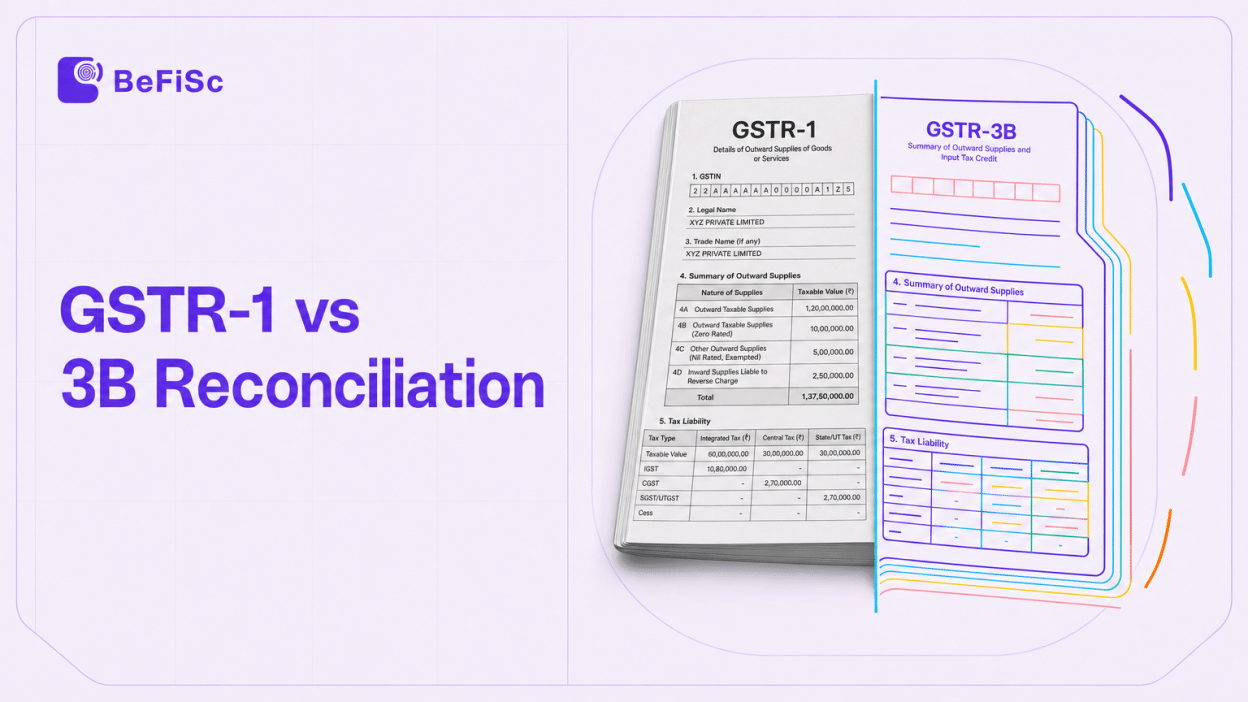
GSTR-1 vs 3B is the comparison between what a business tells the GST system it sold (GSTR-1, invoice by invoice) and what it declared and paid tax on (GSTR-3B, in summary). For a lender, a persistent gap is an early signal of inflated sales, under-reported tax, or stress.
GST returns are now a standard input for MSME credit: filed monthly or quarterly, held in a government system, and hard to restate after the fact.
But GST-based lending is only as good as its GSTR-1 vs 3B reconciliation logic. This guide covers what each return contains, what changed in 2025, how to read a mismatch, and a checklist with a worked example.
GSTR-1 vs 3B: The Difference Between the Two Returns
| Attribute | GSTR-1 | GSTR-3B |
|---|---|---|
| What it reports | Outward supplies, invoice-level for B2B, summarised for B2C | Summary of outward supplies, ITC claimed and tax paid |
| Granularity | Invoice, credit note, debit note, HSN summary | Aggregate figures by table |
| Tax payment | No payment | Tax is paid with this return |
| Feeds into | Buyers’ GSTR-2B (their ITC statement) | Electronic liability and cash ledgers |
| Corrections | Through amendments or GSTR-1A | Liability now locked to GSTR-1/1A values |
| Lender reading | What the business says it sold | What the business paid tax on |
Where GSTR-2B fits
GSTR-2B is an auto-drafted statement of input tax credit available to a buyer, built from its suppliers’ GSTR-1 filings. Comparing ITC claimed in GSTR-3B with GSTR-2B shows whether a borrower claims credit its suppliers never reported.
Due Dates, IFF and the QRMP Scheme
- GSTR-1, monthly filers: 11th of the following month.
- GSTR-1, quarterly filers under QRMP: 13th of the month after the quarter. They may upload B2B invoices for the first two months through the Invoice Furnishing Facility (IFF).
- GSTR-3B, monthly filers: 20th of the following month.
- GSTR-3B, quarterly filers under QRMP: 22nd or 24th of the month after the quarter, depending on the state.
For underwriting, the filing date matters as much as the amount. A business that files GSTR-1 on time but GSTR-3B months late is reporting sales without paying the tax on them.
What Changed in 2025: Hard-Lock and the Three-Year Time-Bar
GSTR-3B liability is now non-editable
In an advisory dated 7 June 2025, GSTN announced that the tax liability auto-populated in GSTR-3B from GSTR-1, GSTR-1A and IFF would become non-editable from the July 2025 tax period, filed in August 2025. Corrections must now be made at source, through GSTR-1A, before GSTR-3B is filed.
For lenders, this narrows the GSTR-1 vs. 3B gap from July 2025 onward. Earlier periods still carry the old risk of manual edits, so a 24-month analysis spans two regimes.
Returns are barred after three years.
Following amendments made through the Finance Act, 2023, GSTN advised that returns cannot be filed once three years have passed from their due date. The portal began enforcing this in 2025, with further periods barred on a rolling basis (a GSTN advisory of 29 October 2025 listed periods barred from 1 December 2025).
A borrower can no longer clean up very old pending returns before applying; those gaps are now permanent.
What a GSTR-1 vs 3B Gap Actually Means
A mismatch is a question, not a verdict, and its direction shapes the question.
| Gap pattern | Possible innocent cause | Risk interpretation |
|---|---|---|
| GSTR-1 sales higher than GSTR-3B sales | Timing, amendments, advances, export classification | Under-reported tax liability; tax demand risk |
| GSTR-3B sales higher than GSTR-1 | B2C sales reported only in 3B, data entry error | Less common; check for unreported invoices |
| GSTR-1 high, 3B filed late or not at all | Cash-flow strain | Business reporting turnover but not paying tax |
| GSTR-1 spikes in the months before a loan | Seasonal peak | Sales inflated for loan purposes |
| Large B2B sales to a small set of related GSTINs | Group structure | Circular trading among connected entities |
There is also a regulatory risk: sustained under-reporting invites demand notices, interest, and penalties that can absorb the cash flow you are lending against.
How Lenders Use GST Data for Underwriting
GST-based lending uses returns to estimate revenue, seasonality, customer concentration, and filing discipline through three data routes.
- Public GST search: registration status, taxpayer type, principal place of business, and return filing status and dates. It does not show return amounts.
- GST Suvidha Provider (GSP) or taxpayer-authorised access: the borrower authenticates with an OTP and the lender’s provider retrieves return data.
- Account Aggregator: on 23 November 2022, RBI amended the NBFC-AA Directions to add GSTN as a Financial Information Provider, with GSTR-1 and GSTR-3B designated as financial information. With consent, a lender acting as FIU can fetch returns through an AA.
Document consent and purpose, and align retention with DPDP obligations.
GSTR-1 vs GSTR-3B Reconciliation Checklist for Credit Teams
The thresholds below are illustrative starting points. Calibrate them on your own portfolio’s performance data.
- Confirm the GSTIN is active and the legal name matches the borrower’s PAN.
- Pull at least 12, ideally 24, months of GSTR-1 and GSTR-3B.
- Compute the monthly gap: (GSTR-1 taxable value minus GSTR-3B Table 3.1 taxable value) divided by GSTR-1 taxable value.
- Flag any single month with a gap above 10% and any rolling quarter above 5% (illustrative).
- Check filing delays: count months where GSTR-3B was filed more than 30 days after its due date.
- Compare GSTR-3B ITC claimed with GSTR-2B available; flag ITC claimed above 2B by more than 5% (illustrative).
- Compare GST turnover with bank statement credits for the same months; large unexplained differences need a narrative.
- Look for turnover spikes in the three months before the application relative to the prior year.
- Review top B2B customers for concentration and related-party GSTINs (same PAN, same address, same promoters).
- Treat pre-July 2025 and post-July 2025 periods separately when interpreting gaps, because of the hard-lock.
Worked Example
Illustrative data for a trading business applying for a working capital line in early 2026 (figures in Rs lakh).
| Month | GSTR-1 taxable value | GSTR-3B taxable value | Gap % | 3B filed | Bank credits |
|---|---|---|---|---|---|
| Jun 2025 | 42.0 | 36.5 | 13.1% | 18 days late | 37.9 |
| Jul 2025 | 44.5 | 44.5 | 0.0% | On time | 39.2 |
| Aug 2025 | 46.0 | 46.0 | 0.0% | 41 days late | 38.4 |
| Sep 2025 | 61.0 | 61.0 | 0.0% | 35 days late | 40.1 |
| Oct 2025 | 63.5 | 63.5 | 0.0% | 38 days late | 39.6 |
| Nov 2025 | 64.0 | 64.0 | 0.0% | 44 days late | 41.0 |
Reading it: June shows a classic pre-hard-lock GSTR-1 vs 3B gap, which disappears from July as the hard-lock predicts. But GSTR-3B is now filed late every month, and GST turnover jumps about 33% in September while bank credits barely move, just before the application.
The likely story is reported sales outrunning real collections. That case needs bank statements, debtor ageing, and a customer list before a decision.
Fraud Patterns That Show Up in GST Data
The Finance Ministry told Parliament that tax authorities detected fake input tax credit of Rs 74,782 crore across 30,162 cases in FY 2025-26, as reported on 30 July 2026. Lenders meet the same networks from the other side, because fake invoicing inflates turnover as well as credit.
- Fake invoice networks: GSTINs that issue invoices with no movement of goods. Sales look large in GSTR-1; bank credits do not follow.
- Circular trading: a cluster of related GSTINs invoicing each other to build turnover. Look for shared PANs, addresses, or mobile numbers.
- ITC excess: ITC claimed in GSTR-3B well above what appears in GSTR-2B.
- Short-life GSTINs: newly registered entities with large turnover from month one, often cancelled within a year.
Where Public GST Data Ends and Consented Data Begins
Public GST search shows whether a GSTIN is active, suspended, or cancelled, who the taxpayer is, and when returns were filed. It does not show how much was declared in GSTR-1 or GSTR-3B. Return-level amounts require the borrower’s consent through a GSP, the AA framework, or a direct upload.
That makes public data the right first gate, screening out cancelled registrations and chronic non-filers before you spend effort on consent flows.
Where BeFiSc fits: BizCheck returns a business risk report in about 60 seconds from GST, MCA, Udyam, and digital footprint data, including GST registration status and return filing history from public sources. It does not show GSTR-1 or GSTR-3B amounts and does not perform the reconciliation itself; that needs consented return data. Use a free BizCheck report to screen a borrower’s GST filing discipline first.
Key Takeaways
- GSTR-1 vs 3B compares what a business reported selling with what it paid tax on; persistent gaps signal tax or credit risk.
- From the July 2025 tax period, GSTR-3B outward liability is locked to GSTR-1/1A, so gap analysis must treat older periods differently.
- Returns more than three years past due can no longer be filed, so old gaps stay in the record.
- Filing delays and turnover spikes before an application often matter more than the gap itself.
- Public GST data shows status and filing dates; return amounts need consent via GSP or Account Aggregator.
Frequently Asked Questions
How many months of GST returns should a lender review?
Twelve months is a common minimum; 24 months shows seasonality and filing behaviour better.
Can lenders see GSTR-1 and GSTR-3B amounts without the borrower’s consent?
No. Public GST search shows registration and filing status only. Return amounts need borrower authorisation through a GSP, an Account Aggregator, or a borrower upload
Can GSTR-3B still differ from GSTR-1 after the hard-lock?
For tax periods from July 2025, the auto-populated outward liability in GSTR-3B cannot be edited, so it should track GSTR-1 and GSTR-1A. Differences can still appear in other tables, in ITC claims, and in pre-July 2025 history.
Why do GSTR-1 and GSTR-3B not match?
Timing differences, amendments, advances, and classification errors are common causes. Persistent gaps can also indicate under-reported tax or inflated sales.
What is the difference between GSTR-1 and GSTR-3B?
GSTR-1 reports outward supplies at invoice level and feeds buyers’ GSTR-2B. GSTR-3B is a summary return through which the business declares liability, claims input tax credit, and pays tax.
Conclusion
GSTR-1 vs 3B reconciliation is no longer just a tax team exercise. For lenders, it is a test of whether reported revenue is real, taxed, and consistent with the money moving through the borrower’s accounts.
The 2025 hard-lock reduces one kind of manipulation but moves attention to filing delays, turnover spikes, and ITC claims. Build your checklist around those signals, screen with public GST data first, and reserve consented return pulls for the borrowers who pass.
Screen a borrower’s GST filing history with a free BizCheck report.