
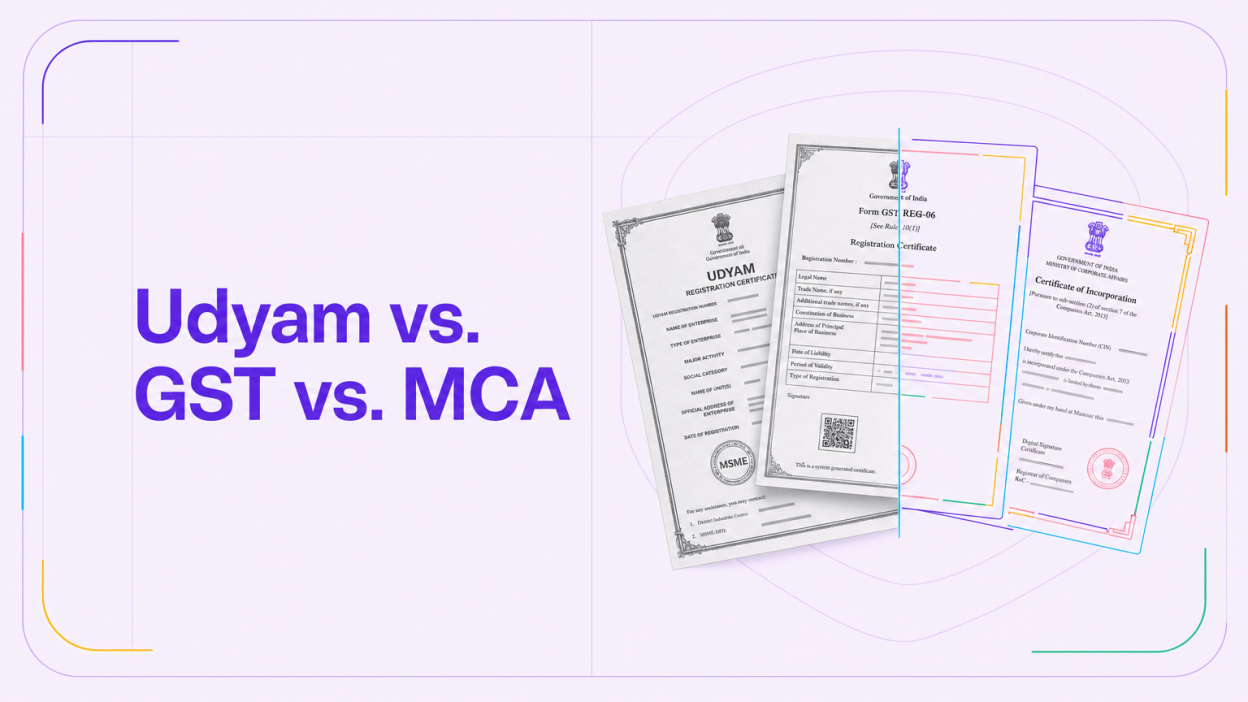
Udyam vs. GST vs. MCA comes down to purpose. Udyam registration certifies a business as a micro, small, or medium enterprise under the MSMED Act, 2006. GST registration makes it a taxpayer under the CGST Act, 2017. MCA registration creates a company or LLP as a legal entity. Neither of them alone proves a business is real and trading.
Founders ask the Udyam vs GST question when they start: which do I need, and is Udyam mandatory if I already have GST? Credit and onboarding teams ask a harder version: when a borrower shows me one of these certificates, what has actually been proven?
This guide answers both: one comparison table for the searcher, then how lenders and payment aggregators combine the three to separate operating businesses from paper ones.
Udyam, GST and MCA in One Paragraph Each
Udyam registration
Udyam is the MSME registration run by the Ministry of Micro, Small and Medium Enterprises under the MSMED Act, 2006. It is free, paperless, and based on self-declaration, with PAN validation and investment and turnover data drawn from income tax and GST records. It issues a permanent Udyam Registration Number (URN).
As of a PIB release dated 14 July 2026, more than 8.9 crore enterprises had registered across the Udyam Registration Portal and the Udyam Assist Platform. Udyam Assist lets informal micro enterprises without GST or income tax records get recognised through authorised partners such as banks and NBFCs.
GST registration
GST registration is issued under the CGST Act, 2017 and state GST laws through the GST portal. The 15-character GSTIN embeds the state code and the business PAN. Registration is required once aggregate turnover crosses the threshold, and in several cases (inter-state supply, e-commerce sellers, reverse charge) regardless of turnover.
MCA registration
MCA registration means incorporation with the Registrar of Companies under the Companies Act, 2013, or the LLP Act, 2008. It creates a separate legal person with a CIN or LLPIN, with filings on the MCA21 V3 portal. Proprietorships and most partnership firms never appear on MCA.
Udyam vs GST vs MCA: The Side-by-Side Comparison
| Attribute | Udyam | GST | MCA (company or LLP) |
|---|---|---|---|
| Issuing authority | Ministry of MSME | GSTN, with central and state tax administrations | Ministry of Corporate Affairs, Registrar of Companies |
| Legal basis | MSMED Act, 2006 | CGST Act, 2017 and SGST/IGST Acts | Companies Act, 2013; LLP Act, 2008 |
| Who must register | Voluntary; needed to claim MSME benefits | Turnover above threshold, or mandatory categories | Anyone choosing a company or LLP structure |
| Identifier | Udyam Registration Number | 15-character GSTIN | CIN or LLPIN |
| What it proves | Self-declared MSME category | Registered taxpayer at a principal place of business | Legal existence, directors or partners, capital |
| Primary verification source | Udyam portal | GST portal taxpayer search, filing history | MCA21 V3 master data, filings |
| Government fee | Free | Free | Statutory fees and stamp duty apply |
| Validity | Permanent; category updates annually from ITR and GST data | Until cancelled or surrendered (casual taxpayers: limited period) | Until struck off, wound up or dissolved |
| Status that matters | Category and date of registration | Active, suspended or cancelled; return filing | Active, strike-off, under liquidation, annual filings |
Since 1 April 2025, MSME classification uses revised limits notified in March 2025. A micro enterprise is now one with investment up to Rs 2.5 crore and turnover up to Rs 10 crore. Small enterprises go up to Rs 25 crore investment and Rs 100 crore turnover, and medium enterprises up to Rs 125 crore and Rs 500 crore.
On the GST side of the Udyam vs GST question, thresholds have not moved since 1 April 2019. Suppliers of goods register above Rs 40 lakh aggregate turnover in most states (Rs 20 lakh in several special category states). Service providers register above Rs 20 lakh (Rs 10 lakh in special category states).
Is Udyam Registration Mandatory?
No. In the Udyam vs GST split, only GST can be compulsory. Udyam is voluntary under the MSMED Act. What Udyam gives is access: priority sector lending classification, delayed-payment protection under the MSMED Act, credit guarantee schemes, and government procurement preferences.
GST, by contrast, is compulsory once a business crosses the threshold or falls into a mandatory category. MCA registration is compulsory only if the founders choose a company or LLP structure.
Common combinations you will see
- Proprietorship with Udyam and GST, no MCA record: the typical small trader.
- Private limited company with all three.
- Udyam only: service businesses below the GST threshold, or Udyam Assist micro enterprises.
What Each Registration Proves, and What It Does Not
This is where Udyam vs GST vs MCA stops being a founder question and becomes a risk question. In the Udyam vs GST comparison especially, the cheaper registration proves less.
Udyam proves a declaration
Udyam confirms that someone holding a valid PAN declared an enterprise and its activity. Self-declared and free, it is the easiest to obtain, and a fresh certificate says little about whether the business existed last month.
GST proves a tax identity, with a trail
GST registration involves document upload and often place-of-business verification. The filing history matters more: two years of on-time GSTR-1 and GSTR-3B is far stronger evidence of trade than any registration date.
GST can be suspended or cancelled, including for non-filing, so a certificate PDF may already be stale.
MCA proves legal existence and accountability
MCA records show the entity exists, its directors or designated partners, capital, registered office, and whether annual filings are up to date. They establish who is accountable. They do not prove the company has revenue or operations.
Why you triangulate
No single registry answers “is this business real and operating?” Check five dimensions across them:
- Identity: do the GSTIN, CIN, and URN resolve to the same PAN?
- Existence: are the registrations active, and how old?
- Activity: does GST filing history show continuous returns?
- Accountability: do MCA directors match GST promoters and the people you deal with?
- Consistency: do addresses, names, and declared activity agree?
When one breaks, ask before you disburse.
Red Flags Across the Three Registries
These are signals for review, not automatic rejections.
| Red flag | Where it shows | What it may indicate |
|---|---|---|
| Udyam registered days or weeks before the application | Udyam portal | Registration created to meet a lender’s checklist |
| GSTIN cancelled or suspended | GST portal | Non-filing, fake invoicing investigation, or closed business |
| Long gaps in GST return filing | GST filing history | Dormant business or cash-flow stress |
| Company status “Strike Off” or “Under process of striking off” | MCA master data | Entity no longer exists for legal purposes |
| Different addresses on GST, MCA and Udyam with no explanation | All three | Virtual office, or registrations belonging to different businesses |
| Udyam turnover far above GST-reported activity | Udyam and GST | Inconsistent declarations |
Illustrative scenario
An NBFC receives an MSME loan application from a private limited company. Udyam shows “Small” category and the GSTIN is active, but no GST returns have been filed for seven months, and the last MCA annual return is three years old. Each document looks fine alone. Together, they describe a business that may have stopped operating.
Verifying Business Registrations at Scale for Your Business
For a lender, PA, or marketplace onboarding thousands of businesses a month, manual portal checks do not hold up. Screenshots create audit gaps, and reviewers end up checking certificates rather than live status.
A scalable approach:
- Collect identifiers, not PDFs: PAN, GSTIN, CIN or LLPIN, and URN.
- Pull live, timestamped status from each registry through an API.
- Match names and PAN across sources with fuzzy matching.
- Score registration age, filing continuity and status changes, and route red flags to a reviewer.
- Re-check active relationships on a schedule, since GST cancellation or MCA strike-off can happen after onboarding.
Where BeFiSc fits: BizCheck produces a business risk report in about 60 seconds from GST, MCA, Udyam, and digital footprint data, so reviewers see registration status, age, and consistency in one place instead of three portals. It does not replace your credit policy, site visits, or bank statement analysis, and it cannot verify a business that holds none of these registrations. Start with a free BizCheck report on a business you are reviewing.
Key Takeaways
- Udyam vs GST vs MCA is a question of purpose: MSME status, tax identity, and legal existence, respectively.
- In Udyam vs GST terms, Udyam is voluntary and free; GST is compulsory above Rs 40 lakh (goods) or Rs 20 lakh (services) in most states; MCA applies only to companies and LLPs.
- MSME limits were revised from 1 April 2025, with micro enterprises now up to Rs 2.5 crore investment and Rs 10 crore turnover.
- No registration alone proves a business is real and operating. Triangulate identity, existence, activity, accountability, and consistency.
- Re-verify status after onboarding, because GST cancellation and MCA strike-off happen without notice to you.
Frequently Asked Questions
Which registration is best for business verification in India?
None works alone. GST filing history is the best activity signal, MCA is best for legal existence, and Udyam adds declared size. Business verification in India works best when all records are checked together.
Does MCA registration apply to proprietorships?
No. MCA covers companies and LLPs only. Proprietorships and most partnership firms are verified through PAN, GST, Udyam, shop licences, and bank records.
Can a business have Udyam without GST?
Yes. Businesses below the GST threshold, and micro enterprises registered via the Udyam Assist Platform, can hold Udyam recognition without a GSTIN.
Is Udyam registration mandatory if I have GST?
No. Udyam is voluntary. A GST-registered business can operate without it but cannot claim MSME benefits such as delayed-payment protection.
What is the difference between Udyam and GST registration?
Udyam certifies MSME status under the MSMED Act, 2006. GST registration makes a business a taxpayer under the CGST Act, 2017, able to collect GST and claim input tax credit. One is a classification, the other a tax obligation.
Conclusion
For a founder, the Udyam vs GST decision is simple: register for GST when the law requires it, and take Udyam because it is free and opens MSME benefits. MCA registration follows from the choice of structure.
For anyone extending credit, Udyam vs GST vs MCA is a different question. Each registration proves something narrow, and fraudsters know which ones are cheapest to obtain. Treat registrations as data points to reconcile, not certificates to file, and keep checking them for as long as the relationship lasts.
Run a free BizCheck report across GST, MCA, and Udyam