Account aggregator interoperability, announced by RBI on 7 October 2026, will let a customer onboard with one NBFC-AA and share financial information from any Financial Information Provider (FIP) through it. RBI expects implementation by 31 December 2026. For lenders, it should close coverage gaps in AA journeys, though PDF statements and statement fraud checks remain necessary.
The announcement came in RBI’s Statement on Developmental and Regulatory Policies, released alongside the Monetary Policy Committee’s decision to raise the repo rate by 25 basis points to 5.50%. For credit and product teams, the AA item may matter more than the rate move.
The AA framework has grown fast, but a structural gap has kept many loan journeys falling back to uploaded PDFs. This piece explains what RBI decided, why the gap existed, what changes for Financial Information Users (FIUs), and what a lender should prepare before the year-end target.
What RBI announced on 7 October 2026
RBI’s statement (Press Release 2026-2027/1265) carried three items, two of which concern the account aggregator network.
Interoperability among NBFC-AAs
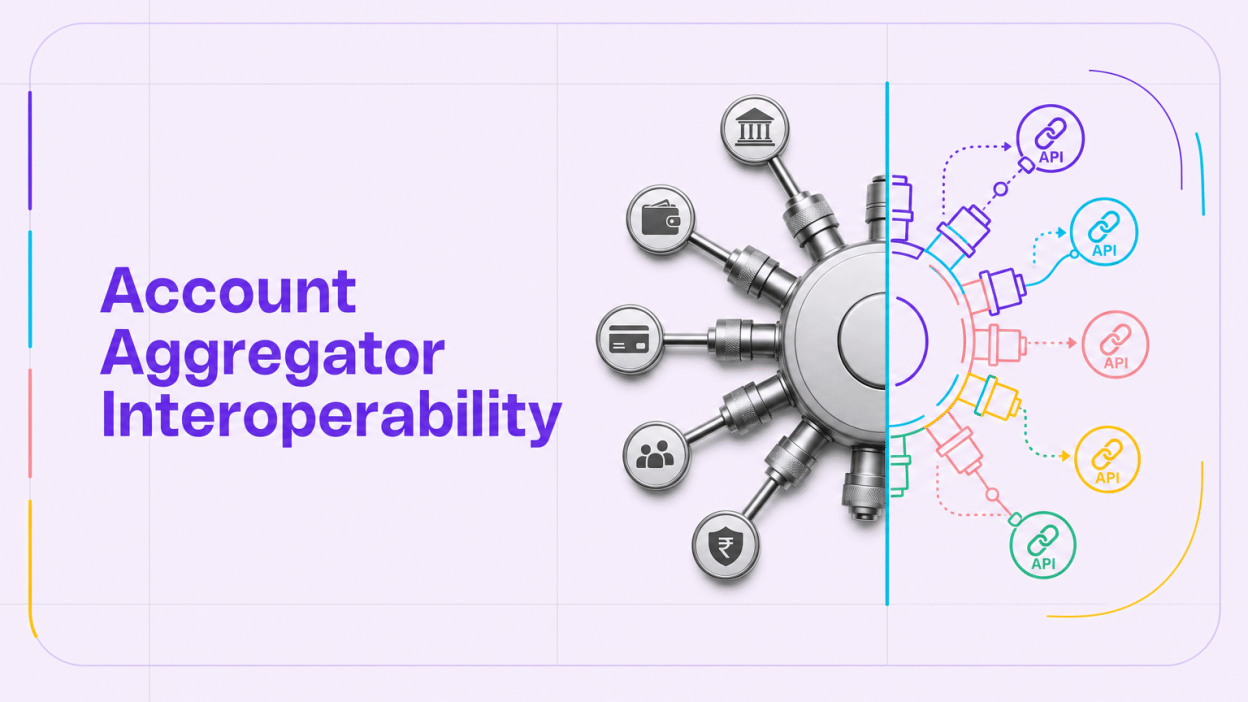
RBI said it has decided to implement interoperability among NBFC-Account Aggregators so that customers can access and share financial information across different FIPs through any NBFC-AA of their choice. Governor Sanjay Malhotra described the outcome as aggregation “through all account aggregators by onboarding on only one account aggregator,” as reported by Business Standard.
Bank deposits in the Consolidated Account Statement
SEBI-regulated depositories (NSDL and CDSL) will be facilitated to include bank deposit account information in the Consolidated Account Statement (CAS), through NBFC-AAs. Demat holders will see securities and bank deposits in one place. Customers without demat accounts can continue to obtain a consolidated view and share it through NBFC-AAs.
The third item, a Technical Consultative Committee for Financial Markets, does not directly affect AA-based lending. Both AA-related measures are expected to be implemented by 31 December 2026. The operative directions had not been published at the time of writing.
Why lenders still faced coverage gaps
The AA framework runs on common technical standards, but FIPs have not been required to integrate with every AA. In practice, a lender partners with one or two AAs, and the borrower’s bank may not be live on those AAs.
Sahamati’s data, cited by Outlook Money, shows the scale of the issue. As of August 2026, 81 of 176 FIPs (46%) worked with three or fewer AAs. Over the same period, the ecosystem recorded 566 million fulfilled consents and 338 million linked accounts. Volume is high, yet reach per AA is uneven.
What the gap looked like in a loan journey
Consider an illustrative case. A small-ticket personal loan app integrates one AA. A salaried applicant banks with a regional bank that is live only on a different AA. Today, the applicant either creates a second AA account or abandons the flow and uploads a PDF statement.
Both outcomes cost the lender: drop-off during a second registration, or slower decisions and higher manipulation risk on a PDF the applicant controls.
MediaNama noted that, under the new arrangement, the second sign-up should not be needed.
How account aggregator interoperability could work
RBI’s statement sets the outcome, not the architecture. Two broad models are being discussed in commentary, and the final directions may combine elements of both.
| Design question | Model A: FIPs connect to all AAs | Model B: AA-to-AA routing |
|---|---|---|
| Who builds new connections | Each FIP integrates with every NBFC-AA | AAs interconnect and relay requests to the AA that holds the FIP link |
| Load on FIPs | High: more integrations to maintain | Lower: existing FIP links reused |
| Consent handling | Consent raised and fulfilled within one AA | Consent may pass across two AAs; responsibility must be defined |
| Latency and failure points | Fewer hops | More hops, more points of failure |
| Commercial terms | FIP-AA contracts multiply | Inter-AA settlement needed |
Vinod Kothari Consultants, writing on 7 October 2026, flagged technical standards, allocation of responsibility among participants, and the economics of cross-aggregator requests as the issues that will decide whether the promise holds. MediaNama raised a similar question: will FIPs have to connect to all AAs, or will AAs interconnect with each other?
For a lender, the model matters less than fetch success rate, time to data, and clear accountability when a fetch fails.
What changes for lenders and FIUs
Here is what is likely to shift once interoperability is live.
Coverage stops depending on your AA partner
If customers can reach any FIP through your AA, choosing an AA becomes a question of service quality, pricing, and uptime rather than network reach.
Consent journeys get shorter
Fewer applicants should be asked to register twice. Expect higher AA completion rates in segments where regional banks, co-operative banks and small finance banks were poorly covered.
Data volume rises, and so does responsibility
More AA data means more FI data stored and retained. Teams should check that downstream use, such as model training or cross-sell, stays within the consented purpose and the DPDP Act, 2023.
Why PDF statements and fraud checks still matter
Interoperability improves reach. It does not make the PDF route obsolete before 31 December 2026, and probably not after.
- Not every borrower will consent to AA sharing, especially first-time or older customers.
- Some FIPs, accounts or account types may not be live or may return incomplete data in the early months.
- Business borrowers often bank with several institutions and produce statements for periods outside an AA fetch window.
- AA fetch failures and timeouts will not disappear on day one.
The PDF route carries known risks such as edited balances and inserted salary credits. Lenders should apply metadata and structural checks, as described in our guide.
Even AA data needs analysis. AA data is sourced from the FIP, which reduces document tampering risk, but it does not stop round-tripping between related accounts, salary credits from shell employers, or loan stacking. Those are behavioural signals, and they need the same analysis as any statement.
What lenders should do before 31 December 2026
Treat the next 12 weeks as preparation, not migration.
- Baseline your AA funnel. Measure consent approval, fetch success, and data completeness by FIP.
- Map PDF fallback volume by bank. That is where interoperability should show impact first.
- Review AA contracts. Check exclusivity, pricing per fetch, and SLAs.
- Revisit consent templates. Confirm purpose codes, data ranges, and fetch frequency match actual use, including periodic monitoring.
- Normalise data from both routes. AA JSON and parsed PDFs should land in one schema.
- Keep statement fraud controls on. Do not relax PDF checks because AA volume rises; fraudsters move to the route with weaker controls.
- Assign an owner for the RBI directions, to map them against your journeys within days of issue.
Where BeFiSc fits: Finnalyzer is BeFiSc’s bank statement analysis product. It parses 100+ statement formats and returns income, obligations, balance behaviour, and risk signals that credit teams can use in underwriting, which keeps the PDF fallback route fast and consistent. Finnalyzer is not an account aggregator or FIU platform and does not raise or manage AA consents. Whether it can ingest AA-fetched data directly should be confirmed with BeFiSc for your integration.
Open questions to track
Several points remain open until RBI issues directions:
- Existing handles and consents: MediaNama noted the release does not say whether existing AA handles and consents carry over.
- Liability: Who answers for a failed or delayed fetch when two AAs are involved.
- Pricing: Who pays for cross-AA requests, and whether costs pass to FIUs.
- CAS access for FIUs: Whether CAS with bank deposits becomes usable for lending.
- Data protection alignment: How consent artefacts map to DPDP Act notice and consent obligations.
Sahamati CEO BG Mahesh framed the change as one that “strengthens consumer choice and agency, which are foundational to the Account Aggregator framework,” and compared it to the choice UPI gives across apps. Lenders should plan for that choice to become real, while preparing for an uneven rollout.
Key Takeaways
- RBI announced account aggregator interoperability on 7 October 2026, with implementation expected by 31 December 2026.
- Customers will be able to reach data at any FIP through one NBFC-AA, addressing a gap where 46% of FIPs worked with three or fewer AAs (Sahamati, August 2026).
- Bank deposit information will be added to depository CAS through NBFC-AAs, including a consolidated view for customers without demat accounts.
- The operative directions, architecture, liability and pricing are still open.
- PDF statements will remain a needed fallback, so statement fraud checks and consistent analysis must stay in place.
- Lenders should baseline AA funnels and unify AA and PDF data into one schema now.
Frequently Asked Questions
Does AA data remove the need for bank statement analysis?
No. AA data reduces document tampering risk because it comes from the FIP, but lenders still need to read income stability, obligations, bounces, circular transactions and related-party flows. Those signals require analysis regardless of the data route.
Do lenders still need PDF bank statements after interoperability?
Yes. Some customers will not consent to AA sharing, some FIPs or account types may be incomplete early on, and AA fetches can fail. A PDF route with tamper checks and consistent analysis remains part of a resilient underwriting flow.
When will account aggregator interoperability take effect?
RBI said both AA-related measures are expected to be implemented by 31 December 2026. The operative directions had not been issued at the time of writing, so lenders should watch for RBI’s notification and Sahamati’s technical guidance.
What is account aggregator interoperability?
It is the ability of a customer to access and share financial information held at any FIP through any NBFC-AA of their choice. RBI announced it on 7 October 2026. A customer will no longer need to register with a second AA simply because their bank is not live on the first.
Conclusion
Account aggregator interoperability addresses the most practical complaint lenders have had about AA journeys: the borrower’s bank was often on the wrong network. If RBI’s 31 December 2026 target holds, more applicants will complete AA consent on the first attempt, and the choice of AA will turn on service quality.
The change does not remove the need for disciplined statement analysis. Lenders that baseline their funnels now, unify AA and PDF data, and keep fraud controls on the fallback route will be able to measure the benefit and avoid shifting risk into the channel that remains weakest.