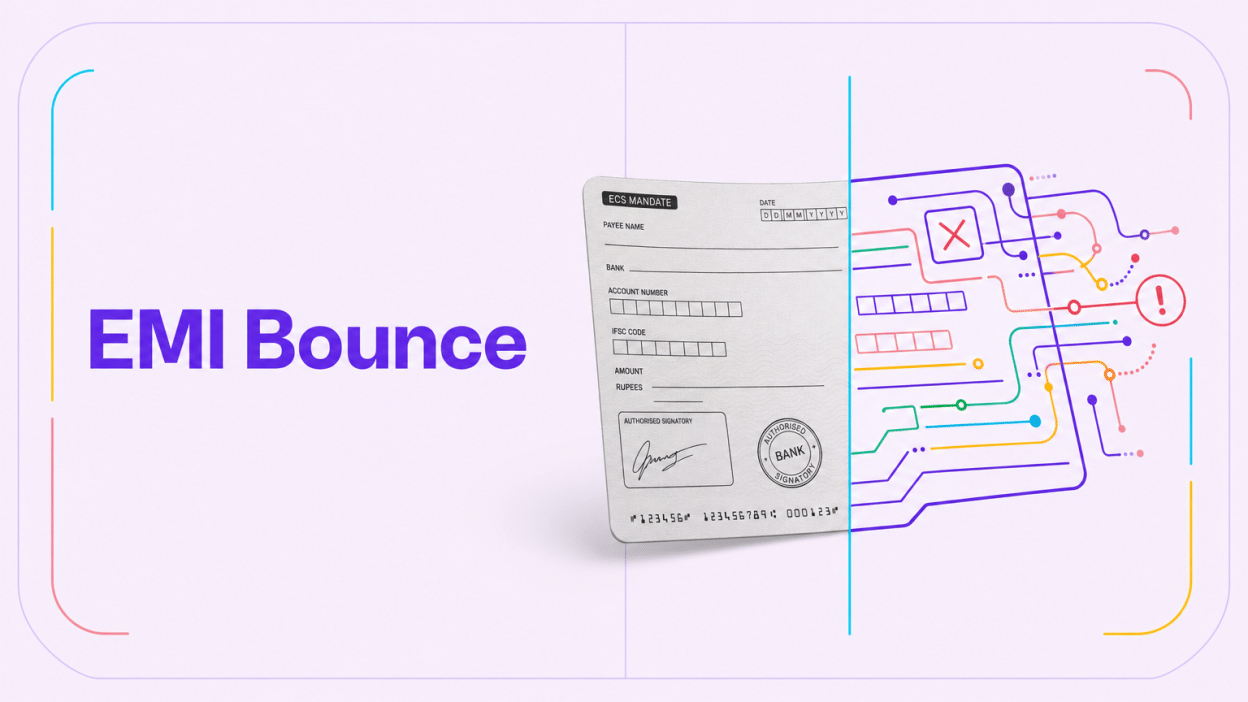
An EMI bounce happens when a scheduled loan instalment, collected through a NACH or ECS mandate or a post-dated cheque, is returned unpaid by the borrower’s bank. The most common reason is insufficient balance, but closed accounts, frozen accounts and cancelled mandates also trigger returns.
For a borrower, one bounce means a charge, a reminder call and possibly a mark on the credit report. For a lender, the same event is a data point, and a pattern of them is one of the clearest early signals of stress.
This guide covers both sides. It explains return reasons and the rules that govern charges and legal action, then shows how credit teams read EMI bounce patterns in bank statements during underwriting.
How an EMI Bounce Happens
Most retail and MSME loans in India are repaid through an auto-debit mandate registered on NACH, the National Automated Clearing House operated by NPCI. On the due date, the lender’s sponsor bank presents a debit to the borrower’s bank.
If the borrower’s bank cannot honour it, the debit is returned with a reason code. The lender sees a failed collection; the borrower sees a reversed or failed debit, often followed by a return charge from their own bank.
Cheque-based repayment works similarly. A post-dated cheque presented for clearing that comes back unpaid is a cheque bounce, and it carries a separate statutory consequence.
Common NACH Return Reasons
NPCI’s NACH system uses numeric return codes. Payment providers that document the NACH debit flow list, among others:
| Code | Reason | What it usually signals |
|---|---|---|
| 01 | Account closed | Borrower moved banks without updating the mandate |
| 02 | No such account | Account details invalid or closed without mandate cancellation |
| 04 | Balance insufficient | Liquidity shortfall on the due date |
| 05 | Not arranged for | Account not in good standing |
| 08 | Mandate not received | Mandate status issue at the destination bank |
| 11 | Invalid IFSC/MICR | Branch closed or merged |
| 68 | Account frozen or blocked | Regulatory, legal, or fraud-related freeze |
Code 04 is the one that matters most for credit. It reflects cash shortfall, while several of the others reflect administrative issues that a lender can fix with a new mandate.
What Happens After an EMI Bounce
Penal charges, not penal interest
RBI’s circular “Fair Lending Practice – Penal Charges in Loan Accounts”, dated 18 August 2023 and effective 1 January 2024, changed how lenders can penalise defaults. Penalties for breaching material loan terms must be levied as “penal charges”, not as penal interest added to the rate.
The circular also says penal charges must be reasonable, must not be capitalised, must follow a board-approved policy, and must be disclosed in the loan agreement and key fact statement. Borrowers must be told the charge and the reason when it is levied.
These instructions now sit in RBI’s entity-specific Responsible Business Conduct Directions, 2025, issued on 28 November 2025. The NBFC version (RBI/DOR/2025-26/362) carries the same rule: penal charges “shall not be levied in the form of ‘penal interest’”. Compliance teams should map policies to the new paragraph numbers.
The borrower may also pay a separate return charge to their own bank. That fee is set by the bank, not the lender.
Credit bureau reporting
A missed EMI shows up as days past due in the lender’s next submission to credit information companies. Since 1 January 2025, RBI requires credit institutions to report credit information fortnightly, as of the 15th and the last day of each month, within seven calendar days (RBI/2024-25/60). A short delay now reaches the bureau faster than under monthly reporting.
Legal exposure
Two statutes create criminal liability for dishonoured payments:
- Section 138 of the Negotiable Instruments Act, 1881 covers cheques. Punishment can extend to two years’ imprisonment, a fine up to twice the cheque amount, or both. The payee must send written notice within 30 days of learning of the dishonour, and the drawer has 15 days to pay.
- Section 25 of the Payment and Settlement Systems Act, 2007 covers electronic funds transfers dishonoured for insufficient funds. It follows a similar notice-and-payment structure and carries comparable penalties.
In practice, lenders use these provisions selectively. A single EMI bounce caused by a timing mismatch rarely leads to prosecution, but repeated defaults on mandates or cheques can.
Reading EMI Bounces in Bank Statements at Scale
For an underwriter, the question is not whether an applicant has ever missed a payment. It is whether their bank statement shows a pattern that predicts missed payments on a new loan. Our guide covers the wider framework; bounce analysis is one of its sharpest tools.
Inward vs outward returns
An inward return is a debit initiated against the applicant’s account that failed, such as an EMI, SIP, or utility mandate. It indicates the applicant could not pay.
An outward return is a cheque or instrument the applicant deposited that bounced. It suggests the applicant’s own customers or counterparties are weak. For MSME borrowers, frequent outward returns can be as telling as inward ones.
Frequency, recency and cure
Three questions sharpen the signal:
- How many returns in the last three and six months?
- How recent is the latest one?
- Was each bounce cured, meaning the same amount was paid within a few days?
A bounce-then-cure pattern where every return is followed by a successful re-presentation suggests timing problems rather than insolvency. Repeated uncured returns indicate deeper stress.
Hidden EMIs to other lenders
Statements often reveal EMIs and NACH debits to lenders the applicant did not declare, including small-ticket app lenders. These obligations rarely appear prominently in a quick review and are among the. Missing them understates FOIR and overstates repayment capacity.
Where BeFiSc fits: Finnalyzer converts bank statements in more than 100 Indian formats into structured, categorised transactions. Credit teams can then run rules for returns, recurring EMIs and undeclared obligations across every file instead of scanning PDFs by hand. A Finnalyzer trial lets you test this on your own applicant statements.
Statement Narration Patterns
Banks describe returns differently, which is why manual review misses them. The patterns below are illustrative and vary by bank.
| Illustrative narration | Likely meaning | Direction |
|---|---|---|
| ACH DR RTN / NACH RETURN followed by lender name | EMI mandate debit returned | Inward |
| RETURN CHG / ACH RTN CHGS with GST | Bank’s return charge after a failed debit | Inward |
| ECS RTN followed by reference number | Older ECS debit returned | Inward |
| CHQ RTN / I/W CHQ RET with reason | Cheque issued by applicant bounced | Inward |
| O/W CHQ RET / DEP CHQ RETURNED | Cheque deposited by applicant bounced | Outward |
| NACH DR to unfamiliar NBFC or app name | Undeclared loan obligation | Debit (not a return) |
The return charge line is often easier to spot than the return itself, because charges recur with similar amounts and GST. Rules should search for both.
Underwriting Rules That Use Bounce Data
Policies differ by product, but common rules include:
- Decline or refer applicants with uncured inward returns in the last 30 to 60 days.
- Count inward returns over six months and set a hard threshold by product risk.
- Treat cured, timing-related returns more leniently than uncured ones.
- Flag outward returns above a set share of credits for MSME applicants.
- Add all detected EMIs to the obligation total before computing FOIR.
- Refer files where returns cluster just before the application date.
Bounce data also supports fraud checks. Statements with zero returns but other anomalies, such as uniform fonts or round-number balances, may be edited. Pair statement analysis with tamper checks, especially in prone journeys.
Manual review rarely scales beyond a few files a day. Automating parsing with a makes these rules consistent; our comparison of the covers selection criteria.
Key Takeaways
- An EMI bounce is a mandate debit, or cheque returned unpaid; code 04, balance insufficient, is the clearest credit signal.
- RBI rules require penal charges, not penal interest, with board-approved policy and disclosure; these now sit in the 2025 Responsible Business Conduct Directions.
- Fortnightly bureau reporting since January 2025 means missed EMIs reach credit reports faster.
- Underwriters should separate inward from outward returns and weigh frequency, recency and cure.
- Undeclared EMIs found in statements change FOIR and should feed directly into limit decisions.
Frequently Asked Questions
How do lenders spot bounces in bank statements?
They look for return narrations, return charges and failed mandate debits, then measure frequency, recency and whether each was cured.
Is an EMI bounce a criminal offence?
A dishonoured cheque can attract Section 138 of the Negotiable Instruments Act, and a dishonoured electronic debit can attract Section 25 of the Payment and Settlement Systems Act, subject to notice and other conditions.
Does one EMI bounce affect my credit score?
A missed instalment is reported as days past due in the lender’s next bureau submission. Paying quickly limits the impact, but the record can still appear.
What are the RBI guidelines for EMI bounce charges?
RBI requires lenders to levy penalties as reasonable penal charges, not penal interest, without capitalising them, under a board-approved policy disclosed in the loan agreement and key fact statement. Your bank may charge a separate return fee
What is an EMI bounce?
It is a scheduled loan instalment that the borrower’s bank returns unpaid, usually because of insufficient balance. It can occur through a NACH or ECS mandate or a cheque.
Conclusion
An EMI bounce is a small event with a long trail: a charge, a bureau entry, sometimes a legal notice, and a permanent line in the bank statement. For lenders, that trail is valuable evidence that is too often read inconsistently.
The institutions that price risk well treat bounce analysis as a structured rule set, not an analyst’s impression. With statements parsed and categorised automatically, every file gets the same scrutiny, and early stress shows up before the first instalment on the new loan.