
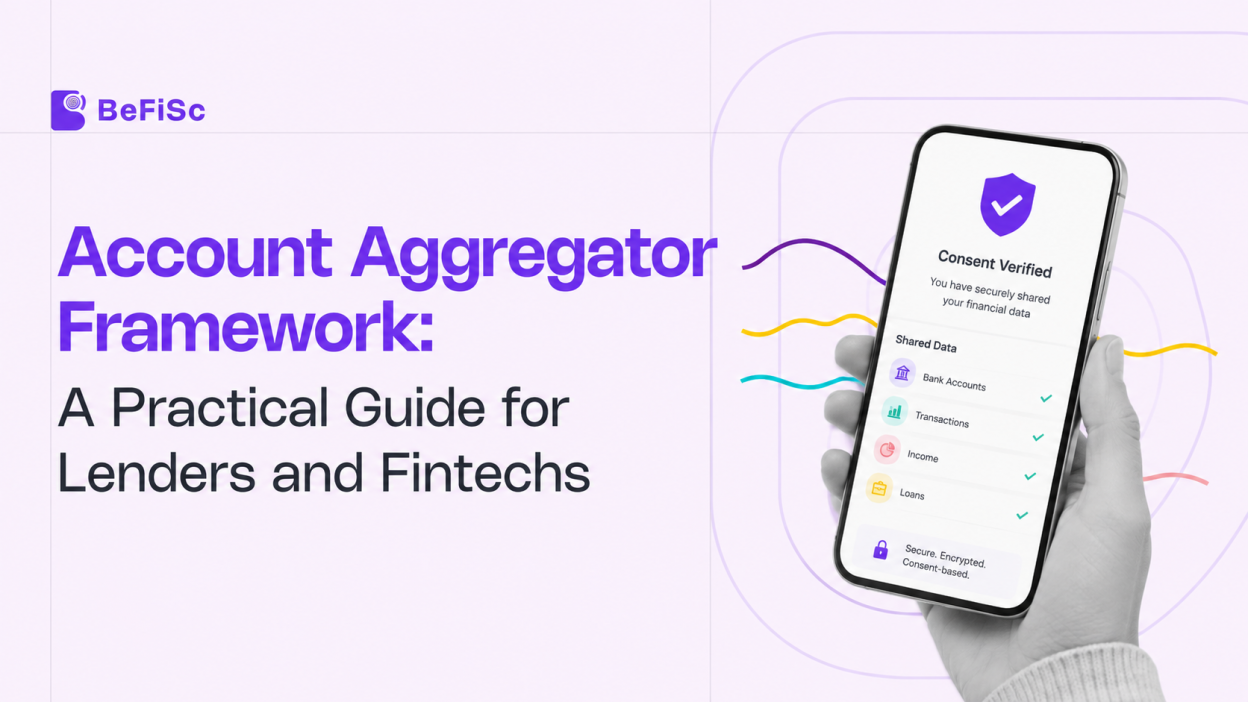
For decades, proving income in India meant emailing bank statement PDFs documents that are slow to collect, painful to parse, and easy to forge. The account aggregator framework replaces that entire pattern with a consent-driven data pipe: the customer approves a request, and verified financial data flows from their bank to the lender through an RBI-licensed intermediary, digitally signed at the source.
Adoption has crossed the tipping point. Hundreds of banks, NBFCs, and financial institutions are live on the network, and cumulative consents have run into the hundreds of millions. Yet many lending teams still understand the account aggregator framework only as a buzzword. This guide explains the architecture, the consent mechanics, the practical lending use cases, and the failure modes that determine whether an AA integration actually performs.
What Is the Account Aggregator Framework?
The account aggregator framework is India’s regulated system for consent-based sharing of financial data. It was created by the RBI through the NBFC-Account Aggregator Master Directions (2016) and operationalised in 2021, built on the DEPA (Data Empowerment and Protection Architecture) model and technical standards published by ReBIT.
At its core sits a new class of RBI-licensed entity: the Account Aggregator (NBFC-AA). An AA does one job: it moves encrypted financial data from institutions that hold it to institutions that need it, strictly on the customer’s digital consent. The AA cannot read, store, or sell the data it transports. It is a consent manager and a pipe, deliberately “data-blind.”
The framework’s scope started with bank deposit accounts and has been expanding across the financial system securities, insurance, pensions, and GST data under a cross-regulator design involving the RBI, SEBI, IRDAI, and PFRDA. Sahamati, the industry alliance, coordinates ecosystem standards and onboarding.
The Three Roles: FIP, AA, and FIU
Every transaction in the account aggregator framework involves three parties, and the vocabulary matters because contracts, certifications, and integrations are organised around it.
The FIP (Financial Information Provider) holds the customer’s data typically a bank, but also insurers, depositories, and mutual fund RTAs. When valid consent arrives, the FIP packages the requested data, signs it, encrypts it, and ships it.
The AA (Account Aggregator) manages the customer’s consent and relays the encrypted payload. The customer holds an AA handle (similar in spirit to a UPI ID) through an AA app of their choice, where they can view, approve, pause, and revoke consents.
The FIU (Financial Information User) consumes the data: a lender underwriting a loan, a PFM app building a dashboard, a wealth platform assessing suitability. FIUs must be regulated entities and must handle received data per the consent’s terms.
The separation is the framework’s trust design. The FIP never learns the FIU’s underwriting logic. The FIU never touches bank credentials. And the AA, which sees everything, reads nothing.
How the Consent Artefact Works
The consent artefact is the legal and technical heart of the account aggregator framework. It is a machine-readable, digitally signed object specifying exactly what the customer agreed to.
A consent artefact defines, among other fields: the data types requested (for example, deposit account statements), the accounts covered, the date range of data, the purpose code, whether access is one-time or recurring, the frequency of recurring fetches, and the consent’s expiry.
Three properties make it more than a checkbox.
It is granular. A lender can request twelve months of statements from one account for the stated purpose of loan underwriting and nothing more travels.
It is revocable. The customer can revoke consent from their AA app at any time, and recurring fetches stop.
It is auditable. Every consent, fetch, and delivery is logged with signatures across the chain. When the DPDP Act asks a lender to prove a lawful basis for the financial data it holds, an AA consent artefact is close to the strongest evidence available a synergy we explored in our analysis of [DPDP obligations for fintechs]
For lenders, the operational implication is that consent design is product design. Over-broad requests depress approval rates; well-scoped requests convert.
What the Account Aggregator Framework Means for Lending
Lending is the framework’s flagship use case, and the impact lands in four places.
Income and cash-flow verification. Instead of collecting PDFs, the lender fetches source-signed statement data and runs it through analysis directly through the workflow our [bank statement analysis API guide]describes, now fed by a tamper-proof channel.
Cash-flow-based underwriting. Reliable transaction data at scale enables lending decisions built on cash-flow patterns rather than collateral or bureau history alone. For thin-file and self-employed borrowers, this is often the difference between a decision and a rejection a gap we examined in [credit risk assessment signals lenders miss]
Monitoring through recurring consent. A lender with recurring-fetch consent can monitor a borrower’s account health across the loan tenure, spotting stress early instead of at default.
Cost and speed. AA fetches completely in seconds and costs a fraction of manual statement operations, compressing loan turnaround times from days to minutes for data-ready customers.
The RBI’s digital lending framework reinforces the direction: regulated, consent-based data flows are the compliant path, while scraping and credential-sharing patterns face increasing hostility.
AA Data vs Uploaded Bank Statements: The Fraud Difference
The account aggregator framework changes the fraud equation in a way that underwriting teams should internalise.
An uploaded bank statement is an image of a claim. It can be edited, fabricated from templates, or assembled from screenshots the risk class we dissected in [why screenshot PDFs are a compliance nightmare] and our work on first-party fraud. Detection depends on forensic analysis and is probabilistic.
AA-delivered data is signed at source by the FIP and encrypted end-to-end. The borrower never touches the payload, so there is nothing to edit. Statement fraud does not become harder; it becomes structurally impossible on that channel.
The honest caveat: AA data authenticates the account’s contents, not the borrower’s intent. Mule-fed accounts, circular transactions staged to inflate income, and coordinated first-party fraud remain live threats that need behavioural analysis on top of authentic data. Authenticity moves the battle; it does not end it.
Implementation Realities: Coverage, Drop-offs, and Data Quality
Four realities separate AA integrations that perform from those that stall.
FIP coverage and reliability. Not every bank is live, and among live FIPs, response reliability varies. Production systems track FIP-level success rates and route around weak providers, with a statement-upload fallback for uncovered accounts.
Consent-journey drop-off. The customer must discover their AA handle (or create one), locate their accounts, and approve the request. Each step leaks conversion. In-flow education, sensible defaults, and requesting the minimum viable scope measurably improve completion.
Data quality variance. FIPs differ in how they populate transaction narrations and balances. Your analysis layer needs normalisation logic per FIP quirk, or downstream models will misread perfectly authentic data.
Consent lifecycle operations. Recurring consents expire, get revoked, and need renewal journeys. Treat the consent state as a monitored operational domain because a fetch against an expired consent is not a bug; it is a compliance incident.
Key Takeaways
- The account aggregator framework is RBI-regulated, consent-based financial data sharing built on DEPA with data-blind NBFC-AAs as the transport layer.
- FIPs hold data, FIUs consume it, AAs manage consent, and the consent artefact defines scope, purpose, duration, and revocability in signed, auditable form.
- For lenders, the framework enables tamper-proof statement fetches, cash-flow underwriting, and tenure-long monitoring at a fraction of manual cost.
- AA data eliminates statement forgery on its channel, but behavioural fraud, staged transactions, mule funding, and intentional default still require dedicated detection.
- Performance depends on operations: FIP-level routing, consent-journey UX, per-FIP data normalisation, and disciplined consent-lifecycle management.
Frequently Asked Questions
Can a customer revoke consent under the account aggregator framework?
Yes. Revocability is central to the account aggregator framework: the customer can pause or revoke any consent from their AA app, after which recurring data fetches must stop. FIUs need operational processes to handle revocation events cleanly.
How does the account aggregator framework help digital lending?
Lenders use the account aggregator framework to fetch verified bank statements in seconds, underwrite on real cash flows, and monitor borrower accounts through recurring consent. This cuts turnaround time, cost, and statement-fraud exposure simultaneously.
What is the account aggregator framework?
The account aggregator framework is India’s RBI-regulated system for sharing financial data with customer consent. Licensed NBFC-AAs transport encrypted, source-signed data from financial information providers (FIPs) to financial information users (FIUs) based on a digital consent artefact.
Who can use the account aggregator framework to fetch data?
Only regulated financial information users such as banks, NBFCs, insurers, and SEBI-regulated entities can receive data through the account aggregator framework, and only for the purpose, scope, and duration specified in the customer’s consent artefact.
Is data shared through the account aggregator framework safe?
Yes, by design. Data in the account aggregator framework is encrypted end-to-end and digitally signed by the source institution. The AA itself cannot read the payload, and every consent and fetch is logged for audit.
Conclusion
The account aggregator framework is best understood not as a data product but as a change in who controls financial information. Data now moves because the customer says so signed, scoped, and revocable and institutions compete on what they do with it rather than on how they extract it.
For lenders, the strategic question has moved past “should we integrate?” to “how good is our consent UX, our FIP routing, and our cash-flow analytics?” As the framework absorbs more data types and the DPDP Act raises the price of unconsented data, AA-native institutions will underwrite faster, monitor deeper, and defend their data practices more easily than anyone still asking for PDFs.
[…] implementation, through the consent-centric and privacy-conscious Account Aggregator framework, is among the world’s most distinctive, embedding user-controlled data sharing into the […]