A used-car loan against a vehicle the borrower does not own. A logistics fleet onboarding a truck whose registration lapsed two years ago. An insurance policy issued on a car already hypothecated to another lender. Each of these failures begins the same way: someone accepted a photocopy of a registration certificate at face value.
The registration certificate (RC) is the anchor document of vehicle ownership in India, and it is also one of the most casually forged. A vehicle RC verification API replaces document trust with source truth, pulling the vehicle’s live record from the national VAHAN registry in real time. This guide explains what the API returns, who depends on it, the fraud patterns it defeats, and how to build it into underwriting and onboarding flows.
What Is a Vehicle RC Verification API?
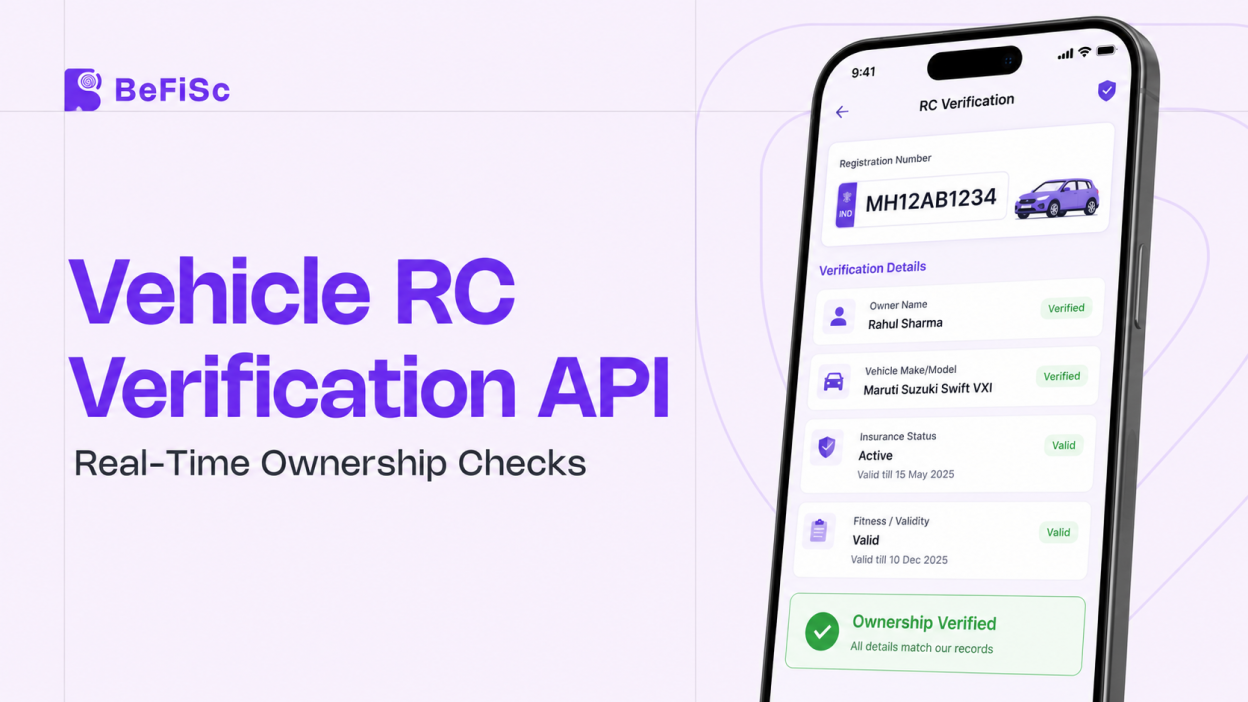
A vehicle RC verification API validates a vehicle’s registration details against government transport records in the VAHAN database maintained under the Ministry of Road Transport and Highways, aggregating registrations from RTOs nationwide. The caller submits a registration number (and, in some variants, a chassis number), and the API returns the vehicle’s official record.
The shift is from inspecting a document to querying the source. A photocopied RC proves only that a document exists; the API response proves what the government’s record says today: current owner, registration validity, hypothecation status, and the vehicle’s technical identity.
Timeliness is part of the value. Ownership transfers, loan closures, and fitness renewals update the registry; a document photographed last year says nothing about any of them. For any decision where the vehicle is collateral, cargo carrier, or insured asset, the live record is the only defensible basis.
What the API Returns: Fields That Matter
A typical vehicle RC verification API response carries four clusters of fields.
Ownership and registration. Registered owner name, registration number, registration date and validity, RTO of registration, and the owner’s serial number, which reveals how many hands the vehicle has passed through.
Vehicle identity. Chassis number and engine number, the immutable identifiers that bind the record to a physical machine. Maker, model, vehicle class, fuel type, and manufacturing year complete the profile.
Encumbrance. Hypothecation or lease status and the financier’s name, where the vehicle secures a loan the single most consequential field for lenders, addressed in its own section below.
Compliance status. Fitness certificate validity, insurance validity as recorded, tax status, and permit details for commercial vehicles.
Two verification moves multiply the response’s power. First, name-match the registered owner against the applicant using fuzzy logic, the discipline from our API guide. Second, for high-stakes cases, physically match the chassis number on the vehicle against the record, closing the loop between the database and the machine.
Who Uses RC Verification: Five Use Cases
Vehicle and used-car lenders. Before financing a vehicle purchase or a loan against a vehicle, the lender confirms ownership, checks existing hypothecation, and validates the asset’s identity and age inputs that flow straight into loan-to-value and title decisions.
Insurers. At policy issuance and claims, RC verification confirms the insured vehicle exists as described, is registered to the proposer, and matches the claimed specifications, cutting both mispriced policies and staged-claim exposure.
Used-vehicle marketplaces. Platforms listing vehicles verify RC details at listing time, filtering stolen, misdescribed, or encumbered inventory before buyers ever see it the same trust-at-source posture we advocate for merchant onboarding fraud .
Logistics and mobility platforms. Fleet onboarding pairs the driver with RC verification for the vehicle: valid registration, commercial permit where required, and fitness.
Corporate fleet and leasing operations. Lessors and fleet managers verify assets at intake and audit encumbrance status across portfolios periodically.
The Fraud Patterns RC Verification Defeats
Four patterns account for most vehicle-linked fraud, and the API addresses each structurally.
Forged or doctored RCs. Templates for RC smart cards circulate freely; a forged card supporting a loan application is a commodity attack. Source verification makes the forgery irrelevant; the record either matches or it does not.
Ownership misrepresentation. The applicant presents a genuine RC for a vehicle they do not own. Matching the owner’s name against the applicant’s verified identity closes this, subject to legitimate transfer-lag windows discussed below.
Double financing. A vehicle already hypothecated is offered as fresh collateral to a second lender. The hypothecation field exposes the existing charge instantly.
Identity swapping. A record for one vehicle supports a transaction involving another the classic cloned-plate or salvage-rebirth pattern. Chassis and engine numbers in the response, checked against the physical asset, break the swap.
None of this replaces behavioural fraud controls; a legitimate vehicle can still anchor a first-party fraud application. The API removes the asset-identity layer of the attack surface, so investigation effort concentrates on intent consistent with the layered posture in our digital lending fraud analysis.
Hypothecation: The Field Lenders Cannot Skip
Hypothecation deserves separate treatment because it is where the most expensive mistakes concentrate.
When a vehicle secures a loan, the financier’s charge is endorsed on the registration record. A vehicle RC verification API surfaces that endorsement and the financier’s name. Three operational rules follow.
Check at origination, always. An existing hypothecation on a vehicle offered as collateral means the equity backing your loan may not exist. Every vehicle-secured credit decision needs this field in its policy, not in an analyst’s habit.
Verify termination, not promises. Borrowers refinancing will assert that the prior loan is closed. The record’s hypothecation status after the prior lender’s termination filing is the fact; the assertion is not.
Re-check at portfolio events. Top-ups, restructures, and repossession actions warrant a fresh pull because the record can change over a loan’s life.
The registry reflects filings, and filings lag reality. A closed loan may show hypothecated until the termination is processed. Build a review path for these windows rather than hard-declining, and document the evidence you accepted.
Integration Patterns and Edge Cases
Four practices make RC verification production-grade.
Verify at the decision point. Call the API where the result changes the outcome: underwriting, listing approval, claim admission, and store the full response with a timestamp as decision evidence.
Handle registry lag gracefully. Recent ownership transfers and loan closures take time to reflect. Define documented exception paths (transfer application receipts, lender NOCs) with expiry windows, so lag neither blocks legitimate business nor becomes a permanent bypass.
Combine with OCR for document-first flows. Where the journey starts with an RC image, [OCR extraction] reads the registration number, and the API verifies it; the document becomes an input, never the evidence.
Respect the data’s purpose. Vehicle records contain personal data (owner names, linkage to addresses via RTO records). Pull them for the stated verification purpose and retain them under policy, in line with DPDP obligations.
Key Takeaways
- A vehicle RC verification API validates ownership, registration, identity, and encumbrance against live VAHAN records instead of trusting documents.
- The response’s power multiplies when paired with owner name matching and, for high-stakes cases, physical chassis verification.
- Lenders, insurers, marketplaces, and fleet platforms use it to defeat forged RCs, ownership misrepresentation, double financing, and identity swaps.
- Hypothecation status is the non-negotiable field for any vehicle secured lending decision checked at origination, closure, and portfolio events.
- Build for registry lag with documented exception paths, and store timestamped responses as decision evidence.
Frequently Asked Questions
What are the limitations of a vehicle RC verification API?
Registry updates lag real events: recent ownership transfers and loan closures may not yet be reflected. A vehicle RC verification API also cannot judge intent; a genuine vehicle can still anchor a fraudulent application, so it belongs inside a layered fraud stack.
Can a vehicle RC verification API detect a fake RC document?
Yes, structurally. Because a vehicle RC verification API checks the source registry rather than the document, a forged RC simply fails to match the official record; no forensic document analysis is required for the ownership question.
Why do lenders use a vehicle RC verification API?
Lenders use a vehicle RC verification API to confirm the applicant owns the vehicle, detect existing loans through the hypothecation field, and validate the asset’s identity and age, protecting collateral value and preventing double financing.
What details does a vehicle RC verification API return?
Lenders use a vehicle RC verification API to confirm the applicant owns the vehicle, detect existing loans through the hypothecation field, and validate the asset’s identity and age, protecting collateral value and preventing double financing.
What is a vehicle RC verification API?
A vehicle RC verification API validates a vehicle’s registration certificate details against government transport records (the VAHAN registry) in real time, returning the registered owner, vehicle identity, registration validity, and hypothecation status.
Conclusion
Vehicle verification illustrates a principle that now runs through all of Indian regtech: wherever a government registry exists, the registry, not the document, is the evidence. The RC card in an applicant’s hand is a claim; the VAHAN record is the fact, and the API is simply the shortest path between a decision and that fact.
As transport records deepen challan histories, fitness telemetry, and transfer digitisation, the same API surface will carry AML Compliance Software India. Lenders and platforms that wire RC verification into their decision points today are also laying the pipe for whatever the registry learns to say next.