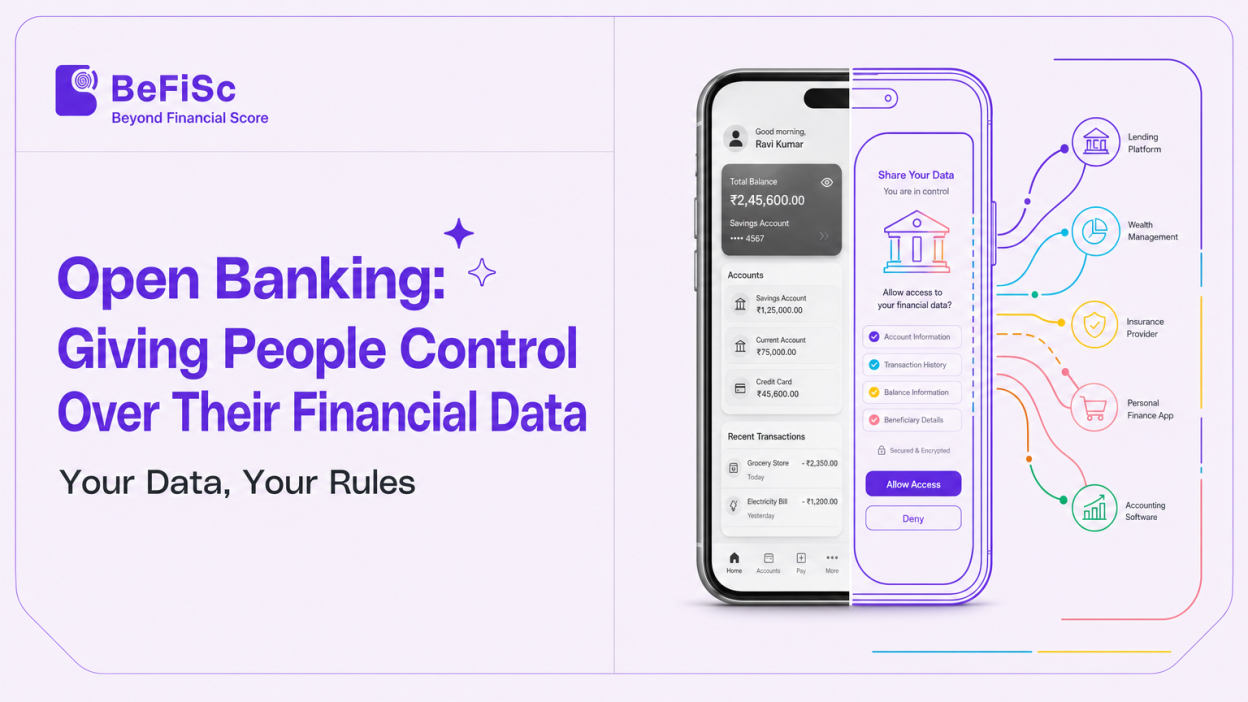
For most of banking history, your financial data sat locked inside your bank: the record of your income, your spending, your savings- accessible to the bank but not easily shareable by you with anyone else. This data asymmetry shaped everything: a lender assessing you could not easily see your full financial picture, a new service could not access your history, and you, the person whose data it was, had little practical control over sharing it. Open banking upends this arrangement. It gives consumers the ability to securely share their financial data with third parties of their choosing, through consent and standardised connections, unlocking their own financial information for services that can use it to benefit them.
India built one of the world’s most distinctive open-banking frameworks through the Account Aggregator ecosystem, embedding consent-based data sharing into its digital financial infrastructure. This guide explains what open banking is, how it works through consent and APIs, India’s Account Aggregator model, the benefits it unlocks for lending and inclusion, the fraud and privacy implications, and how it fits the broader shift toward user-controlled financial data.
What Is Open Banking?
Open banking is a framework that enables consumers to securely share their financial data held by their banks and financial institutions with authorised third-party providers of their choosing, through their consent and standardised technical connections (APIs), so that those third parties can provide services using the data.
The defining principle is consumer-controlled data sharing. Open banking shifts control over financial data toward the consumer, enabling them to authorise the sharing of their data with chosen third parties, rather than the data being locked within their bank. The consumer decides to share their financial information with a service (a lender, a financial app, a provider), grants consent, and the data is shared securely through standardised connections. The consumer’s consent and choice drive the sharing.
Three elements are essential. First, consent: the consumer must authorise the sharing, giving them control. Second, secure standardised connections (APIs) are the technical means by which data is shared securely and reliably between institutions and authorised third parties. Third, authorised third parties are the services that receive and use the data, operating within a regulated framework. Together, these enable secure, consent-based, standardised financial-data sharing.
Open banking represents a fundamental shift from data locked within institutions to data that consumers can share under their control. This unlocks the value of financial data, enabling services that use a consumer’s full financial picture to benefit them (better lending, financial management, tailored services) while keeping the consumer in control of their data. It is, at its core, about giving people the ability to leverage their own financial data, securely and by consent, connecting to the broader theme of user-controlled data central to modern financial infrastructure. Understanding open banking as consent-based, API-enabled, consumer-controlled financial-data sharing is the foundation for understanding its mechanics, benefits, and India’s distinctive implementation.
The Problem Open Banking Solves
Open banking addresses a genuine problem: the locked, siloed nature of financial data. Understanding this problem clarifies its value.
The data-silo problem. Traditionally, financial data sat locked within the institution holding it; a bank held its customers’ data, but the customer could not easily share it, and other services could not easily access it. This siloing meant financial data’s value was largely confined to the holding institution, unavailable for services that could use it to benefit the consumer. The data existed but was trapped.
The consumer-control gap. Consumers had little practical control over their financial data; they could not easily share it, leverage it, or direct its use. Despite the data being about them, they could not unlock its value by sharing it with services they chose. This lack of consumer control over their own financial data was a fundamental limitation.
The friction and access problem. Without easy data sharing, services needing a consumer’s financial data faced friction and cumbersome processes (manual document collection, statement uploads, screen scraping) to obtain data, creating friction and limiting access. A lender assessing a consumer, or a service needing their financial history, had to obtain the data through inefficient means. This friction limited the services that could effectively use financial data and the consumers who could access them.
The inclusion barrier. The friction and data access problem particularly affected the underserved; those whose financial data was hard to access or assess faced barriers to services (like credit) that depend on financial data. Locked, hard-to-share data was a barrier to financial inclusion, limiting access for those who could benefit from data-driven services.
Open banking solves these problems by enabling secure, consent-based data sharing, unlocking data from silos, giving consumers control, reducing friction, and improving access. It transforms financial data from a locked, institution-confined asset into a shareable, consumer-controlled resource that can power beneficial services. This is why open banking has spread globally and why India built its distinctive framework to unlock the value of financial data for consumers and services while keeping consumers in control, addressing the genuine limitations of the siloed, locked-data status quo.
How Open Banking Works: Consent and APIs
Open banking works through the interplay of consent and standardised technical connections, and understanding this mechanism clarifies how secure, controlled data sharing happens.
The consent mechanism. At the heart of open banking is consent: the consumer authorising the sharing of specific data, with a specific party, for a specific purpose, for a specific period. Consent is granular and controlled: the consumer specifies what data is shared, with whom, for what, and for how long, and can revoke it. This consent architecture ensures the consumer controls the sharing; data is shared only with their specific authorisation, not broadly or without consent. Robust, granular, revocable consent is the foundation of open banking’s consumer control.
The API mechanism. The technical sharing happens through APIs (application programming interfaces), standardised connections enabling secure, reliable data sharing between institutions and authorised third parties. APIs replace insecure, unreliable methods (like screen scraping) with secure, standardised, purpose-built connections. Through APIs, authorised data flows securely and reliably from the data-holding institution to the authorised third party, under the consumer’s consent. Standardised APIs are the secure technical rails of open banking.
The flow. The typical flow: the consumer wants a service that needs their financial data; they consent to sharing the specific data with the service; the data flows securely via APIs from the holding institution to the service, under the consent; the service uses the data to provide value. The consumer initiates and controls (via consent), the APIs enable secure sharing, and the third party uses the data all within a regulated, consent-governed framework.
The regulated framework. Open banking operates within a regulatory framework that governs who can participate (authorised third parties), how consent works, how data is shared and protected, and what standards apply. This framework ensures that the sharing is secure, consent-based, and protected; that participants are authorised; that consent is genuine, data is protected, and standards are met. The regulated framework is essential to open banking’s trustworthiness, ensuring the powerful capability of data sharing operates safely.
Security and standardisation. Security (protecting data in sharing) and standardisation (common technical standards enabling reliable interoperability) are essential; open banking requires secure, standardised sharing that consumers and institutions can trust. The move from insecure methods (screen scraping) to secure, standardised APIs is a key open-banking advance, enabling trustworthy data sharing. Understanding open banking’s mechanisms granular consent, secure standardised APIs, a regulated framework, and security clarifies how it delivers controlled, secure financial-data sharing and sets up understanding of India’s specific implementation.
India’s Account Aggregator Model
India built a distinctive open-banking framework through the Account Aggregator (AA) ecosystem, and understanding it illustrates open banking in the Indian context.
The Account Aggregator concept. India’s [Account Aggregator] framework enables consent-based financial-data sharing through licensed Account Aggregator entities that facilitate the secure sharing of a consumer’s financial data (from data-holding institutions) with data-using institutions, under the consumer’s consent. The AA acts as a consent and data-flow intermediary, enabling the consumer to share their data securely and by consent, without the AA itself seeing the data content. The Account Aggregator is India’s mechanism for consent-based open-banking data sharing.
The consent-centric design. The AA framework is built around consent: the consumer grants consent through the AA for specific data to be shared with a specific institution for a specific purpose, and the AA facilitates the consented data flow. The framework’s consent architecture gives consumers granular control over their financial data sharing, embodying open banking’s consent principle. India’s AA model is notably consent-centric, placing consumer consent at the centre of data sharing.
The data-blind intermediary. A distinctive feature is that the Account Aggregator is “data-blind”; it facilitates the data flow (based on consent) but does not itself access or store the data content, which flows encrypted between the data provider and data user. This design protects data (the intermediary does not see it) while enabling sharing, a privacy-protective architecture. The data-blind AA is a distinctive, privacy-conscious element of India’s model.
The ecosystem roles. The AA ecosystem involves financial information providers (FIPs, the institutions holding data), financial information users (FIUs, the institutions using data), and Account Aggregators (the consent-and-flow intermediaries). This structure organises the ecosystem: providers share data, users receive it, and AAs facilitate the consented flow. The framework connects India’s financial institutions in a consent-based data-sharing ecosystem.
The India Stack connection. The Account Aggregator framework is part of India’s broader digital financial infrastructure ([India Stack]) alongside Aadhaar, UPI, and other components, reflecting India’s distinctive approach to building consent-based, interoperable digital financial infrastructure. The AA framework embeds open banking into India’s digital-finance foundation, connecting it to the [DEPA (Data Empowerment and Protection Architecture)] consent-based data-sharing vision. India’s Account Aggregator model is thus a distinctive, consent-centric, privacy-conscious implementation of open banking, embedded in the country’s digital financial infrastructure and central to its data-sharing future.
What Open Banking Enables
Open banking unlocks a range of valuable services and capabilities, and understanding them clarifies its practical benefits.
Better lending and credit assessment. A leading application is improved lending with access to a consumer’s financial data (via consent); lenders can assess creditworthiness more accurately and efficiently, using the consumer’s actual financial picture. Open banking enables [data-driven underwriting], [bank statement analysis], income and cash-flow assessment, and richer credit assessment, improving lending decisions and reducing friction. This lending application, particularly through [Account Aggregator] data, is a major open-banking benefit in India.
Financial management and insights. Open banking enables financial-management services apps and tools that aggregate a consumer’s financial data (via consent) to provide insights, budgeting, and financial management. Consumers can see and manage their finances holistically, powered by consent-based data aggregation. Personal financial management is a common open-banking application.
Streamlined onboarding and services. Open banking reduces friction in onboarding and services, enabling consumers to share their data (via consent) rather than manually providing it, streamlining processes that need financial data. This reduces the friction of accessing financial services, improving the experience. Frictionless, consent-based data sharing streamlines many financial-service processes.
Tailored and new services. Access to financial data (by consent) enables tailored and innovative services and products designed around the consumer’s actual financial situation, and new offerings that the data unlocks. Open banking enables innovation in financial services, powered by consent-based access to financial data. The data unlocks new value and services.
The value-unlocking principle. Across these applications, open banking’s benefit is unlocking the value of financial data for better lending, financial management, streamlined services, and innovation while keeping consumers in control via consent. It transforms locked financial data into a resource that powers beneficial, consumer-controlled services. This value-unlocking, particularly for lending and inclusion in India, is the practical payoff of open banking, and the reason it matters for consumers, financial services, and the broader financial system. Understanding what open banking enables clarifies why it is significant beyond the abstract principle of data sharing.
Open Banking and Financial Inclusion
Open banking has particular significance for financial inclusion, especially in a market like India, and understanding this clarifies one of its most important impacts.
The inclusion opportunity. Open banking can advance financial inclusion by enabling data-driven services for the underserved using consent-based data sharing to assess and serve people who were previously excluded due to data-access barriers. Where locked, hard-to-access data was a barrier to inclusion, open banking’s consent-based sharing can unlock access, enabling lenders and services to assess and serve the underserved using their financial data. This inclusion potential is a major open-banking benefit in inclusion-focused markets.
The thin-file lending connection. Open banking supports lending to [thin-file] and underserved borrowers by providing access (via consent) to their financial data, bank transaction data, cash flows, and financial history that can be used for [alternative-data credit assessment]. Where traditional credit data is absent, open-banking data (like [bank statement analysis] via Account Aggregator) enables assessment, unlocking credit for the underserved. This connects open banking directly to the inclusion-through-data theme central to Indian fintech.
The Indian context. In India, with its large underserved population and its Account Aggregator framework, open banking is particularly significant for inclusion, enabling consent-based access to financial data that can extend credit and services to the underserved. India’s AA-based open banking is explicitly connected to financial inclusion, using consent-based data sharing to serve those the traditional system has underserved. This makes open banking a key element of India’s inclusion agenda.
The empowerment dimension. Open banking’s consent-based model empowers consumers, giving them control over their data and the ability to leverage it for their benefit, including access to services. This empowerment, particularly for the underserved who can use their data (via consent) to access services, is an inclusion benefit for consumers controlling and benefiting from their own financial data. The [Data Empowerment] framing of India’s approach reflects this empowerment dimension.
The responsible-inclusion imperative. Realising open banking’s inclusion potential responsibly requires ensuring the data sharing is genuinely consent-based and privacy-protective, that the services it enables are fair and beneficial (not predatory), and that inclusion does not become exploitation. Open banking’s inclusion promise depends on responsible implementation, genuine consent, privacy protection, and fair services. Understanding open banking’s inclusion significance and the responsible implementation it requires clarifies one of its most important impacts, particularly in India’s inclusion-focused context.
The Fraud and Privacy Implications
Open banking, while beneficial, has significant fraud and privacy implications that must be understood and managed.
The privacy considerations. Open banking involves sharing sensitive financial data, raising serious privacy considerations; the data shared is highly sensitive, and its sharing must be genuinely consent-based, purpose-limited, secure, and protected. The [DPDP Act]and data-protection principles apply strongly: consent must be genuine and informed, data used only for the consented purpose, and data protected in sharing and use. Open banking’s privacy depends on robust consent and data protection; the framework’s consent-centric, secure design (like India’s data-blind AA) addresses this, but privacy remains a central concern requiring careful protection. The sensitivity of financial data makes privacy paramount in open banking.
The consent-integrity challenge. Because consent is central, the integrity of consent matters greatly; consent must be genuine, informed, and not manipulated or coerced. Risks include consent fatigue (consumers consenting without understanding), manipulated consent, and misuse of consented data. Ensuring consent is genuine and meaningful, not a formality or manipulation, is essential to open banking’s integrity and a real challenge. The framework must ensure consent genuinely reflects informed consumer choice.
The fraud vectors. Open banking introduces fraud considerations; the data sharing and the services it enables can be targeted by fraud. Risks include fraudulent access to data (through compromised consent or [account takeover]), misuse of shared data, and fraud in the services open banking enables (like [application fraud] using shared data). Open banking’s data sharing must be secured against fraudulent access and misuse, and the services it powers must have fraud protection. The [authentication], [fraud detection], and security measures this series has explored apply to open banking.
The data-security imperative. The security of data in sharing and storage is critical; open banking’s benefits depend on the shared data being protected against breach and misuse. Secure sharing (APIs, encryption), secure handling by data users, and protection against breach are essential. The data-security dimension, connecting to [tokenisation] and data protection, is central to open banking’s trustworthiness. A breach or misuse of open-banking data would be highly damaging given its sensitivity.
The balanced view. Open banking’s benefits (data unlocking, inclusion, better services) come with real fraud and privacy implications (data sensitivity, consent integrity, fraud vectors, security) that must be managed. Responsible open banking with genuine consent, robust privacy protection, strong security, and fraud prevention delivers the benefits while managing the risks. The consent-centric, privacy-conscious design of frameworks like India’s AA addresses these, but ongoing attention to consent integrity, privacy, security, and fraud is essential. Understanding open banking’s fraud and privacy implications, and the responsible management they require, gives a balanced view of a powerful capability that must be implemented carefully.
Open Banking, Open Finance and the Future
Open banking is part of a broader evolution toward user-controlled financial data, and understanding this trajectory clarifies where it is heading.
From open banking to open finance. Open banking (sharing banking data) is expanding toward open finance, extending consent-based data sharing across the broader financial landscape (investments, insurance, pensions, and more), not just banking. Open finance generalises the open-banking principle to all financial data, enabling consumers to share and leverage their full financial picture across the financial system. This expansion from banking to broader finance is a key direction, unlocking more comprehensive data-driven services.
The India Stack and DEPA vision. India’s approach, through the Account Aggregator framework and the broader [Data Empowerment and Protection Architecture (DEPA)] vision, extends consent-based data sharing as a foundational infrastructure potentially beyond finance to other data domains. India’s vision of consent-based, user-controlled data sharing as digital infrastructure is expansive, positioning open banking within a broader data-empowerment framework. This distinctive, infrastructure-level approach is a notable direction.
The user-empowerment trajectory. The broader trajectory is toward user-controlled, consent-based data sharing that empowers consumers to leverage their own data across finance and potentially beyond. This user-empowerment vision, giving people control over and benefit from their data, is the deeper significance of open banking, connecting to broader movements in data rights and empowerment. Open banking is an early, significant realisation of user-controlled data.
The innovation and inclusion continuation. As open banking and open finance develop, they continue to unlock innovation (new data-driven services) and inclusion (data-driven access for the underserved), extending the benefits across more data and more services. The continued development of consent-based data sharing promises ongoing innovation and inclusion, powered by user-controlled data.
The governance imperative. Realising this future responsibly requires strong governance, genuine consent, privacy protection, security, and fair services as data sharing expands. The benefits of open banking and open finance depend on responsible governance ensuring the powerful capability of data sharing serves consumers safely. Understanding open banking’s trajectory toward open finance, user empowerment, and expanded innovation and inclusion, requiring strong governance, clarifies where this significant development is heading and its broader importance for the future of financial data.
Key Takeaways
- Open banking enables consumers to securely share their financial data with authorised third parties of their choosing, through consent and standardised APIs, shifting control over financial data to the consumer.
- It solves the locked-data problem: financial data traditionally siloed within institutions, with consumers lacking control and services facing friction accessing it, limiting value and inclusion.
- It works through granular, revocable consent, secure standardised APIs, and a regulated framework; India’s distinctive Account Aggregator model is consent-centric and “data-blind.”
- It enables better lending and credit assessment, financial management, streamlined onboarding, and innovation with particular significance for financial inclusion by unlocking data-driven services for the underserved.
- It carries real fraud and privacy implications (data sensitivity, consent integrity, fraud vectors, security) requiring responsible management, and is evolving toward open finance and broader user-controlled data sharing.
Frequently Asked Questions
What are the risks of open banking?
Open banking’s risks include privacy concerns (sharing highly sensitive financial data), consent-integrity challenges (ensuring consent is genuine and informed), fraud vectors (fraudulent data access or misuse), and data security (protecting shared data). Responsible open banking manages these through robust consent, privacy protection, security, and fraud prevention.
How does open banking help financial inclusion?
Open banking helps inclusion by enabling data-driven services for the underserved using consent-based data sharing (like bank statement data via Account Aggregator) to assess and serve people previously excluded by data-access barriers. It unlocks credit and services for thin-file borrowers using their financial data.
What is India’s Account Aggregator framework?
India’s Account Aggregator framework is its open-banking model, using licensed Account Aggregator entities to facilitate consent-based financial-data sharing between data-holding and data-using institutions. It’s consent-centric and “data-blind”; the aggregator facilitates the consented data flow without seeing the data content, making it privacy-conscious.
How does open banking work?
Open banking works through consent and APIs: the consumer grants granular, revocable consent to share specific data with a specific party for a specific purpose, and the data flows securely via standardised APIs from the holding institution to the authorised third party, all within a regulated framework that ensures security and protection.
What is open banking?
Open banking is a framework that enables consumers to securely share their financial data held by their banks with authorised third-party providers of their choosing, through their consent and standardised APIs. It shifts control over financial data to the consumer, unlocking its value for beneficial services.
Conclusion
Open banking represents a quiet revolution in who controls financial data. For generations, the record of a person’s financial life sat locked inside the institution that held it, valuable but trapped, unavailable to the person it described or to the services that could have used it to help them. Open banking breaks this lock not by taking data from institutions, but by giving consumers the power to share their own data, securely and by consent, with whomever they choose. In doing so, it transforms financial data from a siloed asset into a resource that people can leverage for their own benefit, while keeping them firmly in control.
India’s implementation, through the consent-centric and privacy-conscious Account Aggregator framework, is among the world’s most distinctive, embedding user-controlled data sharing into the country’s digital financial infrastructure. Its significance is greatest where the need is greatest in unlocking credit and services for the underserved, using consent-based access to financial data to assess and serve people the traditional system left behind. This inclusion promise, powered by data people control, is open banking at its best. But the capability is powerful precisely because the data is sensitive, and that power demands responsibility: genuine consent that people actually understand, robust protection of the data shared, strong security against breach and fraud, and fair services that benefit rather than exploit. As open banking expands toward open finance and broader user-controlled data sharing, these responsibilities only grow. The promise is a financial system where people control and benefit from their own data; realising it well, securely, privately, inclusively, and fairly is the work that makes open banking not just a technical framework but a genuine advance in financial empowerment.