
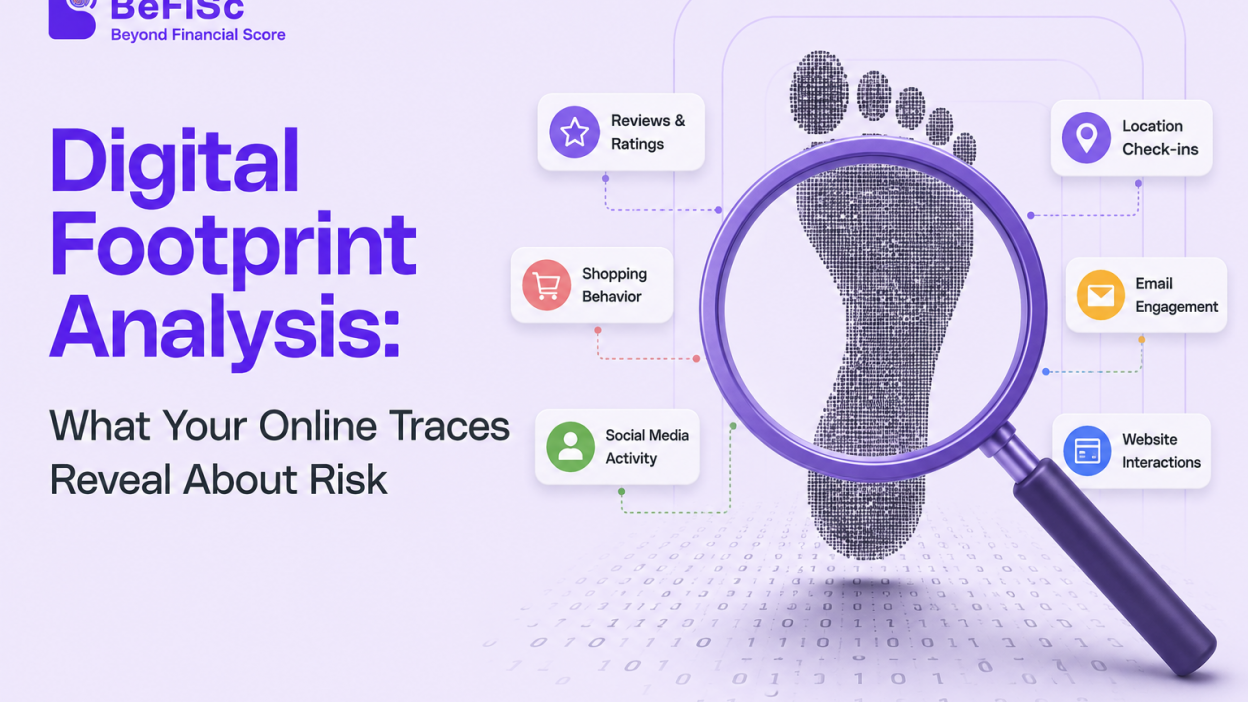
Every person interacting with a financial service arrives trailing a digital footprint: an email address with a history, a phone number with an age and a set of linked services, an IP address with a reputation, a device with a fingerprint. Individually, these traces seem trivial. Analysed together, they reveal a surprising amount about whether a person is genuine or fraudulent, established or fabricated, low-risk or high-risk, often before any traditional identity document or credit record is even considered. Digital footprint analysis is the discipline of reading these online traces to assess fraud and credit risk, and it has become a valuable layer in both [fraud detection] and [thin-file lending], particularly in a market like India with large underserved and thin-file populations.
The core insight is that genuine, established people have rich, consistent, aged digital footprints, while fraudsters and fabricated identities often do not, and this difference is detectable. This guide explains what digital footprint analysis is, the signals it uses, how it detects fraud, its value for thin-file credit assessment, its limitations, and the important privacy considerations it raises.
What Is Digital Footprint Analysis?
Digital footprint analysis is the practice of assessing the digital traces associated with a person, their email address, phone number, IP address, device, and related online signals to evaluate fraud risk, verify legitimacy, and assess creditworthiness, particularly where traditional data is limited.
The defining idea is deriving risk and legitimacy signals from digital identifiers and their characteristics. Rather than relying solely on identity documents and credit records, digital footprint analysis examines the digital attributes a person presents: how old their email is, whether their phone number is linked to established services, whether their IP is associated with fraud, and whether their device shows fraud signals, drawing inferences about their legitimacy and risk from these attributes. The digital footprint becomes a signal of who the person is and how risky they are.
This works because digital identifiers carry rich, revealing metadata. An email address is not just an address; it has an age, a domain, a pattern, and links to other services. A phone number has an age, a type, a carrier, and associated services. An IP address has a reputation, a location, and a type. A device has a fingerprint and a history. These characteristics, analysed individually and together, reveal patterns that distinguish genuine from fraudulent and low-risk from high-risk.
Digital footprint analysis is used in two main contexts: fraud detection (assessing whether a person or transaction is fraudulent, especially at [onboarding/application] ) and credit/thin-file assessment (evaluating creditworthiness where traditional data is thin, using digital signals as [alternative data] ). In both cases, it provides a signal beyond traditional identity and credit data derived from the digital traces everyone now leaves, which is why it has become a valuable layer in modern risk assessment, particularly for digital-first financial services and underserved populations.
The Signals: Email, Phone, IP, and Device
Digital footprint analysis draws on several categories of digital signals, each carrying revealing characteristics. Understanding them clarifies what the analysis actually examines.
Email intelligence. An email address carries substantial signal: its age (how long it has existed established emails suggest genuineness, brand-new ones can indicate fabrication), its domain (established providers versus disposable/temporary email services), its pattern (random-looking versus natural), and its links to other services and accounts (an email connected to many established services suggests a real person; one connected to nothing suggests a fabricated or throwaway identity). Email intelligence assesses these characteristics to gauge whether the email and, by extension, the person is genuine and established or suspicious and new.
Phone intelligence. A phone number similarly carries signals: its age and tenure (established numbers versus newly acquired), its type (a genuine mobile number versus a virtual/VoIP number often used in fraud), its carrier and line type, its links to established services and accounts, and whether it is associated with the claimed identity. Phone intelligence assesses whether the number is a genuine, established, personal number consistent with a real person, or a suspicious, virtual, or disposable number characteristic of fraud. Phone number verification and intelligence are particularly valuable given how central phone numbers are to [authentication] and identity.
IP intelligence. An IP address carries signal about the connection: its reputation (associated with fraud, spam, or clean), its type (residential, mobile, data-centre/hosting the latter often used to hide origin), whether it is a proxy/VPN/Tor (used to conceal location and identity), its geolocation (and whether it is consistent with the claimed location), and its association with fraud. IP intelligence assesses whether the connection is a genuine, consistent, clean one or a suspicious, concealed, or fraud-associated one, with signals of attempts to hide origin or of fraud infrastructure.
Device intelligence. As covered in [device fingerprinting], the device carries signals of its fingerprint, its history, whether it is associated with fraud, whether it shows signs of emulation or manipulation, and whether it is consistent with the claimed identity and behaviour. Device signals contribute to the digital footprint, indicating fraud-associated or manipulated devices.
Broader digital signals. Beyond these core signals, digital footprint analysis can incorporate other online traces, such as social and web presence (a genuine person often has some consistent online presence; a fabricated identity often does not), the consistency of digital signals with each other and with the claimed identity, and behavioural signals. The breadth of digital traces provides many potential signals.
No single signal is definitive; digital footprint analysis combines these into an overall assessment. The power is in the combination and consistency of many signals aggregating into a coherent picture of genuineness and risk, which the following sections explain.
The Core Insight: Genuine vs Fabricated Footprints
The foundational insight underlying digital footprint analysis the reason it works is the systematic difference between genuine and fabricated digital footprints.
Genuine people have rich, aged, consistent footprints. A real, established person accumulates a rich digital footprint over time: an aged email linked to many services, an established phone number with tenure and associations, consistent digital signals, and a coherent online presence. This footprint is deep (many signals), aged (built over time), consistent (signals align with each other and the claimed identity), and hard to fabricate (it reflects genuine history). Genuine footprints look genuine because they are.
Fraudsters and fabricated identities have thin, new, inconsistent footprints. Fraudsters and [synthetic identities], by contrast, often present thin or fabricated footprints: newly-created emails, virtual or new phone numbers, concealed IPs, fraud-associated devices, absent or inconsistent online presence, and signals that do not cohere. Fabricating a rich, aged, consistent digital footprint is genuinely hard; it requires time, effort, and consistency that fraudsters, especially at scale, often cannot or do not invest. So fraudulent footprints tend to be thin, new, concealed, and inconsistent.
The detectable difference. This systematic difference genuine footprints are rich, aged, and consistent; fraudulent ones are thin, new, and inconsistent is what digital footprint analysis detects. By assessing the depth, age, consistency, and characteristics of the digital footprint, the analysis distinguishes the genuine person (rich, coherent footprint) from the fraudster or fabricated identity (thin, incoherent footprint). The difference is often detectable even before traditional verification, providing an early, valuable signal.
The scale factor. The difference is especially pronounced at scale. A fraudster fabricating many identities cannot invest in building rich, aged, consistent footprints for each; the effort is prohibitive, so mass-fabricated identities tend to share thin, new, or inconsistent footprint characteristics. This makes digital footprint analysis particularly effective against organised, at-scale fraud (mass account opening, [synthetic identity] operations), where the footprints betray their fabrication. Genuine people, meanwhile, cannot help but have real footprints.
The insight’s implications. This core insight that genuine and fabricated footprints systematically differ and that the difference is detectable is why digital footprint analysis works and what it fundamentally assesses. It reframes fraud detection around a hard-to-fake signal (the accumulated digital footprint) rather than easily forged documents, adding a dimension that fabrication struggles to replicate. Understanding this insight clarifies both the power and the limits of the technique: it is powerful because footprints are hard to fake, but limited because genuine people can have thin footprints too (the thin-file challenge, addressed below).
How Digital Footprint Analysis Detects Fraud
Digital footprint analysis detects fraud by assessing the footprint’s characteristics for signals of fraud and fabrication, applied especially at onboarding and transactions.
Fabrication signals. The analysis flags the thin, new, inconsistent footprints characteristic of fabricated identities: new emails and phones, concealed IPs, absent online presence, and inconsistent signals indicating a potentially [synthetic or fraudulent identity]. At [application/onboarding], these fabrication signals help catch fraudulent applications before accounts are opened.
Concealment signals. The analysis detects attempts to conceal identity and origin, proxy/VPN/Tor use, data-centre IPs, virtual phone numbers, and disposable emails, which, while sometimes legitimate, are associated with fraud and warrant scrutiny. Concealment signals indicate someone hiding their true origin or identity, a common fraud characteristic.
Inconsistency signals. The analysis flags inconsistencies between the digital signals and the claimed identity, between different signals, or between the footprint and expected patterns. A claimed identity whose digital footprint does not match (wrong location, inconsistent signals, footprint inconsistent with the claimed person) suggests fraud. Consistency across the footprint is a genuineness signal; inconsistency is a fraud signal.
Fraud-association signals. The analysis checks whether footprint elements IPs, devices, emails, phones are associated with known fraud, catching identifiers linked to prior fraud or fraud infrastructure. Elements with fraud history are strong risk signals.
Velocity and pattern signals. The analysis detects patterns across applications and transactions, with many applications sharing footprint elements (shared devices, IPs, or patterns indicating organised fraud), connecting to the [network/graph analysis] that exposes fraud rings. Velocity and shared-element patterns reveal coordinated fraud.
The application context. Digital footprint analysis is especially valuable at [onboarding and application], where it assesses the footprint of a new applicant a stranger with no prior relationship providing signal about their legitimacy from their digital traces. It adds a fraud-detection layer at the critical front-door stage, complementing identity and document verification with footprint-based assessment. It also contributes to transaction-level fraud detection, assessing the footprint context of transactions.
The contributory role. Digital footprint analysis provides contributory signals, not definitive verdicts. A thin or concealed footprint raises risk but is not proof of fraud (genuine reasons exist), so the signals feed into a broader [risk assessment] rather than deciding alone. This contributory framing, consistent with the multi-signal approach throughout this series, is how digital footprint analysis is properly used as a valuable signal within layered detection, not a sole decision-maker.
Digital Footprint Analysis for Thin-File Credit
Beyond fraud detection, digital footprint analysis has significant value for credit assessment, particularly for thin-file and underserved populations, an important application in India.
The thin-file problem. Many people, especially in emerging markets and among the underserved, lack traditional credit history (a “thin file”), making conventional credit assessment difficult. Without credit records, lenders struggle to assess creditworthiness, potentially excluding creditworthy but thin-file individuals from credit. This is a major [financial-inclusion] challenge, particularly acute in India with its large underserved population.
Digital footprint as alternative data. Digital footprint analysis provides [alternative data] for assessing thin-file individuals using digital signals (email, phone, digital presence, and their characteristics) as inputs to creditworthiness assessment where traditional data is absent. The digital footprint offers signals about a thin-file person that can supplement or substitute for missing credit history, enabling assessment where conventional data cannot. This connects digital footprint analysis to the broader [alternative-data lending] movement.
What the footprint signals for credit. For credit assessment, footprint signals can indicate stability and genuineness (an established, consistent digital footprint suggesting a stable, real person), and provide inputs to risk models that assess creditworthiness from non-traditional data. While the digital footprint does not directly measure ability or willingness to repay the way credit history does, it provides signals about the applicant’s genuineness, stability, and risk that inform assessment, particularly for distinguishing genuine thin-file applicants from fraudulent ones and for supplementing thin traditional data.
The inclusion value. By enabling assessment of thin-file individuals through digital signals, digital footprint analysis supports financial inclusion, allowing lenders to assess and serve creditworthy people who lack traditional credit history, using their digital footprint as a signal. This is a significant benefit in inclusion-focused markets, helping extend credit responsibly to the underserved. It aligns with the inclusion-through-alternative-data theme central to Indian fintech.
The important caveat. However, digital footprint analysis for credit must be used carefully and fairly; digital signals are imperfect proxies, can carry bias, and must not unfairly exclude or profile. The [fairness and bias] considerations of alternative-data credit assessment apply strongly, and responsible use requires ensuring digital-footprint-based credit assessment is fair, non-discriminatory, and genuinely predictive rather than spuriously correlated. Used responsibly, digital footprint analysis is a valuable tool for inclusive credit assessment; used carelessly, it risks unfair exclusion or bias a balance central to its responsible application.
Combining Signals and Risk Scoring
Digital footprint analysis derives its power from combining many signals into an overall risk assessment, and understanding this combination clarifies how it is used in practice.
The multi-signal combination. No single digital signal is definitive: an aged email, an established phone, a clean IP each provides some signal, but the assessment comes from combining them. Digital footprint analysis aggregates the many signals (email, phone, IP, device, presence, consistency) into an overall picture, weighing them together to assess genuineness and risk. The combination is far more powerful than any single signal, as multiple aligning signals build confidence and inconsistencies raise flags.
Consistency as a meta-signal. A particularly important assessment is consistency: whether the various signals cohere with each other and with the claimed identity. Consistent signals (all indicating a genuine, established person, aligned with the claimed identity) build confidence; inconsistent signals (a genuine-looking email but a concealed IP and virtual phone, or signals inconsistent with the claimed identity) raise risk. Consistency across the footprint is itself a powerful signal of genuineness, and inconsistency a signal of fraud.
Risk scoring. The combined signals typically feed a risk score, a quantified assessment of fraud or credit risk derived from the digital footprint, used within a [risk-based] decision framework. The score drives decisions (approve, review, step-up, decline) proportionate to the assessed risk. Digital footprint analysis thus produces a risk signal or score that integrates into the institution’s broader risk decisioning, contributing the footprint dimension to the overall assessment.
Integration with other signals and AI. Digital footprint analysis integrates with the other layers this series has covered [identity verification], [behavioural biometrics], [device intelligence], [transaction monitoring], and [network analysis] as one input to a comprehensive, multi-signal risk assessment. [AI and machine learning] increasingly combine digital footprint signals with other data to produce sophisticated risk assessments, with the footprint providing valuable features. Digital footprint analysis is thus part of the broader multi-signal, AI-driven risk assessment, contributing its distinctive footprint-based signals.
The combination principle. The essential principle: digital footprint analysis works by combining many individually modest signals into a coherent, consistency-weighted assessment, integrated with other risk signals into an overall risk score and decision. This combination of footprint signals with each other, and of the footprint assessment with other risk layers, is how digital footprint analysis delivers value, as a rich, hard-to-fake dimension within multi-signal risk assessment.
Limitations and Considerations
A balanced view requires acknowledging digital footprint analysis’s limitations, which shape how it should be used.
The thin-genuine-footprint problem. The core limitation mirrors the core insight’s flip side: some genuine people have thin digital footprints the genuinely underserved, those new to digital services, the elderly, or those with limited online presence. A thin footprint is not proof of fraud; it can indicate a genuine person with limited digital presence. Treating thin footprints as fraudulent would unfairly penalise genuine underserved people, the very inclusion problem the technology aims to help solve. This limitation requires careful, contextual use that does not automatically penalise thin footprints, especially in inclusion contexts.
Probabilistic, not definitive. Digital footprint signals are probabilistic, not definitive. A concealed IP, virtual phone, or thin footprint raises risk but has legitimate explanations (privacy-conscious users use VPNs; genuine people use virtual numbers; real people have thin footprints). The signals indicate risk, not certainty, and must be used as contributory signals within broader assessment, not sole determinants. Over-reliance on any single footprint signal produces false positives.
Evasion. Sophisticated fraudsters can attempt to build or fake footprints, age identities, and acquire established-looking emails and phones, using residential IPs to defeat footprint analysis. While building rich, consistent, aged footprints at scale is hard, determined fraudsters evolve, and footprint analysis is part of an ongoing arms race, not a permanent solution. Its effectiveness depends on staying ahead of evasion.
Bias and fairness. As noted, digital footprint signals can carry bias correlating with demographics, geography, or circumstances in ways that could produce unfair outcomes, particularly in credit. Ensuring footprint analysis is fair and non-discriminatory, and does not proxy for protected characteristics or unfairly exclude, is a critical responsibility, connecting to the [AI fairness] and [DPDP] considerations.
Data quality and coverage. Footprint analysis depends on data quality and coverage, which vary; signals may be incomplete, outdated, or unavailable, affecting reliability. The analysis is only as good as the underlying data.
These limitations mean digital footprint analysis is a valuable but imperfect tool, powerful as a contributory signal within a multi-signal, risk-based, fair assessment, but not a definitive or standalone judge, and requiring careful use that avoids penalising genuine thin footprints and ensures fairness. Understanding the limitations is essential to using the technique responsibly and effectively.
Privacy and Responsible Use
Digital footprint analysis raises significant privacy considerations that must be addressed for responsible use, particularly under India’s evolving data-protection framework.
The privacy tension. Digital footprint analysis involves collecting and analysing data about individuals’ digital identifiers, presence, and characteristics inherently personal data. This engages data-protection principles: lawful basis, transparency, purpose limitation, data minimisation, and security. There is a genuine tension between the fraud-prevention and risk-assessment value of footprint analysis and the privacy of the individuals whose digital traces are analysed. Analysing people’s digital footprints is powerful but privacy-sensitive.
The DPDP framework. Under India’s [Digital Personal Data Protection Act] and data-protection principles, digital footprint analysis must operate lawfully with an appropriate legal basis, transparency about data use, purpose limitation (using data for a legitimate fraud-prevention/risk purpose, not repurposing it), data minimisation (using only necessary data), and security. Responsible footprint analysis respects these principles, keeping the practice within data-protection bounds.
The legitimate-purpose framing. Digital footprint analysis for fraud prevention and responsible risk assessment serves legitimate, broadly accepted purposes protecting against fraud and enabling responsible (including inclusive) credit assessment. This legitimate purpose supports its use, but does not exempt it from data-protection requirements. Responsible use keeps footprint analysis firmly tied to these legitimate purposes, with appropriate governance, rather than expanding into unrelated profiling or surveillance.
The fairness dimension. Beyond privacy, fairness is a responsible-use imperative ensuring footprint analysis does not unfairly discriminate, profile, or exclude, particularly in credit. The [bias and fairness] considerations are central, requiring testing for and mitigating unfair outcomes. Responsible footprint analysis is both privacy-respecting and fair.
The transparency and control balance. Responsible use also considers transparency (individuals having appropriate awareness of data use) and, where relevant, control, balancing the effectiveness of fraud prevention (which can require some opacity to avoid tipping off fraudsters) with data-protection transparency expectations. Navigating this balance thoughtfully is part of responsible deployment.
The responsible-use principle. Digital footprint analysis is a valuable tool that must be used responsibly and lawfully under data protection, for legitimate fraud-prevention and risk purposes, fairly and without unfair discrimination, with appropriate governance. Used responsibly, it protects against fraud and supports inclusive assessment while respecting privacy and fairness; used carelessly, it risks privacy violation, unfair profiling, and exclusion. This responsible-use framing, consistent with the privacy and fairness themes throughout this series, is essential to deploying digital footprint analysis in a way that is both effective and ethical.
Key Takeaways
- Digital footprint analysis assesses the digital traces associated with a person’s email, phone, IP, device, and online presence to evaluate fraud risk, verify legitimacy, and assess creditworthiness where traditional data is limited.
- Its core insight is that genuine, established people have rich, aged, consistent digital footprints, while fraudsters and fabricated identities have thin, new, inconsistent ones a hard-to-fake, detectable difference, especially at scale.
- It detects fraud through fabrication, concealment, inconsistency, fraud-association, and velocity signals, especially at onboarding, and provides valuable alternative data for thin-file credit assessment and financial inclusion.
- Its power comes from combining many modest signals into a consistency-weighted risk score, integrated with other risk layers and AI as a contributory signal, not a definitive judge.
- It has real limitations (genuine thin footprints, probabilistic signals, evasion, bias) and raises significant privacy and fairness considerations requiring responsible, DPDP-aligned, fair use.
Frequently Asked Questions
How does digital footprint analysis help thin-file credit assessment?
It provides alternative data for assessing people who lack traditional credit history, using digital signals (established email, phone, consistent presence) to gauge genuineness and stability. This enables lenders to assess creditworthy thin-file individuals who would otherwise be excluded, supporting financial inclusion, though it must be used fairly to avoid bias.
Does digital footprint analysis raise privacy concerns?
Yes. It involves collecting and analysing personal data about individuals’ digital identifiers and presence, engaging data-protection principles like lawful basis, transparency, purpose limitation, and minimisation under frameworks like the DPDP Act. Responsible use limits it to legitimate fraud-prevention and risk purposes, with fairness and appropriate governance.
How does digital footprint analysis detect fraud?
It detects fraud by identifying the thin, new, inconsistent footprints characteristic of fabricated identities, concealment signals (VPNs, virtual phones, disposable emails), inconsistencies between signals and the claimed identity, fraud-associated identifiers, and velocity patterns across applications, especially at onboarding, as contributory signals within broader risk assessment.
What signals does digital footprint analysis use?
It uses email intelligence (age, domain, links to services), phone intelligence (age, type, associations), IP intelligence (reputation, type, proxy/VPN use, location), device intelligence (fingerprint, fraud association), and broader signals like online presence and the consistency of signals with each other and the claimed identity.
What is digital footprint analysis?
Digital footprint analysis assesses the digital traces associated with a person their email address, phone number, IP address, device, and online presence to evaluate fraud risk, verify legitimacy, and assess creditworthiness, particularly where traditional identity documents or credit records are limited.
Conclusion
Digital footprint analysis reflects a simple but powerful truth about the digital age: everyone leaves traces, and those traces reveal more than any single one of them suggests. The age of an email, the type of a phone number, the reputation of an IP, the consistency of it all assembled- these fragments distinguish the genuine, established person from the fabricated identity or the fraudster hiding their origin, often before any document is checked. And crucially, they do so by reading something fraudsters find genuinely hard to fake: the rich, aged, coherent footprint that only real history produces.
This makes digital footprint analysis valuable in two directions at once. It catches fraud in the thin, concealed, inconsistent footprints of fabricated identities and organised operations that cannot invest in building genuine traces at scale. And it enables inclusion, reading the digital footprints of thin-file, underserved people to assess creditworthiness where traditional data fails, extending responsible credit to those the conventional system overlooks. That dual value, in a market like India with vast underserved and thin-file populations, is precisely why the technique has become an important layer in modern risk assessment. But its power comes with genuine responsibility. The same thin footprint that flags a fraudster can belong to a perfectly genuine underserved person, so the technique must never penalise thinness automatically. Its signals are probabilistic, its outputs must be fair and unbiased, and its analysis of personal digital traces must respect privacy under the DPDP framework. Used responsibly as a contributory signal within multi-signal, risk-based, fair, and privacy-respecting assessment, digital footprint analysis reads the traces we all leave to distinguish genuine from fraudulent and to include rather than exclude. That is its promise, and realising it well is the discipline that separates responsible deployment from careless profiling.



[…] and many are later reassigned. If a bank still treats a revoked number as its customer’s, OTPs can reach a stranger, and accounts linked to fraud-flagged numbers can keep […]