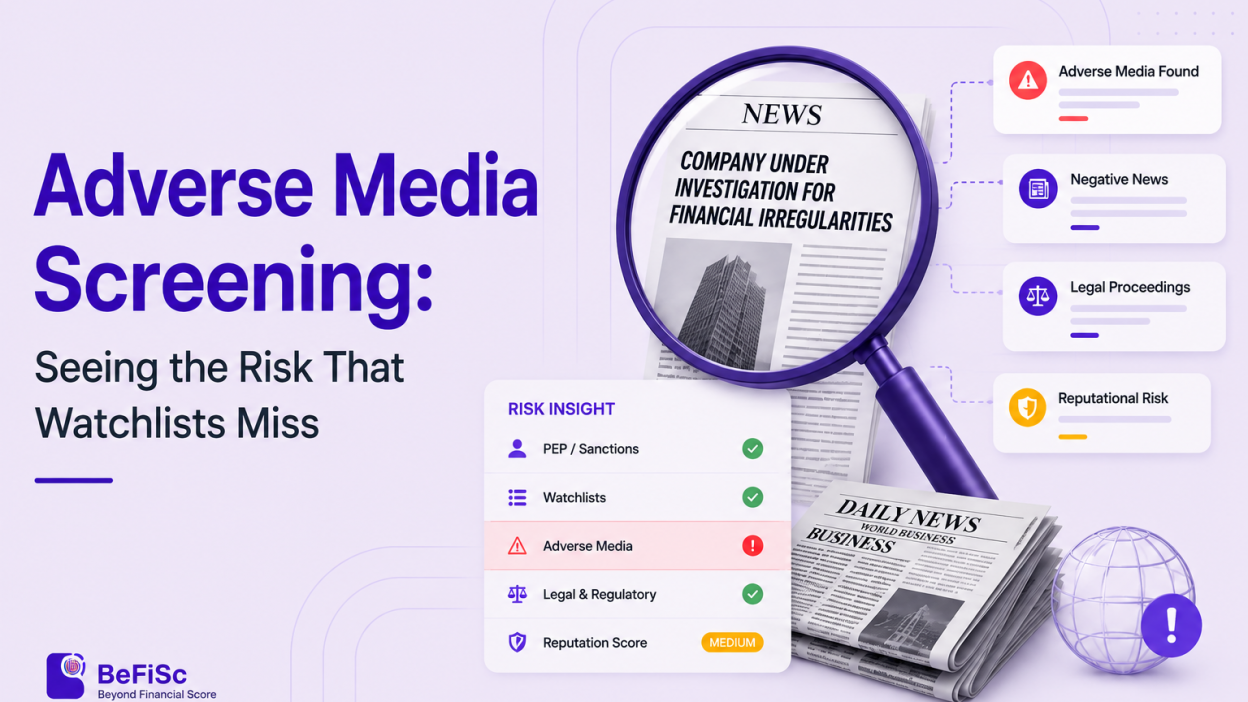
By the time someone appears on a sanctions list or a wanted-persons database, the risk they pose is already officially investigated, adjudicated, and formally recorded. But financial crime does not begin at the moment of official designation; it is often reported, alleged, and investigated in the public domain long before it ever reaches a watchlist. Adverse media screening is how financial institutions see this earlier, unofficial signal, scanning news, publications, and public sources for negative information about their customers and prospects, catching indications of criminality, corruption, fraud, and other risks that formal lists have not yet captured or never will. It is the discipline of reading what the world is already saying about a person or business, and factoring it into the assessment of who to do business with.
Adverse media screening complements the [sanctions and watchlist screening] this series has covered, extending [due diligence]beyond official lists into the broader information environment. This guide explains what adverse media screening is, why it matters, how it works, its relationship to other screening, the significant false-positive and quality challenges it faces, and how technology and AI are reshaping it.
What Is Adverse Media Screening?
Adverse media screening (also called negative news screening) is the process of searching news media, publications, and other public sources for negative or adverse information about a customer, prospect, or associated party, such as involvement in crime, fraud, corruption, money laundering, or other risk-relevant conduct to inform risk assessment and due diligence.
The defining characteristic is the source: unlike [sanctions or PEP screening], which checks official, structured lists, adverse media screening searches the unstructured, open information environment news articles, media reports, publications, and public sources for negative information. It looks not at what official lists say about a person, but at what the wider world is reporting about them, capturing risk signals that appear in the public domain.
This matters because adverse media captures risk that official lists do not. A person may be reported, alleged, or investigated in the media for financial crime, fraud, corruption, or other conduct long before (or without ever) appearing on a formal watchlist. Adverse media screening surfaces these earlier and broader signals: allegations, investigations, reported involvement in crime, reputational red flags that official-list screening would miss. It extends the risk-assessment lens from the formally designated to the publicly reported.
Adverse media screening is a component of [customer due diligence], and AML informs the risk assessment of customers by checking whether negative information exists about them. It is particularly important for higher-risk customers and [enhanced due diligence], where a fuller understanding of the customer’s risk profile, including any adverse public information, is warranted. By incorporating what the public domain reveals, adverse media screening gives institutions a richer, earlier, and broader view of customer risk than lists alone provide.
Why Adverse Media Screening Matters
Adverse media screening addresses a genuine gap in list-based screening, and understanding this gap clarifies its value.
The list-lag problem. Official lists (sanctions, wanted persons, regulatory actions) reflect risk only after it has been officially established, investigated, adjudicated, and formally recorded. But financial crime is often reported and investigated in the public domain well before it reaches an official list, if it ever does. Adverse media screening captures this earlier signal: the reported, alleged, or investigated conduct that precedes or never reaches official designation. It sees risk before the list does, providing earlier warning.
The coverage-gap problem. Official lists cover specific, defined categories (sanctioned parties, designated PEPs, listed criminals), but much risk-relevant conduct falls outside these categories: fraud, corruption, criminal association, reputational risk, and conduct that is reported but not officially listed. Adverse media screening covers this broader landscape of risk-relevant information that lists do not capture, extending coverage beyond the formally designated. Many genuinely risky customers never appear on any official list but are extensively reported in the media.
The reputational-risk dimension. Beyond regulatory risk, institutions face reputational risk from association with parties involved in crime, scandal, or misconduct, even where no official designation exists. Adverse media screening helps institutions identify and manage this reputational risk, understanding whether prospective or existing customers carry reputational red flags reported in the public domain. Protecting against reputational harm from bad associations is a distinct value of adverse media screening.
The due diligence completeness. Effective [due diligence], especially [enhanced due diligence] for higher-risk customers, requires understanding the customer’s full risk profile, which includes any adverse public information. Adverse media screening completes the due-diligence picture, ensuring institutions consider what is publicly known about a customer, not just what official lists say. It is part of genuinely knowing the customer.
The regulatory expectation. Regulators and standards increasingly expect institutions to consider adverse media as part of due diligence and risk assessment, particularly for higher-risk relationships. Adverse media screening has become a recognised component of robust AML/CDD, expected as part of comprehensive customer risk assessment. It is not optional diligence but an expected element of understanding customer risk.
Adverse media screening matters, in sum, because it sees risk earlier and more broadly than lists, addresses reputational risk, completes due diligence, and meets regulatory expectations, capturing the risk signals that the public domain reveals but official lists miss.
Adverse Media vs Sanctions and PEP Screening
Adverse media screening is often grouped with [sanctions and PEP screening] , but it differs in important ways, and understanding the distinctions clarifies each.
The source difference. Sanctions and PEP screening check official, structured, defined lists (sanctions lists, PEP databases), authoritative sources with clear entries. Adverse media screening searches unstructured, open, undefined sources (news, publications, public information), a vast, unstructured information environment with no defined list. This source difference is fundamental: list screening matches against defined entries; adverse media screening searches open information.
The certainty difference. Sanctions and PEP screening deal with defined statuses (a party is or is not sanctioned or a PEP) relatively clear determinations against authoritative lists. Adverse media deals with reported, alleged, and investigated conduct, often uncertain, unproven, and requiring judgment (an allegation is not a conviction; a report may be inaccurate; relevance varies). Adverse media findings are inherently less certain and more judgment-dependent than list matches, requiring assessment of what the information actually means for risk.
The action difference. Sanctions screening often requires definite action (sanctioned parties must not be dealt with, a hard regulatory requirement). Adverse media informs risk assessment more than mandating specific action. Negative information raises risk and warrants consideration, but the response is a risk-based judgment (enhanced diligence, closer monitoring, declining the relationship, or accepting it with understanding) rather than a mandatory prohibition. Adverse media feeds risk-based decisions rather than triggering automatic requirements.
The complementary relationship. The three are complementary components of screening and due diligence: sanctions screening enforces prohibitions on designated parties; PEP screening identifies politically exposed persons requiring enhanced diligence; and adverse media screening surfaces the broader, earlier, publicly reported risk signals. Together they provide layered risk identification, official prohibitions (sanctions), heightened-risk categories (PEPs), and open-source risk signals (adverse media). Comprehensive screening incorporates all three, each covering what the others miss.
The judgment emphasis. Because adverse media is uncertain and judgment-dependent, it requires more human assessment than list matching, evaluating whether a media finding is genuinely about the customer, genuinely risk-relevant, and how it should affect the risk assessment. This judgment dimension, and the resulting false-positive challenge, is central to adverse media screening (as discussed below), distinguishing it from the more binary nature of list matching. Understanding adverse media as judgment-heavy, open-source, risk-informing screening distinct from but complementary to list-based sanctions and PEP screening clarifies its distinctive character and challenges.
How Adverse Media Screening Works
Adverse media screening involves searching, matching, and assessing open-source information, and understanding the process clarifies both how it works and where its challenges lie.
Source coverage. Adverse media screening searches a wide range of sources: news media (local, national, international), publications, regulatory and enforcement announcements, and other public information for negative information. The breadth and quality of source coverage matter: comprehensive, reliable, current sources produce better screening. Screening solutions aggregate and search extensive source sets to maximise coverage of relevant adverse information.
Searching and matching. The screening searches these sources for the customer (by name and identifying information), attempting to find media mentioning them in a negative context. This involves name matching (finding media about the specific person, despite name variations, common names, and ambiguity) and entity resolution (determining whether the media is genuinely about the customer, not a different person with a similar name). Accurate matching is a core challenge: finding genuine matches while avoiding false matches to different people.
Relevance and category assessment. Found media is assessed for relevance, whether it is genuinely about the customer, genuinely negative/risk-relevant, and what category of risk it indicates (crime, fraud, corruption, etc.). Not all negative media is relevant (an unrelated person, an irrelevant matter, an outdated or minor issue), so assessment filters genuine, relevant adverse media from noise. This assessment is judgment-heavy and central to useful screening.
Risk evaluation and action. Genuinely relevant adverse media is evaluated for its risk implications: how serious, how credible, and how relevant to the financial-crime and reputational risk the customer poses, informing the risk-based decision (enhanced diligence, monitoring, declining, accepting). The adverse media finding feeds the overall [customer risk assessment] and the appropriate response.
Documentation and defensibility. The screening, findings, assessments, and decisions are documented, providing a defensible record of the adverse media diligence performed and the reasoning behind decisions. Documentation supports regulatory defensibility and consistent decision-making.
The process search comprehensive sources, match to the customer, assess relevance, evaluating risk, deciding, and documenting is conceptually straightforward but practically challenging, particularly the matching and relevance-assessment steps, which generate false positives and quality challenges that dominate adverse media screening (discussed below). The quality of sources, matching, and assessment determines whether screening produces useful risk intelligence or overwhelming noise.
The Categories of Adverse Media
Adverse media spans various categories of negative information, and understanding them clarifies what the screening seeks and how relevance is assessed.
Financial crime. Media reporting involvement in money laundering, fraud, financial crime, and related conduct directly relevant to AML risk. This is core adverse media, indicating financial-crime risk.
Corruption and bribery. Reports of corruption, bribery, and related misconduct highly relevant to risk, especially for [PEPs] and higher-risk relationships. Corruption reporting is a key adverse-media category, connecting to the corruption risk PEP screening addresses.
Other crimes. Reports of criminal involvement generally include organised crime, trafficking, violent crime, and other criminality, indicating risk and potential association with criminal activity or proceeds.
Regulatory and enforcement actions. Reports of regulatory actions, enforcement, sanctions (beyond formal lists), and legal proceedings against the party indicate regulatory and legal risk. This overlaps with but extends beyond formal lists, capturing reported actions.
Terrorism and security. Reports connecting the party to terrorism, extremism, or security concerns are highly relevant, connecting to [terrorist-financing] risk.
Reputational and other. Broader reputational red flags include scandal, misconduct, controversial associations, and other information affecting the party’s risk and reputation. These inform reputational risk even where not directly criminal.
The relevance spectrum. Adverse media ranges from clearly relevant (reported financial crime, corruption, criminality) to marginally or not relevant (minor, old, unrelated, or non-risk matters). A central task is distinguishing genuinely risk-relevant adverse media from the vast volume of negative or neutral information that is not relevant to financial-crime and reputational risk. The categories help structure this, identifying which negative information genuinely indicates the risks that matter, versus noise. Effective screening focuses on the risk-relevant categories while filtering the irrelevant, a judgment central to producing useful screening rather than overwhelming, unfocused results.
The False Positive and Quality Challenge
The dominant practical challenge in adverse media screening, as in much screening, is false positives and information quality, and understanding it is essential to understanding the discipline.
The false-positive problem. Adverse media screening generates significant false-positive matches that are not genuinely about the customer (different person, same name) or not genuinely risk-relevant (irrelevant, minor, outdated, or non-negative information). Given the vast, unstructured information environment and the ambiguity of names and relevance, false positives are a major burden; screening can produce large volumes of matches, most of which are not genuine, relevant risk signals. Sifting genuine, relevant adverse media from this noise is the core operational challenge.
The name and entity-resolution challenge. A major false-positive source is name matching; common names, name variations, and ambiguity make it hard to determine whether media is about the specific customer or a different person. Entity resolution (accurately linking media to the correct person) is difficult and a key driver of both false positives (matching to the wrong person) and false negatives (missing genuine matches). Accurate entity resolution is central to screening quality.
The relevance-assessment burden. Even correctly matched media requires relevance assessment: is it genuinely negative, genuinely risk-relevant, current, and material? This assessment is judgment-heavy and resource-intensive, and much matched media is not genuinely relevant. The burden of assessing relevance across many matches is significant, consuming compliance resources and creating the risk that genuine signals are lost in the volume.
The information-quality problem. Adverse media varies in quality, and reliable sources differ in credibility; information may be inaccurate, allegations are unproven, and reports may be outdated or contested. Assessing the quality, credibility, and current relevance of adverse media is essential but difficult, and poor-quality information can mislead. Screening must weigh not just whether negative information exists but how reliable and material it is.
The efficiency-versus-thoroughness tension. Comprehensive screening (broad sources, sensitive matching) catches more genuine risk but generates more false positives and noise; narrow screening reduces noise but risks missing genuine signals. Balancing thoroughness (catching genuine adverse media) against efficiency (avoiding overwhelming false positives) is a central tension, mirroring the [false-positive trade-offs] throughout screening and monitoring.
These challenges- false positives, entity resolution, relevance assessment, information quality, and the thoroughness-efficiency tension make adverse media screening operationally demanding and drive the technology and AI developments (below) aimed at improving matching, relevance, and quality assessment. Managing these challenges to produce genuine risk intelligence rather than overwhelming noise is the practical art of effective adverse media screening.
Ongoing Monitoring and Adverse Media
Adverse media screening is not only an onboarding activity but an ongoing one, and understanding this connects it to the [perpetual-monitoring] theme of modern compliance.
The point-in-time limitation. Screening only at onboarding captures adverse media existing at that time, but customers’ risk profiles change; new adverse media can emerge after onboarding (a customer becomes involved in reported crime, faces new allegations, or is newly implicated). Onboarding-only screening misses this emerging adverse media, leaving the risk assessment outdated. Adverse information that appears after onboarding goes unnoticed without ongoing screening.
The ongoing monitoring need. Effective adverse media management requires ongoing monitoring, periodically or continuously re-screening customers for new adverse media, so that emerging negative information is detected and the risk assessment updated. This connects adverse media to the [ongoing/perpetual monitoring] that keeps customer risk understanding current, rather than frozen at onboarding. Ongoing adverse media screening ensures newly emerging risk signals are caught.
The event-driven dimension. Adverse media monitoring can be event-driven, triggered by new media appearing about a customer, aligning with the [perpetual-KYC] shift toward event-driven, continuous compliance. When new adverse media emerges about a customer, it triggers review and reassessment, keeping the risk understanding current in response to real-world developments. This event-driven adverse media monitoring is part of the broader move toward dynamic, continuous compliance.
The integration with customer risk. Ongoing adverse media findings feed the [dynamic customer risk assessment], updating the customer’s risk profile as new negative information emerges and triggering appropriate responses (enhanced diligence, monitoring, review). Adverse media becomes a continuous input to keeping customer risk understanding current, integrated with the broader ongoing-monitoring framework.
The operational challenge. Ongoing adverse media monitoring intensifies the false-positive and quality challenges; continuously screening customers generates ongoing volumes of matches to assess. Managing this efficiently (through technology, prioritisation, and focus on genuine risk) is essential to making ongoing adverse media monitoring sustainable rather than overwhelming. The efficiency challenge is amplified by the ongoing, continuous nature.
Adverse media screening, understood as ongoing rather than point-in-time, is thus part of the [perpetual, dynamic compliance] direction continuously scanning for emerging negative information to keep customer risk understanding current, integrated with the broader ongoing-monitoring framework, and dependent on technology to manage the resulting volume.
Technology, AI and the Future
Technology and AI are central to making adverse media screening effective, particularly in addressing the false-positive and quality challenges, and understanding this indicates where the field is heading.
The technology necessity. The vast, unstructured information environment and the false-positive/quality challenges make adverse media screening dependent on technology; no manual process can search the volume of sources, match accurately, and assess relevance at scale. Technology that aggregates sources, matches accurately, and filters relevance is essential to practical adverse media screening. This is why adverse media screening is a technology-driven discipline.
AI for matching and relevance. [AI and machine learning] increasingly improve the hardest parts of adverse media screening: entity resolution (accurately matching media to the correct person, reducing false positives from name ambiguity), relevance assessment (determining whether media is genuinely risk-relevant, filtering noise), and categorisation (identifying the type and severity of risk). AI-driven matching and relevance filtering directly address the false-positive challenge, improving the signal-to-noise ratio that is adverse media screening’s central problem. Natural-language processing enables understanding of unstructured media that traditional matching cannot.
Reducing false positives. The primary AI contribution is reducing false positives: better entity resolution (fewer wrong-person matches), better relevance assessment (fewer irrelevant matches), and better prioritisation (surfacing genuine, material risk while filtering noise). By improving matching and relevance, AI makes adverse media screening more efficient and effective, addressing its dominant operational challenge. This false-positive reduction is the key value AI brings to adverse media screening.
Broader and better sources. Technology enables broader source coverage (more comprehensive information) and better source quality assessment (weighing credibility and relevance), improving both the completeness and reliability of screening. Access to more and better sources, intelligently assessed, improves screening quality.
The governance and responsibility dimension. As with [AI in fraud detection], AI in adverse media screening raises governance considerations, accuracy, explainability, bias, and the need for human judgment on consequential decisions. Adverse media decisions (affecting whether to serve a customer) require human assessment and defensibility, so AI augments rather than replaces judgment, particularly given the uncertainty and judgment-dependence of adverse media. Responsible AI use in adverse media screening balances efficiency with judgment and defensibility.
The strategic direction. Adverse media screening is becoming more technology- and AI-driven, more comprehensive, more accurate, with fewer false positives, and increasingly continuous while retaining the human judgment that its uncertain, consequential nature requires. It is evolving from a noisy, resource-intensive process toward a more efficient, intelligent one that surfaces genuine risk from the vast information environment. As part of the broader [RegTech] transformation, adverse media screening exemplifies technology addressing a genuine compliance challenge, seeing the risk that watchlists miss, efficiently and accurately, in the ever-growing ocean of public information.
Key Takeaways
- Adverse media screening searches news and public sources for negative information about customers, capturing risk (crime, fraud, corruption) reported in the public domain before or without official watchlist designation.
- It matters because it sees risk earlier and more broadly than lists, addresses reputational risk, completes due diligence, and meets regulatory expectations, capturing what lists miss.
- It differs from sanctions and PEP screening: it searches unstructured open sources rather than defined lists, deals with uncertain reported conduct rather than defined statuses, and informs risk-based judgment rather than mandating action.
- Its dominant challenge is false positives and information quality driven by name/entity-resolution difficulty and relevance assessment across a vast information environment, requiring judgment to separate genuine signals from noise.
- It’s increasingly ongoing (not just at onboarding) and technology/AI-driven, with AI improving entity resolution, relevance assessment, and false-positive reduction, while human judgment remains essential for consequential decisions.
Frequently Asked Questions
Is adverse media screening a one-time or ongoing process?
Effective adverse media screening is ongoing, not just at onboarding because new negative information can emerge after a customer is onboarded. Ongoing or event-driven re-screening detects emerging adverse media and keeps the customer’s risk assessment current, aligning with the perpetual-monitoring direction of modern compliance.
What is the biggest challenge in adverse media screening?
The biggest challenge is false positives and information quality matches that aren’t genuinely about the customer (name ambiguity) or aren’t genuinely risk-relevant (irrelevant, minor, or outdated information). Separating genuine, material risk signals from the vast noise of the information environment requires significant judgment and drives AI adoption.
Why does adverse media screening matter for AML?
It matters because financial crime is often reported in the media before or without ever reaching official watchlists, so adverse media screening catches earlier and broader risk signals. It also addresses reputational risk, completes due diligence (especially enhanced due diligence for higher-risk customers), and meets regulatory expectations.
How is adverse media screening different from sanctions screening?
Sanctions screening checks official, defined lists for designated parties, requiring definite action. Adverse media screening searches unstructured open sources (news, publications) for reported, often uncertain conduct, informing risk-based judgment rather than mandating action. Adverse media captures risk earlier and more broadly than official lists.
What is adverse media screening?
Adverse media screening (negative news screening) is the process of searching news, publications, and public sources for negative information about a customer, such as involvement in crime, fraud, corruption, or money laundering, to inform risk assessment and due diligence. It captures risk reported publicly, beyond official watchlists.
Conclusion
It exists because risk announces itself in the world long before it becomes official. The allegations, the investigations, the reported involvement in crime and corruption these appear in news and public sources while the formal watchlists are still empty, and often they remain there without ever reaching a list at all. By reading what the world is already saying about a customer, adverse media screening extends the risk-assessment lens beyond the formally designated to the publicly reported, catching the earlier and broader signals that list-based screening, for all its authority, simply cannot see.
That reach comes at the cost of certainty, and this is the discipline’s defining tension. Where a sanctions match is a clear fact, an adverse media hit is a matter of judgment: is this the right person, is this genuinely risk-relevant, is this reliable and material? The vast, unstructured information environment generates false positives and noise on a scale that can overwhelm, and separating genuine risk intelligence from that noise is where the real work lies. This is why adverse media screening has become so dependent on technology and increasingly on AI: better entity resolution to match the right person, better relevance assessment to filter the noise, better source coverage to catch what matters all aimed at raising the signal above the din. Yet the judgment at its core cannot be automated away, because the decisions it informs whether to serve a customer, how closely to watch them are consequential and must be defensible. Understood as an ongoing, technology-enabled, judgment-dependent discipline, adverse media screening is an essential complement to list-based screening: the means by which institutions see the risk that watchlists miss, and act on what the public domain reveals before it ever becomes official.