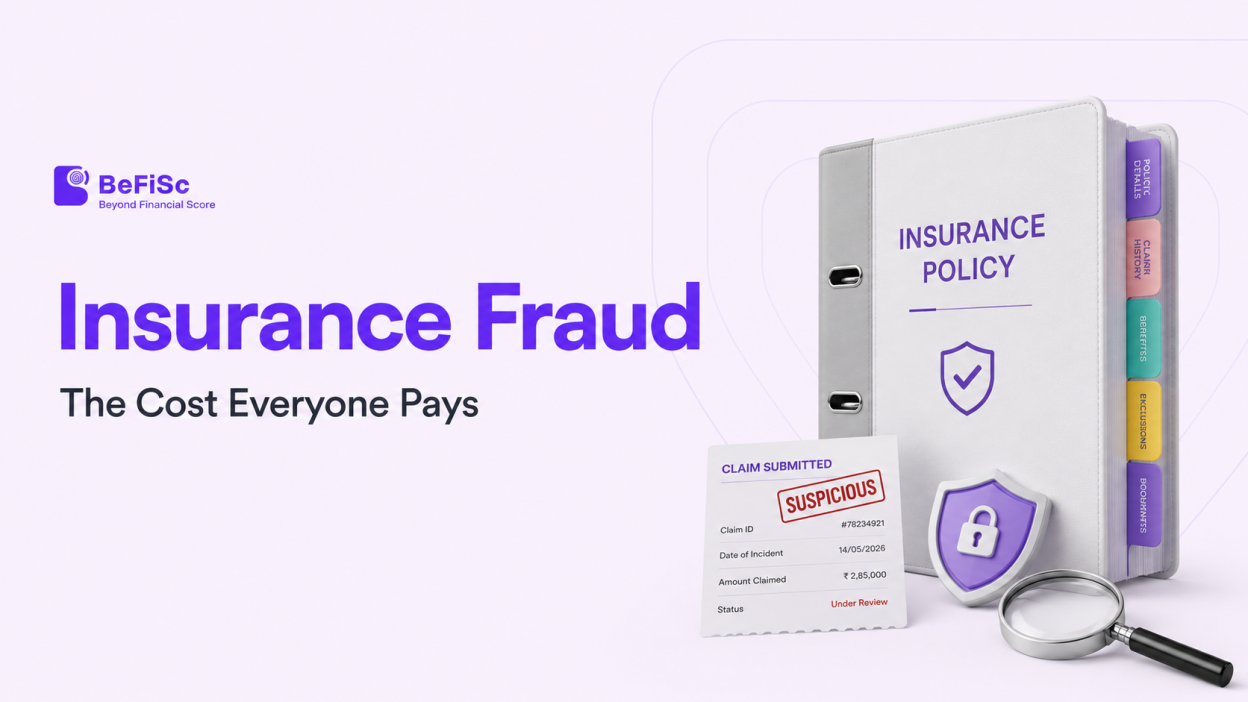
Insurance works by pooling risk; many people pay premiums so that the few who suffer losses can be compensated. It attacks this foundation directly, extracting money from the pool through false applications and fabricated or inflated claims, so that money meant to compensate genuine losses instead flows to those who deceive. The cost is not borne by insurers alone; it is passed to every honest policyholder through higher premiums, making insurance fraud a cost that everyone ultimately pays. It ranges from the individual exaggerating a claim to sophisticated organised rings staging accidents and fabricating losses at scale, and it spans every line of insurance.
It shares deep parallels with the [application fraud], [first-party fraud], and detection challenges this series has explored, applied to the specific context of insurance. This guide explains what insurance fraud is, its two entry points (application and claims), the distinction between soft and hard fraud, organised insurance fraud, the red flags, why it is hard to detect, and how insurers fight it with data and AI.
What Is Insurance Fraud?
It is any act of deception committed against an insurer to obtain an improper payment or benefit through false information on an insurance application or through false, fabricated, exaggerated, or staged claims, extracting money from the insurance system that the perpetrator is not genuinely entitled to.
The defining characteristic is deception to obtain improper insurance benefits. It deceives the insurer about the risk being insured (application fraud) or about a loss (claims fraud) to obtain a payment or benefit the perpetrator does not legitimately deserve. Whether misrepresenting information to obtain coverage or cheaper premiums, or fabricating or inflating a claim to obtain a payout, the fraud extracts improper value through deception.
It attacks the risk-pooling foundation of insurance. Insurance works by pooling premiums to compensate for genuine losses; insurance fraud extracts money from this pool through deception, so that funds meant for genuine claims flow to fraudsters. This is why it harms everyone; the extracted money raises the cost of insurance, passed to honest policyholders through higher premiums. Insurance fraud is a cost borne by all honest policyholders, not just insurers.
It spans a wide spectrum from individuals committing opportunistic fraud (exaggerating a genuine claim) to organised criminals staging elaborate schemes (fabricated accidents, ghost policies, systematic fraud). It affects every line of insurance (health, motor, life, property, and others), and it occurs at two entry points: the application (deceiving to obtain coverage) and the claim (deceiving to obtain a payout). Understanding insurance fraud as deception against insurers to obtain improper benefits spanning application and claims, individuals and organised rings, and every insurance line is the foundation for understanding its types and detection, and for recognising it as a cost that ultimately falls on everyone who buys insurance honestly.
Application Fraud vs Claims Fraud
It occurs at two fundamental entry points: the application and the claim, and understanding this distinction clarifies the two faces of insurance fraud.
Application (underwriting) fraud. Application fraud deceives the insurer at the application/underwriting stage, providing false information to obtain coverage, obtain it when it should be denied, or obtain cheaper premiums than the true risk warrants. Examples include misrepresenting health, circumstances, or risk factors; concealing material information; and falsifying details to obtain favourable terms. Application fraud corrupts the underwriting process: the insurer prices and provides coverage based on false information, mispricing or wrongly granting the risk. This parallels the [application fraud] discussed for financial services, applied to insurance underwriting.
Claims fraud. Claims fraud deceives the insurer at the claim stage, making false, fabricated, exaggerated, or staged claims to obtain a payout the perpetrator is not entitled to. Examples include fabricating losses that did not occur, exaggerating genuine losses, staging accidents or events, and claiming for pre-existing or excluded conditions. Claims fraud extracts improper payouts through deception about losses. This is the most visible form of insurance fraud: the fabricated or inflated claim.
The two-entry-point significance. The distinction matters because the two require different detection and defences. Application fraud is detected at underwriting by verifying application information, assessing risk accurately, and detecting misrepresentation. Claims fraud is detected at claims by investigating claims, verifying losses, and detecting fabrication and exaggeration. Insurers must defend both entry points: accurate underwriting (against application fraud) and rigorous claims assessment (against claims fraud). Focusing only on one leaves the other exposed.
The connection. The two can connect: application fraud (obtaining coverage through deception) can set up subsequent claims fraud (claiming on the fraudulently obtained coverage), and sophisticated schemes combine both (obtaining coverage to then claim fraudulently). Understanding both entry points and their potential connection clarifies the full scope of insurance fraud deception at application, at claims, or both and the need to defend both the underwriting and claims stages against the deception that insurance fraud represents.
Soft Fraud vs Hard Fraud
It is commonly distinguished as “soft” or “hard,” and understanding this distinction clarifies the spectrum of intent and severity.
Soft fraud (opportunistic). Soft fraud is opportunistic, typically involving exaggerating an otherwise genuine claim or minor misrepresentation by ordinary policyholders who are not career criminals. Examples include inflating the value of a genuine loss, adding minor false elements to a real claim, or minor application misrepresentation. Soft fraud is usually opportunistic and individual, a genuine policyholder taking advantage, exaggerating, or bending the truth, rather than fabricating from nothing. It is widespread precisely because it involves ordinary people making opportunistic choices, and it can seem minor individually but is significant in aggregate.
Hard fraud (deliberate). Hard fraud is deliberate and premeditated fabrication of losses, staging events, or committing it as an intentional scheme, often by organised criminals. Examples include staging accidents, fabricating claims for losses that never occurred, and organised fraud rings. Hard fraud is deliberate fabrication and premeditated deception, frequently involving organised crime, and it is more serious per incident than soft fraud. Hard fraud is the calculated, fabricated insurance fraud that organised schemes represent.
The spectrum and its parallel. The soft-hard distinction mirrors the [intent spectrum] seen throughout fraud from opportunistic exaggeration (soft, like [friendly fraud]) to deliberate fabrication (hard, like organised fraud). Soft fraud is the widespread, opportunistic, individual end; hard fraud is the deliberate, premeditated, often organised end. Both are insurance fraud, but they differ in intent, severity, and how they are addressed.
The detection and response implications. The distinction affects detection and response. Soft fraud is widespread but individually small, hard to detect (genuine claims with exaggeration) and addressed partly through claims scrutiny and deterrence. Hard fraud is more serious and organised, requiring investigation, [network analysis], and law enforcement. Insurers address both: scrutinising claims for exaggeration (soft fraud) and investigating fabricated and organised schemes (hard fraud). Understanding the soft-hard distinction clarifies the spectrum of insurance fraud from opportunistic exaggeration by ordinary policyholders to deliberate fabrication by organised criminals and the different detection and response each requires. Both matter: soft fraud for its aggregate cost, hard fraud for its severity.
The Main Types of Insurance Fraud
It takes many specific forms across insurance lines, and understanding the main types clarifies the landscape.
Claims fabrication and exaggeration. Fabricating losses that did not occur or exaggerating genuine losses to obtain larger payouts is core claims fraud, spanning from soft (exaggeration) to hard (full fabrication). This is the most common insurance fraud, inflating or inventing claims.
Staged events. Staging accidents, thefts, damage, or other insured events to claim for losses deliberately caused or faked is a form of hard fraud, often organised. Staged motor accidents are a classic example, deliberately causing or faking accidents to claim.
Application misrepresentation. Providing false information on applications, misrepresenting health, circumstances, risk factors, or concealing material information to obtain coverage or cheaper premiums (application fraud). This corrupts underwriting through deception.
Ghost and phantom policies/claims. Ghost policies (policies for non-existent or fabricated insureds) and phantom claims (claims for non-existent losses or insureds) fabricate the insured or the loss entirely. Ghost policies and phantom claims involve fabrication at a fundamental level, connecting to [identity and synthetic-identity] fraud applied to insurance.
Premium fraud. Deceiving to obtain lower premiums than the true risk warrants, misrepresenting risk factors to reduce premiums, a form of application fraud focused on pricing.
Health insurance fraud. In health insurance fabricated or inflated medical claims, billing for services not rendered, claims for excluded or pre-existing conditions, and provider fraud (fraud by healthcare providers). Health insurance fraud is significant and varied, involving both policyholders and providers.
Motor insurance fraud. In motor insurance, staged accidents, exaggerated damage claims, fabricated thefts, and organised motor fraud rings. Motor insurance fraud is common and often organised.
In life insurance, fabricated deaths, murder for insurance, and application fraud concealing material health information. Life insurance fraud, while less common, can be serious.
The breadth. Insurance fraud spans these types across every insurance line, a broad landscape of deception at application and claims, by individuals and organised rings. Understanding the main types clarifies the varied ways insurance fraud manifests, and the need for detection tailored to each insurance line’s specific fraud patterns. The common thread is deception to extract improper benefit, taking many forms across the insurance landscape.
Organised Insurance Fraud
Beyond individual fraud, organised insurance fraud schemes run by criminal rings represent a serious and distinct threat, and understanding them clarifies the high-severity end of it.
The organised-ring model. Organised insurance fraud involves criminal rings systematically committing insurance fraud at scale, staging accidents, fabricating claims, running ghost-policy schemes, and coordinating fraud across many claims, policies, and participants. Organised rings treat insurance fraud as a business, systematically extracting money through coordinated, repeated fraud. This is hard fraud at an organised scale.
The staged-accident schemes. A common organised scheme is staged accidents rings deliberately causing or faking accidents, then filing coordinated claims (for vehicle damage, injuries, and related losses), often involving multiple participants (drivers, passengers, and sometimes complicit providers). Staged-accident rings extract substantial money through coordinated fabricated claims, and they are a significant organised-fraud threat, especially in motor insurance.
The provider and professional involvement. Organised insurance fraud often involves complicit professionals, healthcare providers, repair services, or others who facilitate the fraud (fabricating medical claims, inflating repair costs, providing false documentation). Professional involvement lends the fraud false credibility and enables systematic schemes. Provider fraud, particularly in health insurance, is a significant organised-fraud dimension.
The network nature. Organised insurance fraud is inherently networked, involving connected participants, claims, policies, and schemes. This network nature means [graph and network analysis] is particularly powerful for detecting organised insurance fraud exposing the connections between claims, participants, providers, and policies that reveal organised rings. Individual-claim analysis misses the organised scheme; network analysis reveals the ring. This connects organised insurance fraud to the network-detection theme throughout this series.
The severity and response. Organised insurance fraud is serious, extracting substantial money through systematic, coordinated schemes, and often involves organised crime. Addressing it requires investigation, network analysis, data sharing across insurers (to detect rings operating across companies), and law enforcement. The organised, networked, systematic nature of organised insurance fraud makes it a high-severity threat requiring sophisticated detection and coordinated response. Understanding organised insurance fraud, its ring model, staged schemes, professional involvement, and network nature clarifies the serious end of insurance fraud and the network-analysis and coordinated approaches needed to combat it.
Why Insurance Fraud Is Hard to Detect
Insurance fraud presents distinctive detection challenges, and understanding them clarifies why it persists and what detection must overcome.
The genuine-claim resemblance. Much insurance fraud, especially soft fraud and sophisticated hard fraud, resembles genuine claims. An exaggerated claim looks like a genuine claim; a well-fabricated claim mimics a real one; application misrepresentation looks like honest information. Distinguishing fraudulent from genuine claims and applications is genuinely difficult, because fraud is designed to look legitimate. This resemblance is the core detection challenge in telling the fraudulent from the genuine when they look alike.
The hidden intent. As with [first-party fraud] generally, insurance fraud often lies in intent and truth (whether the claim is genuine, whether the application is truthful) that is not directly observable. Whether a policyholder exaggerated, whether a loss really occurred, whether information was truthfully disclosed- these truths are hard to verify, and the deception is in the hidden reality. Detecting insurance fraud requires uncovering hidden truth, which is difficult.
The verification difficulty. Verifying claims and applications, whether losses genuinely occurred and whether information is true, can be difficult and resource-intensive. Investigating every claim thoroughly is impractical (most claims are genuine, and investigation is costly), so insurers must identify which claims warrant scrutiny, risking missing fraud (under-investigation) or wrongly suspecting genuine claims (over-investigation). The verification challenge and its resource constraints make comprehensive fraud detection difficult.
The volume and speed pressure. Insurers process large volumes of claims and applications, with pressure to process them quickly (for customer service and efficiency). This volume and speed pressure limits the scrutiny each claim receives, creating an opportunity for fraud to slip through. Balancing efficient processing against fraud detection is a genuine tension, mirroring the [friction-fraud tension] elsewhere.
The false-positive cost. Wrongly suspecting genuine claims (false positives) harms genuine customers by delaying or denying legitimate claims, damaging trust and experience. Insurance fraud detection must avoid wrongly flagging genuine claims, balancing fraud detection against fair treatment of honest policyholders. This false-positive concern, central throughout this series, applies strongly to insurance, where wrongly denying genuine claims is a serious harm.
These challenges genuine-claim resemblance, hidden intent, verification difficulty, volume pressure, and false-positive cost make insurance fraud hard to detect and drive the data-and-AI approaches (below) that improve detection while managing the balance between catching fraud and fairly serving genuine policyholders. Understanding the challenges clarifies why insurance fraud persists and what its detection must overcome.
How Insurers Detect and Fight Fraud
Insurers combat fraud through a combination of data, analytics, AI, and investigation, and understanding these approaches clarifies the modern insurance-fraud defence.
Data and analytics. Insurers use data analytics to identify potentially fraudulent claims and applications, analysing patterns, anomalies, and risk indicators to flag those warranting scrutiny. Data-driven detection identifies suspicious claims and applications from patterns that manual review would miss, focusing investigation on higher-risk cases. This analytical approach is foundational to modern insurance-fraud detection.
AI and machine learning. [AI and machine learning] increasingly power insurance-fraud detection, learning fraud patterns from data, scoring claims and applications for fraud risk, and detecting subtle and complex fraud that rules and manual review miss. AI improves detection accuracy, catching more fraud while reducing false positives (better distinguishing fraudulent from genuine), and enabling detection at the volume and speed insurers require. AI is central to modern insurance fraud detection, applying the [AI-fraud-detection] principles to insurance.
Network and link analysis. [Graph and network analysis]detects organised insurance fraud exposing the connections between claims, participants, providers, and policies that reveal organised rings. Network analysis is particularly powerful against organised, networked insurance fraud, uncovering the schemes that individual-claim analysis misses. This is a key tool against organised insurance fraud.
Application and underwriting verification. At the application stage, verifying information [identity verification], information verification, and risk assessment detects application fraud, ensuring underwriting is based on accurate information. Robust underwriting verification defends the application entry point against misrepresentation and fabrication.
Claims investigation. Rigorous claims assessment and investigation, verifying losses, investigating suspicious claims, and detecting fabrication and exaggeration defend the claims entry point. Focused investigation of flagged claims (identified by analytics and AI) uncovers claims fraud efficiently, concentrating investigation where fraud risk is highest.
Data sharing and industry collaboration. Sharing fraud intelligence across insurers and detecting fraud rings operating across multiple insurers addresses organised fraud that spans companies. Industry collaboration and shared databases reveal fraud patterns and rings that no single insurer sees alone, a key defence against organised and cross-insurer fraud.
The layered, balanced approach. Effective insurance-fraud defence combines these data analytics and AI (flagging risk), network analysis (organised fraud), underwriting and claims verification (both entry points), investigation (focused scrutiny), and industry collaboration (cross-insurer fraud) into a layered approach, balanced against fairly serving genuine policyholders (managing false positives). This layered, AI-enabled, balanced defence is how modern insurers combat fraud, catching fraud efficiently across both entry points while fairly treating the honest majority. Understanding these approaches clarifies the modern insurance-fraud defence and its connection to the data, AI, and network-analysis themes central to this series.
Key Takeaways
- Insurance fraud is deception against insurers to obtain improper payment or benefit through false applications or false, fabricated, exaggerated, or staged claims, extracting money from the risk pool that everyone ultimately pays for through higher premiums.
- It occurs at two entry points: application (underwriting) fraud, deceiving to obtain coverage or cheaper premiums, and claims fraud, deceiving to obtain improper payouts, both must be defended.
- It spans soft fraud (opportunistic exaggeration by ordinary policyholders) and hard fraud (deliberate fabrication, often organised), a spectrum of intent and severity requiring different responses.
- Organised insurance fraud (criminal rings staging accidents, running ghost policies, involving complicit providers) is a serious, networked threat best detected through graph and network analysis.
- It’s hard to detect because fraud resembles genuine claims, intent is hidden, and verification is difficult driving data, AI, and network-analysis approaches balanced against fairly serving honest policyholders.
Frequently Asked Questions
How do insurers detect fraud?
Insurers detect fraud using data analytics and AI (flagging suspicious claims and applications), network analysis (detecting organised rings), underwriting verification (application fraud), claims investigation (claims fraud), and industry data sharing (cross-insurer fraud) a layered approach balanced against fairly serving genuine policyholders and avoiding false positives.
What is organised insurance fraud?
Organised insurance fraud involves criminal rings systematically committing fraud at scale staging accidents, fabricating claims, running ghost-policy schemes, and coordinating fraud across participants, often with complicit providers. It’s networked in nature, making graph and network analysis particularly effective at detecting the connections that reveal rings.
What is the difference between soft and hard insurance fraud?
Soft fraud is opportunistic ordinary policyholders exaggerating genuine claims or making minor misrepresentations. Hard fraud is deliberate and premeditated fabricating losses, staging events, or organised schemes, often by criminals. Soft fraud is widespread but individually small; hard fraud is more serious per incident and frequently organised.
What is the difference between application fraud and claims fraud in insurance?
Application (underwriting) fraud deceives the insurer at the application stage providing false information to obtain coverage or cheaper premiums. Claims fraud deceives at the claim stage making false, fabricated, exaggerated, or staged claims for improper payouts. Insurers must defend both entry points with different detection approaches.
What is insurance fraud?
Insurance fraud is any deception committed against an insurer to obtain an improper payment or benefit through false information on an application, or through false, fabricated, exaggerated, or staged claims. It extracts money from the insurance risk pool, raising costs that are passed to honest policyholders through higher premiums.
Conclusion
Insurance fraud is a betrayal of the simple, powerful idea at the heart of insurance: that many contribute so the unfortunate few can be made whole. By extracting money from that shared pool through false applications and fabricated claims, insurance fraud diverts funds meant for genuine losses to those who deceive, and because the loss is spread across the pool, it is honest policyholders who ultimately pay, through the higher premiums that fraud drives. This is why insurance fraud is not a victimless crime against faceless insurers but a cost borne by everyone who buys insurance in good faith.
Its challenge lies in its resemblance to legitimacy. From the ordinary policyholder who exaggerates a genuine claim to the organised ring that stages accidents and fabricates losses at scale, insurance fraud is designed to look like the real thing: genuine claims, truthful applications, legitimate losses. Distinguishing the fraudulent from the genuine, when they look alike, and the deception hides in unobservable intent, is the core difficulty, made harder by the volume and speed of claims and the real harm of wrongly denying honest policyholders. The modern response meets this challenge with data and AI that flag risk from patterns invisible to manual review, network analysis that exposes the organised rings behind coordinated schemes, rigorous verification at both the application and claims entry points, and industry collaboration that reveals fraud spanning multiple insurers. Balanced carefully against the imperative to serve the honest majority fairly, this layered, intelligent defence is how insurers protect the risk pool. In the end, fighting insurance fraud is about protecting the integrity of a shared promise that when genuine loss strikes, the pool will be there and ensuring that the deception of the few does not erode the trust and affordability on which insurance, for everyone, depends.