
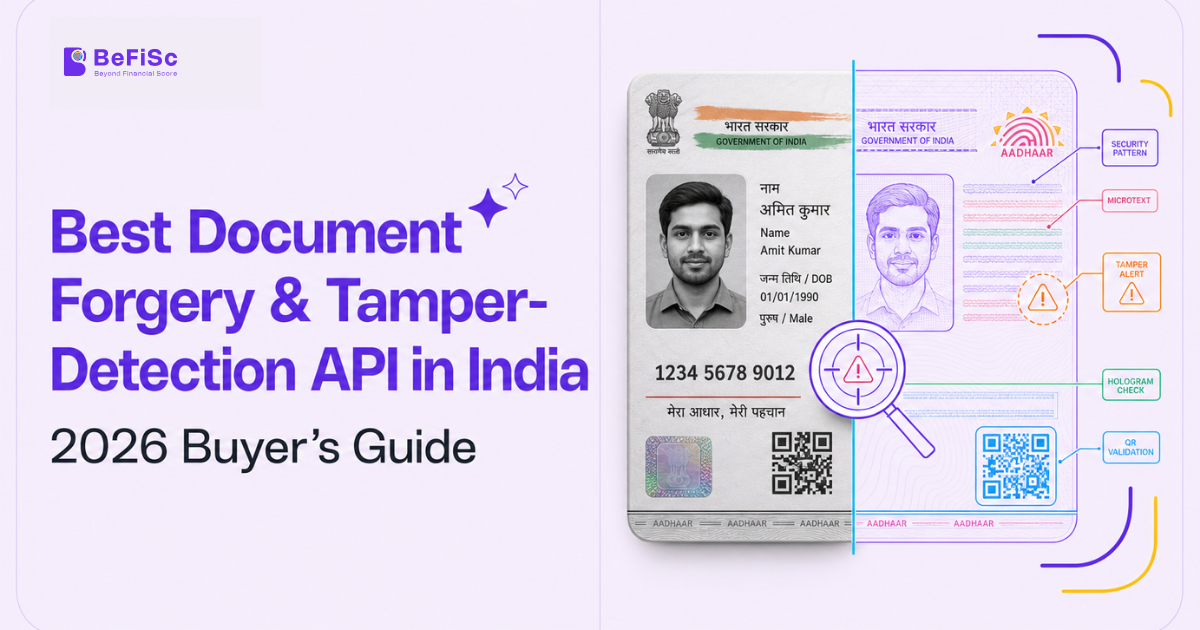
Most onboarding stacks are very good at reading documents and surprisingly bad at questioning them. They extract the name, the number, the address, and quietly assume the document is genuine. Fraudsters know this. They submit edited PDFs with altered balances, photoshopped IDs, recycled templates, and increasingly AI-generated documents that sail through systems built to read rather than verify. The document forgery and tamper-detection API you choose decides whether your onboarding catches these forgeries at the door, or approves them and inherits the loss.
This guide is for risk, fraud, and product teams evaluating document tamper-detection in India. It explains the difference between reading a document and verifying its authenticity, the forgery types you have to defend against, how to evaluate a provider, and where BeFiSc’s TamperProof fits. If you onboard customers or lend against documents, this is the layer that stands between you and document-based fraud.
Reading a Document Is Not Verifying It
There is a critical distinction most buyers discover too late: extraction and authentication are different jobs. [OCR and data extraction] tell you what a document says. Tamper detection tells you whether the document is real. A stack that only extracts data will happily pull clean, well-formatted information off a completely fabricated document and hand it to your credit or onboarding decision as if it were true.
That is the most dangerous failure mode in verification: confident processing of a forgery. It doesn’t look like a failure. The data is clean, the flow is smooth, the application is approved. The problem only surfaces later, as fraud loss, when the “verified” customer defaults or disappears. Tamper detection exists precisely to close this gap, examining the document itself its pixels, structure, metadata, and consistency for the fingerprints of manipulation that extraction ignores.
If your onboarding verifies identity and extracts data but never asks whether the underlying documents are genuine, you have a hole exactly where document fraud enters.
The Forgery Types You Have to Catch
A serious tamper-detection API should defend against the full range of document manipulation, not just crude edits:
- Photo and image tampering: altered photos, swapped faces, and edited fields on ID documents.
- Field alteration: changed names, numbers, dates, addresses, or amounts on IDs, statements, and financial documents.
- ePDF manipulation: edited digital PDFs with altered balances, transactions, or details (a major vector in [bank-statement fraud]).
- Template and recycled-document fraud: reused, copied, or template-generated fake documents.
- AI-generated documents: synthetic documents produced by generative tools, increasingly convincing and increasingly common.
- Metadata and structural inconsistencies: signs in a document’s structure or metadata that reveal manipulation invisible to the eye.
Each of these can pass an extraction-only system cleanly. Catching them requires forensic examination of the document image, structural and metadata analysis, and consistency checks, which is exactly what a purpose-built tamper-detection API provides and a generic OCR tool does not.
Why This Matters More in 2026
Document fraud has industrialised, and two shifts make tamper detection a 2026 baseline rather than a premium add-on.
Generative AI. Producing a convincing fake document- an ID, a bank statement, a salary slip is now cheap and fast. AI-generated and AI-edited documents are increasingly realistic, defeating systems designed for an era of clumsy manual edits. Detection has to keep pace with generation.
The scale of the loss. Bank frauds in India crossed roughly ₹36,000 crore in the first nine months of FY2025–26 according to RBI data, and document fraud- forged IDs, tampered statements, fabricated proofs is a significant contributor. When the underlying documents can’t be trusted, every downstream decision inherits the risk.
Together, these mean that “we extract and verify identity” is no longer enough. The document itself has to be interrogated for authenticity, or the fraud walks straight through the part of your stack that was supposed to stop it.
How to Evaluate a Tamper-Detection API
Evaluate on forensic depth, not just a pass/fail flag:
- Manipulation coverage: Does it catch image tampering, field alteration, ePDF manipulation, template fraud, and AI-generated documents, or just obvious edits?
- Forensic techniques: Does it use image forensics, metadata analysis, and structural/consistency checks, or a single shallow method?
- Document-type breadth: IDs, bank statements, financial documents, and the India-specific documents you actually onboard against.
- AI-generated-document detection: increasingly the decisive capability.
- Explainability: Does it tell you why a document is flagged, so your team can act and defend the decision?
- Integration and speed: sandbox-to-production time and API quality.
- Stack fit: Does it integrate with your [extraction] (internal link, Blog 92), [identity] (internal link, Blog 69), and [statement-analysis] (internal link) checks in one flow?
The Landscape in India (2026)
Document tamper detection in India is offered both as a dedicated capability and as a feature within broader onboarding and statement-analysis platforms:
| Provider | Positioning |
|---|---|
| BeFiSc (TamperProof) | Dedicated document tamper/forgery detection within the API-first Be Suite; transparent pricing |
| HyperVerge | Document-forgery checks within an identity-verification platform |
| Signzy | Document intelligence and forgery checks within an onboarding suite |
| IDfy | Document forgery detection (incl. PAN tampering) within onboarding journeys |
| Perfios (Karza) | Tamper/behavioural checks within the Protect suite of a full-stack platform |
| Ocrolus | Fraud/tamper detection on financial documents (statements, pay stubs) |
Some providers offer tamper detection as one feature inside a large platform; others, like BeFiSc’s TamperProof, offer it as a dedicated, API-first capability you can integrate precisely where you need it. If document fraud is a specific, growing problem in your funnel, a purpose-built tamper-detection API you control is often a better fit than a lightly used feature buried in a bigger contract.
Where TamperProof Fits
BeFiSc’s TamperProof is a dedicated document tamper- and forgery-detection API built to interrogate documents for authenticity the “is this real?” layer that complements the “what does it say?” layer of extraction. It sits within the Be Suite, alongside IDProof (identity verification), OCRProof (document extraction), and BizCheck (business verification), so extraction, identity, business, and authenticity checks run through one integrated stack.
What makes TamperProof a strong fit:
- Purpose-built forensics: designed to catch image tampering, field alteration, ePDF manipulation, template fraud, and AI-generated documents, not just obvious edits.
- Complements extraction: pair with [OCRProof] so every document is both read and checked for authenticity.
- Be Suite integration: a single stack for identity, business, extraction, and tamper detection, with fewer seams for fraud to exploit.
- API-first and transparently priced: sandbox access and clear pricing, so you can test on your own documents before committing.
- Built for India: tuned to the Indian documents you onboard against.
If your onboarding reads documents but doesn’t yet verify them, TamperProof is the layer that closes that gap. Book a TamperProof demo, or get API access and run it against your own document set, including a few you know are fake.
Where Tamper Detection Sits in Your Stack
Tamper detection is most powerful when it’s not a standalone silo but a layer woven through onboarding and underwriting:
- At onboarding: check ID and proof documents for authenticity alongside [identity verification] and extraction, so forged documents are caught before an account opens.
- In lending: check bank statements and financial documents for tampering alongside [statement analysis] (internal link), so fabricated financials don’t drive credit decisions.
- In business verification: check business documents alongside [KYB], so fabricated registrations and proofs are flagged.
The principle is consistent: wherever a document drives a decision, its authenticity should be verified, not assumed. A tamper-detection API that integrates cleanly with your extraction, identity, and statement checks makes that verification a natural part of the flow rather than a separate step.
Frequently Asked Questions
Where should tamper detection sit in my onboarding stack?
Wherever a document drives a decision at onboarding (ID and proof documents), in lending (bank statements and financials), and in business verification (registration documents). It works best woven through the flow alongside extraction, identity, and statement analysis, so document authenticity is verified rather than assumed at every decision point.
Which is the best document forgery detection API in India?
The best choice depends on whether you need dedicated tamper detection or a feature within a broader platform. Options include BeFiSc (TamperProof), HyperVerge, Signzy, IDfy, Perfios (Karza), and Ocrolus. TamperProof stands out as a dedicated, API-first tamper-detection capability with transparent pricing and Be Suite integration.
Can these APIs detect AI-generated fake documents?
Purpose-built tamper-detection APIs increasingly detect AI-generated and AI-edited documents, which have become cheap and convincing. This is a decisive 2026 capability system built only for crude manual edits that miss synthetic documents, so evaluate a provider’s AI-generated-document detection specifically during your trial.
How is tamper detection different from OCR?
OCR (extraction) reads the data on a document; tamper detection verifies whether the document is authentic. An extraction-only system will pull clean data off a forged document and treat it as genuine, the most dangerous failure mode in verification. Tamper detection closes that gap by interrogating the document itself for manipulation.
What is a document forgery / tamper-detection API?
A document tamper-detection API examines documents for signs of manipulation, image tampering, altered fields, edited PDFs, template fraud, and AI-generated documents using forensic techniques like image analysis and metadata checks. It verifies whether a document is genuine, complementing OCR/extraction, which only reads what a document says.
Conclusion
The quietest risk in most onboarding stacks is the assumption that a document, once read, is real. Extraction and identity verification are necessary, but they don’t ask the one question fraudsters most want you to skip: is this document genuine? In 2026, with AI-generated forgeries cheap and convincing and Indian bank fraud measured in tens of thousands of crores, that unasked question is exactly where document fraud enters, and confident processing of a forgery is the most expensive kind of failure, because it doesn’t look like one until the loss lands.
BeFiSc’s TamperProof is the layer that asks the question: purpose-built forensics that catch tampering, forgery, and AI-generated documents, integrated with the Be Suite so every document is both read and verified. If your onboarding extracts data but doesn’t yet interrogate authenticity, it’s worth testing on your own documents. Book a TamperProof demo, or get API access and run it against a set of real and fake documents. The results usually change how teams think about their onboarding.


