
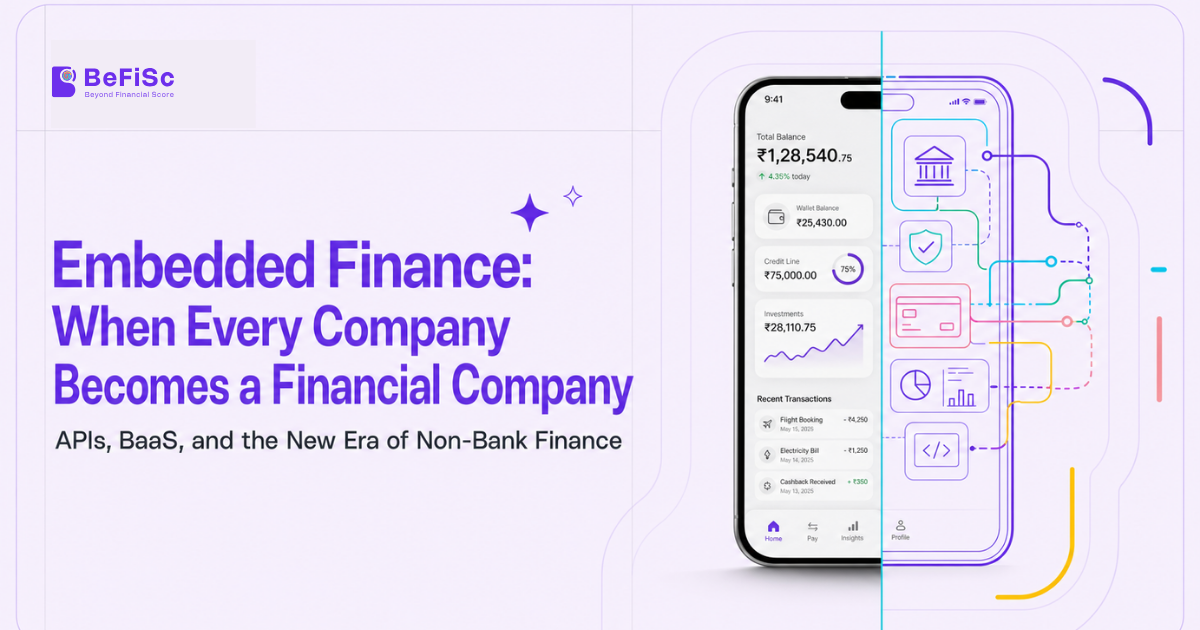
The most significant shift in how financial services reach people may be that they increasingly do not come from banks at all, at least not visibly. When a ride-hailing app offers its drivers instant earnings and a debit card, when an e-commerce platform lets a small seller borrow against future sales, when a checkout page offers instalment payments without redirecting anywhere, financial services are being delivered inside non-financial products, at the exact moment they are needed. This is embedded finance: the integration of financial services into the platforms, apps, and journeys of non-financial businesses, so that banking, lending, payments, and insurance appear seamlessly within products people already use.
Embedded finance is reshaping the financial-services landscape, blurring the line between financial and non-financial companies and creating new opportunities and new risks around who delivers financial services and how they are regulated. It rests on the [API banking] and infrastructure this series has explored, and it raises distinctive compliance and fraud questions. This guide explains what embedded finance is, how the banking-as-a-service model enables it, its main forms, why it is growing, the regulatory and fraud considerations, and the Indian context.
What Is Embedded Finance?
Embedded finance is the integration of financial services such as payments, lending, banking, and insurance directly into the products, platforms, and customer journeys of non-financial businesses, so that these services are delivered seamlessly within a non-financial context rather than through a separate financial institution.
The defining characteristic is financial services embedded within non-financial products. Rather than a customer going to a bank or financial provider separately, embedded finance brings the financial service into the non-financial product they are already using: a payment within an app, a loan within an e-commerce platform, insurance within a purchase. The financial service becomes part of the non-financial experience, delivered at the point of need within the customer’s existing journey.
This represents a shift in how and where financial services are delivered. Traditionally, financial services came from financial institutions, accessed separately. Embedded finance delivers them within non-financial platforms and moments, with the financial service integrated seamlessly into the non-financial product, often invisibly (the customer may not perceive a separate financial provider at all). The financial service is embedded, contextual, and seamless rather than separate and standalone.
Embedded finance is enabled by financial infrastructure, such as APIs, banking-as-a-service platforms, and fintech infrastructure that let non-financial companies integrate financial services into their products. A non-financial company does not become a bank; it embeds financial services provided (behind the scenes) by licensed financial institutions and infrastructure providers, delivered through the non-financial company’s product. This infrastructure, the subject of the banking-as-a-service model below, is what makes embedded finance possible, letting any company embed financial services without becoming a financial institution itself. Understanding embedded finance as financial services seamlessly integrated into non-financial products, enabled by financial infrastructure, is the foundation for understanding its model, forms, and implications.
The Banking-as-a-Service Model
Embedded finance is enabled primarily by the banking-as-a-service (BaaS) model, and understanding it clarifies how non-financial companies deliver financial services.
The BaaS concept. Banking-as-a-service (BaaS) is a model in which licensed financial institutions provide financial services and infrastructure to non-financial companies through APIs, enabling those companies to embed financial services into their products. The licensed institution provides the regulated financial capability (the banking, lending, or payment service, and the licence and compliance behind it), while the non-financial company provides the customer-facing product and experience. BaaS is the infrastructure layer that lets non-financial companies offer financial services without holding the licences themselves.
The three-party structure. Embedded finance via BaaS typically involves three parties: the licensed financial institution (providing the regulated financial service and holding the licence), the BaaS/infrastructure provider (providing the technical platform and APIs connecting the institution to the non-financial company, sometimes the institution itself, sometimes a separate fintech), and the non-financial company (embedding the financial service into its product and owning the customer relationship). This structure distributes the roles of regulated capability, technical infrastructure, and customer-facing product across the parties, enabling embedded finance.
API enablement. The technical enablement is through APIs; the non-financial company integrates the financial service via APIs provided by the BaaS platform, embedding the capability into its product. APIs make the integration seamless and scalable, letting non-financial companies embed financial services relatively easily. This [API-driven] integration is central to embedded finance, connecting it to the broader API-banking and open-finance developments.
The licence-and-compliance division. A crucial feature is the division of licence and compliance: the licensed financial institution holds the regulatory licence and bears (or shares) regulatory responsibility, while the non-financial company embeds the service without holding the licence. This division lets non-financial companies offer financial services without becoming licensed institutions, but it also creates the regulatory complexity (discussed below) of who is responsible for compliance, a central embedded-finance challenge. The licence remains with the institution, but the customer-facing service is delivered by the non-financial company, distributing responsibility in ways that require careful governance.
The infrastructure significance. BaaS is the infrastructure that makes embedded finance possible, the layer connecting regulated financial capability to non-financial products. Understanding BaaS clarifies how embedded finance works: licensed institutions provide regulated financial services through API-driven infrastructure to non-financial companies, which embed those services into their products, delivering financial services within non-financial contexts. This model regulated capability, technical infrastructure, and non-financial delivery is the engine of embedded finance, and its licence-and-responsibility structure shapes the regulatory and fraud considerations that follow.
The Main Forms of Embedded Finance
Embedded finance takes several main forms, corresponding to the financial services embedded, and understanding them clarifies the landscape.
Embedded payments. Integrating payment capabilities directly into non-financial products, enabling payments within an app or platform without redirecting to a separate payment provider. Embedded payments make paying seamless within the product (in-app payments, one-click checkout, integrated payment flows), and they are among the most common embedded-finance forms. The seamless payment experience within non-financial products is embedded payments.
Embedded lending. Integrating lending and credit into non-financial products, offering loans, credit, or financing within the customer’s journey, at the point of need. Examples include [BNPL] at checkout, financing within e-commerce, and credit offered to a platform’s users or sellers (like working-capital loans to marketplace sellers). Embedded lending delivers credit contextually within non-financial products, often using the platform’s data to assess borrowers. It is a significant and growing embedded-finance form.
Embedded banking (accounts and cards). Integrating banking capabilities accounts, cards, and banking features into non-financial products. Examples include platforms offering their users or workers accounts and cards (a gig platform offering drivers accounts and instant earnings, a business platform offering integrated banking to its users). Embedded banking brings banking capabilities into non-financial platforms, letting them offer account and card features to their users.
Embedded insurance. Integrating insurance into non-financial products, offering relevant insurance at the point of need within the customer’s journey. Examples include insurance offered at purchase (travel insurance when booking, product insurance at checkout, coverage relevant to the transaction). Embedded insurance delivers contextual insurance within non-financial products, at the moment it is relevant.
Embedded investments and other services. Beyond these, embedded finance extends to investments, savings, and other financial services integrated into non-financial products, the general pattern of embedding relevant financial services contextually. The forms continue to expand as more financial services are embedded into more products.
The contextual-delivery theme. Across these forms, the common theme is contextual, seamless delivery of financial services within non-financial products at the point of need: payments where you transact, lending where you buy, banking where you work, insurance where you purchase. Embedded finance delivers the right financial service at the right moment within the non-financial experience, which is its core value. Understanding the main forms of payments, lending, banking, insurance, and beyond clarifies the breadth of embedded finance and the pattern of contextual, seamless financial-service delivery that unites them.
Why Embedded Finance Is Growing
Embedded finance is growing rapidly for compelling reasons, and understanding them clarifies its significance and trajectory.
The customer-experience benefit. Embedded finance improves customer experience by delivering financial services seamlessly within products people already use, at the point of need, without friction or redirection. Contextual, seamless financial services are more convenient than separate ones; paying, borrowing, or insuring within the product is easier than going elsewhere. This experience benefit drives adoption, as embedded finance meets customers’ needs more conveniently.
The value for non-financial companies. Embedded finance offers non-financial companies significant value: new revenue streams (from the embedded financial services), deeper customer relationships and engagement, and enhanced products. Embedding financial services lets non-financial companies monetise financial services, increase engagement, and improve their products, creating a strong incentive to embed finance. The commercial value for non-financial companies is a major growth driver.
The data advantage. Non-financial platforms often have rich data about their users (transactions, behaviour, activity) that enables better financial services; for example, a platform lending to its sellers using its data on their sales. This data advantage lets embedded finance offer better-targeted, better-underwritten financial services, connecting to [alternative-data] approaches. The data platforms they hold make their embedded financial services more effective, a further growth driver.
The infrastructure enablement. The maturation of [BaaS and API infrastructure] has made embedding financial services easier and more accessible, lowering the barrier for non-financial companies to embed finance. As the infrastructure has matured, embedding finance has become more feasible for more companies, accelerating growth. The enabling infrastructure is a key growth factor.
The financial-inclusion potential. Embedded finance can extend financial services to underserved users through the non-financial platforms they use, reaching people via platforms they already engage with, potentially advancing [inclusion]. By delivering financial services through widely used non-financial platforms, embedded finance can reach underserved populations, a potential inclusion benefit particularly relevant in markets like India. Together, these drivers- customer experience, commercial value, data advantage, infrastructure, and inclusion explain embedded finance’s rapid growth and its transformation of how financial services are delivered. Understanding why it is growing clarifies its significance and its trajectory toward financial services increasingly embedded within non-financial products.
The Regulatory Considerations
Embedded finance raises significant regulatory considerations, arising from its distribution of financial-service delivery across licensed and non-licensed parties, and understanding them clarifies a central challenge.
The licence-and-responsibility question. The core regulatory consideration is the division of licence and responsibility: the licensed institution holds the licence, but the non-financial company delivers the customer-facing service. This raises questions about who is responsible for regulatory compliance, consumer protection, and the various obligations attached to financial services. Regulators are concerned that financial services delivered through non-financial companies are properly regulated and that responsibility is clear, even though the customer-facing party is not the licence holder. Clarifying and ensuring compliance responsibility across the embedded-finance structure is a central regulatory challenge.
The compliance-across-the-chain challenge. Embedded finance’s multi-party structure (licensed institution, infrastructure provider, non-financial company) means compliance obligations span the chain [KYC/AML], consumer protection, [data protection], and other requirements must be met across the parties. Ensuring compliance is properly discharged across the embedded-finance chain, with clear responsibility, is complex and a key regulatory focus. Gaps or ambiguity in who ensures compliance can create risk, which regulators seek to address.
The consumer-protection concern. Regulators are concerned about consumer protection in embedded finance, ensuring customers are protected, understand the financial services they are using, know who provides them, and have appropriate recourse, even when the service is embedded in a non-financial product and the provider is not visible. The seamless, embedded delivery must not obscure consumer protections or leave customers unclear about their financial services and rights. Consumer protection in the embedded context is a significant regulatory consideration.
The regulatory-perimeter question. Embedded finance raises questions about the regulatory perimeter, ensuring that financial services delivered through non-financial companies remain within appropriate regulation, and that the model does not enable financial services to escape proper regulation. Regulators seek to ensure embedded finance operates within the regulatory framework, with financial services properly regulated regardless of the non-financial delivery. Keeping embedded finance within the regulatory perimeter is a policy focus.
The evolving regulatory response. Regulators are developing their responses to embedded finance and BaaS, clarifying responsibilities, ensuring compliance across the chain, protecting consumers, and keeping the model within appropriate regulation. In various jurisdictions, including India, regulatory attention to embedded finance, BaaS, and the responsibilities of the parties is developing, shaping how embedded finance must operate. Understanding the regulatory considerations of licence and responsibility, compliance across the chain, consumer protection, and the regulatory perimeter clarifies the central challenges embedded finance faces and the regulatory framework it must operate within, which is developing as the model grows.
Fraud and Compliance in Embedded Finance
Embedded finance carries distinctive fraud and compliance implications, and understanding them clarifies the risks that must be managed.
KYC/AML across the chain. Embedded finance must ensure [KYC and AML] obligations are met, customers verified, monitoring performed, and financial-crime risk managed across the embedded-finance chain. The question of who performs KYC/AML (the institution, the infrastructure provider, the non-financial company) and how it is ensured is a key compliance challenge. Robust KYC/AML must be discharged despite the distributed structure, ensuring embedded financial services are not misused for financial crime. This connects embedded finance to the [onboarding and verification] discipline central to this series.
The fraud exposure. Embedded finance faces the fraud risks of the financial services it embeds: [application fraud] in embedded lending, [payment fraud] in embedded payments, [account takeover] in embedded banking delivered through non-financial platforms. The embedded, seamless delivery must incorporate fraud prevention, and the non-financial platform’s fraud exposure now includes the embedded financial services. Managing fraud across embedded financial services, within the seamless experience, is a significant challenge, connecting to the [passive, risk-based fraud prevention] this series has emphasised.
The responsibility-clarity challenge. As with regulation, fraud and compliance responsibility must be clear across the embedded-finance chain: who prevents fraud, who ensures compliance, who bears the risk. Ambiguity in responsibility can create gaps where fraud and compliance failures occur. Clear allocation of fraud-prevention and compliance responsibility across the parties is essential to managing embedded-finance risk. This responsibility-clarity challenge is central to embedded-finance risk management.
The data-and-privacy dimension. Embedded finance involves sharing and using customer data across the parties (the non-financial platform’s data, the financial service’s data), engaging [data-protection]considerations. Ensuring data is properly protected and used across the embedded-finance chain, consistent with [DPDP] and privacy requirements, is important. The data-sharing inherent in embedded finance must respect privacy and data protection, a compliance dimension to manage.
The governance imperative. Managing embedded-finance fraud and compliance requires strong governance across the chain, clear responsibilities, robust KYC/AML, fraud prevention, data protection, and coordination among the parties. The distributed structure makes governance both more complex and more essential, ensuring that despite the multiple parties, fraud and compliance are properly managed. Understanding the fraud and compliance implications of embedded finance KYC/AML across the chain, fraud exposure, responsibility clarity, data protection, and governance clarifies the risks embedded finance must manage and the importance of strong governance across its distributed structure. Embedded finance’s benefits come with the responsibility to manage these risks well.
Embedded Finance in India
Embedded finance has significant relevance and a distinctive context in India, and understanding it clarifies the Indian embedded-finance landscape.
The infrastructure foundation. India’s [digital financial infrastructure] [UPI], [Aadhaar], [Account Aggregator], and the broader India Stack provide a strong foundation for embedded finance, enabling financial services to be embedded into digital products. India’s infrastructure makes embedding payments, lending, and other services relatively accessible, supporting embedded-finance growth. This infrastructure foundation is a distinctive Indian advantage for embedded finance.
The growth and applications. Embedded finance has grown in India across applications: embedded [payments] (UPI and other payments within apps), embedded lending (credit within platforms, [BNPL], seller financing), embedded banking, and embedded insurance. India’s digital-commerce growth and infrastructure have driven embedded-finance adoption across these applications, integrating financial services into the digital products Indians use. The growth reflects India’s digital-finance dynamism.
Regulatory attention. India’s regulators (notably the RBI) have given attention to embedded finance and related models, including [BaaS] arrangements, [digital lending], [PPI], and the responsibilities of the parties. RBI actions on [digital lending] (requiring regulated-entity involvement and transparency) and on [PPI-credit arrangements] reflect regulatory concern about ensuring embedded and platform-based financial services operate within proper regulation. The Indian regulatory framework for embedded finance and related models is developing, shaping how embedded finance operates in India.
The inclusion opportunity. Embedded finance offers significant inclusion potential in India, reaching underserved populations through the widely used digital platforms they engage with, delivering financial services (payments, credit) to those the traditional system has underserved. India’s large underserved population and widespread digital-platform use make embedded finance a potential inclusion driver, extending financial services through platforms people already use. This inclusion opportunity is a significant aspect of Indian embedded finance.
The distinctive landscape. India’s embedded-finance landscape, built on strong digital infrastructure, growing across applications, subject to developing regulation, and offering significant inclusion potential, is distinctive and dynamic. Understanding embedded finance in India clarifies how this global trend manifests in a market with world-leading digital financial infrastructure, significant inclusion needs, and active regulatory attention. Embedded finance in India represents both a major opportunity (inclusion, innovation, growth) and a developing regulatory challenge (ensuring proper regulation, compliance, and consumer protection across the model), making it a significant and evolving part of India’s financial landscape.
The Future of Embedded Finance
Embedded finance continues to evolve, and understanding its trajectory clarifies where it is heading.
The continued expansion. Embedded finance is expanding into more financial services (beyond payments and lending to insurance, investments, and more), more industries and platforms (embedding finance into ever more non-financial products), and more contexts. The trend is toward financial services increasingly embedded across the digital economy, with more companies embedding more financial services. This expansion is the dominant trajectory.
The infrastructure maturation. The [BaaS and API infrastructure] enabling embedded finance continues to mature, making embedding easier, more capable, and more accessible. As infrastructure matures, embedded finance becomes more feasible and sophisticated, supporting continued growth and capability. The maturing infrastructure underpins embedded finance’s future.
Regulatory development. Regulation of embedded finance and BaaS is developing, clarifying responsibilities, ensuring compliance and consumer protection, and keeping the model within appropriate regulation. As embedded finance grows, its regulation matures, shaping how it must operate. The regulatory framework’s development is a key part of embedded finance’s future, ensuring the model operates responsibly as it scales.
The blurring of financial and non-financial. Embedded finance continues to blur the line between financial and non-financial companies as more non-financial companies deliver financial services; the distinction erodes. This blurring reshapes the financial-services landscape, with financial services increasingly delivered by non-financial companies through embedded models. The erosion of the financial/non-financial boundary is a profound, continuing shift.
The strategic significance. Embedded finance represents a fundamental change in how financial services are delivered, from separate financial institutions to embedded, contextual services within non-financial products. This shift, enabled by infrastructure and driven by experience and commercial value, is reshaping financial services, and its continued growth will further transform how, where, and by whom financial services are delivered. Understanding embedded finance’s trajectory continued expansion, infrastructure maturation, regulatory development, and the blurring of financial and non-financial services- clarifies its significance as a defining shift in financial services, with profound implications for the industry, regulation, and how people access financial services. Embedded finance is, increasingly, the future of financial-service delivery.
Key Takeaways
- Embedded finance integrates financial services (payments, lending, banking, insurance) directly into the products and journeys of non-financial businesses, delivering them seamlessly at the point of need.
- It’s enabled by the banking-as-a-service (BaaS) model, where licensed institutions provide regulated financial capability through APIs to non-financial companies that embed it, distributing licence, infrastructure, and delivery across parties.
- Its main forms are embedded payments, lending (including BNPL and seller financing), banking (accounts and cards), and insurance, all delivering contextual financial services within non-financial products.
- It’s growing due to customer-experience benefits, commercial value for platforms, data advantages, maturing infrastructure, and inclusion potential, but raises regulatory questions about licence, responsibility, compliance across the chain, and consumer protection.
- In India, strong digital infrastructure (UPI, Aadhaar, Account Aggregator) drives embedded finance with significant inclusion potential, amid developing RBI regulation of digital lending, BaaS, and related models.
Frequently Asked Questions
How is embedded finance developing in India?
India’s strong digital infrastructure (UPI, Aadhaar, Account Aggregator) makes embedded finance highly feasible, driving growth in embedded payments, lending, banking, and insurance with significant financial-inclusion potential. RBI regulation of digital lending, banking-as-a-service, and prepaid instruments is developing to ensure these models operate within proper regulation.
What are the risks of embedded finance?
Embedded finance’s risks include regulatory complexity (unclear responsibility across licensed institutions, infrastructure providers, and non-financial companies), KYC/AML and fraud exposure across the chain, consumer-protection concerns (customers unclear on who provides the service), and data-protection issues from sharing data across parties, all requiring strong governance.
What are the main types of embedded finance?
The main types are embedded payments (payments within non-financial products), embedded lending (loans and credit like BNPL or seller financing within platforms), embedded banking (accounts and cards offered by non-financial platforms), and embedded insurance (coverage at the point of need), plus embedded investments and other services.
What is banking-as-a-service (BaaS)?
Banking-as-a-service is the model that enables embedded finance: licensed financial institutions provide regulated financial services and infrastructure to non-financial companies through APIs, letting those companies embed financial services into their products without holding the licences themselves. The institution provides the regulated capability; the non-financial company owns the customer experience.
What is embedded finance?
Embedded finance is the integration of financial services payments, lending, banking, and insurance directly into the products and customer journeys of non-financial businesses, so they’re delivered seamlessly within a non-financial context (like a loan within an e-commerce platform or payments within an app) rather than through a separate financial institution.
Conclusion
Embedded finance marks a quiet but profound redrawing of the financial-services map. The bank branch gave way to the banking app, and now the banking app is giving way to something less visible still: financial services woven invisibly into the non-financial products people already use, appearing exactly when and where they are needed. A loan at checkout, a card for gig workers, insurance at purchase, payments within an app these are financial services delivered without a bank in sight, powered behind the scenes by the banking-as-a-service infrastructure that lets any company become, in effect, a financial company. It is a shift that blurs the line between financial and non-financial businesses and reshapes how, where, and by whom financial services reach people.
The promise is genuine, more convenient, contextual financial services; new value for the platforms that embed them; and, in a market like India with its world-leading digital infrastructure, a powerful new channel for reaching the underserved through the platforms they already use. But the same distribution of delivery across licensed institutions, infrastructure providers, and non-financial companies that makes embedded finance powerful also makes its governance essential and complex. Someone must ensure the KYC and AML obligations are met, the fraud is prevented, the consumers are protected, and the data is safeguarded, and in a multi-party model, clarity about who bears that responsibility is not automatic but must be deliberately established. This is why the regulatory attention to embedded finance and banking-as-a-service, in India and globally, matters so much: it is the work of ensuring that financial services embedded everywhere remain properly regulated, compliant, and safe. Embedded finance is, increasingly, the future of how financial services are delivered, and realising that future well means embedding not just the services, but the responsibility to deliver them safely, into every product that carries them.


[…] genuine sellers onboard quickly while fabricated ones are filtered out increasingly important as [embedded finance] puts financial services inside non-financial […]