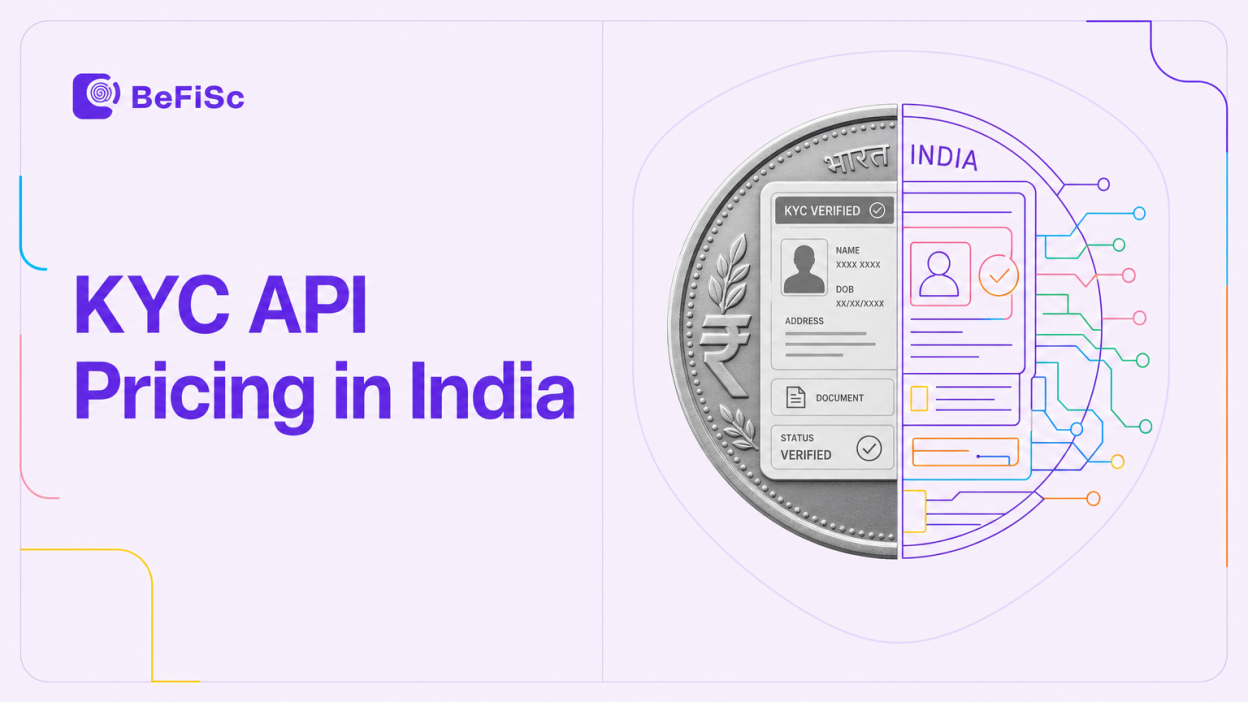
Almost no KYC API provider in India publishes a public price list, and that isn’t an oversight; pricing in this category is genuinely variable, driven by verification type, monthly volume, and contractual commitments that don’t reduce to a single number. “Transparent pricing” is a common marketing phrase across the category, but transparent almost always means a sales conversation, not a price page.
That opacity puts buyers at a disadvantage during vendor evaluation. This guide breaks down how KYC API pricing is actually structured in the Indian market, what drives the per-verification cost up or down, and which costs typically don’t appear in a vendor’s initial quote but show up on the invoice six months later.
How KYC API Pricing Is Structured
Three pricing models dominate the Indian market, and most vendors use some combination of them.
Per-transaction (pay-as-you-go). The business pays a fixed fee per successful verification call, sometimes with a lower rate for failed or invalid attempts. This model suits early-stage fintechs and NBFCs still validating unit economics, because it carries no minimum commitment, but it is almost always the most expensive per-verification rate available from a given vendor.
Volume-tiered. Rates decrease as monthly transaction volume crosses defined thresholds, a structure similar to cloud infrastructure pricing. This rewards scale but requires reasonably accurate volume forecasting during contract negotiation, since committing to a tier the business doesn’t reach forfeits the pricing advantage without another mechanism (a true-up clause, for instance) to recover it.
Committed-volume or annual contracts. Larger NBFCs, banks, and well-funded fintechs negotiate annual minimums in exchange for the lowest per-verification rates, often bundled with dedicated support SLAs and CKYCRR integration support that isn’t available at the pay-as-you-go tier.
A fourth, less common structure flat monthly platform fees plus usage appears among vendors bundling KYC with a broader compliance suite (AML screening, risk scoring, document management), where the API itself is one line item inside a larger subscription.
What Drives Cost Per Verification
Not all verification calls cost the same, and understanding why matters more than any headline rate a vendor quotes.
Verification method. OTP-based eKYC is typically the cheapest call a provider offers, since it requires only an SMS round-trip against UIDAI. Biometric authentication costs more, because it requires either dedicated hardware integration or a higher-compute face-match/liveness pipeline. Offline Aadhaar XML verification sits in between: no live UIDAI call, but cryptographic signature verification and (often) a face-match step against the photo in the XML.
Source query cost. Some underlying government or bureau sources charge the KYC API provider a wholesale fee per query, which gets passed through with a margin. PAN verification against NSDL/Protean, for instance, carries a different wholesale cost structure than Aadhaar authentication through UIDAI’s AUA/KUA framework; a vendor bundling both into one flat “identity verification” rate is absorbing that variance somewhere.
Retry and failure handling. A verification that fails on the first attempt (mismatched OTP, expired session, source-system downtime) and is retried may or may not be billed again depending on the vendor’s failure-handling policy; this single clause can materially change effective cost per successfully onboarded customer, especially for businesses with lower-literacy or lower-connectivity customer bases where first-attempt failure rates run higher.
Bundled versus à-la-carte features. A vendor quoting a low per-verification rate for bare Aadhaar OTP authentication, with CKYCRR search-and-fetch, risk scoring, and document forgery detection priced as separate add-ons, can end up more expensive in total than a vendor quoting a higher base rate that already includes those capabilities.
The Hidden Costs Vendors Don’t Lead With
Three cost categories consistently surprise buyers who evaluated only the headline per-verification rate.
Integration and engineering time. A well-documented REST API with sandbox credentials and clear error codes can be integrated in days; a poorly documented one can consume weeks of engineering time that never appears on the vendor’s invoice but is a real cost to the business.
Minimum commitment shortfalls. Annual contracts with committed volumes carry a real risk: if actual usage falls short of the commitment (common in the first year after signing, when onboarding volumes are still being forecast), the effective per-verification cost rises well above the negotiated rate, sometimes above what a pay-as-you-go plan would have cost.
Compliance features priced as upsells. CKYCRR integration, audit-trail export, and periodic re-KYC automation are treated as core infrastructure by some vendors and as premium add-ons by others. A buyer who assumes these are included, based on a generic “KYC compliance” pitch, can find them absent from the base contract.
A Buyer’s Cost Checklist
Before signing, a compliance or procurement team should get written answers to:
- Is the quoted rate per successful verification only, or per attempt (including failures)?
- Does the rate include CKYCRR search-and-fetch, or is that priced separately?
- What happens to the per-verification rate if committed volume isn’t reached? Is there a true-up, a penalty, or a rate increase?
- Is periodic re-KYC billed at the same rate as new-customer onboarding, or differently?
- Are audit-trail export and retention included, or an add-on with its own pricing?
- What is the cost of a failed verification that requires a manual review fallback?
Key Takeaways
- No major KYC API provider in India publishes public pricing; “transparent pricing” in marketing copy typically means a sales conversation, not a published rate card.
- Per-transaction, volume-tiered, and committed-volume annual contracts are the three dominant pricing structures, often combined.
- Verification method (OTP versus biometric versus offline XML) and underlying source-query costs are the biggest drivers of per-verification price variance between vendors.
- Retry/failure billing policy and whether CKYCRR integration is included or an add-on are the two clauses most likely to change effective cost after signing.
- Committed-volume contracts only pay off if forecasted volume is actually reached get the shortfall terms in writing before committing.
Frequently Asked Questions
Are compliance features like CKYCRR integration usually included in the base price?
Not universally; some vendors treat it as core infrastructure, while others price it as an add-on. This should be confirmed in writing before signing rather than assumed from marketing materials.
Should a startup choose pay-as-you-go or a committed-volume contract?
Pay-as-you-go suits a business still validating onboarding volume and unit economics; committed-volume contracts make sense once monthly verification volume is predictable enough to forecast a minimum with reasonable confidence, since falling short of a committed minimum can erase the pricing advantage.
Do KYC API providers charge for failed verification attempts?
Policies vary by vendor and should be confirmed explicitly in the contract; some bill only successful verifications, others bill per attempt regardless of outcome, which can materially affect total cost for businesses with higher first-attempt failure rates.
Is Aadhaar-based verification cheaper than PAN or GST verification?
Cost varies by underlying source-query fees and verification method rather than by a fixed rule, though OTP-based Aadhaar authentication is generally among the lower-cost verification types offered by most providers, since it doesn’t require biometric hardware or a live face-match pipeline.
What is the typical pricing model for a KYC API in India?
Most providers use a hybrid of per-transaction pricing at low volumes and volume-tiered or committed-annual pricing at scale. Exact rates are negotiated per contract rather than published publicly.
Conclusion
KYC API pricing in India resists simple comparison because the category genuinely lacks standardized public rate cards, and the vendors that most loudly advertise “transparent pricing” are, in practice, no more likely to publish a number than those that don’t. The buyers who get the best terms are the ones who ask about failure billing, commitment shortfalls, and add-on structure before signing, not the ones who compare a single quoted per-verification rate across vendors and assume it’s the whole picture.
The total cost of a KYC API relationship is determined less by the headline rate and more by how closely that rate matches the business’s actual verification mix, failure patterns, and compliance feature requirements over a full contract year, which is exactly the information a first sales call rarely volunteers unprompted.