
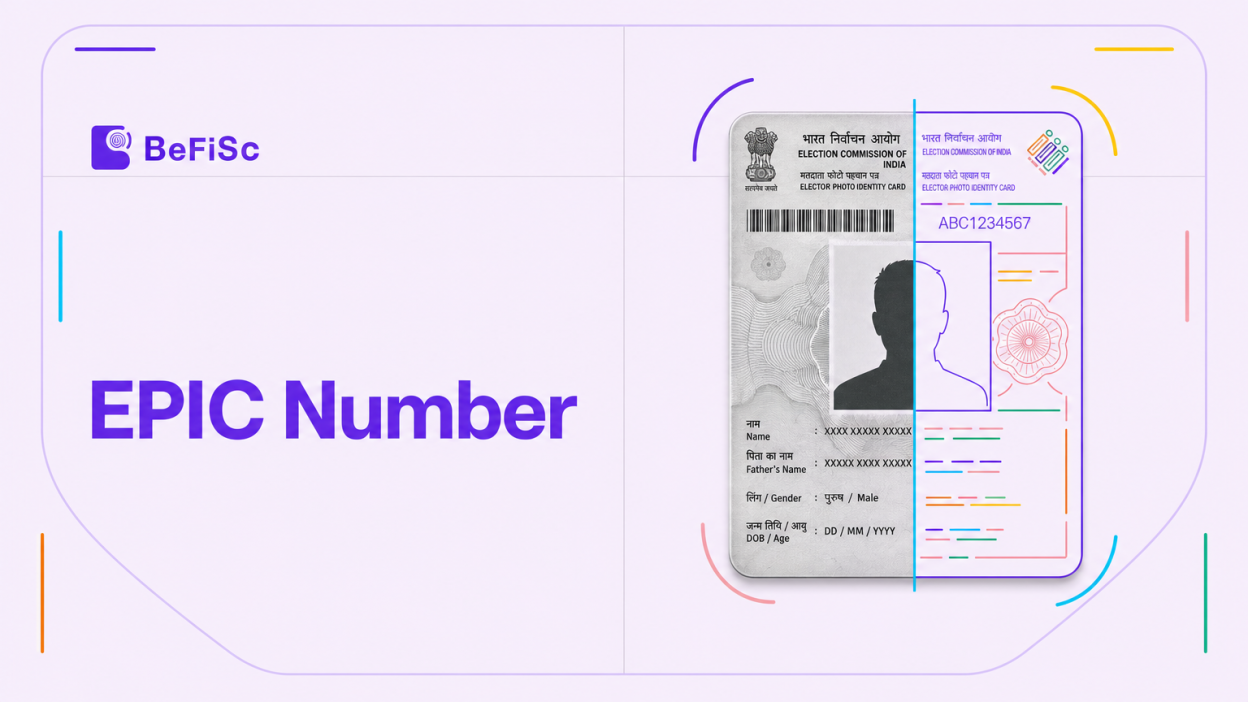
An EPIC number is the unique alphanumeric identifier printed on every Elector Photo Identity Card issued by the Election Commission of India. Most cards carry a 10-character code, usually three letters followed by seven digits. You can find it on the front of the card, search it on the ECI’s electoral search portal, and use it to download an e-EPIC.
Voters need the EPIC number to check the electoral roll, download a digital card, or update details. Banks, NBFCs and fintechs meet the same number daily, because the voter ID remains an officially valid document for KYC.
This guide covers both sides: how to find, search, and download, then what a voter ID proves for risk teams and how to verify it at scale.
What Is an EPIC Number?
EPIC stands for Elector Photo Identity Card. The EPIC number links the card to a single entry in the electoral roll of a specific assembly constituency and polling station.
The format
Cards in the current series typically carry ten characters: a three-letter prefix and seven digits. Older cards can look different, so a format check alone never proves a number is fake.
Why some voters once shared a number
In March 2025, ECI acknowledged that some Electoral Registration Officers had not used the correct series since EPIC series were allotted to states and union territories in 2000. The result was duplicate EPIC numbers held by genuine electors in different constituencies.
In May 2025, it reported the issue resolved after searching the data of more than 99 crore electors, with affected voters issued new numbers. An older photocopy may therefore carry a superseded EPIC number.
How to Find Your EPIC Number
On a physical card, the EPIC number is printed on the front, near the photograph. Without the card, use electoral search:
- Open ECI’s Electoral Search portal at electoralsearch.eci.gov.in.
- Choose search by details, enter your name, relative’s name, age or date of birth, state and district, and complete the captcha.
- Alternatively, choose search by mobile if your number is registered with ECI, and verify with the OTP.
- Read the EPIC number, part number, and serial number from your matching electoral roll entry.
This is also the answer to the common “EPIC number without voter ID” query: the electoral roll entry holds the number even when the physical card is lost.
To check a known number, select search by EPIC and enter the number and state. No result usually means a typo, a replaced number, or a deleted roll entry.
The ECINET app
ECI launched ECINET on 22 January 2026, integrating more than 40 election apps and web services. It subsumes the Voter Helpline App, so it is now the official mobile route for roll search and e-EPIC services.
How to Download an e-EPIC
The e-EPIC is a digital, non-editable PDF version of the voter card. It was launched on National Voters’ Day, 25 January 2021, initially for new electors and then extended to all electors.
To download it:
- Log in to the Voters’ Service Portal at voters.eci.gov.in using your mobile number registered with ECI.
- Select the e-EPIC download option.
- Enter your EPIC number or Form 6 reference number and select your state.
- Verify with the OTP sent to the registered mobile.
- Download the PDF and store it on your phone or DigiLocker.
If your mobile number is not linked to your electoral record, update it through Form 8 first.
Why the EPIC Number Matters Beyond Voting
For regulated entities, the voter ID card is more than an election document. RBI’s KYC framework lists “the Voter’s Identity Card issued by the Election Commission of India” among the six officially valid documents (OVDs), alongside the passport, driving licence, proof of possession of Aadhaar, NREGA job card and NPR letter.
RBI consolidated these instructions into the Reserve Bank of India (Commercial Banks – Know Your Customer) Directions, 2025, issued on 28 November 2025. Our explains how the framework applies across entity types.
That status makes it common in rural and semi-urban lending, microfinance and gold loans, and among customers who prefer not to share Aadhaar.
What a voter ID does not prove
The card proves that a person with this name and photograph was enrolled at a given address when it was issued. It does not prove:
- That the address is current. Many voters move without transferring their enrolment.
- That the photograph resembles the holder today. Older cards carry low-resolution photos of a much younger person.
- That the name matches other KYC documents. Transliteration variations are common.
A voter ID should therefore be one input to a verification decision, not the decision itself.
Verifying Voter IDs at Scale for Your Business
At volume, an agent eyeballing a photocopy is not a control. The work splits into four checks.
1. Is the document real and on the roll?
The first check confirms that the EPIC number exists on the electoral roll and that the roll entry matches the card. Our document explains the request and response patterns in detail.
Treat a “not found” result carefully. Given the 2025 renumbering and routine roll revisions, a mismatch should trigger a request for the current card or e-EPIC, not an automatic rejection.
2. Does the customer match the card?
OCR extracts the name, number, and photo from the uploaded image. A face match then compares the card photo with a live selfie, and liveness detection confirms the selfie is a real person in front of the camera rather than a printed photo or replayed video.
Old card photos lower match scores for genuine customers, so route low-confidence matches to manual review. Our guide covers threshold design.
3. Do the names agree across documents?
“Mohd. Irfan Shaikh” on a voter ID and “Mohammed Irfan Sheikh” on PAN would fail an exact match. A fuzzy scores similarity while handling initials, honorifics, and transliteration.
4. Is the address still valid?
Because the address on a voter ID can be stale, many lenders confirm the current address separately. RBI’s KYC FAQs (9 June 2025) also allow deemed OVDs, such as a utility bill not more than two months old, when the OVD does not show the current address, with the customer required to submit an OVD carrying the current address within three months.
Where BeFiSc fits: IDProof gives your team face match, liveness, name match, and DigiLocker document retrieval in one API workflow, so a voter ID submitted at onboarding is checked against a live customer and cross-matched with PAN and bank account details, with most results returned in about three seconds. Book a demo to see the workflow on your own sample cases.
A real-world scenario
Consider a microfinance lender whose borrowers mostly submit voter IDs. Branch staff once compared photocopies by eye. With roll matching, face match, and name match in the flow, mismatched cases go to a supervisor and the rest clear straight through, each with an audit trail of why it was approved.
Fraud Patterns Around Voter ID Cards
| Pattern | How it shows up | Control |
|---|---|---|
| Photo substitution | Genuine EPIC details, fraudster’s photo pasted on the card image | Roll match plus face match against a live selfie |
| Edited card images | Name or date of birth altered in an image editor | Compare OCR output with roll data; flag inconsistencies |
| Borrowed identity | Relative or associate uses a real voter’s card | Liveness check and face match; device and contact signals |
| Stale or superseded number | Old photocopy with a replaced EPIC number | Request current card or e-EPIC on mismatch |
| Address mismatch | Card address differs from residence | Deemed OVD or address verification; follow-up within three months |
A voter ID image alone is weak evidence. It becomes strong only when tied to a live person, an authoritative record, and consistent data across documents.
Key Takeaways
- The EPIC number is the unique identifier on an Elector Photo Identity Card, usually ten characters in the current series.
- You can find it on the card, through electoral search by details or mobile, or inside the ECINET app launched in January 2026.
- RBI’s KYC framework treats the voter ID as an officially valid document, but its address and photo are often outdated.
- Businesses should combine roll matching, face match with liveness, name match, and current-address checks rather than relying on the card image.
Frequently Asked Questions
Why might an EPIC number not show up in a search?
It may have been mistyped, replaced during the ECI’s 2025 de-duplication exercise, or removed in a roll revision. Check your latest card or contact your Electoral Registration Officer.
Can a bank accept a voter ID for KYC?
Yes. RBI’s KYC framework lists the voter’s identity card as an officially valid document. Banks and NBFCs still verify both the document and the customer.
Is the e-EPIC valid as identity proof?
The e-EPIC is the ECI’s official digital voter card, issued as a non-editable PDF. Organisations may still set their own rules on accepting digital copies.
How can I find my EPIC number without my voter ID card?
Use the search by details or search by mobile option on electoralsearch.eci.gov.in, or the roll search inside the ECINET app. Your electoral roll entry shows the EPIC number along with your part and serial number.
What is the EPIC number on a voter ID card?
It is the unique number ECI assigns to each elector, printed on the front of the card. It links the holder to one entry in the electoral roll.
Conclusion
The EPIC number serves voters as a key to the electoral roll and businesses as a reference point for identity. Those two uses demand different levels of trust. A voter needs to find their entry; a lender needs to know the person in front of them is the person on the roll, today, at the address they claim.
Teams that tie the voter ID to a live face, a matched name, and a current address onboard genuine customers faster and absorb fewer losses.