
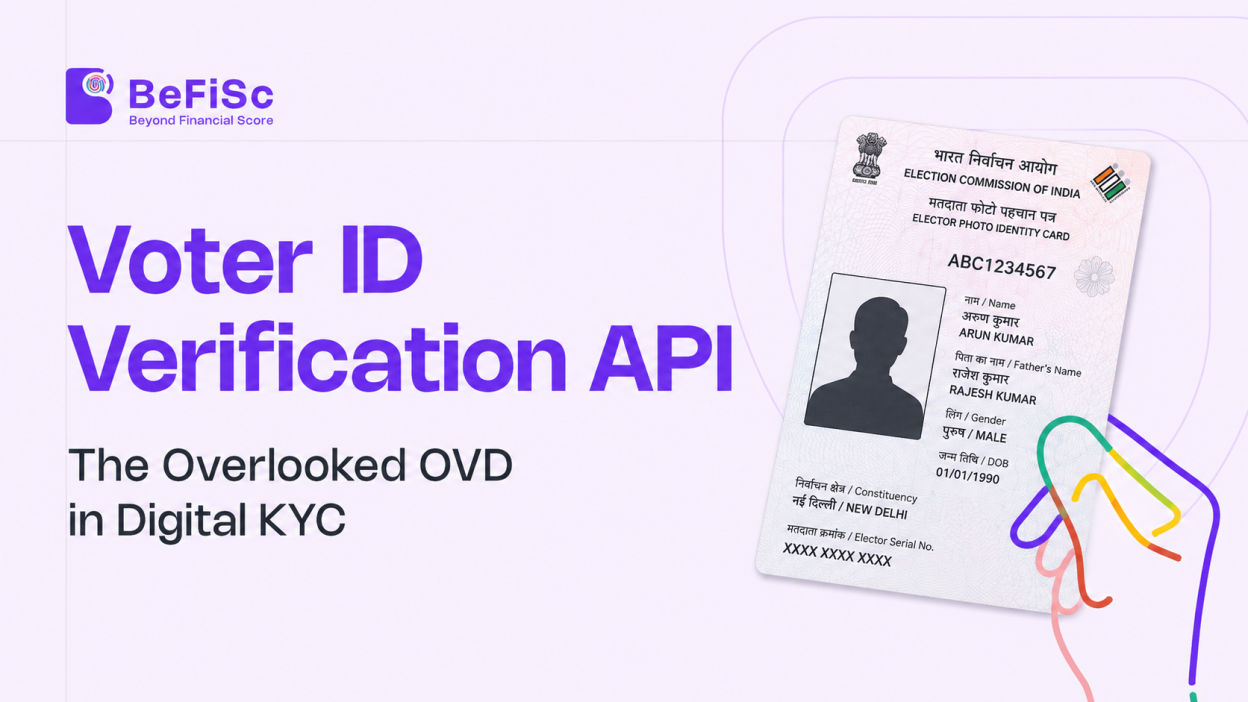
Every KYC stack optimises for Aadhaar and PAN, and for most urban customers, that is enough. But India’s regulated onboarding was never designed around two documents. The PMLA framework recognises a set of officially valid documents (OVDs), and among them sits one of the most widely held identity credentials in the country: the voter ID, or EPIC (Electors Photo Identity Card), issued by the Election Commission of India.
For customers at the edges of the formal system where Aadhaar-mobile linkage is broken, PAN is absent, or eKYC consent fails the voter ID is often the document that decides whether onboarding succeeds at all. A voter ID verification API makes that document usable at digital speed, validating EPIC details against electoral records instead of trusting a card image. This guide explains how the API works, where it fits in an OVD waterfall, and the design details that make it perform.
What Is a Voter ID Verification API?
A voter ID verification API validates a voter’s EPIC number against Election Commission electoral roll data, returning the registered elector’s details, name, relation name (father/mother/husband as recorded), gender, age band, and the constituency and state of registration.
As with every source-verification API in this series, the mechanism replaces document inspection with registry truth. An EPIC card image can be edited or fabricated; the electoral record either contains that EPIC with matching details or it does not. The verification question collapses from “does this card look genuine?” to “does this number resolve, and do the details match?”
The API’s typical inputs are the EPIC number, with the applicant’s name used for match scoring on the response. Output handling follows the standard pattern: fuzzy name comparison against the application using the techniques from our API guide, with scored routing to pass, review, or fail.
The Voter ID’s Status as an OVD
The regulatory anchor matters because it is what makes the voter ID more than a convenience.
Under the PMLA rules and the RBI’s KYC Master Directions, the voter ID issued by the Election Commission is one of the officially valid documents acceptable for customer identification alongside the passport, driving licence, Aadhaar (in permitted forms), NREGA job card, and National Population Register letter. An institution’s KYC policy that accepts OVDs must, in substance, be able to process a voter ID.
This is where many digital-first stacks quietly fail their own policy. The policy document lists all OVDs; the product flow supports two. Customers presenting a voter ID fall into a manual branch that takes days or get turned away. For institutions with financial-inclusion mandates, priority-sector obligations, or simply large non-metro customer bases, that gap is both a compliance inconsistency and a conversion leak. Our [KYC for NBFCs guide] covers how OVD handling fits the broader regulatory frame.
A voter ID verification API closes the gap: the “manual branch” becomes another automated rail with the same speed and audit quality as the Aadhaar path.
How EPIC Verification Works
A production voter ID verification flow runs in four steps.
Step 1: Capture
The customer enters the EPIC number, or photographs the card and an [OCR service] extracts it. As always, OCR is input assistance, not evidence.
Step 2: Registry Query
The API queries electoral roll data with the EPIC number and returns the registered record or a not-found result.
Step 3: Match Scoring
Returned name and relation name are matched against application data with fuzzy logic tolerant of transliteration and ordering variants, which electoral records exhibit heavily. Age band and gender act as consistency checks.
Step 4: Binding and Decision
For unassisted digital journeys, a live selfie face-matched against the captured card photo with [liveness detection] binds the credential to the person, since the electoral registry query itself returns demographic text rather than an image in most integrations. The composite decision and evidence bundle then enter the KYC record.
Latency is comparable to other registry checks: seconds, not minutes, which is what allows the voter ID path to sit inside the main onboarding flow rather than a side queue.
Where Voter ID Verification Fits: The OVD Waterfall
The voter ID rarely leads a verification strategy; it completes one. The practical architecture is an OVD waterfall ordered by assurance, cost, and coverage.
Aadhaar-anchored rails first: eKYC, for their cryptographic assurance and depth. PAN alongside, where the product requires it. Then the physical-OVD rails: driving licence, passport, and voter ID, each verified at source through its respective API.
The voter ID’s specific role in that waterfall is coverage of the segments other rails miss: customers whose Aadhaar-linked mobile is inactive (breaking OTP-based flows), customers without driving licences or passports (a large majority outside urban professional segments), and assisted journeys banking correspondents, rural branch tablets, field agents where the voter ID is often the document the customer actually carries.
Designed this way, the voter ID path is not a degraded fallback but a first-class rail with its own source verification, match scoring, and face binding differing from the Aadhaar path in data richness, not in process integrity.
Strengths and Limitations of Electoral Data
Honest system design requires knowing what electoral records are and are not.
Strengths. Coverage is enormous; the electoral roll is among the largest identity databases in the country, reaching deep into segments other registries miss. The document’s OVD status is unambiguous. And issuance involves a physical verification trail through the electoral machinery.
Limitations. Electoral records carry age bands rather than full dates of birth in many data surfaces, so DOB-exact policies need an alternate evidence path. Addresses reflect electoral registration, which lags relocation. Name transliteration variance is high, demanding generous match tolerance. And the registry’s purpose is electoral, not financial its update cadence follows revision cycles, not customer life events.
None of these limits disqualifies the rail; they define its role. The voter ID verifies identity and name; it pairs with other evidence for date-of-birth precision and current-address requirements, exactly as a risk-based KYC design like the tiered model in our [risk-based KYC guide] would prescribe.
Implementation Notes for Production Flows
Four notes from the field.
Tolerate transliteration aggressively. Electoral names show the widest variance of any registry in this series. Thresholds tuned on PAN-grade data will falsely reject at unacceptable rates; calibrate on labelled electoral pairs.
Handle not-found without accusation. EPIC records shift across constituency revisions; a not-found is a routing event to another OVD or a review queue, not a fraud signal by itself.
Keep the evidence bundle uniform. Whatever rail verified the customer, the KYC record should carry the same structure: input, registry response, match scores, binding result, timestamps. Uniform evidence is what makes multi-OVD stacks auditable.
Mind data minimisation. Electoral data includes relation names and constituency details beyond the KYC need. Store only what your purpose requires under DPDP discipline, not the full response by default.
Key Takeaways
- A voter ID verification API validates EPIC details against Election Commission records, turning a widely held OVD into a digital-speed KYC rail.
- The voter ID’s OVD status under PMLA and RBI KYC norms means policies already accept it; the API makes product flows match the policy.
- Its role is coverage: customers with broken Aadhaar-mobile linkage, no PAN/DL/passport, and assisted rural journeys.
- Electoral data’s quirks age bands, transliteration variance, registration-lagged addresses define pairing needs, not disqualification.
- Uniform evidence bundles and generous, calibrated match tolerance are the implementation details that decide performance.
Frequently Asked Questions
How does a voter ID verification API handle name mismatches?
Electoral records show heavy transliteration and ordering variance, so a voter ID verification API should feed fuzzy name-match scoring with tolerances calibrated on electoral data, routing borderline scores to review rather than auto-failing them.
Can a voter ID verification API confirm the person’s date of birth and address?
Partially. Electoral data commonly carries age bands rather than exact dates of birth, and addresses reflect electoral registration. Pair a voter ID verification API with additional evidence where your policy needs DOB precision or a current address.
When should a business use a voter ID verification API instead of Aadhaar eKYC?
Use a voter ID verification API when Aadhaar rails fail or are unavailable, when Aadhaar-mobile linkage consent is declined, or when customers lack other OVDs. It functions as a first-class rail in an OVD waterfall, not merely a manual fallback.
Is a voter ID valid for KYC, and does a voter ID verification API satisfy it?
Yes. The voter ID is an officially valid document under PMLA rules and RBI KYC directions. A voter ID verification API satisfies the verification obligation by checking the document’s details at source rather than accepting a card image.
What is a voter ID verification API?
A voter ID verification API validates an EPIC number against Election Commission electoral records, returning the registered elector’s name, relation name, gender, age band, and constituency for matching against the applicant’s details.
Conclusion
The measure of a KYC stack is not how smoothly it handles the ideal customer but how well it serves the customer the default rails miss. The voter ID held by hundreds of millions, recognised by regulation, and now verifiable at source in seconds, is the clearest test of that measure most institutions face.
As inclusion moves from mandate to market, with credit, insurance, and payments all pushing past the metro core, the stacks that win will be the ones that made every OVD a first-class rail early. The voter ID verification API is a small integration with a disproportionate reach payoff.

[…] is India’s framework for reusing verified KYC across banks, NBFCs, insurers, brokers and pension […]