
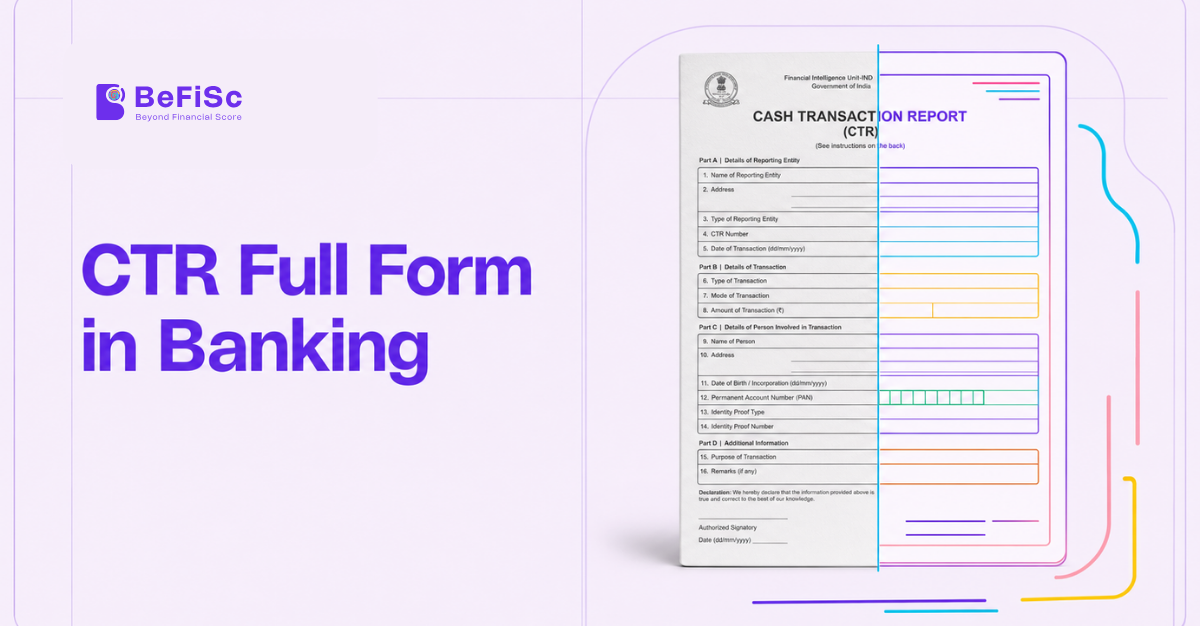
The CTR full form in banking is Cash Transaction Report. It is a monthly report that banks and other reporting entities file with the Financial Intelligence Unit-India (FIU-IND) under the Prevention of Money Laundering Act, 2002, covering cash transactions above ₹10 lakh and connected cash transactions that together cross ₹10 lakh in a month.
Most people meet the term in a branch circular or an exam syllabus and stop at the explanation. Compliance teams cannot delay reporting because every CTR has a fixed threshold, deadline, and format, and regulators count each day of delay.
This guide explains what the PML Rules require, how CTR differs from other FIU-IND reports, which cash patterns people use to stay below the threshold, and how lenders interpret the same signals in bank statements.
What CTR Means and Who Files It
A cash transaction report is a record of reportable cash activity that a reporting entity sends to FIU-IND each month. The obligation sits in Section 12 of the PMLA, which requires reporting entities to maintain records of prescribed transactions and furnish them to the Director, FIU-IND.
Reporting entities include banks, NBFCs, payment system operators and securities market intermediaries, among others. The CTR in banking is a high-volume report because banks handle physical cash at scale. FIU-IND’s Annual Report for 2021-22 states that it received over 1.42 crore CTRs in that financial year, alongside 4.33 lakh suspicious transaction reports. Cash reporting is a data-volume exercise first and an investigative exercise second.
What the PML Rules Actually Require
The thresholds sit in Rule 3(1) of the Prevention of Money-Laundering (Maintenance of Records) Rules, 2005. Two clauses drive the CTR:
- Clause (A): all cash transactions of a value of more than ₹10 lakh or its equivalent in foreign currency.
- Clause (B): all series of cash transactions integrally connected that have been individually valued below ₹10 lakh, where the series has taken place within a month, and the monthly aggregate exceeds ₹10 lakh.
Note the wording: “more than” ₹10 lakh. A single deposit of exactly ₹10,00,000 does not trigger clause (A) on its own, although it may still form part of a connected series.
The filing deadline
Rule 8(1) requires the Principal Officer of the reporting entity to furnish information on clauses (A), (B), (BA), (C) and (E) every month to the Director by the 15th day of the succeeding month. Cash activity in September 2026 is therefore due by 15 October 2026.
Rule 8(4) adds that each day of delay in furnishing a report, or in rectifying a misreported transaction, is treated as a separate violation. That is why a late CTR batch is a counting problem, not a single lapse.
Who is accountable
Rule 7 makes the Principal Officer, an officer at management level, responsible for furnishing the information. RBI’s KYC Master Direction also requires transaction records to be preserved for at least five years (para 46).
CTR vs STR vs CCR vs NTR vs CBWTR
FIU-IND accepts five principal report types through FINGate 2.0. The ctr full form in banking is often confused with the others because all are filed by the same Principal Officer to the same portal.
| Report | Full form | PML Rule 3(1) clause | Trigger | Frequency |
|---|---|---|---|---|
| CTR | Cash Transaction Report | (A) and (B) | Cash over ₹10 lakh, or connected cash series over ₹10 lakh in a month | Monthly, by 15th of next month |
| STR | Suspicious Transaction Report | (D) | Any transaction, cash or not, that gives rise to reasonable grounds of suspicion | Promptly, once the Principal Officer is satisfied it is suspicious |
| CCR | Counterfeit Currency Report | (C) | Cash transactions where forged or counterfeit notes were used as genuine | Monthly, by 15th of next month |
| NTR | Non-Profit Transaction Report | (BA) | Receipts by non-profit organisations above ₹10 lakh | Monthly, by 15th of next month |
| CBWTR | Cross-Border Wire Transfer Report | (E) | Cross-border wire transfers above ₹5 lakh | Monthly, by the 15th of the next month |
The key distinction is judgement. A CTR is threshold-based; an STR is judgement-based and has no threshold. A ₹9 lakh cash deposit never appears in a CTR on its own, but it can be the subject of an STR if the pattern around it looks wrong.
Counterfeit currency reports are also volume-heavy. FIU-IND’s 2021-22 report records over 2.20 lakh CCRs, over 8.16 lakh NTRs and over 1.36 crore CBWTRs received during the year.
How a CTR Is Prepared and Filed on FINnet 2.0
FINnet 2.0 is FIU-IND’s reporting system, built around three components: FINGate for collection, FINCore for processing, and FINex for dissemination. Reporting entities register on FINnet 2.0 and file through FINGate 2.0.
A typical monthly CTR workflow inside a bank or NBFC looks like this:
- Extract all cash-tagged credits and debits for the month from the core banking system, by customer and account.
- Flag single transactions above ₹10 lakh under clause (A).
- Aggregate cash transactions per customer across accounts for the month and flag series above ₹10 lakh under clause (B).
- Validate customer identifiers, KYC fields, and branch codes against FIU-IND’s reporting format.
- Generate the report file, run FIU-IND validation checks, and correct rejections.
- Have the Principal Officer approve and submit through FINGate 2.0 before the 15th.
- Archive the submission acknowledgement and the underlying data for the retention period.
Steps 3 and 4 are where most errors originate: mis-tagged cash drops out of the population, and incomplete KYC fields cause rejections that age past the deadline.
Structuring and Smurfing: Patterns Built to Avoid a CTR
Any fixed threshold invites behaviour designed to stay under it. Structuring means splitting cash into amounts below the reporting line. Smurfing is the same idea spread across several people or accounts.
Clause (B) targets this, but only captures what the institution sees as connected. Common patterns:
- Repeated deposits of ₹9 lakh to ₹9.9 lakh across a month, often at different branches.
- Cash deposited into several family or employee accounts and then swept by transfer into one account.
- Cash credited and then withdrawn within hours, leaving a near-zero balance.
These patterns overlap with money mule behaviour, which is why cash monitoring sits in the same team at most banks. Where the pattern looks deliberate, the right instrument is an STR, not a CTR.
A real-world scenario
A small distributor deposits ₹4 lakh, ₹3.5 lakh and ₹3 lakh in cash across three branches of the same bank in one month. No single deposit crosses ₹10 lakh, but the aggregate of ₹10.5 lakh falls under clause (B). If the bank’s aggregation logic runs per branch rather than per customer, the CTR is missed. Enforcement often hinges on gaps like this: FIU-IND’s April 2025 order against Union Bank of India imposed a ₹37 lakh penalty for contraventions of Section 12 read with Rules 3, 7 and 9.
Verifying This at Scale for Your Business
Lenders care about the same cash signals even when they file no CTR. For MSME and self-employed borrowers, the bank statement is often the main evidence of income, and cash shapes how it should be read. Credit teams typically check:
- Share of cash deposits in total credits, month by month.
- Clusters of cash deposits just below round thresholds.
- Cash credits followed quickly by large transfers out.
- Cash withdrawal patterns that suggest income is not staying in the account.
A cash-heavy borrower is not automatically risky, but the underwriting note should say so. Doing this by eye on long PDFs is slow and inconsistent, which is where structured helps.
Where BeFiSc fits: Finnalyzer, BeFiSc’s bank statement analysis product, reads 100+ statement formats and surfaces cash deposit and withdrawal patterns so credit and compliance teams can see cash concentration before a loan is approved. It does not generate or file CTRs; it gives your analysts a cleaner view of the statement. Book a demo with your own sample statements.
Key Takeaways
- In banking, CTR stands for Cash Transaction Report, filed monthly with FIU-IND under Section 12 of the PMLA.
- Rule 3(1)(A) covers cash above ₹10 lakh; Rule 3(1)(B) covers integrally connected cash series below ₹10 lakh each that cross ₹10 lakh in a month.
- Rule 8 sets the deadline at the 15th of the following month, and each day of delay counts as a separate violation.
- CTRs are threshold-based; STRs are judgement-based. Structured cash below the line belongs in an STR review.
- Lenders read the same cash patterns in bank statements to assess income quality and evasion risk.
Frequently Asked Questions
When must a CTR be filed?
Rule 8(1) requires the Principal Officer to submit the report for each month by the 15th day of the succeeding month. Filing is done online through FINGate 2.0 on FIU-IND’s FINnet 2.0 system.
What is the difference between CTR and STR?
A CTR is triggered automatically by a cash amount. An STR is triggered by suspicion and can relate to any transaction of any size, cash or non-cash. A transaction can appear in both if it is large and suspicious.
What is the full form of CTR in banking?
CTR stands for Cash Transaction Report. It is a report that banks and other reporting entities submit to FIU-IND each month covering cash transactions above ₹10 lakh and connected cash transactions that together exceed ₹10 lakh within a month.
Conclusion
The CTR full form in banking is the easy part. The harder part is the data discipline underneath it: correct cash tagging, customer-level aggregation across branches and channels, clean KYC fields, and a filing process that finishes before the 15th every month.
For lenders, the same cash data shows whether declared income is real, whether it stays in the account, and whether activity is being arranged to stay below a reporting line. Teams that read cash patterns early make better credit decisions.