
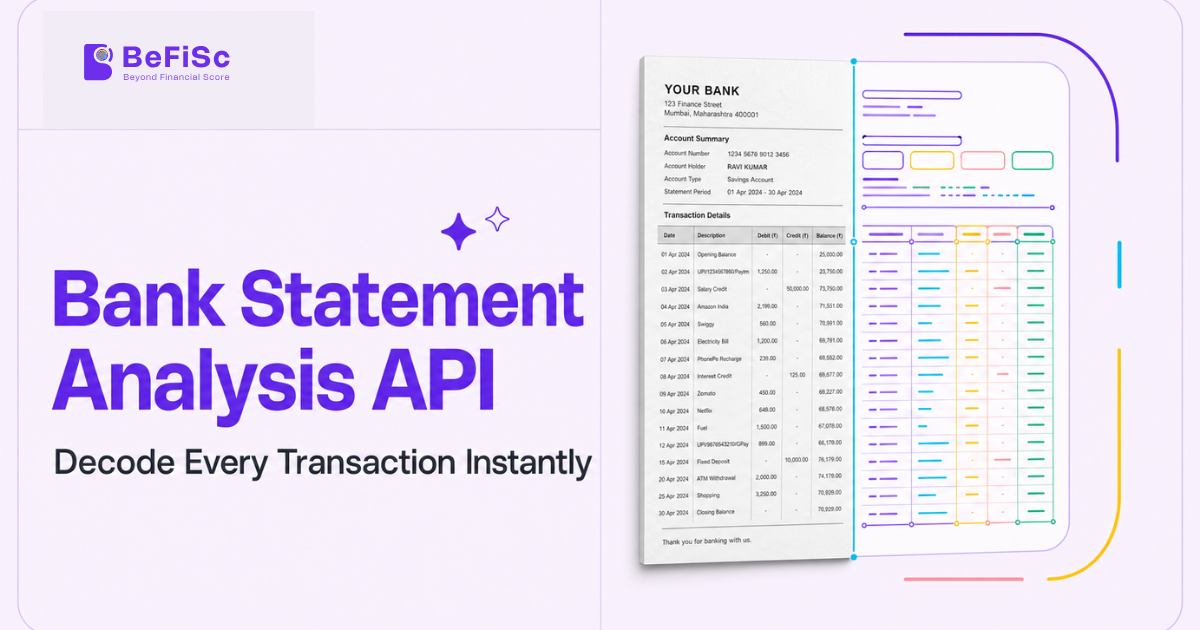
Every lending decision you make rests on a question: can this borrower actually repay? For most Indian lenders, the clearest answer lives in the borrower’s bank statements the real record of income, cash flow, obligations, and financial behaviour. But raw statements are messy, come in hundreds of formats, and are increasingly forged. The bank statement analysis API you choose decides whether you turn that mess into a fast, fraud-checked credit signal, or whether fabricated statements and manual review quietly erode your portfolio.
This guide is for lending, risk, and product teams evaluating a bank statement analysis API in India. It explains the critical difference between tools that merely extract data and tools that actually underwrite, the criteria that matter in production, how the 2026 market looks, and where BeFiSc’s FinEye fits. If a credit or risk decision sits downstream of your statement analysis, this choice matters more than almost any other in your stack.
Why This Choice Decides Your Loan Book
Bank statement analysis sits at the heart of underwriting, so the tool you pick shapes three outcomes directly: how fast you can approve, how accurately you assess risk, and how many fabricated statements you catch before they become defaults.
The fraud dimension is no longer optional. Bank fraud in India crossed roughly ₹36,000 crore in the first nine months of FY2025–26, according to RBI data, and statement fraud is a growing part of it: tampered PDFs, AI-generated statements, and fabricated transaction histories designed to pass exactly the checks weaker tools skip. A statement analyser that extracts numbers but cannot detect [document tampering] or transaction manipulation gives you clean-looking data on a fraudulent application. That is the most dangerous failure mode in lending: confident approval of a fake.
The speed dimension matters too. Manual statement review is slow and inconsistent, and it does not scale. Teams processing thousands of applications a month cannot rely on analysts eyeballing PDFs. The right API automates the extraction-to-insight pipeline, returning income, cash flow, EMI obligations, and fraud flags in minutes, turning underwriting from a bottleneck into a competitive advantage.
Data Extraction vs Real Underwriting Signals
The single most important distinction in this market is between two categories of tools that look similar in a demo but diverge sharply in production:
PDF-to-data converters. These extract transactions from statements into structured data useful for data entry, but they stop there. They tell you what the statement says; they do not tell you what it means or whether it’s real. For a personal one-off, they’re fine. For lending, they solve data entry, not underwriting.
Underwriting-grade analysers. These extract and analyse returning risk signals: income verification, cash-flow patterns, EMI and obligation detection, bounce and irregularity flags, and, critically, [fraud detection] on the statement itself. These are built for the moment a credit decision sits downstream.
Many teams start by shopping in the first category because it’s cheaper, then discover six weeks later that they’ve automated data entry and left underwriting and fraud detection unsolved. If a credit or risk decision depends on the output, you want the second category. FinEye is built for that second category: statement analysis that produces credit-ready signals and fraud flags, not just extracted rows.
What to Evaluate in a Bank Statement Analysis API
The demos blur together; the same handful of questions separate production-grade tools from the rest:
- Ingestion breadth. Can it read ePDFs, scanned documents, camera-clicked images, and password-protected statements across the hundreds of India-native bank formats real borrowers submit?
- Fraud detection depth. Does it catch document tampering, ePDF manipulation, circular transactions, [mule-account] patterns, dormant-account activation, and AI-generated statements, or just extract numbers?
- Underwriting signals. Does it return income, cash flow, EMIs, obligations, and risk indicators, or only raw transactions?
- India-native coverage. Is format coverage built for Indian banks specifically, including regional and smaller banks?
- Account Aggregator integration. Can it consume consented data via the [Account Aggregator] framework for a clean, [DPDP]-aligned data path?
- Integration speed and API quality. How fast is sandbox-to-production, and how good is the documentation?
- Pricing model. Transparent and volume-flexible, or a custom enterprise contract you must negotiate before testing?
That last point is where the market splits. The largest incumbents typically price through custom, sales-led enterprise contracts well-suited to big banks, less so to fintechs and mid-market NBFCs that need to test on real volume first.
The Market in India (2026)
India’s bank statement analysis market has two tiers: pure converters and underwriting-grade platforms, and the serious lending options sit in the second tier:
| Provider | Positioning | Pricing model |
|---|---|---|
| BeFiSc (FinEye) | Underwriting-grade statement analysis with fraud detection; API-first | Transparent, self-serve |
| Perfios | De facto BFSI data platform; broad format coverage; large-bank scale | Custom enterprise |
| FinBox (BankConnect) | Statement analysis within a broader credit-decisioning suite; AA integration | Sales-led / opaque |
| HyperVerge | Onboarding-plus-statement analysis, identity-led | Custom / tiered |
| Ocrolus | Globally referenced document + statement analysis with fraud detection | Custom |
| Precisa | Specialist BSA with deep India-native formats and forensic fraud checks | Volume-flexible |
Perfios is the incumbent scale player trusted by a large number of banks and lenders, with very broad format coverage, typically at custom enterprise pricing. FinBox bundles statement analysis into a wider decisioning platform. Specialists like Precisa compete on India-native format depth and forensic fraud detection. The API-first, transparently priced options where FinEye competes appeal to lenders who want credit-ready signals and fraud detection without an enterprise procurement cycle.
Where FinEye Fits
BeFiSc’s FinEye is an AI-driven bank statement and financial-statement analysis product built for underwriting. It turns raw statements into the signals lenders actually decide on income, cash flow, obligations, and irregularities with fraud detection built into the core workflow rather than bolted on.
What makes FinEye a strong fit for Indian lenders:
- Underwriting-grade output: credit-ready signals (income, cash flow, EMIs, anomalies), not just extracted transactions.
- Fraud detection at the core: designed to flag [tampered statements] (internal link), manipulated ePDFs, and suspicious transaction patterns before they become approvals.
- API-first and transparently priced: sandbox access and clear pricing, so you can test on real statements before committing to a genuine contrast to custom-enterprise incumbents.
- Be Suite integration: pairs FinEye with [IDProof] (identity), [BizCheck] (business verification), and [TamperProof] (document forgery) so identity, business, and financial checks run through one stack.
- Built for India, designed around Indian bank formats and the [Account Aggregator] data path.
If your team wants statement analysis that produces genuine underwriting signals and catches fraud without a months-long enterprise contract to get started, FinEye is built for exactly that. Book a FinEye demo or get API access and run it against your own statements.
Fraud Detection: The 2026 Baseline
A few years ago, statement fraud detection was a premium feature. In 2026, it is a baseline requirement because fraud has industrialised. Fabricated statements now include AI-generated PDFs that look genuine, tampered ePDFs with altered balances, and coordinated [mule-account] patterns designed to fake healthy cash flow.
A modern bank statement analysis API should function partly as a fraud-control unit, flagging:
- Document tampering and ePDF manipulation: altered amounts, balances, or metadata.
- AI-generated and synthetic statements: increasingly common and increasingly convincing.
- Circular and structured transactions: money moving in loops to fake turnover.
- Mule and anomalous patterns: [mule-account signatures], dormant-account activation, and cash flow that doesn’t add up.
This is exactly why the extraction-only tools are dangerous in lending: they present fabricated data as clean data. FinEye embeds fraud detection into the analysis so the statement is assessed for authenticity, not just parsed, which, given India’s fraud numbers, is the difference between a healthy loan book and a growing default problem.
Integration, Account Aggregator and Pricing
The practical questions that decide most evaluations:
- Account Aggregator path. For the cleanest, consent-based, [DPDP] -aligned data, pair statement analysis with the [Account Aggregator] framework, increasingly the standard for consented financial data in India.
- Ingestion flexibility. Ensure the API handles the messy reality of scanned, camera-clicked, and password-protected statements across India-native formats.
- Time-to-live. API-first providers with sandbox access get you to production in days. Test on your own statements before committing.
- Transparent pricing. Volume-flexible, published pricing lets you prove value and scale on your terms a meaningful advantage over custom, enterprise-only pricing if you’re a fintech or mid-market NBFC.
FinEye is built around these realities: API-first, AA-ready, fraud-detecting, and transparently priced so you can move from evaluation to production quickly.
Frequently Asked Questions
Does bank statement analysis work with Account Aggregator?
Yes, pairing bank statement analysis with the Account Aggregator framework gives lenders a clean, consent-based, DPDP-aligned path to fetch statement data directly, reducing manual upload friction and fraud risk. FinEye is built to work with the Account Aggregator data path alongside direct statement ingestion.
Can bank statement analysis detect fraud?
Yes, underwriting-grade analysers detect statement fraud, including document tampering, ePDF manipulation, AI-generated statements, circular transactions, and mule-account patterns. In 2026, this is a baseline requirement, not a premium feature, because fabricated statements are designed to pass tools that only extract data without checking authenticity.
What’s the difference between a bank statement converter and an analysis tool?
A converter extracts transactions into structured data and solves data entry. An analysis tool extracts and analyses, returning underwriting signals (income, cash flow, EMIs) and fraud detection. For lending, you need the analysis tool; converters leave underwriting and fraud detection unsolved, which surfaces as risk in production.
Which is the best bank statement analysis API in India?
The best choice depends on whether a credit decision sits downstream. For underwriting, choose an underwriting-grade analyser that returns risk signals, and fraud detection options include BeFiSc (FinEye), Perfios, FinBox, HyperVerge, Ocrolus, and Precisa. FinEye stands out for underwriting-grade output, built-in fraud detection, and transparent, API-first pricing.
What is a bank statement analysis API?
A bank statement analysis API automatically extracts and analyses a borrower’s bank statements, returning income verification, cash-flow patterns, EMI and obligation detection, and fraud flags so lenders can automate underwriting and make faster, better-informed credit decisions instead of reviewing statements manually.
Conclusion
The bank statement analysis API you choose is, in effect, a decision about your loan book. Pick a tool that only extracts data, automates data entry, and leaves underwriting and fraud detection to chance a dangerous trade in a year when statement fraud is industrialising and Indian bank fraud amounts to tens of thousands of crores. Pick an underwriting-grade analyser with fraud detection at its core, and you turn raw statements into fast, fraud-checked credit signals that protect your portfolio and speed up approvals.
BeFiSc’s FinEye is built for that second outcome: credit-ready signals, embedded fraud detection, India-native coverage, Account Aggregator readiness, and transparent, API-first pricing that lets you test before you commit. If a credit decision sits downstream of your statement analysis, it’s worth running FinEye against your own applications. Book a FinEye demo, or get API access and see how many fabricated statements it catches that your current process would have approved.