Video KYC has changed how India onboards customers. Instead of a branch visit, a bank, NBFC, or payment aggregator can verify a customer’s identity and presence in a live, RBI-supervised video interaction, collapsing days of paperwork into minutes. But not all video KYC is equal, and in 2026 the gap between a strong and a weak provider is measured in two things that hit your bottom line directly: how many genuine customers complete onboarding, and how many fraudsters, increasingly armed with [deepfakes], get through.
This guide is for BFSI and fintech teams choosing a video KYC (V-CIP) provider in India. It explains how V-CIP works, the RBI compliance depth that separates compliant providers from risky ones, why deepfake handling is now the decisive axis, how the market looks, and where BeFiSc fits. If remote onboarding is core to your growth, this decision shapes both your conversion rate and your fraud exposure.
What Video KYC (V-CIP) Actually Is
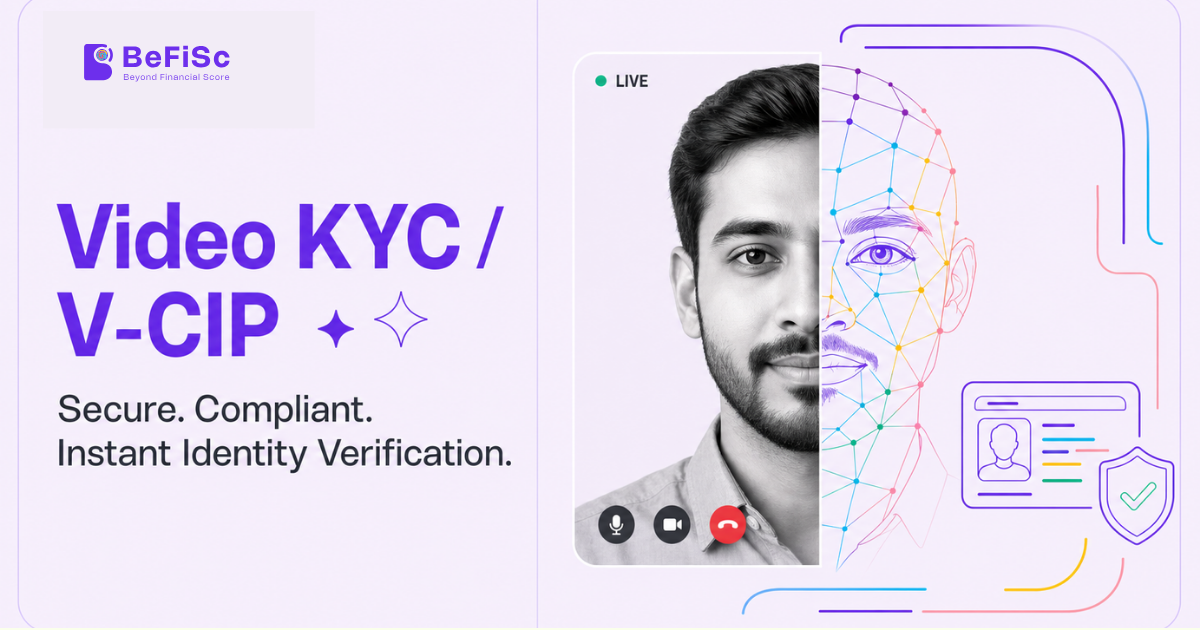
Video KYC, formally Video-based Customer Identification Process (V-CIP), is a live, RBI-permitted method of verifying a customer’s identity remotely through a real-time video interaction. Unlike basic eKYC (which verifies identity through documents and databases), V-CIP confirms both the customer’s identity and their live presence, in real time, without a branch visit.
A compliant V-CIP flow verifies the customer’s identity documents, matches their face to the document, confirms liveness (that a real, live person is present, not a photo, video, or [deepfake]), captures the required information, and records the interaction as regulation demands. It is the mechanism that lets banks, NBFCs, and increasingly payment aggregators and insurers onboard customers digitally while meeting RBI’s supervised-verification requirements.
Because V-CIP is RBI-regulated, the compliance details are not optional extras; they are the difference between an onboarding method you can defend to a regulator and one that exposes you to penalties.
Why the Provider Choice Matters
Your video KYC provider sits directly on your onboarding funnel, so its quality shows up in two numbers you watch closely.
Conversion. V-CIP that is slow, glitchy, or fails genuine customers is a chronic India problem, with regional-language names, older documents, and low-connectivity environments causing drop-off exactly at the moment a customer is ready to convert. Every genuine customer wrongly rejected or frustrated into abandoning is acquisition spend wasted.
Fraud exposure. V-CIP that can’t reliably detect [deepfakes], [presentation attacks], and document forgery lets fraudsters onboard as someone else, the foundation of [account-opening fraud], [money-mule networks], and identity-based crime. In 2026, with deepfakes cheap and convincing, weak liveness is a direct fraud liability.
The right provider maximises completion for genuine customers while catching the fraudulent ones, and does both while keeping you defensibly compliant with RBI’s V-CIP requirements. That combination, not headline speed claims, is what you’re actually buying.
RBI Compliance: The Non-Negotiable Baseline
Video KYC is only useful if it’s compliant, so RBI compliance depth is the first filter, not a nice-to-have. A serious V-CIP provider should demonstrably support:
- RBI V-CIP requirements: the supervised, real-time verification process the RBI specifies, including the required checks, information capture, and recording.
- Sector-specific variants: where relevant, SEBI’s video-based verification (VIPV) for securities and IRDAI’s video-based identification (VBIP) for insurance, so the same provider can serve multiple regulated use cases.
- DPDP readiness: handling of personal data consistent with India’s [Digital Personal Data Protection Act].
- Audit and recording: proper recording, storage, and audit trails to demonstrate compliance.
Providers vary meaningfully in regulatory depth. A provider built specifically for Indian BFSI compliance is a very different proposition from a general video-verification tool retrofitted for India. Given that non-compliance carries monetary penalties under RBI directions, compliance depth should outrank generic feature counts in your evaluation.
Deepfake Detection: The Decisive 2026 Axis
If RBI compliance is the baseline, deepfake handling is the axis on which the strongest providers now separate from the rest. The reason is simple: [deepfake technology] has become cheap, fast, and convincing, and fraudsters use it to defeat video verification by presenting AI-generated faces and manipulated video to onboard as someone else.
A modern V-CIP provider must defend against:
- Presentation attacks: photos, videos, masks, and screens presented to the camera to spoof a live person.
- Injection attacks: feeding synthetic or manipulated video directly into the verification stream, bypassing the camera.
- Deepfakes: AI-generated faces and video designed to pass face-match and basic liveness.
This is why mature [liveness detection] and deepfake defence, not just a face-match score, is the decisive capability in 2026. A provider whose liveness can be defeated by a competent deepfake is a fraud liability regardless of how fast or smooth its flow is. When evaluating, probe deepfake and injection-attack handling specifically; it’s the question that most cleanly separates production-grade providers from the rest.
How to Evaluate a Video KYC Provider
Beyond compliance and deepfake defence, weigh these criteria:
- Verification accuracy on real Indian documents: including regional-language names, older and degraded documents, and low-connectivity conditions (where genuine users get wrongly rejected).
- Liveness and face-match maturity: the depth of liveness and deepfake defence, not just a match score.
- Completion and drop-off rates: how well the flow keeps genuine customers moving to completion.
- Assisted and self-serve modes: agent-assisted V-CIP where required, plus self-serve where allowed.
- API breadth and integration speed: sandbox-to-production time and documentation quality.
- Multilingual and accessibility reach: for India’s linguistic diversity.
- Pricing transparency and volume flexibility: published, scalable pricing versus opaque enterprise contracts.
The Video KYC Landscape in India (2026)
India’s V-CIP market is competitive, and the leading providers differ most on RBI depth, deepfake handling, multilingual reach, and BFSI traction:
| Provider | Positioning |
|---|---|
| BeFiSc | API-first identity verification with liveness/face-match and Be Suite integration; transparent pricing |
| HyperVerge | Identity-led V-CIP with strong liveness and BFSI traction |
| Signzy | V-CIP within a broad onboarding and compliance platform |
| IDfy | V-CIP within ready-made, drop-off-optimised onboarding journeys |
| Cashfree | V-CIP alongside payments infrastructure |
| AuthBridge | V-CIP within a large verification and background-check business |
Each sits differently on the axes that matter. Some emphasise complete, managed onboarding journeys; others emphasise raw, fast-integrating APIs you control. The “best” choice depends on your use case retail bank, NBFC, payment aggregator, or insurer your volume, and whether you want a managed flow or an API-first building block.
Where BeFiSc Fits
BeFiSc approaches video KYC as part of a broader, API-first identity stack, the Be Suite, where IDProof handles identity verification and face-match/liveness, TamperProof handles [document forgery and tamper detection], and OCRProof handles document extraction. That means the pieces of a compliant V-CIP flow document verification, face match, liveness/deepfake defence, and data capture come from one integrated stack rather than several stitched-together vendors.
What makes BeFiSc a strong fit:
- API-first and self-serve: clear documentation and sandbox access, so you test on real conditions before committing.
- Liveness and deepfake-aware face match: [liveness and face-match] designed for the 2026 fraud reality, not just a match score.
- Be Suite integration: document verification, tamper detection, and extraction in one stack, reducing vendors and integration gaps.
- Transparent, pay-as-you-go pricing: a genuine contrast to opaque enterprise contracts, letting fintechs and mid-market lenders start fast.
- Built for India: designed around Indian documents, languages, and RBI’s compliance reality.
If you want video KYC that is compliant, deepfake-aware, and fast to integrate without an enterprise procurement cycle, BeFiSc is built for exactly that. Book a demo or get sandbox access to test the full identity flow.
Integration and Time-to-Live
The practical questions that decide most evaluations:
- Time-to-live. API-first providers with sandbox access get you to production in days. Ask for sandbox keys and test on real documents and conditions upfront.
- One stack, fewer gaps. Prefer a provider where document verification, face match, liveness, and extraction come from one integrated suite fewer vendors, fewer seams for fraud to slip through.
- Deepfake test. During evaluation, specifically test liveness against presentation and injection attempts. It’s the most revealing part of any V-CIP trial.
- Transparent pricing. Volume-flexible pricing lets you prove value and scale on your terms.
Frequently Asked Questions
Is video KYC RBI-compliant?
Video KYC is RBI-permitted when it follows the RBI’s V-CIP requirements: supervised, real-time verification with the required checks, information capture, and recording. Sector variants exist for securities (SEBI VIPV) and insurance (IRDAI VBIP). Choose a provider with demonstrable RBI compliance depth, since non-compliance carries penalties.
Why is deepfake detection important in video KYC?
Because deepfake technology is now cheap and convincing, fraudsters use AI-generated faces and manipulated video to defeat video verification and onboard as someone else. In 2026, mature liveness and deepfake defence against presentation and injection attacks are the decisive capabilities separating strong V-CIP providers from fraud-prone ones.
How is video KYC different from eKYC?
eKYC verifies identity digitally through documents and databases. Video KYC (V-CIP) goes further: a live, RBI-supervised video interaction that verifies both the customer’s identity and their live presence in real time, adding liveness and presence confirmation that document-only eKYC cannot provide.
Which is the best video KYC provider in India?
The best choice depends on your use case (bank, NBFC, payment aggregator, insurer), volume, and whether you want a managed flow or an API-first building block. Strong providers include BeFiSc, HyperVerge, Signzy, IDfy, Cashfree, and AuthBridge. Evaluate on RBI compliance depth and deepfake handling above headline speed claims.
What is video KYC (V-CIP)?
Video KYC, or Video-based Customer Identification Process (V-CIP), is an RBI-permitted method of verifying a customer’s identity remotely through a live, supervised video interaction. It confirms both the customer’s identity and their live presence in real time, letting banks, NBFCs, and payment aggregators onboard customers without a branch visit.
Conclusion
Video KYC is one of the highest-leverage decisions in your onboarding stack, because it sits directly on the two numbers that define digital acquisition: how many genuine customers complete, and how many fraudsters get through. In 2026, the gap between providers is decided less by headline speed and more by two things: demonstrable RBI compliance depth, and mature deepfake and liveness defence against increasingly convincing synthetic attacks. Get both right and V-CIP becomes a growth engine; get them wrong, and it becomes a compliance and fraud liability.
BeFiSc treats video KYC as part of an integrated, API-first identity stack: IDProof for identity and liveness, TamperProof for document forgery, OCRProof for extraction with transparent pricing and a design built for India’s documents, languages, and RBI reality. If remote onboarding is core to your growth, it’s worth testing the full flow on your own conditions. Book a demo, or get sandbox access and see how the flow handles both your genuine customers and a deepfake attempt.