Introduction
In 2023, the Financial Intelligence Unit-India (FIU-IND) received over 1.3 million Suspicious Transaction Reports (STRs). Behind every one of those reports was a transaction monitoring system that identified anomalous financial behaviour, velocity spikes, structuring patterns, connections to flagged counterparties, and surfaced them for review. For fintechs and banks in India, transaction monitoring is both an AML compliance requirement under PMLA 2002 and an operational tool for detecting fraud before it scales.
This guide explains how transaction monitoring systems work, what triggers alerts, what PMLA and the RBI require of regulated entities, and how to build a monitoring architecture that balances fraud detection with operationally manageable false-positive rates.
What Is Transaction Monitoring?
Transaction monitoring is the continuous or periodic analysis of financial transactions, payments, transfers, withdrawals, and deposits to detect patterns that may indicate money laundering, fraud, terrorist financing, or other financial crime. At its core, it is pattern recognition applied to financial data at scale.
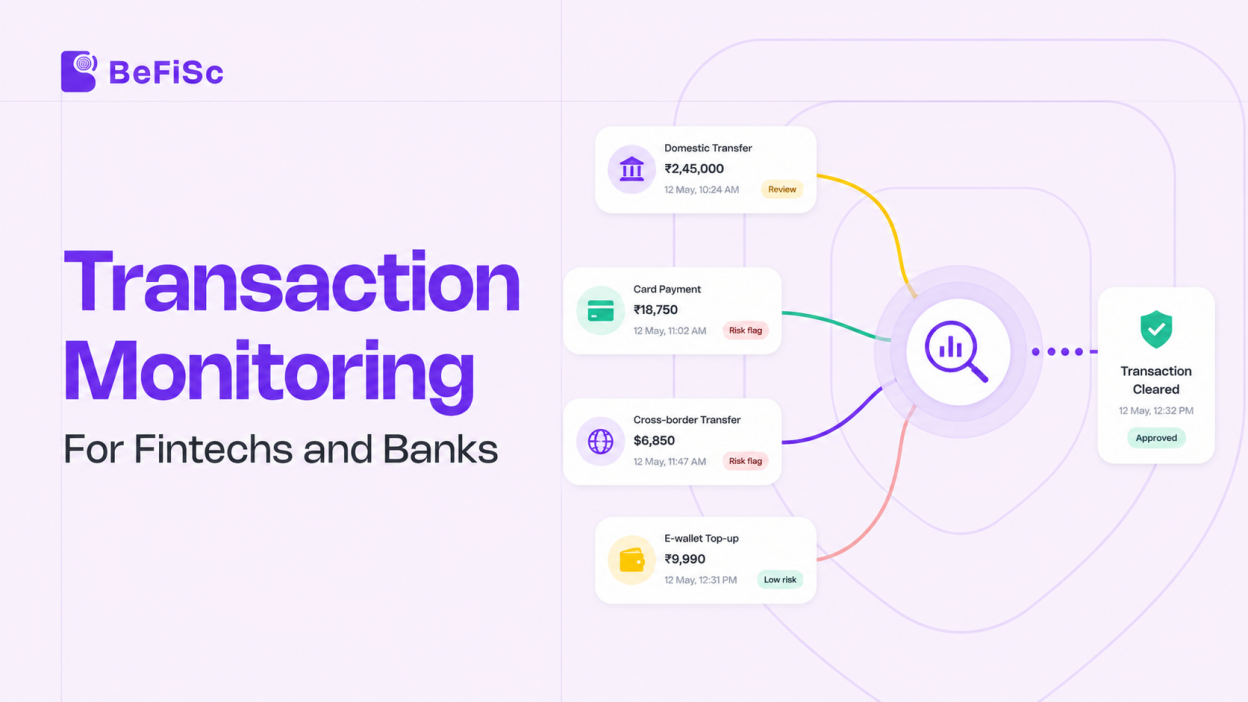
A transaction monitoring system (TMS) ingests transaction data, applies rule sets and statistical models to identify anomalous behaviour, generates alerts when transactions or patterns breach defined thresholds, and routes alerts to compliance or fraud analysts for review. The most actionable outcome of a TMS is either filing a Suspicious Transaction Report with FIU-IND or blocking a transaction before it completes.
How Transaction Monitoring Systems Work
Rule-Based Detection
Traditional transaction monitoring uses rule-based engines: predefined thresholds and conditions that trigger alerts when met. Common rule types include: single transactions above a specified amount threshold (e.g., cash transactions above ₹10 lakh); multiple transactions by the same customer within a defined period that cumulatively exceed a threshold (structuring detection); transactions to or from high-risk jurisdictions or sanctioned counterparties; rapid in-out transaction patterns (layering); and unusual transaction types relative to the customer profile.
Rule-based systems are transparent, auditable, and consistently enforceable. Their weakness is that they generate high false positive rates — analysts spend most of their time reviewing alerts that turn out to be legitimate customer activity.
Behavioral Analytics and ML-Based Detection
Modern transaction monitoring systems layer machine learning models on top of rule engines. Instead of applying uniform thresholds to all customers, ML-based systems learn each customer’s normal transaction behaviour —amounts, frequencies, counterparties, channels, timing, and flag deviations from that individual baseline. This significantly reduces false positives for customers with legitimately high or unusual transaction volumes (traders, business owners) while maintaining sensitivity to genuinely suspicious patterns.
Network Analysis
Advanced TMS implementations include network analysis: mapping relationships between accounts, beneficiaries, and counterparties to detect money mule rings, layering networks, and circular transaction flows that are invisible when analysing individual accounts in isolation.
PMLA and RBI Compliance Requirements for Transaction Monitoring
Under the Prevention of Money Laundering Act 2002 (PMLA) and RBI’s Master Circular on KYC/AML/CFT, regulated entities are required to:
- Maintain and implement a board-approved AML/CFT policy that includes transaction monitoring procedures.
- Monitor transactions on an ongoing basis for unusual patterns inconsistent with the customer’s risk profile and business profile.
- Report Suspicious Transactions to FIU-IND within seven working days of forming the suspicion — not within seven days of the transaction.
- Report Cash Transaction Reports (CTRs) for all cash transactions above ₹10 lakh to FIU-IND within 15 days of the end of the month.
- Maintain records of all transactions for at least five years, with records available for production to regulatory inspections.
FATF Recommendations 10 and 11 — which India has incorporated through PMLA amendments also require risk-proportionate monitoring: customers classified as higher risk must be subject to more intensive transaction monitoring than standard-risk customers.
Understanding False Positives: The Core Operational Challenge
The most significant operational challenge in transaction monitoring is false positive management. Industry benchmarks suggest that traditional rule-based TMS generate between 95% and 99% false positive alert rates, meaning for every 100 alerts generated, fewer than five involve genuinely suspicious activity. At scale, this creates an unsustainable workload for compliance teams.
Factors That Drive High False Positive Rates
- Overly broad rules that do not account for customer segment or risk profile.
- Static thresholds that do not adapt to seasonal business variations.
- Lack of customer behavioural context flagging a corporate account’s monthly salary disbursement because it exceeds a single-transaction threshold.
- Insufficient counterparty data enrichment: inability to automatically confirm that a flagged counterparty is a known legitimate entity.
Strategies to Reduce False Positives
- Segment-specific rule tuning: Apply different threshold sets to different customer segments, retail, SME, corporate, and high-net-worth, rather than uniform rules.
- Behavioural baseline modelling: Use ML models to establish individual customer norms and alert on deviation rather than absolute amounts.
- Alert scoring and prioritisation: Assign risk scores to alerts based on alert type, customer risk tier, and historical resolution patterns, so analysts focus on the highest-priority alerts first.
- Whitelist management: Maintain and regularly review whitelists of known legitimate counterparties (payroll processors, utility providers, major e-commerce platforms) to suppress routine transaction alerts.
Building a Transaction Monitoring Architecture for Indian Fintechs
For fintechs operating under RBI’s regulatory framework, a compliant transaction monitoring architecture requires: data ingestion pipelines capable of processing transactions in near real time; a rule engine configurable by compliance teams without engineering involvement; an ML scoring layer for behavioral analysis; an alert management workflow tool with case management and escalation; FIU-IND reporting integration for automated CTR and STR generation; and a complete audit trail for all alerts including closed, dismissed, and escalated cases.
Where BeFiSc Fits
BeFiSc’s fraud intelligence APIs provide the data enrichment layer that makes transaction monitoring systems more effective. By enriching transaction alerts with real-time KYC data, counterparty verification, and behavioural signals, BeFiSc helps compliance teams make faster, better-informed decisions on whether to escalate or dismiss alerts, directly improving alert resolution rates and reducing the operational burden of false positive management.
Key Takeaways
- Indian fintechs must be able to generate STRs within seven working days and CTRs within 15 days of month-end.
- Transaction monitoring is an ongoing PMLA compliance requirement — not a periodic audit function.
- Rule-based and ML-based monitoring serve different detection purposes; production systems need both.
- False positive reduction is the primary operational challenge; segment-specific tuning and behavioural modelling are the primary solutions.
Frequently Asked Questions
How can fintechs reduce false positives in transaction monitoring?
Fintechs can reduce false positives by segmenting customers, using behavioural baselines, tuning transaction thresholds, enriching alerts with customer and counterparty data, and prioritising alerts based on risk scores.
What transactions should a transaction monitoring system flag?
A TMS should flag unusual transaction amounts, rapid fund movements, structuring, high-risk counterparties, sanctioned entities, unusual geographic activity, and behaviour that differs significantly from a customer’s established profile.
What must be included in a CTR filed with FIU-IND?
A Cash Transaction Report filed with FIU-IND must include the transaction date, amount, currency, branch information, customer identification details (PAN, Aadhaar, account number), and nature of the transaction. CTRs are required for all cash transactions above ₹10 lakh within a calendar month.
What is the difference between rule-based and AI-based transaction monitoring?
Rule-based monitoring uses fixed thresholds and conditions to trigger alerts. AI-based monitoring learns individual customer behavior patterns and flags deviations from those patterns. AI-based systems typically generate significantly fewer false positives but require larger historical datasets for model training.
What is a Suspicious Transaction Report (STR) and when must it be filed?
An STR is a report filed with FIU-IND when a regulated entity has reasonable grounds to suspect that a transaction involves proceeds of crime, is connected to money laundering, or may be financing terrorism. Under PMLA, the STR must be filed within seven working days of the suspicion being formed, not seven days after the transaction itself.
Conclusion
Transaction monitoring plays a critical role in helping Indian fintechs and financial institutions detect suspicious activity and meet their AML obligations. Effective systems combine rule-based detection with behavioural analytics, machine learning, and network analysis to identify risks that simple threshold rules may miss.
However, detection alone is not enough. Fintechs must also manage false positives, maintain complete audit trails, investigate alerts efficiently, and meet FIU-IND reporting requirements within the prescribed timelines. A risk-based monitoring architecture that combines quality data, configurable rules, behavioural intelligence, and effective case management can strengthen both compliance and fraud prevention.