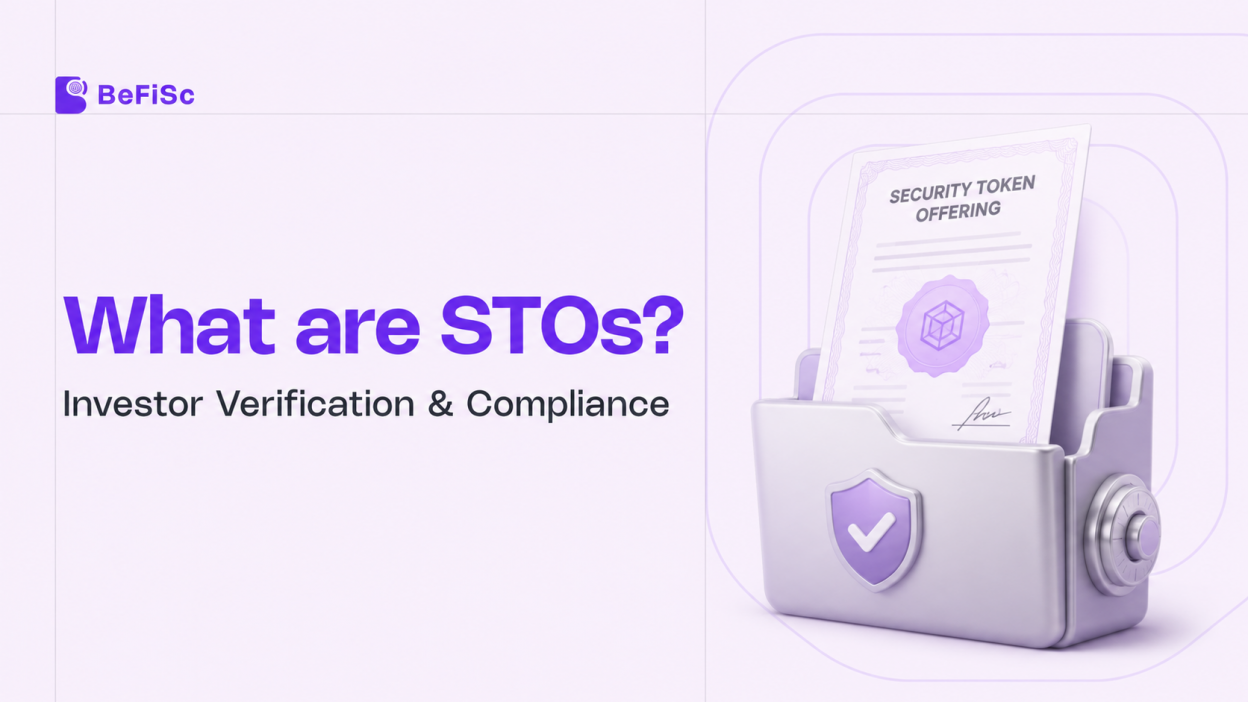
Security Token Offerings (STOs) allow companies to raise capital by issuing blockchain-based tokens that represent real, regulated assets such as equity, debt, or profit-sharing rights. Unlike most crypto token sales, STOs operate within securities and compliance frameworks.
In this India-focused 2026 guide, we explain what STOs are, how they work, how regulation applies in the Indian context, why investor verification matters, and where compliance challenges usually arise.
Key highlights
- STOs are regulated fundraising models where tokens represent securities rather than utility assets.
- Compliance plays a central role, especially around investor eligibility, KYC, and AML.
- In India, STO-style structures require careful legal interpretation across securities, AML, and cross-border laws.
- Investor verification and ongoing monitoring are often the biggest operational challenges.
What is a Security Token Offering (STO)
A Security Token Offering (STO) is a fundraising method where a company issues digital tokens that represent a security. These securities can include equity ownership, debt obligations, profit-sharing arrangements, or asset-backed interests.
In simple terms, an STO delivers a regulated investment using token-based infrastructure.
Example of an STO
One widely referenced example is the tZERO security token offering. In 2018, tZERO raised capital by issuing tokens that represented a security interest in the platform. Importantly, the company restricted participation to eligible investors and enforced identity and compliance checks throughout the process.
This example matters because it shows that STOs focus less on speculation and more on structured, compliant fundraising.
How do STOs work?
Although structures vary, STOs generally follow a predictable flow.
Step 1: Define the investment structure
First, the issuer decides what the token represents. For instance, the token may reflect equity ownership, debt with interest payments, or revenue-sharing rights. At the same time, the issuer defines investor rights, disclosures, lock-in periods, and transfer rules.
As a result, legal documentation forms the foundation of the offering.
Step 2: Map the regulatory approach
Next, the issuer evaluates how securities laws apply. In India, this usually means reviewing the structure against:
- securities and capital market principles
- company law requirements
- AML obligations
- cross-border investment rules, where applicable
Because no dedicated STO framework exists in India, legal interpretation becomes critical at this stage.
Step 3: Issue tokens with built-in controls
After that, the issuer creates tokens on a blockchain. These tokens often include controls that restrict transfers, enforce lock-ins, or limit ownership to verified investors only.
Therefore, compliance becomes part of the token design rather than an afterthought.
Step 4: Verify investors before onboarding
Before accepting funds, issuers verify investors using KYC and AML workflows. In some cases, they also assess risk profiles, residency status, or source of funds.
Step 5: Distribute tokens
Once verification is complete and funds are received, the issuer allocates tokens to the investor’s wallet or custody account. Ownership records update accordingly.
Step 6: Maintain ongoing compliance
Finally, issuers continue monitoring investors, rescreening them as lists update and enforcing transfer restrictions throughout the token’s lifecycle.
STO vs ICO vs IPO: what’s the difference?
Although STOs, ICOs, and IPOs all raise capital, they operate very differently.
- STOs issue regulated securities using tokens.
- ICOs usually sell utility tokens with limited investor protection.
- IPOs list company shares on public exchanges through established capital markets.
In the Indian context, this distinction matters because any structure resembling a public investment product can trigger regulatory scrutiny.
Quick comparison table: STO vs ICO vs IPO
| Feature | STO | ICO | IPO |
|---|---|---|---|
| Regulation | Securities-aligned | Often unclear | Heavily regulated |
| Asset type | Tokenised security | Utility / speculative token | Listed shares |
| Investor protection | High | Low | High |
| Eligibility checks | Strong | Weak or none | Strong |
| Liquidity | Developing | Often high | High |
| Compliance effort | Medium to high | Low (but risky) | Very high |
STO regulations in India: how does it work?
India does not yet have a dedicated STO framework. However, that does not mean STO-style structures are automatically illegal. Instead, issuers must evaluate how existing laws apply.
Key regulatory layers to consider
First, securities regulations matter if tokens provide investment-like returns. In addition, company law determines how ownership and rights are issued and recorded.
At the same time, AML obligations under PMLA apply whenever investment funds move through a platform. Furthermore, cross-border participation introduces FEMA-related requirements.
Because these layers overlap, most India-linked STO structures rely on conservative legal design and limited investor access.
Investor verification for STOs in India
Investor verification determines whether an STO can operate compliantly.
Identity verification
For individuals, verification often includes PAN checks, government ID validation, and liveness verification. For entities, issuers verify company details, directors, and beneficial owners.
Address verification
Issuers confirm residency using recent address documents, especially when jurisdictional restrictions apply.
AML screening
Platforms screen investors against AML compliance software, PEP databases, and adverse media sources. If risks appear, enhanced checks follow.
Source of funds checks
For higher-value investments, issuers may request bank statements or income documentation to establish legitimacy.
Ongoing monitoring
After onboarding, issuers continue screening investors and monitoring transactions for unusual behaviour.
Compliance challenges with STOs
Even when legal design looks sound, execution often creates friction.
First, regulatory ambiguity forces teams to document every decision carefully. Second, cross-border onboarding increases complexity due to varying documents and residency rules. Third, manual verification slows onboarding and increases operational cost.
In addition, transfer restrictions protect compliance but reduce liquidity. Finally, custody and audit expectations remain high because investor rights are involved.
Benefits of STOs
Despite challenges, STO-style models offer advantages:
- fractional ownership enables smaller ticket sizes
- programmable controls enforce compliance automatically
- Operational efficiency improves with fewer manual steps
- ownership records remain transparent and traceable
Risks of STOs
However, issuers must plan for:
- evolving regulatory interpretations
- limited secondary liquidity
- Higher compliance and legal costs
- technical and custody-related risks
Final takeaway
STOs are not unregulated crypto products. They are regulated investment instruments delivered through token technology. In India, success depends less on the token itself and more on how well teams handle investor verification, compliance design, and ongoing monitoring.
Frequently Asked Questions
What compliance checks should the STO platform perform before token insurance?
STO platforms should verify investor identity, residency, eligibility, beneficial ownership, and source of funds before issuing tokens. They should also conduct AML and sanctions screening and maintain ongoing transaction monitoring.
Can STO tokens trade freely?
Generally no. Transfers often require verified counterparties and compliance checks.
What is the biggest compliance challenge?
Investor verification and ongoing monitoring usually create the most operational strain.
Are STOs the same as crypto tokens?
India does not have a single STO rulebook. Any token that behaves like a security must comply with existing securities, company law, AML, and cross-border regulations.
Are STOs legal in India?
India does not have a single STO rulebook. Any token that behaves like a security must comply with existing securities, company law, AML, and cross-border regulations.
Conclusion
STOs combine blockchain technology with regulated investment structures, making compliance a core part of the model. In India, the absence of a dedicated STO framework means issues must be assess securities, Company law, AML, and cross-border requirements. Strong investor verification, risk-based onboarding, transfer controls, and continuous monitoring can help reduce compliance risks while supporitng a more transparent and efficient tokenised investment ecosysytem.