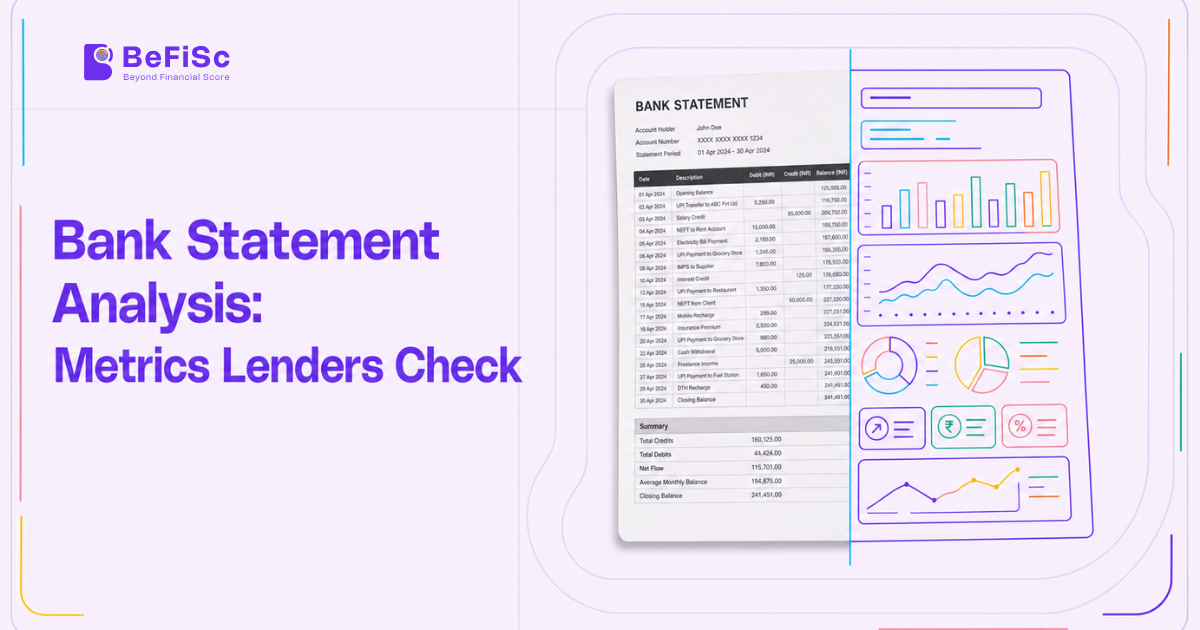
For most Indian lenders, the bank statement is the single most informative document in a loan file. It shows what a borrower earns, what they already owe, how they manage liquidity, and often what they would rather not disclose.
Reading it manually does not scale. A six-month current account statement for a busy MSME can run to thousands of lines. Credit teams need that converted into a few reliable numbers and a short list of warnings.
This guide explains what a bank statement analyser does, the metrics lenders should rely on, the red flags that matter, and how to evaluate a tool before plugging it into your underwriting.
Why Bank Statements Matter in Indian Lending
A large share of India’s borrowers are thin-file or new-to-credit, and many MSMEs have limited audited financials. For these segments, banking behaviour is often the best available evidence of repayment capacity.
Bank statements also capture what bureau reports miss: informal loans repaid by transfer, EMIs to lenders that don’t report promptly, and loan-app repayments that signal stress.
How a Bank Statement Analyser Works
A modern analyser runs five steps.
1. Ingestion
Statements arrive as digital PDFs, scanned images, Excel exports, or structured Account Aggregator data. The tool extracts transactions, balances, and account metadata, handling hundreds of bank-specific layouts.
2. Integrity checks
Before any analysis, the analyser tests whether the document can be trusted: does each running balance equal the previous balance plus credits minus debits; do fonts, metadata, and layout match the issuing bank’s known templates; are there gaps in dates?
3. Categorisation
Each transaction is labelled: salary, business receipts, EMI, NACH debit, rent, utilities, cash deposit, ATM withdrawal, self-transfer, gambling, crypto, returned cheque charges, and so on. Narration parsing, counterparty recognition, and rules work together here.
4. Metric computation
Categorised data becomes monthly income, obligations, balances, and volatility measures.
5. Output
Results feed a credit officer’s report and, through an API, the lender’s business rules engine or scorecard.
The Metrics That Drive Decisions
| Metric | What it tells you | Watch-out |
|---|---|---|
| Monthly salary / net income | Repayment capacity | Separate true salary from self-transfers |
| Existing EMIs and NACH debits | Current obligations | Detect EMIs paid from other accounts |
| FOIR (fixed obligations to income ratio) | Room for a new EMI | Depends on correct income and EMI detection |
| Average bank balance (ABB) | Liquidity cushion; common MSME sizing input | Balances can be dressed up before application |
| Inward and outward bounces | Payment discipline | Count, value and recency all matter |
| Credit and debit turnover | Business scale | Exclude circular and related-party flows |
| Cash deposit share | Informality or diversion risk | Sector norms vary widely |
| Minimum balance breaches and penal charges | Liquidity stress | Rising trend matters more than one event |
FOIR is usually calculated as total monthly fixed obligations, including the proposed EMI, divided by net monthly income. Each lender sets its own thresholds by segment.
Red Flags Credit Teams Should See
- Window dressing: large one-off credits in the weeks before application, often reversed shortly after.
- Circular transactions: money leaving and returning between the same parties to inflate turnover.
- Loan stacking signals: new credits from several digital lenders in a short period, followed by multiple small EMIs.
- Salary inconsistency: salary credited from different employers or on irregular dates without explanation.
- Cheque and ECS returns: especially returns for insufficient funds on EMIs.
- High-risk spend: regular payments to betting, gaming, or crypto platforms.
- Tampering indicators: balance breaks, edited metadata, inconsistent fonts, or a layout that does not match the bank.
Retail vs MSME Analysis
Retail borrowers
The focus is salary stability, existing obligations, and FOIR. Three to six months of the salary account is typical. Key risks are undisclosed loans and income overstated through transfers.
MSME borrowers
The focus shifts to business turnover, ABB, concentration of customers and suppliers, and seasonality. Six to twelve months across all operating accounts is typical. Lenders often reconcile bank credits with GST turnover to test declared revenue.
Common Mistakes
- Analysing one account in isolation. Borrowers may share only their cleanest account. Ask for all primary accounts and compare credits with declared income and bureau obligations.
- Treating PDF uploads as authentic. A tampered statement produces accurate-looking but false metrics. Integrity checks must run first.
- Using averages that hide volatility. A healthy ABB can mask two months near zero. Look at the distribution, not just the mean.
- Ignoring narration quality. Poor categorisation of UPI narrations understates EMIs and overstates income. Test accuracy on your own portfolio.
How to Evaluate an Analyser
Before choosing a tool, test it on 200 to 500 of your own historical files, including known frauds and defaults. Assess:
- Bank and format coverage, including co-operative and small finance banks your borrowers use.
- Extraction accuracy of transactions and balances, measured, not claimed.
- Categorisation accuracy for salary, EMI, and self-transfer, the three that most affect decisions.
- Fraud detection results on known tampered files.
- Turnaround time at your peak volumes.
- Explainability: can a credit officer see which transactions drove each metric?
- Integration: clean APIs, AA support, and outputs your rules engine can use directly.
- Data handling that fits the DPDP Act’s purpose limitation and retention rules.
Use Cases
Instant personal loans: A fintech NBFC takes AA or PDF input, computes salary and FOIR automatically, and auto-approves applications within policy while routing edge cases to underwriters.
MSME term loans: A lender analyses twelve months across three current accounts, removes inter-account transfers, and sizes the loan on ABB and adjusted turnover cross-checked with GST.
Credit card limit setting: A bank uses salary account analysis for new-to-credit customers without bureau history.
Portfolio monitoring: A lender re-analyses statements at renewal to catch rising obligations or falling balances before renewing limits.
Key Takeaways
- Bank statements are the most informative document for thin-file and MSME borrowers.
- A good analyser checks integrity first, then categorises, then computes metrics.
- Income, obligations, FOIR, ABB and bounces drive most decisions; each depends on accurate categorisation.
- Window dressing, circular flows, loan stacking and tampering are the red flags that matter most.
- Evaluate tools on your own historical files, including known frauds, before you trust them.
Frequently Asked Questions
Is Account Aggregator data better than PDF statements?
AA data is more trustworthy because it comes directly from the bank, but it still needs the same analysis to become underwriting metrics.
Can bank statement analysis detect fake statements?
A good analyser checks balance continuity, document metadata, and bank-specific layout signals, which catches most edited PDFs.
What is ABB in banking?
Average bank balance, usually calculated from balances on fixed dates each month. Lenders use it to judge liquidity and size MSME loans.
How many months of bank statements do lenders need?
Typically three to six months for salaried borrowers and six to twelve months for businesses, depending on product and policy.
What is bank statement analysis in lending?
The process of converting a borrower’s bank transactions into income, obligations, liquidity, and risk indicators used in a credit decision.
Conclusion
Bank statement analysis sits at the centre of credit decisions for India’s fastest-growing loan segments. The difference between a good and a mediocre implementation is rarely the number of metrics produced. It is whether the document was trustworthy, whether income and EMIs were categorised correctly, and whether the credit team can see why a number is what it is.
Lenders that invest in integrity checks, accurate categorisation, and explainable outputs make faster decisions with fewer surprises in the portfolio.
FinEye by BeFiSc analyses bank statements from PDFs and Account Aggregator data, with integrity checks, income and obligation detection, and fraud flags built for Indian lending. Book a FinEye demo and test it on your own files.