A GST number on an invoice or onboarding form is easy to type and easy to fake. For a business paying suppliers, a platform onboarding merchants, or a lender assessing an MSME, the question is not whether a GSTIN looks right. It is whether the registration is real, active, belongs to the entity in front of you, and is being used compliantly.
About 10,000 people search “GST registration status” every month in India, and variants like “GST check online” add more. Most are checking a single number. This guide covers that and goes further into how businesses should build GST verification into onboarding at scale.
How to Read a GSTIN
A GSTIN is a 15-character identifier with a fixed structure:
| Position | Meaning | Example |
|---|---|---|
| 1-2 | State code | 07 = Delhi, 27 = Maharashtra |
| 3-12 | PAN of the business | AAACB1234F |
| 13 | Entity number for the same PAN in that state | 1, 2, … |
| 14 | Default character | Z |
| 15 | Check digit | Computed |
Two quick sanity checks follow. The PAN inside the GSTIN should match the PAN the business gave you, and the state code should match the address on the invoice or form. A mismatch on either is an immediate flag.
How to Check GST Registration Status Online
The official route is the GST portal’s taxpayer search.
- Open the GST portal and go to Search Taxpayer.
- Choose to search by GSTIN/UIN, or search by PAN to see all GSTINs under one PAN.
- Enter the number and complete the captcha.
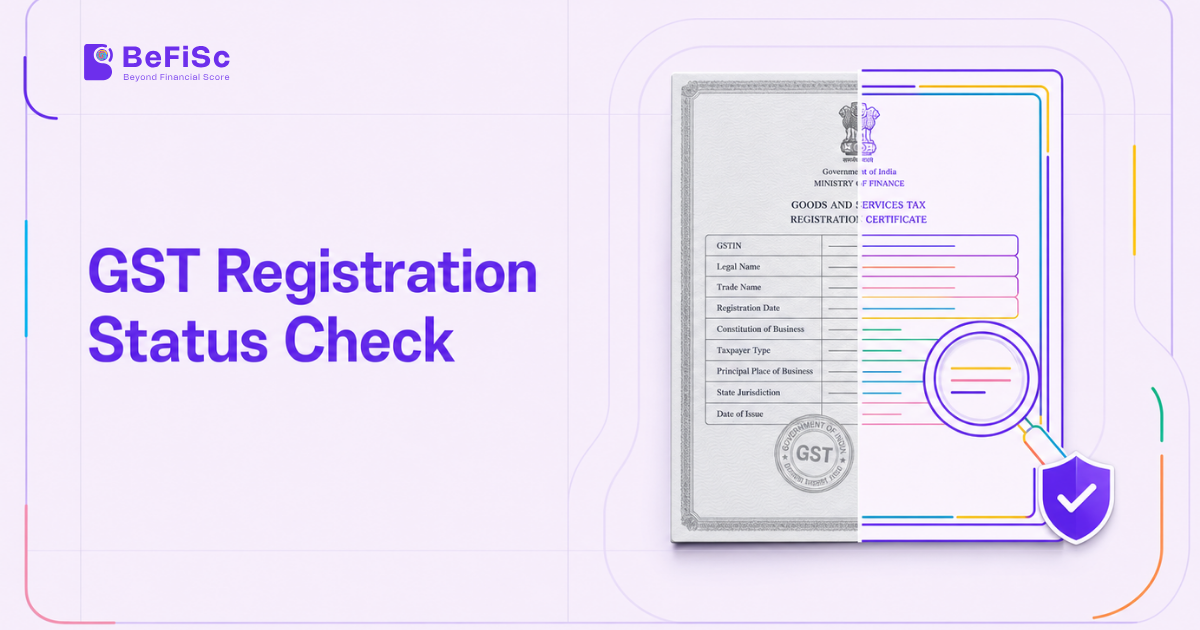
- Review the result: legal name, trade name, registration date, constitution of business, taxpayer type, status, principal place of business, nature of business activities, and return filing history.
This works for one-off checks. For hundreds or thousands of checks a month, businesses use a GST verification API that returns the same public data in structured form.
What Each Status Means
| Status | Meaning | What to do |
|---|---|---|
| Active | Registration is valid | Proceed, then check filing behaviour |
| Suspended | Registration is suspended, usually pending cancellation proceedings or after a cancellation application | Hold; the taxpayer cannot legitimately charge GST in this period |
| Cancelled (by taxpayer) | The business surrendered its registration | Do not accept GST invoices dated after cancellation |
| Cancelled (suo moto) | The tax officer cancelled it, often for non-filing or non-existence at the address | Treat as high risk; investigate before any dealing |
A cancellation date is as important as the status. An invoice dated after cancellation should not carry GST, and input tax credit on it is at risk.
What Else a GST Check Reveals
Beyond status, the public record answers useful onboarding questions:
- Business structure: proprietorship, partnership, LLP, private limited, and so on. It should match what the entity claims to be.
- Taxpayer type: regular or composition. A composition dealer cannot charge GST on invoices, so a composition taxpayer issuing tax invoices is a red flag.
- Registration date: a GSTIN registered weeks ago, now billing large amounts, deserves scrutiny.
- Principal place of business: compare with the address on invoices, KYC, and bank records.
- Return filing history: whether GSTR-1 and GSTR-3B are filed regularly and on time.
Filing history is the most underused signal. A supplier that has stopped filing is a direct input tax credit risk for the buyer, and often a sign of financial stress.
Why GST Verification Matters for Businesses
Input tax credit protection
Under the GST law, a buyer’s input tax credit depends on the supplier reporting the invoice and paying the tax. Credit on invoices from non-existent, cancelled, or non-filing suppliers can be denied or reversed, with interest. Verifying suppliers before paying them is cheaper than defending credit later.
KYB for platforms and payment companies
Marketplaces, payment aggregators and B2B platforms use GST registration as core business-verification evidence. It confirms legal name, type of entity, and operating address from a government source.
MSME lending
For lenders, GST data confirms the business exists and is operating, and filing data supports turnover validation against bank statements.
Common GST-Related Fraud Patterns
- Fake registrations: GSTINs obtained with borrowed identities for shell entities that issue invoices without supplying goods. Tax authorities have run repeated special drives against such registrations, and new registrations now face stricter identity checks, including Aadhaar authentication and, in many states, biometric verification.
- Invoice-only entities: Active GSTINs with little or no real business, used to pass on fake credit.
- Borrowed GSTINs: A genuine business’s GSTIN quoted by an unrelated party to look legitimate.
- Post-cancellation invoicing: Suppliers continuing to charge GST after cancellation.
Building GST Checks into Onboarding
A robust GST verification step includes five checks:
- Format and checksum validation before any external call.
- Live status and details from the GST registry through an API.
- PAN match: the embedded PAN matches the verified PAN of the business.
- Name and address match against the application, using scored name matching rather than exact matching.
- Filing recency for suppliers and borrowers where ongoing compliance matters.
For ongoing relationships, re-check status monthly or before large payments. A supplier that was active at onboarding can be suspended six months later.
Use Cases
Procurement and accounts payable: A manufacturer verifies every new vendor’s GSTIN, blocks payment to suspended or cancelled registrations, and flags vendors who have missed recent returns.
Merchant onboarding: A payment aggregator uses GST verification with PAN and bank account checks to confirm a merchant’s legal identity and address before enabling settlements.
MSME lending: A lender confirms the borrower’s GSTIN is active and filing, then compares GST turnover with bank credits to test declared revenue.
B2B marketplaces: A wholesale platform shows a “GST verified” badge only after status, PAN, and address checks pass.
Key Takeaways
- A GSTIN has 15 characters: state code, PAN, entity number, a default character and a check digit.
- Check status on the GST portal for one-off lookups; use an API for volume.
- Suspended and cancelled statuses, and the cancellation date, matter for input tax credit and risk.
- Taxpayer type, registration date and filing history reveal more than status alone.
- Build GST checks into onboarding with PAN, name and address matching, and re-check periodically.
Frequently Asked Questions
How often should businesses re-verify a supplier’s GST status?
At least monthly for active suppliers, and before any large payment.
Can I find a company’s GST number using its PAN?
Yes. The GST portal allows search by PAN, which lists all GSTINs registered under it.
Can I claim input tax credit from a cancelled GSTIN?
Credit on invoices issued after the cancellation date is at risk. Check the cancellation date before accepting such invoices.
What does GST status “Suspended” mean?
The registration is temporarily suspended, usually while cancellation is being processed. The business should not charge GST in that period.
How do I check if a GST number is valid?
Search the GSTIN on the GST portal’s taxpayer search. It shows whether the registration exists, its status and the registered business details.
Conclusion
GST registration data is one of the richest free business-verification sources in India, but a single status lookup captures only part of its value. The real risk signals sit in taxpayer type, registration age, cancellation dates, filing behaviour and whether the GSTIN actually belongs to the entity presenting it.
Businesses that verify GST at onboarding and keep checking afterwards protect their input tax credit, reduce shell-entity fraud and make faster, better-evidenced decisions about who they deal with.
BeFiSc’s GST verification API returns structured registration and status data that plugs into vendor, merchant and borrower onboarding, alongside PAN, MCA and bank account checks. Request API access to try it on your onboarding flow.