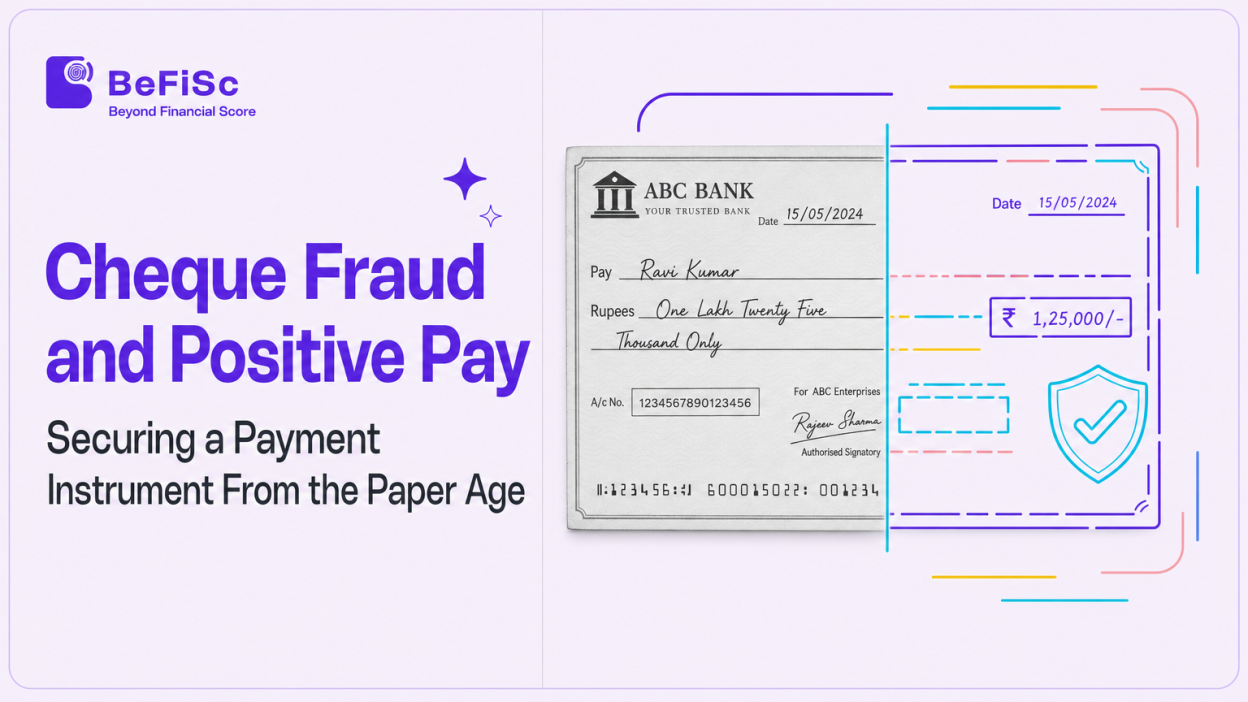
The cheque predates every digital payment method by centuries, and though digital payments now dominate, cheques remain significant in India, particularly for high-value business and personal transactions where their formality and paper trail still matter. But the cheque’s paper-age design carries paper-age vulnerabilities: it can be forged, altered, counterfeited, and stolen, and because a single cheque can carry a large value, cheque fraud can cause substantial loss. Recognising this, the Reserve Bank of India introduced the Positive Pay System, a mechanism that verifies key cheque details before payment, catching the tampering and forgery that cheque fraud relies on, and providing a modern defence for a very old instrument.
Cheque fraud connects to the [document forgery] and [identity fraud] themes of this series, applied to a specific, still-relevant payment instrument, and the Positive Pay System illustrates how a verification layer can secure it. This guide explains what cheque fraud is, its main types, why cheques remain vulnerable, how the Positive Pay System works, its thresholds and mechanics, its effectiveness and limits, and how cheque fraud is prevented more broadly.
What Is Cheque Fraud?
Cheque fraud is any fraud involving the misuse, forgery, alteration, counterfeiting, or theft of cheques to obtain money improperly, deceiving a bank into paying against a cheque that is fraudulent, altered, forged, or otherwise not a legitimate instruction from the genuine account holder.
The defining characteristic is deception involving the cheque instrument. Cheque fraud exploits the cheque by forging it, altering it, counterfeiting it, or misusing a stolen one to obtain payment the perpetrator is not entitled to. The fraud may involve creating a fraudulent cheque, altering a genuine one, forging signatures, or misusing stolen cheques, all to deceive the bank into paying improperly. The cheque is the vehicle of the fraud.
Cheque fraud matters despite the decline of cheques because cheques remain significant for high-value transactions, and a single fraudulent cheque can carry substantial value, making cheque fraud a source of significant loss. High-value business and personal cheques are exactly the target of cheque fraud, where the potential gain is large. The concentration of cheque use in higher-value transactions makes cheque fraud a meaningful risk despite declining cheque volumes.
Cheque fraud exploits the cheque’s paper-based design and its vulnerability to forgery, alteration, and counterfeiting, which digital payments do not share. The cheque, as a physical instrument carrying a payment instruction, can be physically tampered with (altered, forged, counterfeited) in ways digital payments cannot, creating specific vulnerabilities. This is why cheque fraud is a distinct fraud type requiring specific defences (like the Positive Pay System), addressing the paper-based instrument’s particular weaknesses. Understanding cheque fraud as deception involving the misuse, forgery, alteration, or counterfeiting of cheques is significant for its high-value targets and rooted in the cheque’s paper-age vulnerabilities is the foundation for understanding its types and the Positive Pay defence.
The Main Types of Cheque Fraud
Cheque fraud takes several distinct forms, and understanding them clarifies the vulnerabilities the Positive Pay System addresses.
Alteration. Altering a genuine cheque by changing the amount, the payee (beneficiary), the date, or other details to redirect or increase the payment. Alteration takes a genuine cheque and modifies it fraudulently, for example, changing the amount to a larger sum or the payee to the fraudster. Alteration is a core cheque fraud, exploiting the cheque’s physical modifiability, and it is a primary target of Positive Pay (which verifies the key details against tampering).
Forgery. Forging signatures or creating fraudulent cheques, forging the account holder’s signature on a cheque, or creating an entirely fraudulent cheque purporting to be from the account holder. Signature forgery deceives the bank into paying a cheque the genuine account holder did not authorise. Forgery is a fundamental form of cheque fraud, faking the authorisation the cheque represents.
Counterfeiting. Creating counterfeit cheques: producing fake cheques that mimic genuine ones, drawn on real or fabricated accounts. Counterfeit cheques are fraudulent instruments designed to pass as genuine, deceiving the bank into paying. Counterfeiting produces fraudulent cheques from scratch.
Cheque theft and misuse. Stealing genuine cheques (blank or completed) and misusing them by using stolen cheques, often with forgery or alteration, to obtain payment. Stolen-cheque fraud combines theft with forgery/alteration to misuse genuine cheque instruments. This connects cheque fraud to theft and identity misuse.
Cheque kiting. Exploiting the time delay in cheque clearing (the “float”) by writing cheques against insufficient funds and using the clearing delay to create artificial balances is a fraud exploiting cheque-clearing timing. Cheque kiting manipulates the clearing process rather than the instrument itself.
Fraudulent issuance and closed-account cheques. Issuing cheques against closed accounts, insufficient funds, or fraudulently deceiving the recipient into accepting a cheque that will not be honoured. This includes bad-cheque fraud in various forms.
The alteration and forgery focus. The most common and directly targeted types of alteration and forgery involve tampering with the cheque’s key details (amount, payee) or authorisation (signature). These are precisely what the Positive Pay System addresses by verifying the key cheque details before payment to catch tampering and inconsistency. Understanding the types clarifies the vulnerabilities cheque fraud exploits: physical alteration, forgery, counterfeiting, theft, and clearing manipulation, and sets up understanding how Positive Pay defends against the tampering-based fraud (alteration, forgery) that is most directly addressable through detail verification.
Why Cheques Remain Vulnerable
Understanding why cheques are vulnerable to fraud clarifies the need for defences like Positive Pay.
The physical-instrument vulnerability. A cheque is a physical instrument that can be physically tampered with, altered, forged, or counterfeited in ways digital payments cannot. The paper cheque’s physicality allows alteration of its details and forgery of its signature, vulnerabilities inherent to a physical instrument. This physical vulnerability is the root of cheque fraud, absent from digital payments where there is no physical instrument to tamper with.
The manual-verification challenge. Historically, cheque verification relied on manual checks (signature verification, examining the cheque) that are imperfect and hard to perform reliably at scale. Detecting subtle alterations or skilled forgeries through manual examination is difficult, and the volume of cheques makes thorough manual verification challenging. The imperfection of manual cheque verification leaves cheque fraud room to succeed, particularly for subtle tampering.
The high-value concentration. Because cheques are increasingly used for high-value transactions, the potential gain from cheque fraud is large; a single fraudulent high-value cheque can yield substantial money. This concentration of cheque use in higher values makes cheque fraud attractive and its losses significant, justifying focused defences for high-value cheques (which Positive Pay targets).
The clearing process factors. The cheque-clearing process, including the [Cheque Truncation System (CTS)] that clears cheques electronically, involves steps where fraud can be attempted (alteration before clearing, exploiting clearing timing). While CTS improved clearing efficiency, the clearing process and its timing create factors that cheque fraud can exploit (like kiting’s exploitation of float).
The declining-but-significant use. Cheque use has declined with digital payments, but it remains significant for high-value and specific transactions, meaning cheque fraud remains a real risk despite lower volumes. The continued significance of cheques for high-value transactions keeps cheque fraud relevant, justifying continued attention and defences.
These vulnerabilities physical tamperability, imperfect manual verification, high-value concentration, clearing-process factors, and continued significant use explain why cheques remain vulnerable to fraud and why focused defences like the Positive Pay System are valuable, particularly for the high-value cheques where cheque fraud’s potential loss is greatest. Understanding the vulnerabilities clarifies the need for and design of the Positive Pay defence.
What Is the Positive Pay System?
The Positive Pay System (PPS) is India’s principal defence against cheque fraud for high-value cheques, and understanding it clarifies how a verification layer secures the cheque instrument.
The concept. The Positive Pay System is a fraud-prevention mechanism, introduced by the RBI, that requires the issuer of a high-value cheque to submit key details of the cheque to their bank in advance, so that when the cheque is presented for payment, the bank verifies the presented cheque’s details against the pre-submitted details before clearing it. If the details match, the cheque is cleared; if they do not match, the discrepancy is flagged, and the bank can reject the cheque or take action. Positive Pay adds a verification layer confirming the cheque’s key details are as the issuer intended, before payment.
The RBI introduction. The RBI introduced the Positive Pay System through a circular in September 2020, with the system implemented from January 1, 2021. The National Payments Corporation of India (NPCI) developed the Positive Pay facility within the Cheque Truncation System (CTS), making it available to banks. Positive Pay is thus an RBI-mandated, NPCI-developed, CTS-integrated cheque-fraud defence, operational since 2021.
The fraud-prevention logic. Positive Pay’s logic is verification against tampering by having the issuer pre-submit the cheque’s key details and verifying the presented cheque against them. The system catches alteration (details changed from what the issuer submitted) and inconsistency (a presented cheque not matching the issuer’s record). If a fraudster alters a cheque’s amount or payee, the altered details will not match the pre-submitted details, flagging the fraud. Positive Pay directly counters the [alteration] and tampering-based cheque fraud that changes a cheque’s key details by verifying those details against the issuer’s own record.
The high-value focus. Positive Pay focuses on high-value cheques (above thresholds), where cheque fraud’s potential loss is greatest, concentrating the verification defence where it matters most. This targeted focus on high-value cheques makes Positive Pay efficient (verifying the cheques most at risk) while covering the majority of cheque value. Understanding Positive Pay as an RBI-mandated, verification-based, high-value-focused cheque-fraud defence, confirming a cheque’s key details against the issuer’s pre-submitted record before payment, is the foundation for understanding its mechanics and effectiveness.
How Positive Pay Works: Thresholds and Mechanics
The Positive Pay System’s specific thresholds and mechanics determine how it operates, and understanding them clarifies the practical defence.
The details are submitted. The cheque issuer submits key details of the cheque to their bank in advance, typically the cheque number, date, amount, beneficiary (payee) name, account number, and instrument/transaction code. These key details, submitted before the cheque is presented, form the record against which the presented cheque is verified. The six mandatory details capture the essential elements that alteration would change (especially amount and payee), enabling verification against tampering.
The submission channels. Issuers submit the details through convenient channels: mobile banking, internet banking, SMS, or at a branch, usually at least one working day before the cheque is presented for payment. The multiple channels make submission accessible, and the advance-submission requirement ensures the details are on record before the cheque is presented. Convenient, advance submission is central to the system’s practicality.
The thresholds. The thresholds are important: Positive Pay applies to cheques of ₹50,000 and above (banks enable it at this level), and it is mandatory for cheques of ₹5 lakh and above at most banks (some banks set stricter thresholds, such as ₹2 lakh). Below ₹50,000, Positive Pay generally does not apply; between ₹50,000 and the mandatory threshold, it is typically optional but recommended; at and above the mandatory threshold (₹5 lakh at most banks), it is required, with non-submission potentially leading to the cheque being returned unpaid. The thresholds focus mandatory verification on high-value cheques while enabling it more broadly. (Note: thresholds and specifics can vary by bank and evolve; recent updates have introduced customer-defined limits and refined the mechanics.)
The verification and outcome. When the cheque is presented for payment (through [CTS] clearing), the bank verifies the presented cheque’s details against the issuer’s pre-submitted details. If they match (and the cheque is otherwise in order, with sufficient funds, valid signature), the cheque is honoured. If there is a mismatch, the discrepancy is flagged (by CTS to the banks involved), and the bank can reject the cheque or take redressal measures. The verification catches tampering (mismatched details) before payment, preventing the fraud.
The coverage. Positive Pay was designed to cover a large share of cheque value, reportedly covering roughly 20% of cheques by volume but around 80% by value, reflecting its focus on high-value cheques. By targeting high-value cheques, Positive Pay protects the majority of cheque value (where fraud loss is greatest) while applying to a smaller share of cheque volume. This value-focused coverage makes Positive Pay an efficient defence, securing most of the value at risk. Understanding Positive Pay’s mechanics advances submission of key details, application at ₹50,000+ and mandatory at ₹5 lakh+, verification against tampering at clearing, and value-focused coverage clarifies how it practically defends high-value cheques against alteration and forgery.
The Effectiveness and Limits of Positive Pay
A balanced view requires understanding both Positive Pay’s effectiveness and its limits, clarifying what it does and does not achieve.
The effectiveness against tampering. Positive Pay is effective against tampering-based cheque fraud; it targets alteration (changing amount, payee, or details) and inconsistency, which the detail verification catches. By verifying the presented cheque against the issuer’s record, Positive Pay reliably detects altered details, preventing alteration fraud that changes a cheque’s key elements. For its core target of alteration and detail tampering of high-value cheques, Positive Pay is a strong, effective defence, adding verification that catches the tampering.
The high-value protection. By focusing on high-value cheques (covering most cheque value), Positive Pay protects where cheque fraud’s potential loss is greatest, securing the majority of cheque value against tampering. This value-focused protection is efficient and impactful, defending the high-value cheques most at risk. Positive Pay meaningfully improved high-value cheque security in India.
The scope. Positive Pay applies only to cheques above its thresholds; lower-value cheques (below ₹50,000) are not covered, so cheque fraud on lower-value cheques is not addressed by Positive Pay. The threshold focus, while efficient, leaves lower-value cheque fraud outside the system. Positive Pay is a high-value defence, not a universal cheque-fraud solution.
The limits of fraud types. Positive Pay verifies detail consistency (catching alterations), but it does not directly address all cheque fraud types. It relies on the issuer having submitted accurate details, and it primarily catches tampering with the submitted details; it is less directly aimed at, for example, sophisticated counterfeiting that matches submitted details, or fraud not involving detail tampering. Positive Pay addresses the tampering-based fraud (alteration) most directly, but other cheque-fraud types (some forgery, counterfeiting, kiting) may require additional defences. It is a strong layer, not a complete solution to all cheque fraud.
The dependence on submission. Positive Pay depends on the issuer submitting the details; the protection requires the issuer to use the system, submitting accurate details in advance. Where submission is mandatory (high-value cheques), this is ensured; where optional, it depends on the issuer choosing to use it. The system’s protection is realised only when the details are submitted, making issuer participation (mandatory for high-value cheques) essential.
The balanced view. Positive Pay is an effective, valuable defence against tampering-based fraud on high-value cheques, meaningfully improving high-value cheque security, but it is a targeted layer (high-value, tampering-focused), not a universal cheque-fraud solution. It works alongside other cheque-fraud defences (below) to address the broader cheque-fraud landscape. Understanding both Positive Pay’s effectiveness (against high-value alteration) and its limits (scope, fraud types, submission dependence) gives a realistic view of a strong but targeted defence, part of the broader cheque-fraud-prevention picture.
Preventing Cheque Fraud More Broadly
Beyond Positive Pay, cheque fraud is prevented through a range of measures, and understanding them completes the picture of cheque-fraud defence.
Secure cheque design. Cheques incorporate security features, special papers, printing, and design elements that make forgery and alteration harder and detectable. Secure cheque design is a foundational defence, making tampering and counterfeiting more difficult and easier to detect. Physical security features complement the verification of Positive Pay.
Signature verification. Verifying signatures is traditionally manual, increasingly aided by technology that detects forged signatures, defending against forgery fraud. While imperfect, signature verification is a longstanding cheque-fraud defence, catching forged authorisation. Technology increasingly assists signature verification.
Cheque Truncation System (CTS). The [CTS] clears cheques electronically through images, improving cheque-clearing security and efficiency, standardising and securing the clearing process (and providing the platform for Positive Pay). CTS is part of the modern cheque infrastructure that enhances security.
Customer vigilance and safe handling. Account holders protecting their cheques (securing cheque books, careful issuance, monitoring accounts) and being vigilant reduces cheque theft and misuse. Customer safe handling of cheques is an important preventive measure, reducing the theft and misuse that enable fraud. Awareness of cheque-fraud risks helps customers protect themselves.
Monitoring and anomaly detection. Banks monitor cheque transactions for anomalies and suspicious patterns; the [transaction monitoring] applied elsewhere detects fraudulent cheque activity. Monitoring adds a detection layer beyond individual-cheque verification.
Reporting and response. Prompt reporting of lost or stolen cheques and response to suspected fraud limit cheque fraud losses. Fast reporting and response (like the [1930 helpline] for fraud generally) help contain cheque fraud when it occurs.
The layered defence. Effective cheque-fraud prevention layers these secure design, signature verification, CTS, Positive Pay (high-value verification), customer vigilance, monitoring, and reporting into a defence covering the range of cheque fraud. Positive Pay is a key layer (high-value tampering defence), working with the others to address the broader cheque-fraud landscape. Understanding cheque-fraud prevention as a layered defence, with Positive Pay as a central high-value verification layer, clarifies how India secures the cheque instrument against the fraud its paper-age design otherwise invites. The cheque, an instrument from the paper age, is thus defended by a combination of physical security, verification (including the modern Positive Pay layer), monitoring, and vigilance, securing an old instrument for its continued high-value use.
Key Takeaways
- Cheque fraud involves the misuse, forgery, alteration, counterfeiting, or theft of cheques to obtain money improperly, significant because cheques remain used for high-value transactions where a single fraud can cause substantial loss.
- Its main types are alteration (changing amount, payee, or details), forgery (signatures or whole cheques), counterfeiting, theft and misuse, and cheque kiting, with alteration and forgery most directly targeted by Positive Pay.
- The RBI’s Positive Pay System (introduced in 2020, live from January 2021, developed by NPCI within CTS) verifies a high-value cheque’s key details against the issuer’s pre-submitted record before payment, catching tampering.
- Positive Pay applies to cheques of ₹50,000 and above and is mandatory for ₹5 lakh and above at most banks, covering roughly 20% of cheques by volume but around 80% by value, an efficient, value-focused defence.
- Positive Pay is effective against high-value alteration but is a targeted layer, not a universal solution, working alongside secure cheque design, signature verification, CTS, monitoring, and customer vigilance in a layered defence.
Frequently Asked Questions
What is cheque fraud?
Cheque fraud is any fraud involving the misuse, forgery, alteration, counterfeiting, or theft of cheques to obtain money by improperly deceiving a bank into paying against a cheque that is fraudulent, altered, forged, or not a legitimate instruction from the genuine account holder. It’s significant for high-value cheques where losses can be large.
What are the main types of cheque fraud?
Cheque fraud is any fraud involving the misuse, forgery, alteration, counterfeiting, or theft of cheques to obtain money by improperly deceiving a bank into paying against a cheque that is fraudulent, altered, forged, or not a legitimate instruction from the genuine account holder. It’s significant for high-value cheques where losses can be large.
What is the Positive Pay System?
The Positive Pay System (PPS) is an RBI fraud-prevention mechanism, introduced in 2020 and live from January 2021, that requires cheque issuers to submit key cheque details in advance. When the cheque is presented, the bank verifies the presented details against the pre-submitted record before clearing, catching tampering like alteration.
What is the Positive Pay threshold in India?
Positive Pay applies to cheques of ₹50,000 and above (enabled at this level) and is mandatory for cheques of ₹5 lakh and above at most banks, though some banks set stricter thresholds (like ₹2 lakh). It covers roughly 20% of cheques by volume but around 80% by value, focusing on high-value cheques.
How does Positive Pay prevent cheque fraud?
Positive Pay prevents fraud by verifying a presented cheque’s key details (amount, payee, cheque number, and others) against the details the issuer submitted in advance. If a fraudster alters the cheque, the changed details won’t match the pre-submitted record, so the mismatch is flagged, and the cheque can be rejected before payment.
Conclusion
Cheque fraud is a reminder that old instruments carry old vulnerabilities into the modern world. The cheque, for all its centuries of service and its enduring role in high-value transactions, was designed for a paper age, and its physicality, which once made it trustworthy, is exactly what makes it vulnerable to alteration, forgery, and counterfeiting that digital payments cannot suffer. Because cheques now concentrate in high-value transactions, this vulnerability matters: a single tampered cheque can carry a large loss, making cheque fraud a real and continuing risk even as cheque volumes decline.
India’s Positive Pay System is an elegant answer to this old problem, bringing a modern verification layer to a paper instrument. By having the issuer pre-declare a cheque’s key details and verifying the presented cheque against that record before payment, Positive Pay catches the tampering that cheque fraud relies on, closing the gap that manual verification alone left open. Its focus on high-value cheques is deliberate and efficient: covering a modest share of cheques by volume but the great majority by value, it protects where the potential loss is greatest. Yet Positive Pay is a targeted layer, not a universal cure; it secures high-value cheques against alteration but works best alongside secure cheque design, signature verification, the Cheque Truncation System, monitoring, and customer vigilance in a layered defence. Together, these measures secure an instrument from the paper age for its continued use in the digital one. Cheque fraud will persist as long as cheques do, but the combination of a verification layer like Positive Pay and the broader defences around it ensures that a very old payment instrument can still be used, for the high-value transactions where it matters, with confidence that its paper-age vulnerabilities are being met with modern protection.