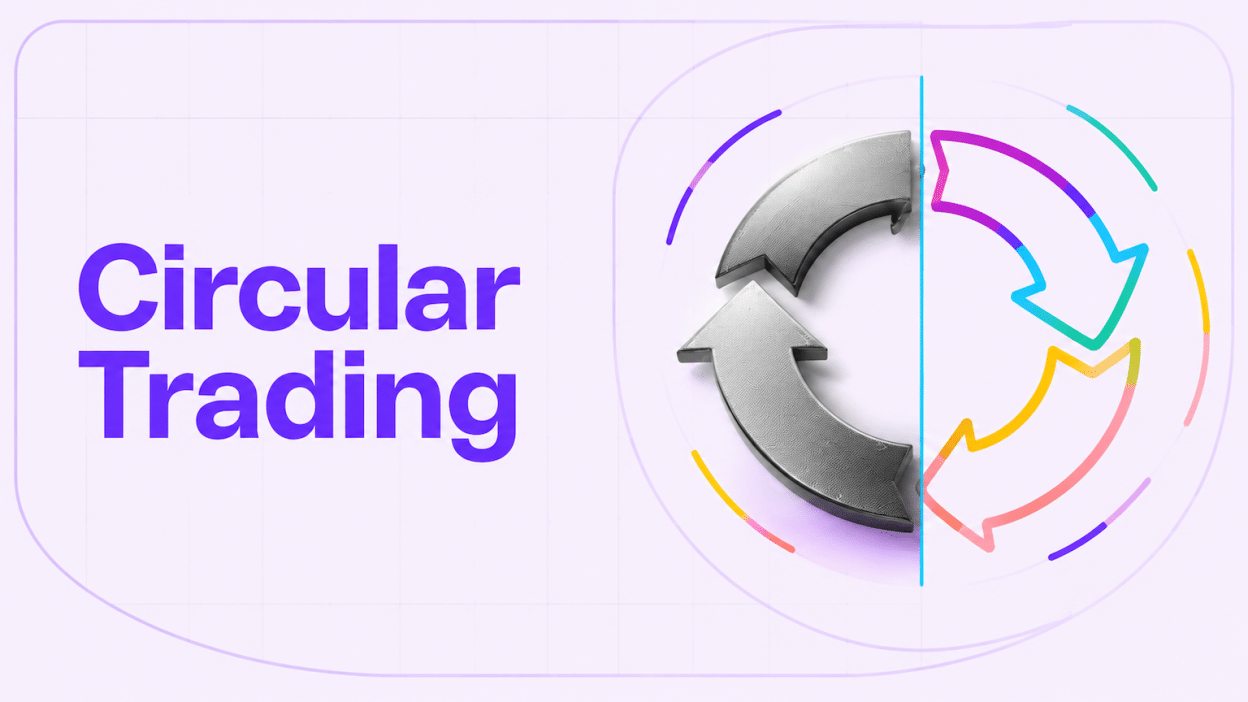
Circular trading is the practice of moving money or invoices in a loop between related or controlled entities so that turnover looks larger than real economic activity. In GST, it creates fake input tax credit; in bank statements, it inflates credits that lenders use to size loans. Both leave traceable patterns.
A borrower shows Rs 4 crore of annual credits in a current account. The GST returns roughly agree. The bureau file is clean. On paper, this is a comfortable MSME working capital case.
Then an analyst notices that six counterparties supply most inflows, three share a registered address, and money arriving on Monday leaves for the same names by Thursday. The money is real; the business is not.
This guide covers how circular trading works in GST and bank statements, what enforcement data shows, and the tests credit teams can run before round-tripped turnover becomes a sanctioned limit.
What circular trading means in Indian lending
Circular trading is a closed loop of transactions in which value leaves an entity and returns to it, directly or through intermediaries, without a matching movement of goods or services.
Tax authorities use the term for invoice chains among shell firms that generate input tax credit without supply. Lenders use it for fund flows between related accounts that manufacture credit turnover or balances.
The two often appear together: a business inflating GST turnover with circular invoices needs matching bank credits, because lenders reconcile the two. That dependency makes the scheme detectable.
Circular trading in GST: fake ITC rings and what enforcement shows
In a typical fake ITC ring, GSTINs registered with borrowed or forged identity documents invoice each other and a beneficiary. No goods move; the beneficiary claims credit.
What the enforcement numbers say
Government disclosures give a sense of scale:
- In a written reply to the Lok Sabha on 5 February 2024, the Ministry of Finance stated that the special drive against fake registrations, running since mid-May 2023, had detected 29,273 bogus firms involved in suspected ITC evasion of Rs 44,015 crore, with 121 arrests.
- A second drive in 2024 was reported by PTI on 24 September 2024 to have detected about 10,700 bogus firms with evasion of over Rs 10,000 crore.
- In a Lok Sabha reply reported on 15 December 2025, the government said fake registrations created with forged PAN or Aadhaar numbers numbered 5,699 (Rs 15,085 crore) in 2023-24 and 3,977 (Rs 13,109 crore) in 2024-25.
The government’s response has focused on Aadhaar authentication, physical verification and return-mismatch alerts (GSTR-1 vs GSTR-3B, GSTR-2B vs ITC claimed). For lenders, the lesson is that a borrower’s GST data can be internally consistent while its counterparties belong to a ring.
Circular trading in bank statements: round-tripping to inflate turnover
Round-tripping in a bank statement means money leaves the borrower’s account and comes back, usually through one or more related accounts, so that it is counted as fresh business credit.
Credit turnover, average balance, and transaction counts, the inputs lenders use to size limits, can all be inflated by cycling the same funds.
Common mechanics
- Sister-concern loops: Funds move from the borrower to a group company, then return as “sales receipts” a few days later.
- Director or family accounts: Promoters move personal savings or borrowed money in and out of the business account to lift balances around month-end.
- Multi-hop chains: Money passes through two or three intermediary accounts so that no single counterparty appears as both payer and payee.
- Cheque and RTGS swaps: Two friendly businesses exchange cheques or transfers of similar value on the same day.
Round-tripping differs from a forged statement: the transactions really happened; only their economic meaning is false. Document checks pass, so behavioural analysis matters.
Why it matters under RBI’s fraud framework
RBI’s Master Directions on Fraud Risk Management (July 2024) require regulated entities to run an early warning signals framework. As summarised by Economic Laws Practice, the indicative EWS list includes “substantial related party transactions”, “large number of transactions with interconnected companies” and “high-value RTGS payment to unrelated parties”. Circular flows tend to trigger several of these at once.
How lenders detect circular trading in bank statements
No single ratio proves circularity; detection works by stacking signals:
- Normalise counterparties. Clean narrations into consistent names across NEFT, RTGS, IMPS, UPI and cheques, or concentration will be understated.
- Measure concentration. Calculate the share of credits from the top 5 and top 10 payers, and of debits to the top 5 payees.
- Find bidirectional counterparties. Flag names that appear as both payer and payee, with value in each direction.
- Match credit-debit pairs. Look for credits followed within days by similar-value debits to the same or linked counterparty.
- Check cut-off timing. Compare balances and inflows in the last five days of each month with the rest of the month.
- Compare inflow quality with declared business. A distributor should show many buyers paying varied amounts; a loop shows a few payers paying round or repeating amounts.
- Reconcile with GST. Compare bank credits with GSTR-1 outward supplies and GSTR-3B turnover for the same months.
Illustrative thresholds a credit policy might use as review triggers (not rules): top-five payer share above 60% of credits, more than 20% of credit value from bidirectional counterparties, or repeated same-amount in-out pairs within seven days.
Signal reference table
| Signal | What it looks like | Innocent explanation to rule out |
|---|---|---|
| High counterparty concentration | A handful of payers drive most credits | Genuine anchor-customer model, such as a vendor to one OEM |
| Bidirectional counterparty | Same entity pays in and receives out | Trade with a supplier who is also a customer |
| Credit-debit pairs | Similar amount in and out within days | Pass-through collections for a principal |
| Month-end balance spikes | Balances rise sharply before statement cut-off | Seasonal receipts |
| Round and repeating amounts | Rs 5,00,000 credits every week from the same name | Fixed-value contracts or rent |
| Bank-GST mismatch | Credits far above or below declared turnover | Advance receipts, exempt supplies, loans received |
Cross-checking with GST and related-party data
Bank statements show money, GST returns show invoices, and corporate records show relationships. Circular trading rarely survives all three views.
Related-party matching
Lenders can map top counterparties against:
- Directors and shareholders of the borrower and its group companies from MCA records.
- GSTINs registered to the same PAN, the same address, or the same authorised signatory.
- Udyam registrations at the same address as the borrower.
When a top-five payer turns out to share a director with the borrower, the “customer” is a related party, and its credits should be excluded or haircut in eligibility calculations.
GST status of counterparties
A check on major counterparties adds another filter: cancelled or suspended registrations, very recent registration dates, or filing gaps are typical of entities created for invoice rings.
Linking to transaction laundering
Where inflows are unrelated to declared business, the pattern overlaps
Use cases: two illustrative patterns
The following scenarios are illustrative and do not describe specific borrowers.
The sister-concern carousel
A trading firm seeks a Rs 50 lakh limit. Forty percent of credits come from two firms that share a director with it, and each credit is followed within four days by a debit to the same firms. Excluding them cuts eligible turnover by over a third.
The month-end lift
A services firm’s balance jumps on the 27th to 30th of each month, funded by a promoter’s savings account, and falls on the 2nd. Full-month daily balances remove the inflation.
Where BeFiSc fits
Where BeFiSc fits: Finnalyzer analyses bank statements across 100+ formats and turns raw entries into structured transaction data that credit teams can use for counterparty review, balance analysis and turnover assessment. Start with a free Finnalyzer trial on your own sample statements.
Key Takeaways
- Circular trading moves value in a loop between related entities to fake turnover in GST, bank statements, or both.
- Government disclosures show tens of thousands of bogus GST firms detected since 2023, so counterparty legitimacy cannot be assumed.
- Round-tripped bank credits pass document checks because they are real transactions; detection depends on behaviour, not forgery tests.
- The strongest signals are counterparty concentration, bidirectional counterparties, matched credit-debit pairs and month-end balance spikes.
- Related-party matching with MCA, GST and Udyam data turns suspicion into an underwriting decision.
Frequently Asked Questions
Can GST data alone confirm genuine turnover?
No. GST returns can be consistent with bank credits while the counterparties are part of an invoice ring. GST data is strongest when combined with bank statement behaviour and counterparty verification.
Is circular trading always fraud?
Not always. Some businesses legitimately trade both ways with one partner, and group treasury transfers are common. It becomes a credit risk when looped flows are presented as independent turnover to obtain a loan.
How can a lender identify round-tripping in a bank statement?
Look for counterparties that both pay and receive funds, credits followed by similar-value debits within days, a few payers driving most inflows, and balance spikes near month-end. Confirm suspicions by matching counterparties with MCA and GST records.
What is circular trading in GST?
Circular trading in GST is a chain of invoices among related or shell firms with no actual supply of goods or services, created mainly to generate and pass on input tax credit. Authorities have detected tens of thousands of such bogus firms in special drives since May 2023.
Conclusion
Circular trading is hard to see one document at a time and much easier when bank flows, GST filings and corporate relationships are read together. The enforcement record since 2023 shows how many entities exist to manufacture paper trade, and lenders inherit that problem whenever they size a turnover limit.
The practical answer is a layered review: normalise counterparties, measure concentration and loops, then confirm relationships and GST standing for the names that matter. Teams that make this routine catch inflated turnover at sanctions rather than at the first missed EMI.