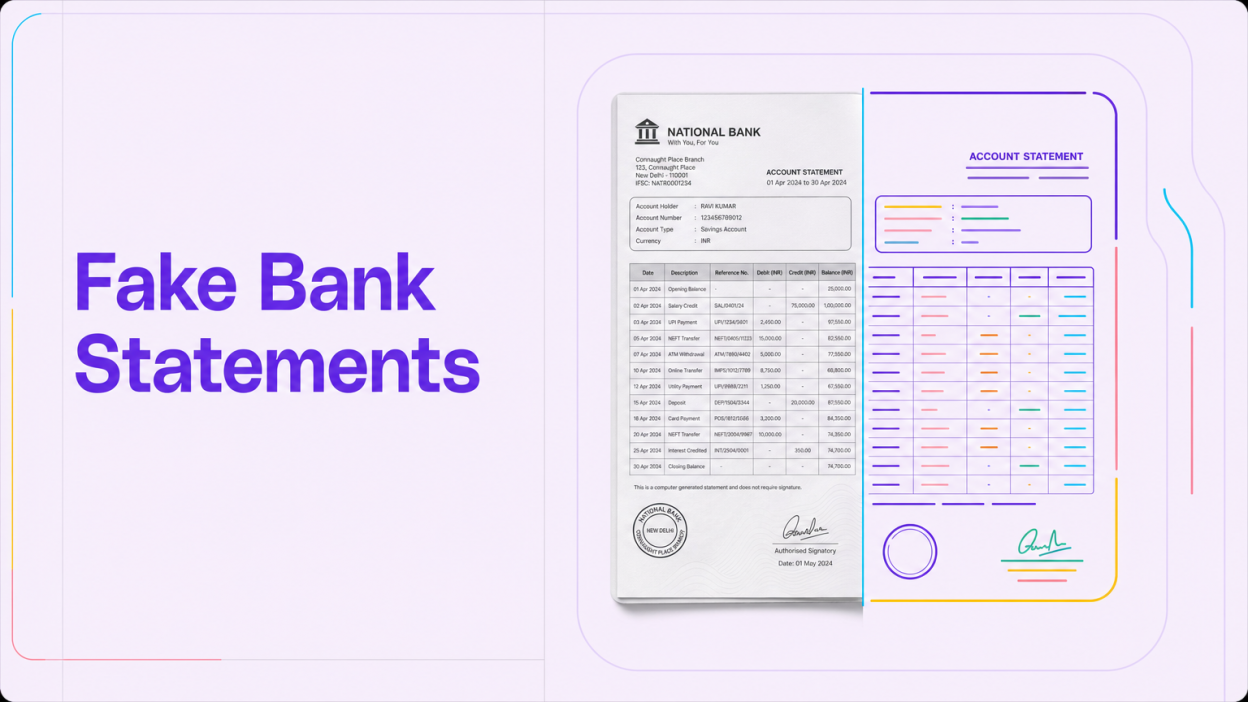
A borrower’s bank statement usually decides the loan amount. That makes it the most attractive document to fake.
Editing a PDF statement takes minutes with free tools, and websites openly offer “statement generators” that reproduce a bank’s layout. The result can look perfect to a human reviewer and still carry invented salary credits, deleted EMIs, or someone else’s transactions.
This guide explains how statement fraud is done, which checks reliably catch it, and how lenders should combine data sourcing, forensics, and analysis so a fake never reaches a credit decision.
Why Statement Fraud Is Rising
Three trends have made statement fraud more common in India:
- Instant digital lending: Decisions in minutes leave little room for manual review, and fraudsters target the fastest journeys.
- Self-uploaded PDFs: Many journeys still accept a PDF the borrower downloads and uploads, giving them full control of the file.
- Organised fraud services: Agents sell “loan file preparation,” including edited statements and matching salary slips.
The damage is not limited to default. Fraudulent files distort risk models, inflate approval rates in the wrong segments, and create regulatory exposure when fraud reporting is triggered.
Five Types of Fake Bank Statements
| Type | How it is made | Hardest part to hide |
|---|---|---|
| Edited PDF | Genuine statement modified: amounts, names, dates or rows changed | Balance arithmetic and file metadata |
| Generated statement | Built from a template or generator imitating a bank layout | Bank-specific structure and reference formats |
| Identity swap | A real statement belonging to someone else, with the name or account number altered | Name, account and IFSC cross-checks |
| Partial statement | Pages or periods removed to hide EMIs, bounces or loans | Balance breaks between pages and periods |
| Manufactured behaviour | Genuine statement, but money was cycled in to inflate credits | Circular flows and timing patterns |
The first four are document fraud. The fifth is behaviour fraud: the file is real, the picture it paints is not. Detection must cover both.
Forensic Checks on the File
PDFs carry evidence of how they were made and edited.
- Producer and creator metadata: A statement “from” a bank’s system that was produced by a consumer PDF editor or converter is suspicious.
- Creation and modification timestamps: Modification long after creation, or timestamps inconsistent with the statement period or editing point.
- Incremental saves and object structure: Edited PDFs often contain multiple revisions or replaced text objects.
- Fonts and rendering: Mixed font subsets, slight size or kerning differences in specific numbers, and text that sits on a different layer from the rest.
- Image-based pages: A digital statement that is actually an image is a warning sign unless the channel explains it, such as a branch scan.
Forensic checks catch careless editing well. Skilled forgers can clean metadata, which is why forensics alone is not enough.
Arithmetic and Structural Checks
Every genuine statement obeys simple rules that forgers often break.
Balance continuity
For every row, the previous balance plus credits minus debits must equal the new balance. Across pages, the closing balance of one page must equal the opening balance of the next. Edited amounts or removed rows usually break this chain.
Bank-specific structure
Each bank has recognisable patterns: column order, date formats, narration styles, cheque and reference number formats, IFSC and account number structure, and the way UPI, NEFT, IMPS and NACH entries are described. A generated statement typically gets some of these wrong.
Reference integrity
UPI references, NEFT UTRs and IMPS references follow set formats. Duplicated or implausible references across different transactions are a strong signal of fabrication.
Missing routine entries
Real accounts show interest credits, SMS or card charges, GST on fees, and small everyday spends. A statement with only large, round salary credits and a few withdrawals looks clean because it was built to.
Behavioural and Cross-Source Checks
The strongest defences compare the statement with independent sources.
- Salary vs employer: Does the employer name in salary credits match the declared employer, and is the amount consistent with salary slips and EPFO contributions?
- Obligations vs bureau: EMIs visible in the credit report should appear as debits. Missing EMIs suggest editing or an undisclosed second account.
- Account ownership: A penny-drop check confirms the account number and returns the holder’s name as per the bank.
- Declared income vs spending: Very high income alongside minimal spending, or no rent despite a rented address, deserves questions.
- Circular flows: Large credits followed by near-identical debits to the same or related parties indicate inflated turnover.
Designing a Statement Fraud Control
A practical design has four layers.
- Source first. Prefer data that the borrower cannot edit: Account Aggregator, bank-direct integrations or statements retrieved from the bank’s own channel. Treat uploaded PDFs as the fallback.
- Screen every PDF. Run forensic, arithmetic, and structural checks automatically before analysis, and block or route failures to review.
- Cross-verify. Match the account through penny drop, compare obligations with bureau data and income with employer signals.
- Learn from outcomes. Feed confirmed frauds, early defaults and their features back into rules and models, and share typologies with your fraud team and industry forums.
Set clear actions for each result: auto-reject for proven tampering, re-source through AA for suspicious files, and manual review for borderline cases. Record reasons so decisions can be defended.
Legal Consequences for Borrowers
Submitting a forged statement to obtain a loan is not a paperwork issue. Forgery, using a forged document as genuine, and cheating are offences under the Bharatiya Nyaya Sanhita, 2023. Regulated lenders also have fraud classification and reporting obligations, which can affect the borrower’s future access to credit.
Lenders should state this clearly in application terms. Clear warnings deter casual fraud, even if they do not stop organised rings.
Use Cases
Instant personal loans: A fintech lender moves to AA-first sourcing, keeps PDF upload as fallback with automatic tamper screening, and sees fraud concentrated in the PDF channel, where it can apply tighter limits.
MSME loans through DSAs: A lender finds that files from certain agents show the same PDF producer software and identical font anomalies. Pattern analysis across applications exposes an organised forgery source.
Credit cards for self-employed: A bank compares uploaded statements with bureau obligations and rejects applications where known EMIs are missing from the statement.
Key Takeaways
- Fake statements are edited, generated, swapped, partial, or built on manufactured behaviour.
- Forensic metadata checks catch careless edits; balance continuity and bank-specific structure catch most of the rest.
- Cross-checks with bureau data, penny drop, and employer signals expose what a clean-looking file hides.
- Source data from AA or the bank directly wherever possible; treat PDFs as fallback.
- Build clear actions and feedback loops so each confirmed fraud improves detection.
Frequently Asked Questions
Do lenders reject all scanned statements?
Not necessarily. Scans from legitimate branch channels can be accepted with extra checks, but image-only files carry higher risk.
What is balance continuity?
The rule that each row’s balance equals the previous balance plus credits minus debits. Breaks usually mean rows were edited or removed.
Can Account Aggregator data be faked?
AA data comes directly from the bank to the lender in encrypted form, so the borrower cannot edit it. Behaviour inside the account can still be manipulated.
Is it a crime to submit a fake bank statement for a loan?
Yes. Forgery and cheating are offences under the Bharatiya Nyaya Sanhita, 2023, and lenders may report the fraud.
How can a lender tell if a bank statement is fake?
By checking file metadata and fonts, verifying that balances add up row by row, comparing layout and reference formats with the issuing bank, and cross-checking against bureau data and account ownership.
Conclusion
Statement fraud succeeds where lenders trust the file instead of testing it. Every fake leaves traces: in metadata, in arithmetic, in bank-specific structure or in inconsistencies with other sources. The task is to check all of them automatically, on every file, before a number reaches the credit decision.
The lenders that manage this best combine authentic sourcing, automatic screening, and cross-verification, and they learn from every confirmed case.
FinEye by BeFiSc runs integrity and tamper checks on every bank statement before analysis, then extracts income, obligations, and risk flags. Book a FinEye demo and test it on your known fraud cases.