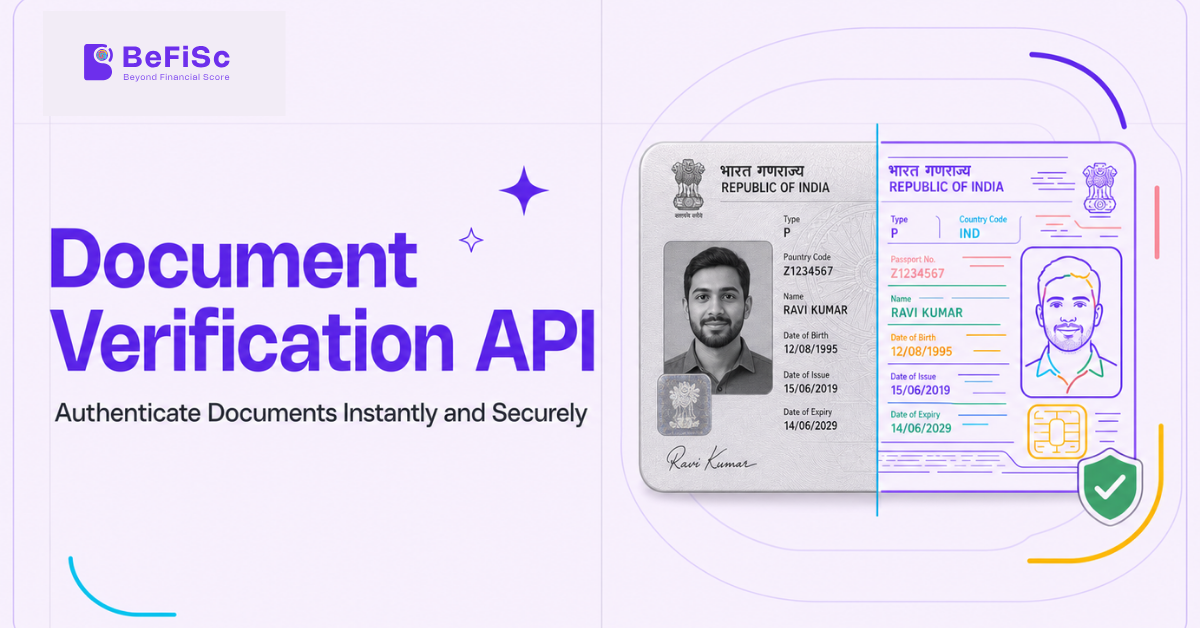
A digitally onboarded customer never hands a physical document to anyone; they upload a photograph or scan of one, which means every document a lender or fintech relies on for identity or income verification has already passed through at least one point where it could have been edited before it ever reached the verification system. Document verification APIs exist because manual visual review, the traditional check, cannot reliably catch modern forgery techniques and doesn’t scale past a handful of applications a day regardless.
This guide covers how document verification and forgery detection actually work at a technical level, the specific fraud typologies common in the Indian market, and what separates a genuinely capable detection system from one that only catches obvious, low-effort forgeries.
What Document Verification Actually Checks
Document verification operates on two distinct questions: is this document authentic (issued by the claimed authority, unaltered since issuance), and does it belong to the person presenting it? These require different techniques and, in a thorough implementation, both run on every submitted document rather than treating a single pass as sufficient.
Authenticity checking examines the document itself: format consistency against known templates, security features where applicable, font and layout irregularities, and digital forensic signals if the document was submitted as a photograph or scan rather than a government-issued digital file. Ownership checking confirms the document’s stated details (name, photograph, document number) are consistent with other information the customer has provided and, where possible, cross-validates against the issuing authority’s own records a PAN or Aadhaar number that exists and returns matching details from NSDL or UIDAI, respectively, is a stronger signal than a document that merely looks correctly formatted.
The Technical Methods Behind Forgery Detection
Template and layout matching. Every government-issued document type has a defined layout, field positions, font choices, and security element placement. A detection system trained on genuine document samples flags deviations: text in the wrong position, inconsistent fonts within a single field, or missing security elements that should be present.
Metadata and digital forensics. For documents submitted as image files, metadata analysis checks whether the file shows signs of editing software modification, inconsistent compression artifacts (a strong signal that part of an image was edited separately and recompressed), or cloning the same texture or pattern repeated in a way that suggests a portion of the image was copied to obscure or alter original content.
Error Level Analysis and similar pixel-forensic techniques. These methods examine compression inconsistencies across different regions of an image; an edited region often compresses differently than the surrounding untouched area, even when the edit is visually seamless to a human reviewer, making this one of the more reliable automated signals for catching sophisticated photo edits.
Font and character-level anomaly detection. Sophisticated forgeries often alter a single field (a date of birth, an address, a name) while leaving the rest of the document genuine. Character-level analysis comparing font weight, kerning, and alignment of the altered field against the rest of the document can catch edits that are otherwise visually convincing.
Cross-document consistency checks. Beyond analyzing a single document in isolation, a mature system checks consistency across multiple documents submitted in the same application: does the photograph on the PAN card resemble the one on the Aadhaar card, does the address match across documents where it should, and are document numbers formatted correctly for their claimed issuing state or authority?
Why Global Detection Tools Often Underperform on Indian Documents
Most off-the-shelf document forensics engines are trained primarily on passports and driver’s licenses from North America and Europe. That training bias creates real accuracy gaps when applied to India’s document landscape.
India does not have a single standardized identity document format. Aadhaar cards, PAN cards, voter ID cards, and driving licenses are each issued by different authorities, and state-issued documents such as driving licenses vary in layout, font, and security features across all 36 states and union territories.
A model trained to recognize the microprint pattern on a Maharashtra driving license will frequently misclassify a structurally different but equally genuine Tamil Nadu license as anomalous. This is a coverage problem, not a detection-quality problem, and it cannot be solved by simply improving a generic model’s accuracy threshold.
Regional-language documents compound the issue. A significant share of Indian identity documents carry text in regional scripts alongside English or Hindi. Optical character recognition and template-matching engines tuned primarily for Latin script often perform poorly on Devanagari, Tamil, Telugu, Bengali, and other regional scripts, producing both false rejections of genuine documents and false acceptances of forged ones.
Image quality is a third factor. Indian users disproportionately complete onboarding on mid-range smartphones over variable network conditions, often in suboptimal lighting. Detection models tuned on high-resolution, studio-quality training data from developed markets tend to flag routine compression artifacts and glare as tampering indicators, inflating false positive rates and creating friction for legitimate customers.
The practical implication for lenders and fintechs is that document verification accuracy claims from vendors should always be qualified by which document types and geographies the underlying model was trained and validated on. A 99 percent accuracy figure benchmarked on US driver’s licenses says little about performance on a Bihar-issued voter ID photographed on a budget Android device.
India-Specific Fraud Typologies
Document fraud in Indian lending and onboarding workflows tends to cluster around a few recurring patterns that a detection system must be explicitly built to catch.
Photocopy and rescan fraud. Genuine documents are photocopied, altered with correction fluid or digital editing, and rescanned. Because the base document is real, basic template matching alone often fails to catch these; the technique needs to be combined with noise-pattern and compression-artifact analysis to detect the double-capture signature.
Synthetic identity assembly. Fraudsters combine a genuine photograph with an altered name or date-of-birth field, or merge details from two different real documents into one synthetic identity. Cross-document consistency checks against CKYCRR records are the primary defense here, since the forged document alone may pass visual inspection.
Screen-capture and replay attacks. Instead of presenting a physical document, fraudsters photograph a document displayed on a second screen. Detection relies on identifying moiré patterns, screen-glare signatures, and pixel-level artifacts characteristic of a screen recapture rather than a physical original.
Third-party document misuse. A genuinmoiréaltered document belonging to someone else is submitted, often with the fraudster’s own photograph substituted through a face-swap or physical photo replacement. This typology depends heavily on liveness detection and face-match accuracy working in tandem with document verification, since the document itself may pass every forensic check.
Expired or superseded document reuse. Older-format Aadhaar or PAN cards without current security features are submitted, sometimes deliberately chosen because legacy formats have fewer machine-readable verification points. A verification system needs explicit logic to flag document formats that predate current issuance standards rather than treating format age as neutral.
Evaluation Criteria for Choosing a Provider
Lenders evaluating document verification vendors should assess capability across five dimensions rather than relying on a single headline accuracy number.
Document coverage breadth. Confirm the vendor’s training and validation set explicitly includes the document types your onboarding flow actually accepts, across the states and languages relevant to your customer base, not just national-ID document classes.
Forgery detection methodology transparency. A credible vendor should be able to describe which combination of methods (template matching, metadata forensics, pixel-level analysis, font anomaly detection) it applies, rather than presenting a single opaque “AI fraud score.”
False positive rate under real conditions. Ask for false positive benchmarks captured on mobile-camera images under variable lighting, not laboratory-quality scans. This number, more than raw accuracy, determines actual customer drop-off.
Integration with CKYCRR and downstream KYC. Document verification should not operate in isolation. Evaluate how tightly the provider’s output feeds into broader KYC and AML workflows, including the KYC API in India and Central KYC Registry checks.
Latency and API reliability. Forensic analysis is computationally heavier than simple OCR extraction. Confirm response times under production load, and understand fallback behavior when a document fails processing rather than failing verification outright.
Key Takeaways
- Document verification must distinguish authenticity checks (is the document genuine) from ownership checks (does it belong to this applicant), and strong platforms address both.
- Effective forgery detection combines template matching, metadata forensics, pixel-level analysis, font anomaly detection, and cross-document consistency checks rather than relying on any single method.
- Global detection models frequently underperform on Indian documents due to format diversity across states, regional-language text, and variable mobile image quality.
- India-specific fraud typologies, including photocopy fraud, synthetic identity assembly, and screen-capture attacks, require detection logic that generic global tools may not have been built for.
- Evaluating a provider requires assessing document coverage breadth, methodology transparency, real-world false positive rates, and CKYCRR integration, not just a headline accuracy claim.
Frequently Asked Questions
How does document verification handle regional-language documents?
Capable systems use OCR engines specifically trained on Indian regional scripts alongside English and Hindi. Systems built primarily for Latin-script documents typically show degraded accuracy on Devanagari, Tamil, Telugu, and other regional-script documents.
Is document verification alone sufficient for RBI-compliant KYC?
No. Document verification is one component of a broader KYC process that, depending on the onboarding method, also requires elements such as Aadhaar-based authentication, CKYCRR checks, or Video-based Customer Identification Process steps under RBI’s KYC Master Directions.
Why do document verification accuracy claims vary so widely between vendors?
Accuracy figures depend heavily on the document types, geographies, and image quality conditions used for benchmarking. A model validated on high-resolution Western passports will report different accuracy than the same architecture validated on mobile-captured Indian regional documents.
Can document verification APIs detect a photocopy of a genuine document?
Yes, when the system includes compression-artifact and noise-pattern analysis in addition to template matching. Template matching alone often cannot distinguish a photocopy of a genuine document from an original, since the visible content is identical.
What is the difference between document verification and identity verification?
Document verification confirms that a submitted document is authentic and unaltered. Identity verification goes further, confirming that the person presenting the document is its legitimate owner, typically through face match and liveness checks layered on top of document analysis.
Conclusion
Forged-document fraud is not a static problem that a one-time integration solves. Fraud techniques evolve in response to whatever detection method becomes standard, and India’s document diversity means generic global tooling will always need local calibration to stay effective.
Lenders that treat document verification as a checkbox integration, rather than a capability requiring ongoing tuning against India-specific fraud patterns and document formats, will find their false positive and false negative rates drifting in opposite undesirable directions over time. The providers worth evaluating are the ones that can speak specifically to Indian document coverage and fraud typologies, not just aggregate global accuracy numbers.