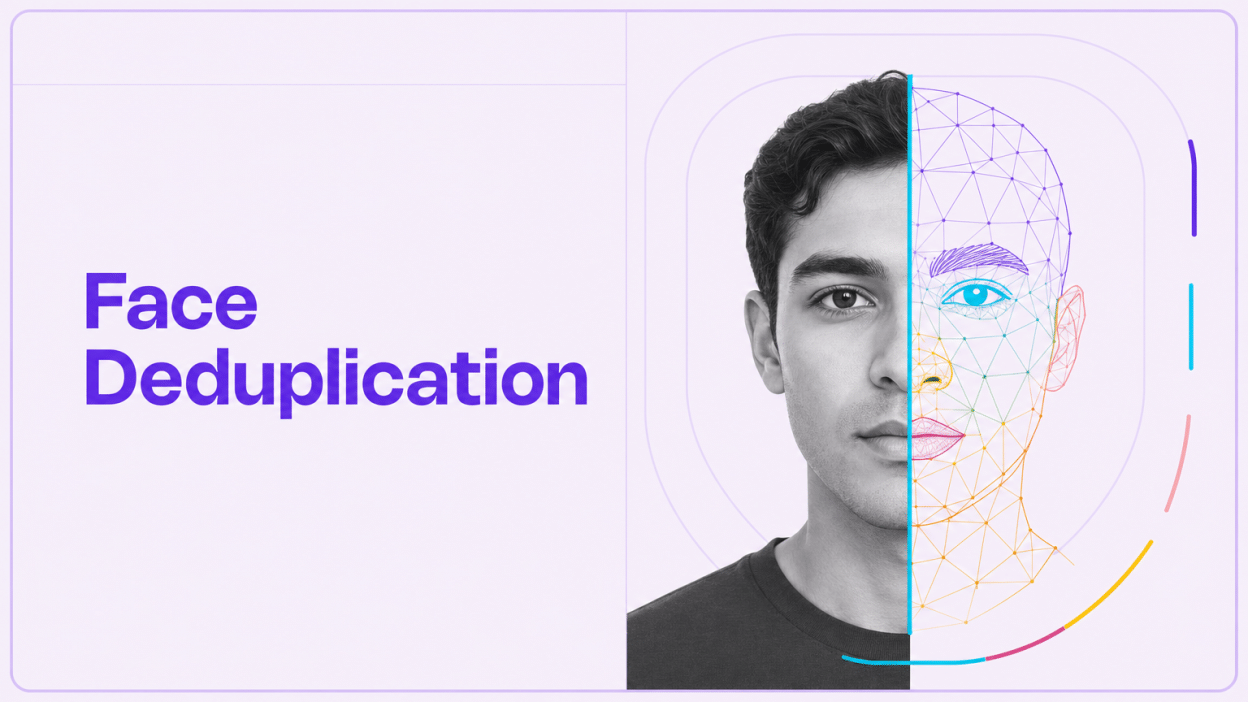
Face deduplication checks whether a new applicant’s face already exists in your customer base under a different name, PAN, or phone number. Unlike a 1:1 face match, which confirms a selfie matches one ID photo, deduplication is a 1:N search across many stored faces. It catches repeat applicants and synthetic identities that document checks miss.
Most onboarding stacks in India now verify that a selfie matches the photo on an ID and that the person is live. That proves the applicant is the document holder. It does not prove the applicant has not already onboarded last month with a different PAN, a different SIM, and a borrowed Aadhaar.
This guide explains how 1:N dedupe differs from face match, why it matters for Indian lenders, gig platforms and wallets, what Aadhaar and DPDP rules mean for storing faces, and how to build, tune and measure a 1:N system.
1:1 face match vs 1:N face deduplication
| Dimension | 1:1 face match | 1:N face deduplication |
|---|---|---|
| Question answered | Is this selfie the same person as this ID photo? | Has this face been seen before in our base? |
| Comparison | One probe against one reference | One probe against N enrolled faces |
| Typical use | KYC, V-CIP, re-authentication | Repeat applicant detection, account farming, synthetic identity |
| Data needed | Selfie and document photo for this applicant | A governed index of templates for prior customers |
| Error that hurts most | False reject of a genuine customer | False positive linking two different people |
| Error growth | Fixed per comparison | Rises with gallery size at a fixed threshold |
The last row is the one teams underestimate. Every new enrolment is another chance for a coincidental match, so a threshold that works for 10,000 customers can generate noise at 10 million.
Why repeat applicants matter in India
Repeat applicants cluster where identity is cheap to vary, and rewards are quick to collect.
- Digital lending: A borrower who defaulted, or was declined, returns with a new PAN, phone, and email. In small-ticket loans, the second loan is often taken with no intent to repay. RBI’s Annual Report 2025-26, as reported on 29 May 2026, recorded 8,640 fraud cases in the advances category involving Rs 40,774 crore in FY26, the largest share by value.
- Gig and delivery platforms: Deactivated workers re-register under a relative’s documents, bringing back the same safety or fraud risk.
- Wallets and payment apps: Sign-up bonuses and cashback reward multiple accounts per person, and those accounts later become mule candidates.
- Referral programmes: One person refers themselves under several identities.
The documents may be real, but the person behind several of them is the same. A face is far harder to vary than a SIM or an email.
Aadhaar, DPDP and the limits on storing faces
Deduplication requires storing face data, and India’s rules shape how you can do that.
Aadhaar face authentication is 1:1
UIDAI’s face authentication verifies a person against the Aadhaar record of the number presented. It is a 1:1 check performed by UIDAI. PIB reported on 11 August 2025 that Aadhaar face authentication had crossed 200 crore transactions, doubling from 100 crore in under six months, and on 18 March 2026 that there were about 134 crore live Aadhaar holders.
Aadhaar-based authentication does not give a regulated entity a way to search UIDAI’s database for duplicates. The Aadhaar framework also restricts storage and sharing of core biometric information, so biometrics captured for Aadhaar authentication must not be reused to build your own index. Your dedupe index must be built from images you lawfully collect, such as onboarding selfies, with appropriate consent.
DPDP Act, 2023 and DPDP Rules, 2025
The Digital Personal Data Protection Rules, 2025 were notified in November 2025, with an 18-month phased compliance window. For a dedupe index, the relevant obligations include:
- Purpose limitation and notice: Tell applicants their facial image will be used to prevent duplicate and fraudulent accounts.
- Valid consent or a legitimate use: Map your legal basis for each purpose; dedupe should not quietly become marketing analytics.
- Security safeguards: Encrypt templates and images, restrict access, and log every search. Failure to maintain reasonable security safeguards can attract a penalty of up to Rs 250 crore.
- Retention: Define how long templates of declined applicants and closed accounts are kept, and erase them when no longer needed, subject to retention mandated by other laws.
- Breach notification: Affected individuals and the Data Protection Board must be informed of breaches.
How a face deduplication system works
1. Capture with liveness first
Deduplication is only as good as the probe image. Run liveness detection before enrolment so a photo, screen replay, or mask is rejected rather than indexed. A spoof that enters the index pollutes every later search.
2. Confirm the 1:1 match
Match the selfie to the ID or DigiLocker photo. This binds the face to the claimed identity before you check whether the face has appeared under another identity.
3. Generate an embedding
A face recognition model converts the image into a numerical vector (template). Templates of the same person sit close together; different people sit further apart. Store templates, not just raw images, and version them by model.
4. Search a vector index
Store templates in a vector index that supports approximate nearest-neighbour search. For each new applicant, retrieve the top candidates and their similarity scores.
5. Apply thresholds and route
- Above a high threshold: strong duplicate signal, route to review or block per policy.
- Between thresholds: send to a manual review queue with both images and identity data.
- Below threshold: proceed.
6. Review with context
Reviewers should see the matched customer’s PAN, name, phone, device, and account status. A face match plus a different PAN is a red flag; a face match plus the same PAN may simply be a returning customer.
Where BeFiSc fits: IDProof provides face match and liveness checks, along with PAN verification, DigiLocker, name match and bank account verification, which supply the verified, live inputs a deduplication index needs. Face deduplication itself, meaning a 1:N search across your customer base, is a workflow you build and govern on your own infrastructure; whether IDProof offers 1:N deduplication should be confirmed with BeFiSc
Threshold tuning and false positives
Why errors grow with scale
At a fixed threshold, the chance that a new face coincidentally resembles someone in the gallery rises as the gallery grows. NIST’s FRTE 1:N evaluation reports identification accuracy at thresholds set to hold the false identification rate (FPIR) at 0.003, which shows how tightly large-scale systems must constrain false matches. NIST also reports demographic differentials, shading results where FPIR for some groups is 20, 40, or 80 times higher than the reference group.
Known false positive sources
- Twins and close relatives: Genuinely different people with near-identical faces.
- Low-quality images: Blur, poor lighting, and compression push unrelated faces closer.
- Ageing and appearance changes: Old selfies may match poorly with new ones, and the reverse.
- Shared devices in families: Relatives onboarding from one phone add a misleading device signal.
Tuning in practice
- Start with a labelled sample of known duplicates and known distinct customers.
- Plot true and false match rates across thresholds on your own data, not vendor defaults.
- Set two thresholds: one for automatic action, one for review.
- Re-tune whenever the model, capture SDK, or gallery size changes significantly.
- Never auto-decline on face similarity alone; combine with PAN, device, and account signals.
Metrics to track
| Metric | What it tells you |
|---|---|
| Duplicate hit rate | Share of applicants flagged as possible duplicates |
| Review confirmation rate | Share of flagged cases reviewers confirm as true duplicates |
| False positive rate in review | Share of flags that were different people |
| Time to review | Operational cost and customer delay |
| Loss rate on confirmed duplicates | Business value of the system |
| Liveness failure rate | Quality of probes entering the index |
A low confirmation rate means thresholds are too loose. A falling hit rate after launch can mean deterrence, or that fraudsters have learned to defeat capture.
Key Takeaways
- Face deduplication is a 1:N search across your customer base; 1:1 face match only confirms a selfie against one document.
- Repeat applicants drive losses in digital lending, gig onboarding, wallets and referral programmes.
- Aadhaar face authentication is 1:1 and cannot be used to search for duplicates; your index must use images you lawfully collect.
- DPDP Rules, 2025 require clear notice, a lawful basis, strong safeguards and defined retention for facial data.
- Liveness must come before enrolment, and thresholds must be tuned on your own data and re-tuned as the gallery grows.
Frequently Asked Questions
What causes false positives in face deduplication?
Twins, close relatives, poor image quality, and large galleries are the main causes of duplicate face detection errors. Two-threshold routing with human review and supporting signals keeps false positives from becoming wrongful declines.
Is storing customer faces allowed under the DPDP Act?
It can be, with a clear purpose, a lawful basis such as consent, reasonable security safeguards, and defined retention. Legal teams should review notices and retention policies under the DPDP Act, 2023, and DPDP Rules, 2025.
Can Aadhaar be used to detect duplicate customers?
No. Aadhaar face authentication is a 1:1 check against the record of the Aadhaar number presented. Regulated entities cannot search UIDAI’s database, and biometrics captured for Aadhaar authentication should not be stored for your own index.
How is face deduplication different from face match?
A face match API compares one selfie with one reference photo to confirm identity. Face deduplication compares one face against many stored faces to find whether the person has onboarded before under a different identity.
What is face deduplication?
Face deduplication checks whether a new applicant’s face matches any face already enrolled in your customer base. It is a one-to-many (1:N) search used to detect repeat applicants and synthetic identities.
Conclusion
Face deduplication answers a question that document checks cannot: has this person been here before? For lenders, gig platforms and wallets dealing with repeat fraud, it closes a gap that new SIMs and borrowed PANs exploit.
It also carries real obligations. A governed index, liveness at capture, tuned thresholds, and DPDP-aligned retention separate a fraud control from a liability.