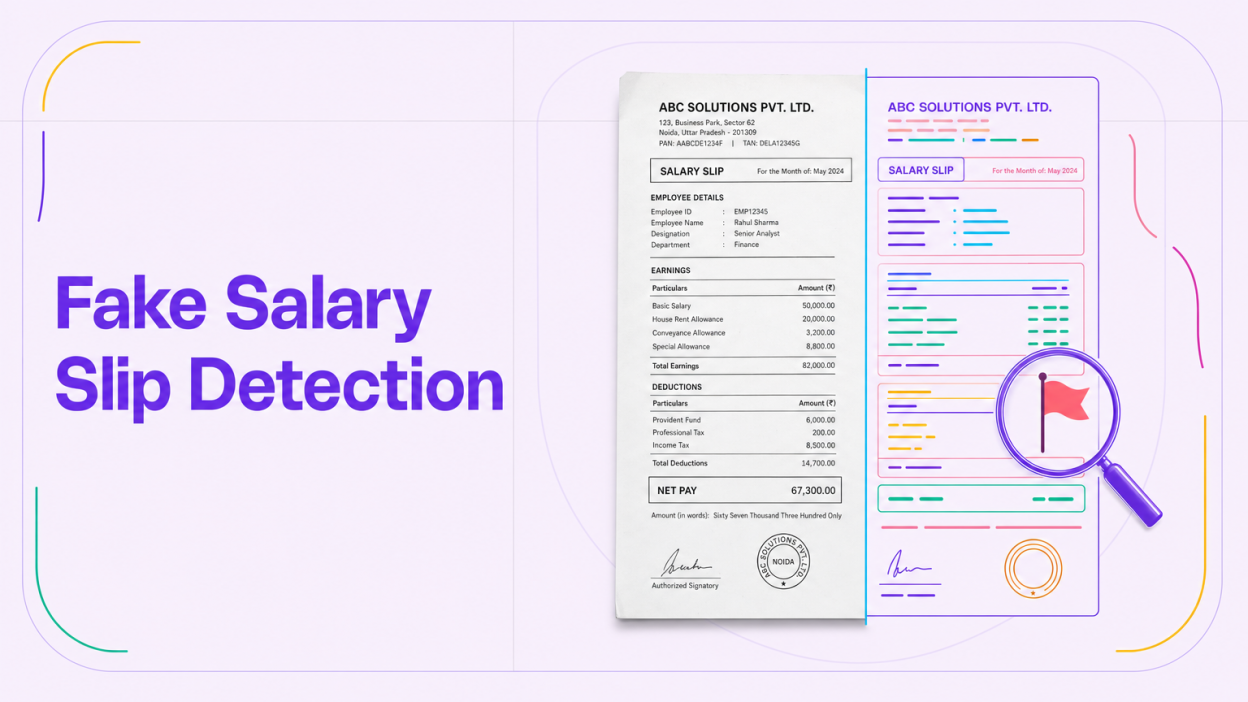
A fake salary slip is caught by checking it against evidence the applicant does not control. Test the file for editing, recompute PF, ESI, professional tax, and TDS, confirm the employer exists, match net pay to salary credits in the bank statement, and confirm employment through UAN history. No single check is enough.
The salary slip is still the first income document most lenders ask for. It is also the weakest. It is generated by the employer’s payroll system, carries no issuer signature that a lender can validate, and arrives as a PDF or phone photo that is trivial to alter.
This guide is written for credit, risk, and HR teams. It explains why payslips are vulnerable, the manipulation patterns that recur, a layered detection checklist, and how to size the checks to the ticket.
Why the Salary Slip Is the Weakest Income Document
Compare a payslip with other income evidence. A bank e-statement often carries the bank’s digital signature. Form 16 Part A comes from TRACES, and from tax year 2026-27 its successor, Form 130, is generated through TRACES as well. EPFO records sit with a government body.
A payslip has none of that. There is no standard format, no central registry, and no cryptographic seal. A small employer may issue it from a spreadsheet. That makes a fake salary slip hard to distinguish from a genuine but informal one.
The stakes are material. RBI’s Annual Report 2025-26 reported 10,114 fraud cases involving Rs 48,021 crore in 2025-26, of which advances accounted for 8,640 cases and Rs 40,774 crore, as reported by PTI. The total includes Rs 30,199 crore across 314 older cases reclassified after a Supreme Court judgment, so the year-on-year comparison needs care. Income proof is one of several entry points into loan fraud, not the whole of it.
Common Manipulation Patterns in Fake Salary Slips
Lenders and employers see the same fake salary slip patterns repeatedly.
- Inflated gross pay on a genuine template. The applicant edits figures on a real slip from their employer. The layout looks authentic because it is.
- Arithmetic that does not reconcile. Gross is raised, but deductions are left unchanged, so PF no longer matches basic, or net pay no longer equals gross minus deductions.
- Statutory deductions that cannot be true. ESI deducted on a salary well above the ESI ceiling, or professional tax charged in a state that does not levy it.
- Non-existent or mismatched employer. A plausible company name with no MCA record, no GST registration, or an address that does not match.
- Recycled slips. The same slip with only the month changed, so the employee ID, days paid, and every figure repeat exactly.
- Bought documents. Slips purchased from informal “document agents”, often paired with altered bank statements to create a consistent but false picture.
The last pattern matters most. Fraud rings know lenders cross-check, so they manipulate several documents together. Detection has to use at least one source the applicant cannot edit.
A Layered Checklist to Detect a Fake Salary Slip
Treat salary slip verification as five layers. Each layer catches failures the others miss.
Layer 1: File and image forensics
Start with the file, where a fake salary slip often leaves traces. Check PDF metadata for the producing application and creation versus modification dates. Look for mixed fonts, misaligned digits, uneven kerning around numbers, and text layers that sit on top of an image. For photographed slips, look for compression inconsistencies around edited figures.
Manual review catches crude edits; automated forensics catches the careful ones. Our guide explains what machine checks look at.
Layer 2: Arithmetic and statutory checks
Recompute the slip. Most fake salary slips fail here, and these checks need no external data, only a calculator and the statutory rules.
| Check | Rule (as of Oct 2026) | Red flag |
|---|---|---|
| Net pay | Gross earnings minus total deductions | Any mismatch, even small |
| Provident Fund | 12% of basic wages plus DA from employee, matched by employer (EPFO) | Employee PF not consistent with stated basic |
| ESI | Applies where wages are up to Rs 21,000 a month (ESIC, since 1 Jan 2017); employee share 0.75% since 1 Jul 2019 | ESI deducted on high salaries, or missing on low ones at a covered employer |
| Professional tax | Set by the state; capped at Rs 2,500 a year by Article 276(2) of the Constitution | PT in a state that does not levy it, or above the slab |
| TDS | Should track annual taxable income and the regime chosen | High salary with zero TDS, or erratic TDS month to month |
Two nuances matter. EPF is mandatory for wages up to Rs 15,000, and many employers cap contributions at that level, so PF below 12% of a large basic is not automatically suspicious. Also, the Code on Social Security brought in a wider definition of wages, under which a portion of total remuneration is added back when allowances are disproportionately high (PIB, 21 Nov 2025). Expect payslip structures to shift as employers adapt.
Layer 3: Employer existence
Confirm the employer is real and active. Check the company on the MCA register for status and incorporation date, and check GST registration for the stated address. A company incorporated three months ago that claims to have paid the applicant for three years is a clear inconsistency. Our explainer covers the fields worth checking.
Layer 4: Salary credit in the bank statement
This is the strongest single cross-check against a fake salary slip. Net pay on the slip should appear as a credit in the bank statement, usually on a consistent date, with a narration referencing the employer or its payroll bank.
Look for mismatched amounts, credits from individuals rather than a company, cash deposits labelled as salary, and round-tripping where the same amount leaves the account shortly after. A can classify salary credits across months at scale.
Layer 5: Employment through UAN and EPFO
Finally, confirm that the applicant is employed where they claim. With consent, UAN-based checks show the establishment where contributions are being made and the employment history. An employer on the slip that never appears in the UAN record needs explanation. See our guides on this and the broader topic.
Where BeFiSc fits: BeFiSc’s TamperProof is a document tamper and forgery detection API that flags signs of editing in submitted documents such as salary slips, before they reach a credit analyst. To measure how much manipulation sits in your existing book, send us 20-50 past salary slips for a free tamper audit and compare the results with your original decisions.
Building Payslip Verification Into Underwriting by Ticket Size
Running every layer on every application is expensive and slows approvals. A proportionate design ties depth to exposure.
| Ticket band (illustrative) | Minimum layers | Escalation trigger |
|---|---|---|
| Small-ticket personal loans | Layers 1, 2 and 4 | Any arithmetic mismatch or missing salary credit |
| Mid-ticket personal and two-wheeler loans | Layers 1 to 4 | Employer under 1 year old, or PF and ESI inconsistent |
| Large-ticket and home loans | All five layers plus Form 16 or Form 130 | Any unexplained gap between slip, statement and UAN |
The bands are illustrative; set them by your own loss data and risk appetite, then apply and audit them consistently.
Signals to track
Track the share of applications failing each layer, the false-positive rate after manual review, and early-delinquency rates for applications that passed with exceptions. Over time, this shows which layers earn their cost.
For employers
Employers verifying a candidate’s previous salary face the same fake salary slip problem. Asking for the last three slips plus matching bank credits, and confirming the previous employer through UAN history, is fairer to candidates than relying on a single document.
Key Takeaways
- The salary slip is the weakest income document: employer-generated, unsigned, and easy to alter, so a fake salary slip often looks authentic.
- Detection works in layers: file forensics, arithmetic and statutory checks, employer existence, salary credits, and UAN employment history.
- Statutory rules give free tests: PF at 12% of basic wages plus DA, ESI for wages up to Rs 21,000 a month, and professional tax capped at Rs 2,500 a year.
- At least one check must use a source the applicant cannot edit, such as bank credits or EPFO records.
- Size verification depth to ticket size, write the policy down, and measure which layers catch real fraud.
Frequently Asked Questions
What is the most reliable check against fake payslips?
Matching net pay to a recurring salary credit from the employer in the bank statement is the strongest single test, because it relies on bank data rather than the applicant’s document. Combined with UAN employment history, it exposes most fabricated or inflated slips.
Can lenders verify salary without the payslip?
Yes, partly. Salary credits in bank statements, Form 16 or Form 130, ITR data, and UAN employment records all provide independent evidence of income or employment, each with consent. Many lenders now treat the payslip as a supporting document and rely on these sources for the actual decision.
Is submitting a fake salary slip for a loan a crime in India?
Submitting forged documents to obtain a loan can attract criminal liability for cheating and forgery under the Bharatiya Nyaya Sanhita, 2023, alongside the lender’s contractual remedies. Lenders should document their findings carefully and follow internal fraud-reporting procedures before taking action.
How can I tell if a salary slip is fake?
Recompute the slip first: net pay should equal gross minus deductions, and PF should match 12% of basic wages plus DA where applicable. Then confirm the employer exists on MCA and GST records, match net pay to a salary credit in the bank statement, and check UAN employment history. A fake salary slip usually fails at least one of these.
Conclusion
Lenders do not need to stop accepting salary slips. They need to stop treating them as proof. The payslip is a claim; bank credits, EPFO records, and registry data are the evidence.
A layered, ticket-sized process catches fake salary slips without slowing genuine borrowers, and it produces an audit trail that stands up to internal and regulatory review.