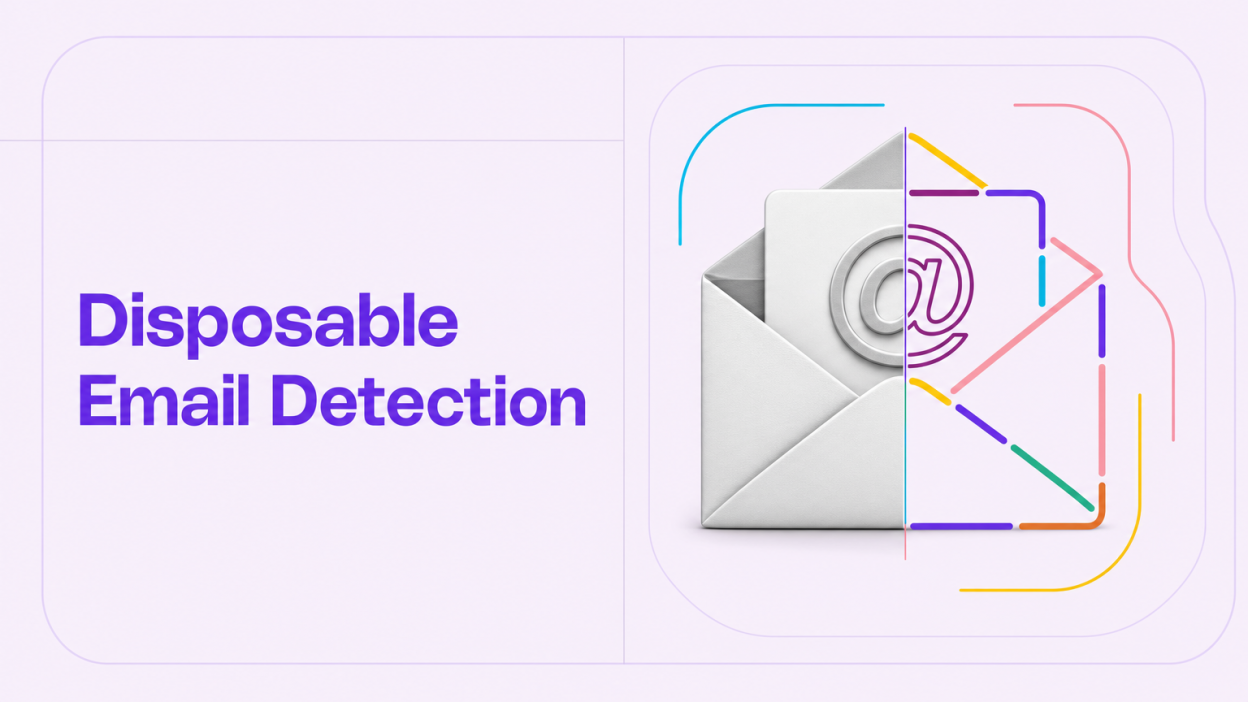
A disposable email is a temporary inbox that works for minutes or days and then disappears. Fintechs detect it by matching domains against maintained lists, checking MX and domain-age signals, and normalising aliases. The right response is rarely a blanket block: most teams step up verification for risky sign-ups and allow the rest.
Temporary email services exist for a legitimate reason. People use them to avoid spam from a one-off download. The same convenience makes them useful to anyone who wants an identity that cannot be traced or contacted later.
For a lender, wallet, or broking app, that matters. This guide explains how temp mail services work, why fraudsters reach for them at sign-up, how detection works and where it fails, and how to design a policy you can measure.
How Disposable Email and Temp Mail Services Work
A temporary email service gives a visitor an inbox without registration. The address is generated on a domain the service controls, and incoming mail is shown on a web page for a short period.
Under the hood, these services publish ordinary MX records so that mail can reach them. Many operate catch-all servers that accept any local part, which is why a visitor can type almost any name before the “@”. To stay ahead of blocklists, larger services rotate through many domains and register new ones regularly.
Variants worth separating
- Classic temp mail: a public, short-lived inbox. Anyone who knows the address can often read it.
- Burner forwarding services: a relay address that forwards to a real inbox and can be switched off. Often used by privacy-conscious customers.
- Alias features of mainstream providers: plus addressing and provider-hosted aliases. These are permanent and tied to a real account.
Only the first category is strongly associated with abuse. Treating all three the same is the most common design error.
Why Fraudsters Use Disposable Email at Fintech Sign-up
An email address is cheap identity infrastructure. A disposable email removes the last cost: the attacker does not even need to maintain a mailbox.
- Promo and referral abuse. Cashback, sign-up bonuses, and referral rewards are claimed repeatedly by one person through many accounts.
- Multi-accounting. A single user opens several accounts to bypass per-customer limits or eligibility rules.
- Synthetic identities. Fabricated identities need contact details that look real but lead nowhere.
- Loan stacking. Borrowers apply to several lenders in a short window with fresh contact details at each, making them harder to link.
- First-party fraud. A real applicant who intends not to repay uses an address they will abandon.
None of these depends on the email alone. Phone numbers, devices, and documents are also involved, which is why email risk works best as one signal among several, alongside.
In lending, the cost is concrete. An applicant who cannot be reached after disbursal turns into a collections problem. The patterns in our guide show how contact details are often the first weak point.
How Disposable Email Detection Works
No single method is complete. Effective disposable email detection layers several signals.
Domain lists, and why they decay
The baseline is a list of known disposable domains. It catches the large public services immediately. Its weakness is decay: services add domains faster than static lists update, and open-source lists vary widely in freshness. A list that is not updated continuously loses accuracy over time.
MX and infrastructure patterns
Many disposable domains share mail infrastructure. When a new, unknown domain points its MX records at servers already associated with temp mail services, that is a strong signal even before the domain appears on any list. A domain with no MX record at all, which under RFC 5321 falls back to its A record, is another risk marker on a sign-up form.
Newly registered domains
Domain age is a useful signal. A domain registered days before a sign-up, with no website and a catch-all mail server, deserves scrutiny. Age alone is weak, since new businesses register A every day, so it should raise a score rather than trigger a block.
Alias and addressing: handle with care
RFC 5233 (January 2008) describes subaddressing, where “user+detail” is delivered to the same user. Google documents that Gmail users can add a plus sign and any word before the “@”, and that dots in Gmail addresses do not change the destination inbox.
This is a legitimate feature. Customers use it to filter mail by sender. Blocking every “+” address will reject genuine users. The better approach is normalisation: strip the tag and, for Gmail, remove dots, then check whether the underlying mailbox already has an account. That catches multi-accounting without penalising the feature.
Behaviour around the address
Context sharpens the signal. Several sign-ups from one device or IP using different disposable domains, or a burst of accounts claiming the same referral code, tell you far more than the domain alone.
Policy Design: Block, Step Up or Allow
A good policy maps risk to friction. Consider three tiers.
| Signal | Suggested action | Rationale |
|---|---|---|
| Known public temp mail domain | Block at form, with a clear message asking for a permanent address | Inbox is public and short-lived; regulated communication cannot rely on it |
| Unknown new domain with temp mail MX pattern | Step up: OTP to email plus phone verification, or manual review | Likely disposable but not confirmed |
| Privacy relay or forwarding alias | Allow, monitor | Often a genuine customer protecting their inbox |
| Gmail plus or dot variant of an existing account | Allow, but link to the existing customer record | Catches duplicates without blocking the feature |
Why blocking needs a clear message
A generic “invalid email” error frustrates genuine users. A specific message (“Please use a permanent email address; we send your loan documents here”) explains the requirement and reduces drop-off.
The regulatory angle
Lenders send sanction letters, Key Fact Statements, and repayment communications by email. The Reserve Bank of India (Digital Lending) Directions, 2025 (8 May 2025) set expectations on disclosures to borrowers, which assumes the lender can reach them. Section 8(3) of the DPDP Act, 2023 also requires a Data Fiduciary to ensure the accuracy and consistency of personal data used for decisions about the Data Principal. A throwaway address is hard to reconcile with either.
Where BeFiSc fits: BeFiSc’s BounceProof is an email validation API that returns a risk-aware result for each address at sign-up. To size the problem in your own funnel, run a free disposable-domain check on your last 1,000 sign-ups and see how many accounts relied on throwaway inboxes.
Measuring the Impact
Detection is only worth its friction if it changes outcomes. Track these before and after rollout.
- Disposable share of sign-ups, by channel and campaign. Spikes often follow a new promo.
- Promo cost per genuine customer. If disposable sign-ups were claiming rewards, this should fall.
- Step-up completion rate. A low rate on flagged users suggests the flag is catching abusers; a low rate on everyone suggests the step-up is too heavy.
- Early-delinquency and contactability for lending cohorts, split by email risk tier.
- False positives, sampled through manual review of blocked and stepped-up users.
Consider a wallet that launches a referral bonus and sees sign-ups jump. If a large share of the new accounts share a handful of unknown domains and a few devices, the bonus is funding abuse. Without email risk data, that becomes visible only after the budget is spent. The same logic applies where small first credit lines attract repeat abuse.
Key Takeaways
- A disposable email is a short-lived inbox, usually on a catch-all domain that rotates frequently to escape blocklists.
- Fraudsters use temporary email for promo abuse, multi-accounting, synthetic identities, loan stacking and first-party fraud.
- Disposable email detection should combine maintained domain lists, MX infrastructure patterns, domain age and behavioural context.
- Do not block Gmail plus or dot addressing; normalise it and link duplicates instead.
- Map signals to block, step-up or allow, and measure promo cost, step-up completion and false positives.
Frequently Asked Questions
Is a disposable email proof of fraud?
No. Many people use temporary email for privacy. It is a risk signal that justifies extra verification for high-value actions such as account opening or loan applications. Combined with device, phone, and document signals, it helps separate genuine privacy-minded customers from organised abuse.
Should I block plus addressing like name+tag@gmail.com?
No. Plus addressing is a standard feature that genuine customers use to filter mail, and Google documents it for Gmail. Instead, normalise the address by removing the tag (and dots for Gmail) and check whether the underlying mailbox already has an account. That catches duplicates without rejecting legitimate users.
How do I detect a disposable email at sign-up?
Check the domain against a continuously updated disposable domain list, then look at MX records and domain age for unknown domains. Add context such as device and referral-code reuse. A fake email checker or validation API can run these checks in real time and return a risk result your form can act on.
What is a disposable email address?
A disposable email address is a temporary inbox created without registration, typically on a domain run by a temp mail service. It receives mail for a short period and then expires. Some services also offer forwarding aliases that relay to a real inbox, which carry lower risk than public temporary inboxes.
Conclusion
Disposable email is a small signal with outsized value. It costs nothing to check at sign-up, and it often surfaces abuse before money moves.
The teams that get this right avoid two extremes: ignoring email risk, and blocking every unfamiliar address. A tiered policy, normalisation for aliases, and a measured step-up path protect promo budgets and credit books while keeping genuine customers moving.