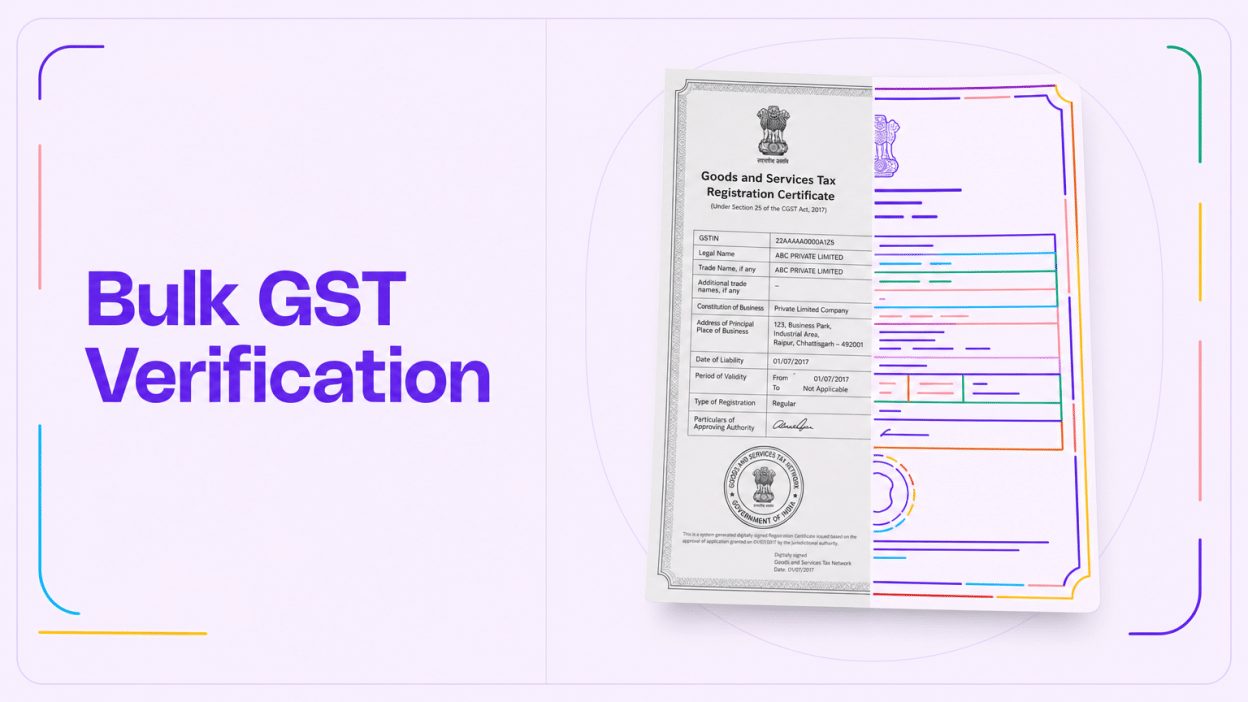
Bulk GST verification means checking every GSTIN in a vendor, seller, or borrower list in one pass for registration status, legal name match, registration date, taxpayer type, and recent filing behaviour. Buy or build it when your master runs past a few hundred GSTINs, because portal checks one by one cannot keep pace with cancellations.
Most finance teams verify a GSTIN once, at onboarding, and never look at it again. The supplier master then ages quietly: registrations get suspended, cancelled, or taken over by a different trade name, while invoices keep flowing and input tax credit keeps getting claimed.
The fix is not more people on the GST portal. It is a repeatable list-level process with clear rules for what gets checked, what triggers a hold, and how often the whole master is re-verified. This guide covers the fields that matter, the ITC exposure behind them, a manual versus automated comparison, a numbered clean-up plan, and a cadence you can defend to auditors.
Why one-by-one GST portal checks do not scale
The public “Search Taxpayer” view on the GST portal is built for a single lookup behind a captcha. That works for a procurement officer adding one supplier. It breaks when a marketplace onboards 400 sellers a week or an AP team inherits a 12,000-row vendor master after an ERP migration.
The time arithmetic is unforgiving. Illustrative: at two minutes per lookup, including CAPTCHA, copy-paste, and note-taking, 5,000 GSTINs take about 167 analyst hours, or roughly a month of one person’s time, for a single pass. By the time the last row is checked, the first rows are already stale.
Manual checks also produce inconsistent evidence. One analyst notes “active”, another pastes a screenshot, a third records nothing. When an assessment notice questions a credit two years later, nobody can show what the GSTIN looked like on the day the invoice was booked.
There is a distinction worth keeping clear. A GST verification API is the plumbing: one call, one GSTIN, a structured response. Bulk GST verification is the operating process built on top: list ingestion, rules, exceptions, evidence, and a re-check schedule. Buying an API without designing the process leaves most of the value on the table.
What an unverified GSTIN list actually costs
The cost shows up in three places: tax leakage, fraud exposure, and analyst time.
On fraud, the scale is documented. The Ministry of Finance reported on 7 January 2024 that the special drive against fake registrations, running since mid-May 2023, had detected 29,273 bogus firms involved in suspected ITC evasion of Rs 44,015 crore. In a Lok Sabha reply reported on 15 December 2025, the government said 3,977 fraudulent registrations created with forged PAN and Aadhaar were detected in FY 2024-25, involving tax evasion of Rs 13,109 crore, and 489 more in April to October 2025.
Those are not abstract numbers for a buyer. Bogus firms exist to issue invoices to real businesses. If one sits in your vendor master, the credit you claimed against its invoices is the first thing an officer will question (the mechanics are covered in.
Return discipline has also tightened. GSTN’s advisory of 7 June 2025 made auto-populated liability in GSTR-3B non-editable from the July 2025 tax period, and reporting at the time noted that returns can no longer be filed after three years from their due date. Errors that once could be patched later now flow straight into liability, so upstream data quality matters more.
Illustrative: a distributor with Rs 120 crore of annual taxable purchases at an 18% rate claims about Rs 21.6 crore of ITC. If 1% of that spend sits with suppliers who turn out to be cancelled or non-filing, roughly Rs 21.6 lakh of credit is exposed to reversal, before interest and the cost of the dispute.
What to verify for every GSTIN
A useful gstin status check covers more than “active or not”. For each row, capture these fields and store them with a timestamp.
- Registration status: active, suspended or cancelled, with the effective date of any cancellation. Suspension often precedes cancellation and is the earliest warning you will get.
- Legal name and trade name: compare both against the name in your vendor master and on the bank account you pay. A mismatch can mean a typo, a business transfer or a borrowed GSTIN.
- Registration date: a GSTIN registered weeks before a large first invoice deserves a second look, especially for high-value or new categories.
- Taxpayer type: regular, composition, input service distributor, non-resident and others. A composition taxpayer cannot charge GST on its invoice, so a composition supplier billing you tax is a red flag.
- Filing frequency and recent filing status: monthly or quarterly, and whether GSTR-1 and GSTR-3B for recent periods are filed. A supplier with an active registration but no recent returns is a live ITC risk.
- State code and principal place of business: the first two digits of the GSTIN should match the state you expect; a mismatch can indicate the wrong registration of a multi-state entity.
The format checks (15 characters, embedded PAN, valid check digit) are the “gst validator” layer. They are necessary but catch only typos. Status and filing behaviour are where the risk sits.
ITC rules that make supplier status your problem
Two conditions in section 16(2) of the CGST Act move supplier risk onto the buyer’s books. Both should be confirmed with your GST advisor against the current text.
Section 16(2)(aa): the invoice must reach GSTR-2B
Clause (aa), inserted by the Finance Act 2021 and notified with effect from 1 January 2022 (Notification 39/2021-Central Tax), allows credit only where the supplier has furnished the invoice in its outward statement and it has been communicated to the recipient. In practice this means the invoice must appear in your GSTR-2B. A supplier that stops filing GSTR-1 stops generating your credit.
Section 16(2)(c): the tax must actually be paid
Clause (c) conditions credit on the tax charged having been actually paid to the government by the supplier, subject to section 41. A supplier that files GSTR-1 but not GSTR-3B can leave you with a credit that appears in 2B yet remains open to challenge.
The practical conclusion is simple. Vendor GST verification is not a one-time KYC step. It is a recurring control over whether your credit stands up.
Manual vs automated bulk GST verification
| Dimension | Manual portal checks | Spreadsheet plus scripts | Automated bulk GST verification |
|---|---|---|---|
| Throughput | 25–30 GSTINs an hour per analyst (illustrative) | Hundreds per batch, fragile | Thousands per run, limited by provider rate limits |
| Fields captured | Whatever the analyst copies | Fixed, often status only | Status, names, dates, type, filing history in a consistent schema |
| Evidence | Screenshots, inconsistent | CSV without source timestamps | Timestamped response per GSTIN, retained |
| Exception handling | Ad hoc | Manual filtering | Rules route cancelled, suspended, name-mismatch and non-filer rows to queues |
| Re-verification | Rarely done | Possible but brittle | Scheduled, with change alerts |
| Main risk | Staleness and human error | Breakage when portal changes | Vendor dependency; data protection terms |
The spreadsheet route is the one most teams try first. It usually fails at the second run, when the scraping breaks or the analyst who wrote it has moved on.
Buyer’s checklist for a GST validator or bulk service
| Criterion | Why it matters | What to ask the vendor |
|---|---|---|
| Source and freshness | Status changes daily; cached data creates false comfort | Is each response fetched live or cached? What is the maximum age? |
| Filing history depth | Recent filing behaviour drives 16(2)(aa) and (c) exposure | How many periods of GSTR-1 and GSTR-3B status do you return? |
| Name matching | Exact match fails on “Pvt Ltd” vs “Private Limited” | Do you return a match score against the name I supply? |
| Bulk ingestion | Masters arrive as CSV or ERP exports | What file formats, row limits and turnaround per batch? |
| Change alerts | The value is in catching cancellations after onboarding | Can you re-run a list on a schedule and return only changes? |
| Evidence retention | Assessments arrive years later | How long are responses stored, and can I export them? |
| Data protection | Director names and addresses can be personal data under the DPDP Act 2023 | Where is data processed, what is retained, and will you sign a processor agreement? |
| Beyond GST | GST alone misses shell entities with clean registrations | Can you add MCA, Udyam and footprint signals for the high-risk subset? |
How to run a vendor-master clean-up
A clean-up is a project with an owner, a deadline and a rulebook. The steps below assume a master of a few thousand GSTINs; scale the timeline to yours.
- Freeze and export (day 1, AP owner). Export every active vendor with GSTIN, legal name, bank account, last payment date and annual spend. Note vendors without a GSTIN separately.
- Run format validation (day 1–2, finance systems). Reject malformed GSTINs and PAN mismatches inside the GSTIN before spending any API calls.
- Run the bulk check (day 2–4, vendor risk). Pull status, names, registration date, taxpayer type and recent filing status for every valid GSTIN.
- Bucket the results (day 4–5, vendor risk). Typical buckets: clean; cancelled or suspended; name mismatch; composition but charging tax; active but non-filing for two or more periods.
- Apply hold rules (day 5, CFO sign-off). Cancelled suppliers move to payment hold pending review. Non-filers get a written request to regularise. Name mismatches go to procurement for documentary proof.
- Escalate the high-risk tail (week 2, vendor risk). For high-spend vendors in the risky buckets, go beyond GST: MCA status, directors, Udyam registration and digital footprint. This is where a consolidated business risk report earns its cost Udyam data also supports .
- Reconcile ITC (week 2–3, tax team). Match exposed vendors against GSTR-2B and decide whether any credit needs reversal or follow-up.
- Record and schedule (week 3, AP owner). Store each response with its timestamp, close the project log and set the re-verification calendar.
Success metrics: share of master verified, number of cancelled suppliers found and held, ITC at risk identified in rupees, and analyst hours spent per 1,000 GSTINs.
Re-verification cadence
A single clean-up decays. Set cadence by risk, not by habit.
- Before every first payment to a new vendor or seller, run a full check.
- Monthly, re-check vendors with spend above your materiality threshold and every vendor in a high-fraud category such as scrap, metals, mobile phones or fast-moving consumer goods trading.
- Quarterly, re-run the entire master and act on changes only.
- On trigger, re-check when bank details change, a name changes, or GSTR-2B shows a sudden gap.
Lenders and marketplaces can map the same cadence to borrower and seller lists. The trigger list matters more than the calendar: most damage happens between scheduled checks.
Where BeFiSc fits: Bulk GST verification tells you whether a registration is alive. It does not tell you whether the business behind it is real. BizCheck builds a business risk report in under 60 seconds from a GSTIN or a mobile number, using GST, MCA, Udyam and digital-footprint data, and profiles the people behind Private Limited entities. Use it on the tail your bulk run flags (cancelled, non-filing, name-mismatched or high-spend vendors) and on every new seller or borrower before KYC. BizCheck sits before KYC rather than replacing it. The quickest way to judge fit is the free POC: send 20–50 of your own cases and get a full report per case, a side-by-side with your current screening and a debrief call, with no setup fee.
What to bring to the POC: a sample of 20–50 GSTINs or mobile numbers, the decision you made on each, and the reason for any rejection.
Key Takeaways
- Bulk GST verification is a process (ingest, check, bucket, hold, re-check), not just an API call; design the rules before you buy.
- Check status, legal and trade name, registration date, taxpayer type and recent filing status for every GSTIN, with a timestamp you can show an auditor.
- CGST s.16(2)(aa) and s.16(2)(c) tie your credit to the supplier’s filing and payment, so supplier non-compliance becomes your ITC exposure.
- Government data shows thousands of bogus and forged-identity registrations every year; a once-only onboarding check misses most of the risk.
- Re-verify by risk tier and on triggers such as bank-detail changes, not only on a calendar.
- Escalate the risky tail to a fuller business check that covers MCA, Udyam and footprint data.
Frequently Asked Question
What does it cost to run a pilot?
Pricing varies by provider and volume, so ask for a rate per check and per batch. For the deeper business check on flagged cases, BizCheck offers a free POC on 20–50 of your own cases with no setup fee, which lets you measure value before committing budget.
Will automated verification replace our GST advisor’s review of ITC?
No. Automation identifies which suppliers are cancelled, suspended, or non-filing and how much spend sits with them. Your tax team still decides whether credit should be reversed, held, or defended, based on GSTR-2B and the underlying documents.
Is it safe to send our vendor list to a verification provider under the DPDP Act?
GSTIN and business data are largely about entities, but director names, proprietor details, and addresses can be personal data. Treat the provider as a data processor: sign a processing agreement, limit fields to what the check needs, and confirm retention and storage location in writing.
How often should we re-verify our vendor master?
Run a full check before the first payment, monthly checks on material and high-risk vendors, and a quarterly sweep of the entire master. Add event triggers such as bank-detail changes and gaps in GSTR-2B. The right cadence is the one that catches a cancellation before the next payment run.
How is bulk GST verification different from a GST verification API?
An API returns data for one GSTIN per call. Bulk GST verification is the process around it: list upload, consistent fields, rules that route exceptions, evidence storage, and scheduled re-checks. Many teams buy an API and still check exceptions by hand because they never built the process.
Conclusion
A vendor master is a living liability. Every cancelled or non-filing supplier left in it is an open question over credit you have already claimed, and the volume of bogus registrations the government reports each year means the question will eventually be asked.
The teams that handle this well treat bulk GST verification as an ongoing control: one disciplined clean-up, rules that route exceptions automatically, and a re-check cadence tied to risk. They also accept that a live GSTIN is not proof of a real business, and they push the risky tail through a deeper check before money moves.
Start with the cases that already worry you. Put 20–50 of them through a side-by-side test and see what your current process missed.
Request a free BizCheck POC on 20–50 of your riskiest vendors or sellers, no setup fee, debrief call included