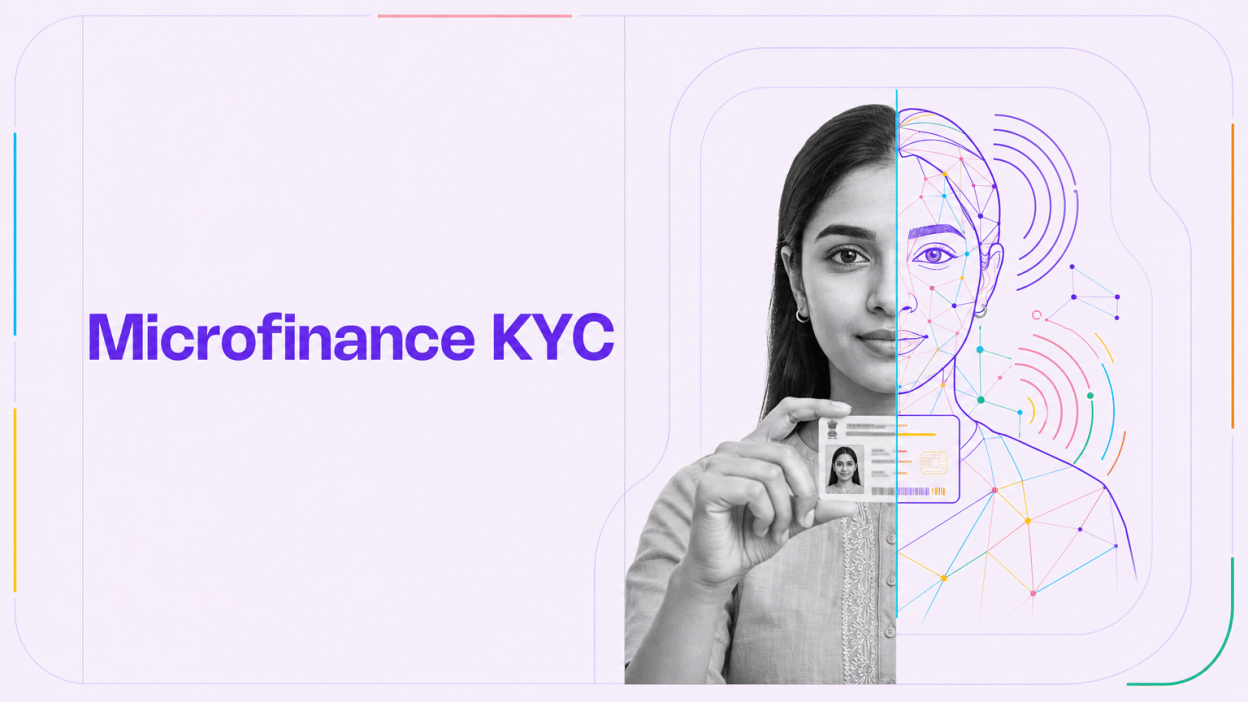
Microfinance KYC must prove three things for every group borrower: the person exists, the person at the centre meeting is that person, and the loan reaches their own account. Use Aadhaar or DigiLocker at source, a live selfie matched to the ID, name match across documents, and account verification before disbursal.
Microfinance has spent two years repairing its balance sheet. MFIN data show the industry’s gross loan portfolio fell to Rs 3,14,728 crore at 31 December 2025, with about 50 lakh clients losing access to formal finance, before rising to Rs 3,25,174 crore in March 2026, the first growth after seven quarters of contraction.
The contraction was mostly driven by over-indebtedness, but identity failures made it worse: loans in the names of people who did not exist, people who lent their name to someone else, and field staff who knew which gaps to exploit. This guide covers the RBI framework, KYC in field and JLG settings, field-agent onboarding, Aadhaar routes, face match, account verification, a checklist, and a rollout plan.
The regulatory framework for microfinance lenders
RBI’s microfinance framework of March 2022 (effective 1 April 2022) defines a microfinance loan as a collateral-free loan to a household with annual income up to Rs 3,00,000. A household means a husband, wife, and their unmarried children. Loan repayments, including all existing loans, may not exceed 50% of monthly household income.
These provisions now sit in the entity-wise Credit Facilities Directions issued on 28 November 2025. The Local Area Banks version, for example, requires a board-approved policy to assess household income, reporting of income to credit information companies, and verification of indebtedness using CIC data and other sources (paras 52 to 58). NBFC-MFIs must also keep at least 60% of total assets in qualifying microfinance assets, under an amendment of 6 June 2025.
KYC itself follows each lender’s KYC Directions 2025. The 50% limit depends on knowing who belongs to the household, so microfinance KYC is also the foundation of the income test.
Over-indebtedness and the guardrails
RBI’s Financial Stability Report of June 2025, as reported by Business Standard, put stress (31 to 180 days past due) in microfinance portfolios at 6.2% in March 2025, up from 4.3% in September 2024. Borrowers with loans from three or more lenders had fallen to 11.7%, and active borrowers had declined by 40 lakh.
The industry’s self-regulatory guardrails tightened in the same period. As reported by Business Standard in November 2024, MFIN set a cap of three microfinance lenders per borrower, a Rs 2 lakh cap on total indebtedness covering microfinance and unsecured retail loans, and a bar on lending to borrowers more than 60 days overdue on more than Rs 3,000.
Every one of these rules depends on correct identity. A cap of three lenders means nothing if the same person borrows under two identities, or if a household spreads loans across relatives who never see the money.
Ghost borrowers and proxy borrowers
Two patterns account for most identity-driven loss in microfinance KYC:
- Ghost borrowers: loans in the name of a person who does not exist, does not know about the loan, or has moved away. Usually created with copied documents, sometimes with insider help.
- Proxy borrowers: a real, consenting person whose name and documents are used to borrow for someone else, often an over-indebted relative or a local agent. The proxy may attend the centre meeting; the money goes elsewhere.
Both defeat bureau-based guardrails. The bureau sees separate, apparently compliant borrowers. The repayment capacity belongs to one person, or to nobody.
Practical signals: the same face across several borrower records, one bank account receiving disbursals for many borrowers, mobile numbers shared across unrelated groups, and names on loan documents that differ from the ID.
What weak microfinance KYC costs
- Credit loss: proxy and ghost loans default when the real beneficiary stops paying, often in clusters.
- Guardrail breaches: lending past the lender cap or income limit because one person appears as several, which surfaces in audits and SRO reviews.
- Operations: field re-verification after a default spike is slow and costly in rural geographies.
- Regulatory and conduct risk: from 1 January 2027, RBI’s recovery amendment Directions require microfinance collections at a mutually agreed central place, so lenders need confidence about who they are collecting from.
Illustrative: a lender with 10 lakh active borrowers finds that 0.5% of records share a face or disbursal account with another borrower. That is 5,000 loans whose repayment capacity was never assessed, concentrated in a few branches.
KYC in field and JLG settings
In a joint liability group, KYC happens at a centre meeting, often with patchy connectivity and borrowers who may not have a smartphone. That rules out some routes and favours others.
- Aadhaar OTP e-KYC needs the OTP on the borrower’s registered mobile; in a household with one phone, that is often the husband’s or son’s. The KYC Directions also limit what OTP-based non-face-to-face accounts can do (para 25 for commercial banks).
- Aadhaar offline XML or DigiLocker returns a signed record with a photo that can be verified without storing the full Aadhaar number.
- Digital KYC, where an authorised officer captures a live photograph of the customer and document with geo-coordinates (para 24 for commercial banks), suits the field officer model well.
- PAN verification is useful where borrowers have PAN, though many do not.
Whatever the route, add a live selfie matched to the ID photo, with liveness to stop a printed photo or a phone screen held up to the tablet. That is the single most direct control against proxies.
Then verify the disbursal account. Disbursing to the borrower’s own verified account, with the holder name matched to the ID, removes the easiest way for a proxy’s loan to reach someone else.
Verifying BCs and field staff
Field officers and BC agents are the people who can create ghost borrowers. Verify them with the same rigour:
- PAN and Aadhaar verified at source at hiring.
- Selfie with liveness matched to the ID, repeated at random on the field app login.
- Salary or commission account verified in their own name.
- Alerts when one officer’s borrowers share faces, phones, or accounts.
Microfinance KYC checklist
| Check | Why it matters | What to ask the vendor or team |
|---|---|---|
| Aadhaar via offline XML or DigiLocker | Source-verified identity and photo | Signature verified? Number masked? Works on low bandwidth? |
| Aadhaar OTP e-KYC | Fast, whether the borrower controls the mobile | How are OTP-route limits enforced? |
| PAN verification | Where available, strengthens identity | Status and name from source? |
| Selfie with liveness and face match | Stops proxies and printed photos | Reference photo source? Retry handling in the field? |
| Name match | Household members share surnames; spellings vary | Scored, with regional transliteration? |
| Disbursal account verification | Money reaches the borrower | Holder name returned and matched? |
| Repeat checks | Same person, many loans | Same face, account or phone across borrowers? |
| Field staff verification | Insider-created ghosts | Same checks on officers and BC agents? |
| Audit trail | Inspections and SRO reviews | Result, timestamp, and geo-tag per check? |
Manual vs automated field KYC
| Factor (Illustrative) | Paper and photocopies | Automated checks on a field tablet |
|---|---|---|
| Identity proof | Photocopy with officer signature | Source-verified record with photo |
| Proxy detection | Officer judgement | Face match with liveness |
| Disbursal account | Passbook copy | Verified account, holder name matched |
| Repeat borrower detection | Rare | Systematic on face, account and phone |
| Evidence | Files at branch | Timestamped, geo-tagged results |
| Turnaround | Days to sanction | Same visit, subject to credit approval |
Rollout plan
- Weeks 1 to 2 (risk, compliance): map routes to your KYC Directions and credit policy; set thresholds for face and name match.
- Weeks 2 to 4 (technology): integrate checks into the field app; design low-connectivity behaviour and retries.
- Weeks 4 to 6 (operations): pilot in five to ten branches, including a high-stress district.
- Weeks 6 to 8 (risk analytics): compare pilot metrics with control branches; tune thresholds.
- Months 3 to 6: roll out by region; run the same checks on field staff and BC agents.
- Ongoing: run repeat-face and shared-account reviews monthly.
Success metrics: first-attempt pass rate in the field, face match failures confirmed as proxies, shared disbursal accounts per thousand loans, time from centre meeting to disbursal, and early delinquency by cohort.
What to bring to the demo: your current field KYC steps, tablet or app details, and anonymised examples of proxy or ghost loans you have found.
Where BeFiSc fits: IDProof gives microfinance lenders one API for Aadhaar routes, including DigiLocker, PAN verification, selfie face match with liveness, name match, and bank account verification, so field officers can verify each borrower and the disbursal account in the same visit. Credit bureau checks and household income assessment stay in your credit process. Book a demo.
Key Takeaways
- A microfinance loan is collateral-free lending to households with annual income up to Rs 3 lakh, with repayments capped at 50% of monthly household income.
- Guardrails on lender count and total indebtedness work only if each borrower is one verified person.
- Ghost and proxy borrowers defeat bureau checks; live selfie with liveness, matched to a source-verified ID, is the most direct control.
- Disbursal to a verified own-name account removes the easiest diversion route.
- Verify field staff and BC agents with the same checks, and review repeat faces and shared accounts monthly.
Frequently Asked Questions
Can automated checks replace field verification entirely?
No. Household income assessment, group formation, and centre discipline remain field functions. Automated checks make sure the person in front of the officer is the person on the loan.
How is borrower data protected?
Under the DPDP Act, the lender is the data fiduciary and the verification provider is its processor. Mask Aadhaar numbers, limit retention to what KYC rules require, and use a data processing agreement.
Will extra checks slow down centre meetings?
Source checks and a selfie take minutes per borrower and replace manual photocopy handling. The pilot should measure time per borrower against your current process.
Does face match work in low-connectivity field conditions?
Capture can happen at the centre meeting, with checks run when the tablet connects, but design retries and a review queue for failed captures. Test behaviour in your weakest branches during the pilot.
What documents are needed for microfinance KYC?
Lenders follow their KYC Directions: an officially valid document such as Aadhaar (with consent), verified through e-KYC, offline XML or DigiLocker, plus PAN or Form 60 as applicable, a photograph, and bank account details. Lenders add household details to apply the income test.
Conclusion
Microfinance is growing again, and lenders will be judged on whether the next cycle is cleaner than the last. The rules on income, repayment burden, and lender count are only as strict as the identity under each loan.
Microfinance KYC that verifies the person, the face, and the account in the same visit gives credit teams a borrower base they can count, field teams a process they can follow, and auditors evidence they can test. Start with the branches where stress was highest.
Book a 30-minute IDProof demo and pilot it in your highest-risk branches