
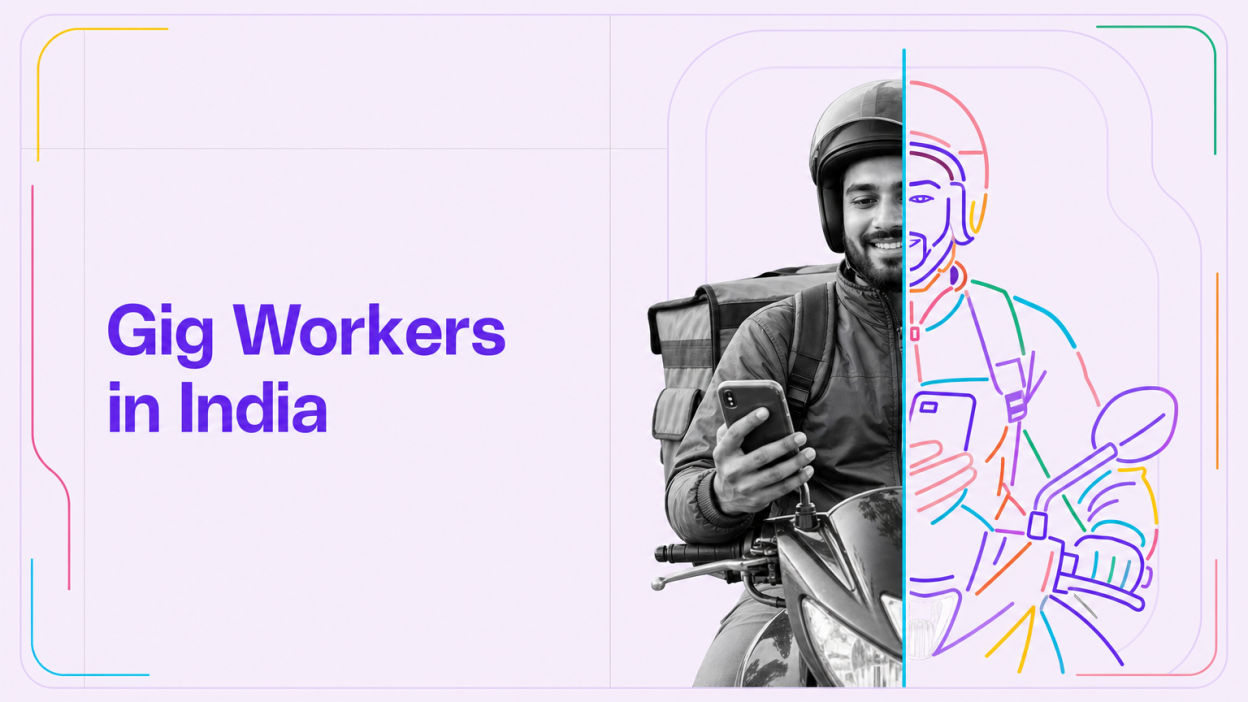
Gig workers in India earn from work outside a traditional employer-employee relationship, often through delivery, mobility, or home-service apps. Since the Code on Social Security, 2020 took effect on 21 November 2025, platforms engaging gig workers carry registration and contribution duties, making onboarding verification a compliance task as well as a safety one.
A delivery partner rings the doorbell of a customer’s home. A beautician walks into a living room. A driver picks up a passenger at midnight. In each case, the platform has vouched for a stranger’s identity, usually after an onboarding check that took a few minutes on a phone.
That check now carries more weight. Indian law formally recognises gig workers; aggregators must report them to a government database, and several states have their own laws. This article covers who counts as a gig worker, what the framework asks of platforms, and how to build a verification flow that holds up at scale.
Who Counts as a Gig Worker in India
The Code on Social Security, 2020 gave Indian law its first formal definitions. Section 2(35) defines a gig worker as “a person who performs work or participates in a work arrangement and earns from such activities outside of a traditional employer-employee relationship.”
A platform worker, under Section 2(61), is a person engaged in platform work: work in which organisations or individuals use an online platform to access other organisations or individuals to provide services in exchange for payment. All platform workers are gig workers, but not all gig workers work through platforms. A freelance photographer hired directly is a gig worker; a food delivery partner on an app is a platform worker.
The Code defines an aggregator as “a digital intermediary or a market place for a buyer or user of a service to connect with the seller or the service provider.” Its Seventh Schedule covers ride-sharing, food and grocery delivery, logistics, e-marketplaces, professional services, healthcare, travel and content services.
How large is the workforce?
NITI Aayog’s June 2022 report, “India’s Booming Gig and Platform Economy”, estimated 7.7 million gig workers in 2020-21 and projected 23.5 million by 2029-30. The government cited these figures in a Rajya Sabha reply published by PIB on 4 December 2025.
Registration is catching up. PIB reported about 5.12 lakh platform workers on the e-Shram portal as of 1 December 2025, and roughly 11.5 lakh by August 2026, after aggregators were directed to onboard their workers.
The Legal Framework Platforms Now Operate Under
The four labour codes were made effective on 21 November 2025. For platforms, three obligations matter most.
Aggregator contribution
Aggregators must contribute 1-2% of annual turnover to a Social Security Fund, capped at 5% of the amount paid or payable to gig and platform workers. Confirm with counsel whether the rate for your category has been notified.
E-Shram registration and data sharing
The Social Security Rules, 2026 require aggregators to share details of the gig and platform workers they engage with the government. On 1 June 2026, the Ministry of Labour and Employment directed aggregators to complete onboarding on the e-Shram portal, integrate through API, and share worker data electronically by 21 June 2026. Workers registered on e-Shram receive a Universal Account Number.
Identity data a platform holds is now reported to a national database, so duplicates and borrowed identities stop being an internal problem.
State laws
Rajasthan passed the Platform Based Gig Workers (Registration and Welfare) Act, 2023. Bihar enacted its own Act on 12 August 2025, and Karnataka passed the Platform Based Gig Workers (Social Security and Welfare) Act on 12 September 2025, with a welfare fee of 1% to 5% of payouts and an obligation to register workers with a state welfare board. Several of these state obligations depend on rules still being framed, so confirm commencement for each state where you operate.
Why Platforms Verify Gig Workers
Platforms verify gig workers for safety, for compliance, and because fraud is expensive.
- Customer safety. Workers enter homes, vehicles, and private spaces. Platforms need confidence that the person on the job is the person who was checked.
- Account renting and sharing. A verified worker lends or rents login credentials to someone unverified. The ID on file is genuine; the person delivering is not.
- Duplicate accounts. One person registers several times with different phone numbers to game incentives, referral bonuses, or rating resets.
- Payouts to mule accounts. Earnings are routed to a bank account that does not belong to the worker, sometimes as part of laundering networks.
- Reporting accuracy. With worker data flowing to e-Shram, a duplicate or fictitious identity becomes a reporting error.
A document check alone addresses none of these fully. The weak point is usually the link between the document, the face, and the bank account.
A Seven-Step Onboarding Verification Flow
Most gig workers should clear this flow on a phone in minutes, with exceptions routed to manual review.
- Capture consent and notice. Show a clear notice explaining what data is collected and why, and record consent before any check runs.
- Verify PAN or an Aadhaar route. Confirm the PAN is valid and the name matches, or use offline Aadhaar verification or DigiLocker to fetch a government-issued document. Our guide explains response fields.
- Run face match with liveness. Compare a live selfie with the photo on the fetched document, and confirm the selfie is a real person in front of the camera.
- Name match across sources. Compare the name on the identity document, the bank account, and any licence. A fuzzy match handles initials and transliteration without approving unrelated names.
- Verify the payout bank account. Confirm the account exists, is active, and that the holder name matches the verified identity. Our guide compares penny-drop and pennyless methods.
- Add role-specific checks. Drivers need licence and vehicle checks; home-service workers may need address or police verification. A covers employment and court-record checks where lawful and proportionate.
- Re-verify periodically. Ask for a fresh liveness selfie at login or at random intervals, and match it against the onboarding face. This is the main control against account renting.
Where BeFiSc fits: IDProof combines PAN and Aadhaar-route checks, DigiLocker retrieval, face match, liveness, name match, and bank account verification behind one API, with average responses of about three seconds. That covers steps 2 to 5 and the re-selfie in step 7 for thousands of workers a day. Book a bulk onboarding demo to test it on a sample of your own applicants.
Where flows typically break
Teams often verify the document thoroughly and the bank account loosely, so a worker later adds a payout account in someone else’s name. Tie any payout change to a fresh liveness check and name match. Without re-verification, a platform knows who was verified on day one, not who is working on day ninety.
Use Cases Across Platform Categories
Food and quick-commerce delivery. Volume is the constraint. A festive-season ramp-up of delivery partners needs straight-through approval for clean applicants and a narrow manual queue. Periodic re-selfies matter most here because account renting is easiest.
Ride-hailing and logistics. Licence and vehicle registration checks sit alongside identity, and many platforms add background checks for drivers carrying passengers.
Home services. Gig workers enter customers’ homes, so identity and address verification carry more weight.
Freelance marketplaces. Workers may never meet customers, but payouts are larger, so bank account ownership and PAN-name consistency come first.
Consent and Data Protection
Gig worker onboarding processes personal data, and from November 2025 the Digital Personal Data Protection Rules, 2025 set the operating framework, with an 18-month phased timeline. The Rules call for standalone, clear consent notices that explain the specific purpose of collection.
For gig workers, that means collecting only what each check needs, storing verification results apart from raw documents where possible, and setting retention periods that respect both labour-law record-keeping and data protection limits. Our guide covers consent design in more detail.
Key Takeaways
- Gig and platform workers have been defined in law since the Code on Social Security, 2020 took effect on 21 November 2025.
- Aggregators owe a contribution of 1-2% of turnover, capped at 5% of worker payouts, and must share worker data with the e-Shram system.
- State laws in Rajasthan, Bihar, and Karnataka add welfare fees and registration duties.
- The main fraud risks with gig workers are account renting, duplicate accounts, and payouts to accounts they do not own.
- An effective flow links documents, face, and bank account, then re-verifies the face periodically.
- Consent notices and data minimisation under the DPDP Rules should be designed into the flow, not added afterwards.
Frequently Asked Questions
Is police verification mandatory for gig workers?
There is no single national rule for all categories. Requirements vary by state, sector and platform policy, so many platforms apply it selectively to roles involving home entry or passenger transport.
How can a platform stop account renting by delivery partners?
Use periodic liveness selfies matched against the onboarding face, especially at login or before high-value shifts. Tie any change of payout account to the same check.
How much do aggregators contribute under the Code on Social Security?
The Code sets 1-2% of annual turnover, capped at 5% of amounts paid or payable to gig and platform workers. Confirm the notified rate for your category with counsel.
Do platforms have to register gig workers on e-Shram?
Under the Social Security Rules, 2026, aggregators must share details of the workers they engage, and the Ministry of Labour and Employment directed them to onboard and integrate with e-Shram by 21 June 2026. Workers can also register themselves.
What is the difference between gig workers and platform workers?
Gig workers earn outside a traditional employer-employee relationship. Platform workers are gig workers who find work through an online platform, such as a delivery or ride-hailing app.
Conclusion
Gig workers have moved from an informal category to a regulated one. Platforms that once verified gig workers mainly to protect customers now also report them to a national database and fund their social security.
The verification flow therefore has to answer three questions reliably: is this a real, unique person, is the person working the one who was verified, and does the payout go to them? Platforms that answer all three at onboarding, and keep answering the second over time, will find compliance and safety point in the same direction.