
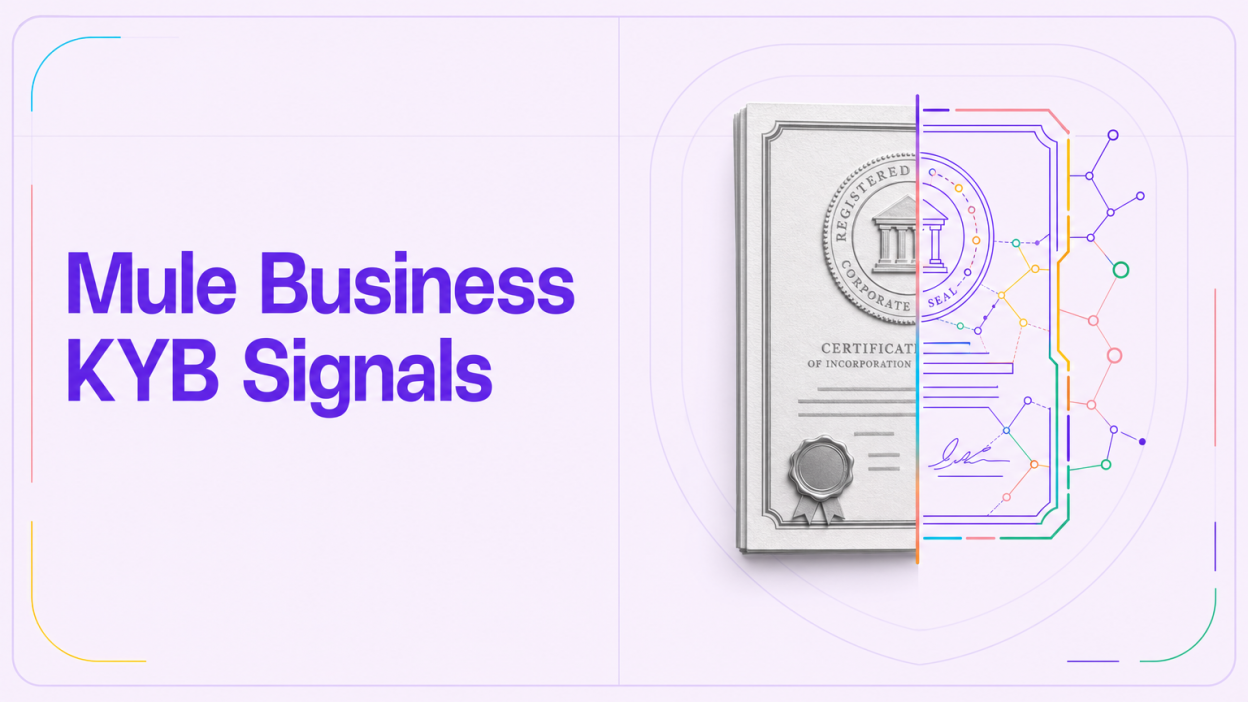
Mule business detection is becoming an important part of KYB as fraud networks increasingly use legitimate-looking businesses to receive, route, or transfer suspicious funds. A company may have a valid GSTIN, PAN, registered address, and bank account—and still present significant risk.
That is what makes mule businesses difficult to detect. Unlike obvious fake entities, suspicious businesses may use legitimate-looking identities and documents while operating primarily to receive, route, or transfer funds on behalf of fraud networks.
For fintechs, banks, payment companies, NBFCs, and digital platforms, traditional Know Your Business (KYB) checks may therefore be only the starting point.
Effective mule business detection requires looking beyond whether a business exists and asking a more important question:
Does this business actually behave like the business it claims to be?
What Is a Mule Business?
A mule business is a business entity or merchant account used to receive, move, withdraw, or redistribute funds for potentially fraudulent or illicit activity.
The entity itself may appear legitimate.
It may have:
- Business registration details
- PAN
- GST registration
- A registered address
- Directors or proprietors
- Bank accounts
- Merchant accounts
- Supporting business documents
That means a simple database match may not always reveal the underlying risk.
Stronger signals often emerge when you evaluate identity, ownership, address, banking, and business information together.
Why Traditional KYB Checks May Miss Mule Businesses
A conventional KYB workflow typically verifies whether submitted business information matches authoritative or available data sources.
For example:
Social
Business name → verified
PAN → verified
GSTIN → active
Bank account → valid
Director → identified
Each result can look acceptable.
But fraud risk often shows up in the relationships between these data points.
Imagine that a company has valid registration details, but its registered address is linked to numerous unrelated entities.
Or its bank account beneficiary does not align cleanly with the declared business.
Or multiple businesses being onboarded share directors, contact information, or addresses.
Individually, these signals may not prove fraud.
Together, they can indicate that the application deserves additional review.
That is why modern business verification needs to move from simple field validation toward connected risk intelligence.
8 KYB Signals That Can Help Identify a Potential Mule Business
1. Multiple Businesses Linked to the Same Address
A registered address shared by several entities is not automatically suspicious. Coworking spaces, corporate offices, and professional service addresses are common.
But unusually high concentration becomes a useful risk signal—particularly when supposedly unrelated businesses repeatedly use the same address.
KYB systems should therefore evaluate not only:
“Is this address valid?”
but also:
“What else is connected to this address?”
This relationship can help uncover clusters that deserve deeper investigation.
2. Director or Proprietor Connections Across Multiple Entities
One individual may legitimately operate several companies.
However, repeated ownership or directorship connections across apparently unrelated entities can become relevant when combined with other anomalies.
For example:
Person A → Company 1
Person A → Company 2
Person A → Company 3
Same address → Multiple companies
Shared contact details → Multiple applications
Connected-entity analysis can provide far more context than verifying each company independently.
3. Business Name and Bank Beneficiary Mismatch
Bank account verification should go beyond confirming that an account exists.
Fintechs may also need to examine whether the beneficiary information reasonably corresponds with the business being onboarded.
A significant mismatch between the declared business and account holder can warrant additional verification.
This becomes particularly important for businesses expected to receive or settle customer funds.
4. GST and Business Identity Inconsistencies
GST data can provide useful context about a business’s declared identity and activity.
Potential risk indicators can include inconsistencies involving:
- Legal business name
- Trade name
- Registration status
- Business constitution
- Registered address
- Declared business activity
A GST registration alone should not be treated as complete evidence that every other claim made during onboarding is accurate.
5. Recently Created Business With High-Risk Activity
A newly registered business is not inherently risky.
But business age becomes more meaningful when considered alongside other signals.
For example, a recently incorporated entity combined with unusual ownership links, mismatched information,n or unexplained transaction behaviour may justify enhanced due diligence.
The principle is simple:
One signal provides information. Multiple connected signals provide context.
6. Shared Contact Information Across Businesses
Repeated phone numbers or email addresses across supposedly independent businesses can help identify hidden relationships.
Again, shared details can have legitimate explanations.
But if multiple applications share:
- Phone numbers
- Email addresses
- Directors
- Addresses
- Bank information
The combined pattern becomes much more valuable for fraud detection than any single field.
7. Frequent Changes in Business Information
Repeated changes to addresses, directors, contact details or other important business information may warrant closer review.
Changes are normal during a company’s lifecycle.
The risk signal comes from the frequency, timing, and combination of those changes.
KYB processes should therefore consider historical and relationship context wherever appropriate rather than relying exclusively on a single snapshot.
8. Identity Verification Passes, but the Business Network Looks Suspicious
This is one of the most important distinctions in modern KYB.
Every individual verification can pass while the overall relationship still deserves investigation.
Consider:
PAN ✓
GST ✓
Bank account ✓
Director ✓
But deeper analysis reveals that several businesses share the same director, address, contact information, or other identifiers.
The individual entities look legitimate.
The network tells a different story.
Mule Account Detection vs Mule Business Detection
The two concepts are related but not identical.
Mule account detection typically focuses on identifying bank accounts or individuals being used to receive and transfer suspicious funds.
Mule business detection examines whether a company, merchant, or business entity may be serving a similar purpose.
Business entities can be more complicated because legitimate corporate structures naturally contain multiple people, accounts, addresses, and relationships.
That makes contextual KYB risk signals especially important.
Instead of relying on one rule, businesses can evaluate combinations of identity, ownership, registration, banking, and relationship signals.
Why Connected KYB Intelligence Matters
Fraudsters rarely operate as isolated data points.
An individual may be connected to a company.
That company may share an address with another company.
Multiple businesses may reuse the same phone number.
A bank beneficiary may not align with the declared entity.
When verification systems examine each field independently, these relationships can be difficult to see.
Connected KYB intelligence helps businesses move from:
“Did this field pass verification?”
to:
“Do all these signals make sense together?”
That distinction can significantly improve the quality of manual review and risk-based onboarding decisions.
How BeFiSc Helps Businesses Strengthen KYB Checks
BeFiSc provides verification and compliance APIs that businesses can integrate into digital onboarding and risk workflows.
Instead of depending on a single verification result, organisations can use relevant verification signals to build a broader picture of the business they are onboarding.
Depending on the workflow and available data, this can include checks around:
- Business identity
- PAN verification
- GST verification
- Bank account verification
- Director and proprietor information
- Business addresses
- Related business information
- Identity and document verification
These signals can then support internal risk rules, enhanced due diligence, and manual review processes.
For fintechs processing large numbers of business applications, API-based verification also makes it possible to automate checks while escalating unusual cases for further investigation.
Building a Risk-Based KYB Workflow
A stronger KYB process does not necessarily mean rejecting every application containing an unusual signal.
Instead, businesses can create different verification paths based on risk.
A simplified workflow might look like:
Step 1: Verify the business
Validate core registration and identity information.
Step 2: Verify associated parties
Check relevant directors, proprietors, or authorised individuals.
Step 3: Verify banking information
Confirm account information and evaluate relevant beneficiary details.
Step 4: Compare information across sources
Look for inconsistencies between submitted data and verified information.
Step 5: Analyse connected signals
Identify shared addresses, contact details, ownership links, or other relationships where relevant.
Step 6: Escalate anomalies
Applications containing significant or multiple risk indicators can be routed for enhanced due diligence or manual review.
This approach helps maintain onboarding efficiency without treating every applicant as equally risky.
One Red Flag Should Not Equal Automatic Fraud
A shared address does not automatically mean a mule business.
A newly incorporated company does not automatically mean fraud.
Multiple directorships do not automatically indicate wrongdoing.
And a data mismatch may sometimes have a legitimate explanation.
The purpose of KYB signals is to help organisations identify cases that deserve closer examination, not to declare fraud from a single data point.
Risk decisions should consider the complete context, applicable regulations, and the organisation’s internal compliance policies.
Frequently Asked Questions
What is mule business detection?
Mule business detection is the process of identifying business entities that may be used to receive, route, or move funds connected with potentially fraudulent or illicit activity. Detection generally requires analysing multiple business, identity, banking, and relationship signals rather than relying on a single verification check.
What are common KYB red flags?
Potential KYB red flags can include inconsistent business information, unusual shared addresses, repeated contact details across entities, ownership relationships, beneficiary mismatches and other discrepancies. A red flag alone does not establish fraud and should generally trigger further investigation.
Can a business pass KYB and still be risky?
Yes. Individual data points may successfully verify while broader relationships or behaviour reveal additional risk. This is why organisations often combine verification results with risk rules, relationship analysis and ongoing monitoring.
How can fintechs detect mule businesses?
Fintechs can strengthen detection by combining business verification, GST information, PAN checks, bank account verification, ownership information and connected-entity signals. Applications containing multiple anomalies can then be escalated for enhanced due diligence.
What is the difference between KYC and KYB?
KYC focuses primarily on verifying individuals, while KYB focuses on verifying businesses and the relevant people associated with them. KYB can include business registration, ownership, directors, addresses, tax identifiers, banking details, and other risk-relevant information.
Can KYB verification be automated through APIs?
Yes. Verification APIs can automate many business and identity checks during onboarding. Organisations can combine API responses with their own risk rules to approve straightforward cases or route higher-risk applications for further review.
Detect More Than a Valid Business
A valid registration tells you that a business exists.
It does not necessarily tell you the full story behind it.
Effective KYB requires connecting business identity, ownership, banking, and related signals to identify inconsistencies that isolated checks may overlook.
Verify the business. Connect the signals. Investigate the risk.
Explore BeFiSc’s business verification and KYB APIs to build a more risk-aware onboarding workflow.
[…] task, identifying the ultimate beneficial owner (UBO), is where many KYB processes are weakest. Ownership chains can run through several companies, trusts, and partnerships, and […]