
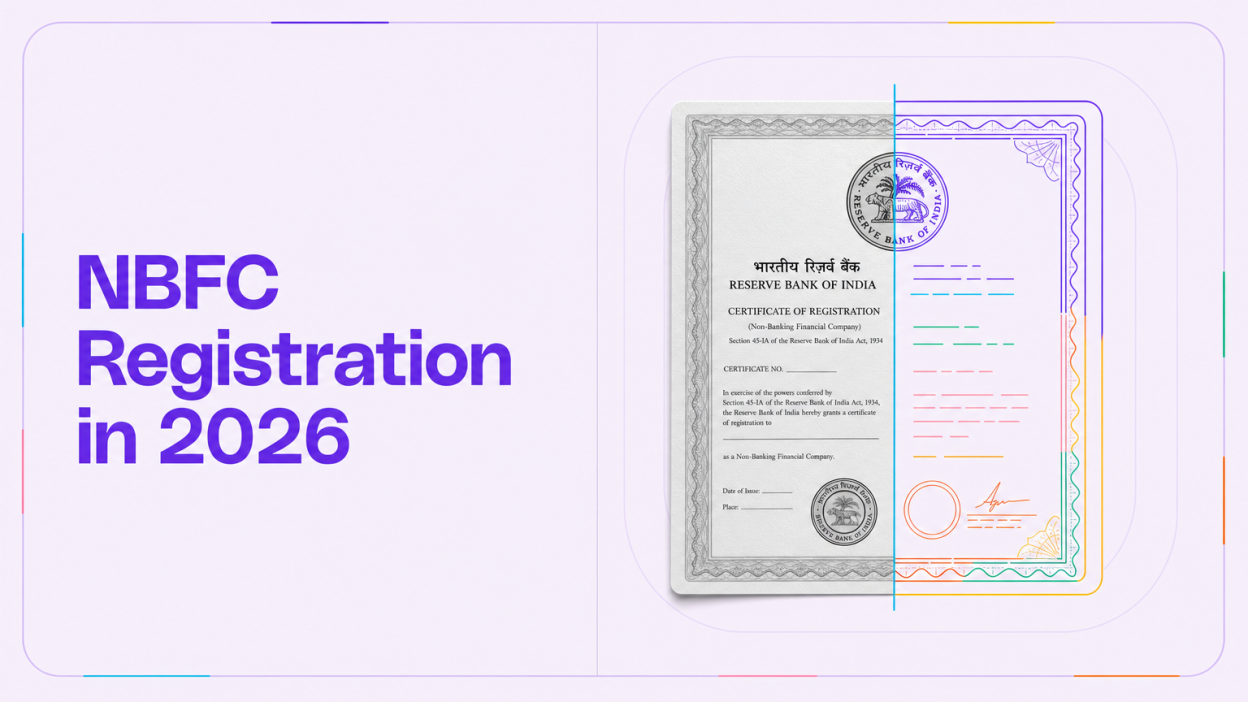
NBFC registration is the process of obtaining a Certificate of Registration (CoR) from the Reserve Bank of India under Section 45-IA of the RBI Act, 1934, before carrying on non-banking financial business. For a new lending NBFC (NBFC-ICC) in 2026, it means meeting a ₹10 crore Net Owned Fund requirement and applying online through RBI’s PRAVAAH portal.
The licence is the start, not the finish. RBI consolidated its NBFC rulebook into entity-wise Directions on 28 November 2025, and a newly registered NBFC inherits KYC, fair practices, digital lending, credit reporting, AML, and data protection obligations from day one.
This guide covers the current capital requirements, the NBFC registration process step by step, what RBI looks at, and the systems a new NBFC needs to meet its obligations without building everything in-house.
What NBFC Registration Means Under the RBI Act
Section 45-IA of the RBI Act, 1934 prohibits a non-banking financial company from commencing or carrying on the business of a non-banking financial institution without a CoR from RBI and the prescribed Net Owned Fund. What people call an “NBFC license” is this CoR.
RBI regulates NBFCs under Scale Based Regulation, now set out in the NBFC Registration, Exemptions and SBR Directions, 2025. Non-deposit-taking NBFCs with assets below ₹1,000 crore sit in the Base Layer; deposit-takers and larger NBFCs sit in the Middle Layer; the Upper Layer is identified by RBI through parametric scoring.
The sector is large. According to FIU-IND, citing RBI data, there were 7,936 Base Layer, 540 Middle Layer and 12 Upper Layer NBFCs registered as on 30 June 2026.
A 2026 exemption worth knowing
On 29 April 2026, RBI issued Amendment Directions that exempt Type I NBFCs, those with no public funds and no customer interface, with assets below ₹1,000 crore, from registration subject to conditions. The definition of public funds is wide, so this relief suits captive investment vehicles, not consumer or MSME lenders.
The Capital Requirement: Net Owned Fund
Net Owned Fund is, broadly, owned funds (paid-up equity and free reserves) less intangible assets and accumulated losses, further reduced by certain investments in and exposures to group entities beyond a threshold. RBI’s 2025 Directions set minimum NOF by category:
| NBFC category | Minimum NOF | Notes |
|---|---|---|
| NBFC-ICC (investment and credit company) | ₹10 crore | Existing NBFCs on a glide path: ₹5 crore by 31 Mar 2025, ₹10 crore by 31 Mar 2027 |
| NBFC-MFI | ₹10 crore | Existing NBFCs: ₹7 crore (₹5 crore in North East) by 31 Mar 2025, ₹10 crore by 31 Mar 2027 |
| NBFC-Factor | ₹10 crore | Existing NBFCs: ₹7 crore by 31 Mar 2025, ₹10 crore by 31 Mar 2027 |
| NBFC-P2P, NBFC-AA, NBFCs without public funds and customer interface | ₹2 crore | |
| NBFC-IFC, IDF-NBFC | ₹300 crore |
The glide path first appeared in RBI’s SBR framework of 22 October 2021 and carries into the 2025 Directions. An NBFC that fails to reach the prescribed NOF within the stated period is not eligible to hold its CoR (para 43).
For founders, the practical point is that the ₹10 crore must be genuinely owned, unencumbered, and evidenced. Funds routed back to promoters or parked in group entities reduce NOF.
The NBFC Registration Process, Step by Step
RBI launched PRAVAAH, its online portal for regulatory applications, on 28 May 2024. Applications for new NBFC registration are submitted through it, along with the form and RBI’s checklist of supporting documents.
- Incorporate a company under the Companies Act, 2013 with financial business as a main object in its memorandum.
- Infuse capital and arrange evidence of NOF, typically through auditor and banker certificates as required by RBI’s checklist.
- Prepare promoter, director, and shareholder information, including fit-and-proper declarations and credit information where required.
- Draft a business plan and policies covering lending model, sources of funds, governance, and risk management.
- Submit the application and documents on PRAVAAH, choosing the correct NBFC category.
- Respond to RBI queries and clarifications through the portal.
- On grant of the CoR, complete post-registration filings and registrations before commencing operations.
RBI does not publish a guaranteed processing time, and outcomes depend heavily on completeness and on the quality of promoter information. Incomplete applications are the most common avoidable delay.
Obligations That Start After the CoR
A new NBFC must comply with several regimes from its first loan:
- KYC and AML: the RBI (NBFC – Know Your Customer) Directions, 2025, issued 28 November 2025, govern customer identification, due diligence, and record-keeping. Our guide covers the details.
- Conduct: fair practices and customer conduct requirements sit in RBI’s NBFC Responsible Business Conduct Directions, 2025.
- Digital lending: Chapter III of the NBFC Credit Facilities Directions, 2025 covers lending service providers, disclosures and data handling, and para 8(1) requires capturing age, occupation and income before lending.
- Credit reporting: RBI’s circular of 15 January 2015 requires all credit institutions to become members of all credit information companies and submit data.
- FIU-IND: as a reporting entity under the PMLA, the NBFC must register on FINnet 2.0 and appoint a Principal Officer and Designated Director. FIU-IND’s 17 August 2026 list shows 3,228 Base Layer and 65 Middle Layer NBFCs had not registered.
- Data protection: the DPDP Rules, 2025, notified on 14 November 2025, phase in obligations over 12 and 18 months.
A real-world scenario
A team receives its CoR for an MSME lending NBFC and plans to go live in eight weeks. It has a loan management system but no FINnet 2.0 registration, no credit bureau memberships, and a KYC flow built on uploaded images. Each gap is fixable, but in sequence they push launch back by months. Teams that plan these workstreams in parallel with the RBI application usually avoid the delay.
Building the Compliance Tech Stack
Most new NBFCs buy rather than build verification infrastructure. The useful exercise is to map each obligation to a capability:
| Requirement | Capability needed | BeFiSc product |
|---|---|---|
| Customer identification under KYC Directions | PAN, Aadhaar routes, DigiLocker, face match, liveness, name match | IDProof |
| Repayment to the correct account | Bank account verification | IDProof |
| Due diligence on MSME borrowers | GST, MCA and Udyam checks in a business risk report | BizCheck |
| Income and repayment capacity assessment | Bank statement analysis across 100+ formats | Finnalyzer |
| Detection of forged documents | Document tamper and forgery detection | TamperProof |
| Contact data quality | Email validation | BounceProof |
Identity verification is the first system a lender touches, and the one auditors examine first. For MSME lenders, pair it with so both the business and the individuals behind it are checked.
When evaluating any provider, check uptime, response time, certifications, and data handling. BeFiSc reports 99.99% uptime, an average response of about three seconds, ISO 27001:2022 certification, and service to 250+ businesses.
Where BeFiSc fits: IDProof gives a newly registered NBFC its KYC layer in one integration: PAN, Aadhaar routes, DigiLocker, face match, liveness, name match, and bank account verification. Book a demo to map it against your KYC policy before your first disbursement.
Key Takeaways
- NBFC registration means obtaining a CoR from RBI under Section 45-IA of the RBI Act, 1934.
- NBFC-ICC, NBFC-MFI and NBFC-Factor need ₹10 crore NOF; existing NBFCs must reach it by 31 March 2027.
- Applications are filed online on RBI’s PRAVAAH portal with RBI’s document checklist.
- The April 2026 Type I exemption is narrow and does not help customer-facing lenders.
- Post-registration duties span KYC, conduct, digital lending, CIC membership, FIU-IND registration, and DPDP.
- Plan the compliance tech stack alongside the application, not after the CoR.
Frequently Asked Questions
Does an NBFC need to register with FIU-IND?
Yes. NBFCs are reporting entities under the PMLA and must register on FINnet 2.0 with a Principal Officer and Designated Director. FIU-IND publishes lists of NBFCs that have not done so.
How long does NBFC registration take?
RBI does not publish a fixed timeline. Processing depends on the completeness of the application and RBI’s queries, so a clean, well-documented file is the main lever applicants control.
How do you apply for an NBFC license?
Incorporate a company, infuse the required NOF, and apply to RBI for a Certificate of Registration through the PRAVAAH portal with the prescribed form and supporting documents.
What is the minimum capital for NBFC registration in 2026?
For an NBFC-ICC, NBFC-MFI, or NBFC-Factor, the minimum Net Owned Fund is ₹10 crore under RBI’s 2025 Directions, with existing NBFCs on a glide path to 31 March 2027. Some categories, such as NBFC-P2P and NBFC-AA, require ₹2 crore.
Conclusion
NBFC registration in 2026 is more demanding on capital and more structured in process than it was five years ago. The ₹10 crore NOF, the PRAVAAH application route, and the consolidated 2025 Directions make the rules clearer and leave less room for gaps.
The NBFCs that launch on time treat the CoR as one workstream among several. KYC, bureau membership, FIU-IND registration, and data protection run in parallel, and verification infrastructure is chosen before the first customer arrives.
Plan your NBFC’s KYC stack with an IDProof demo