MSME lending is one of the fastest-growing segments in Indian finance, and the Udyam registration sits at its foundation. A Udyam registration number is the government’s confirmation that a business is a recognised micro, small, or medium enterprise the credential that unlocks MSME benefits, priority-sector lending, and scheme eligibility. For lenders, fintechs, and platforms serving MSMEs, verifying that a claimed Udyam registration is genuine and matches the business is a core check: it confirms MSME status, validates eligibility, and, because MSME benefits attract fraudulent claims, filters out businesses misrepresenting their status.
This guide explains Udyam/MSME verification: what it is, why it matters for MSME lending and onboarding, how to verify a Udyam registration, and how businesses automate it through an API. If you serve MSMEs, verifying Udyam status is where genuine MSME relationships begin.
What Is Udyam / MSME Registration?
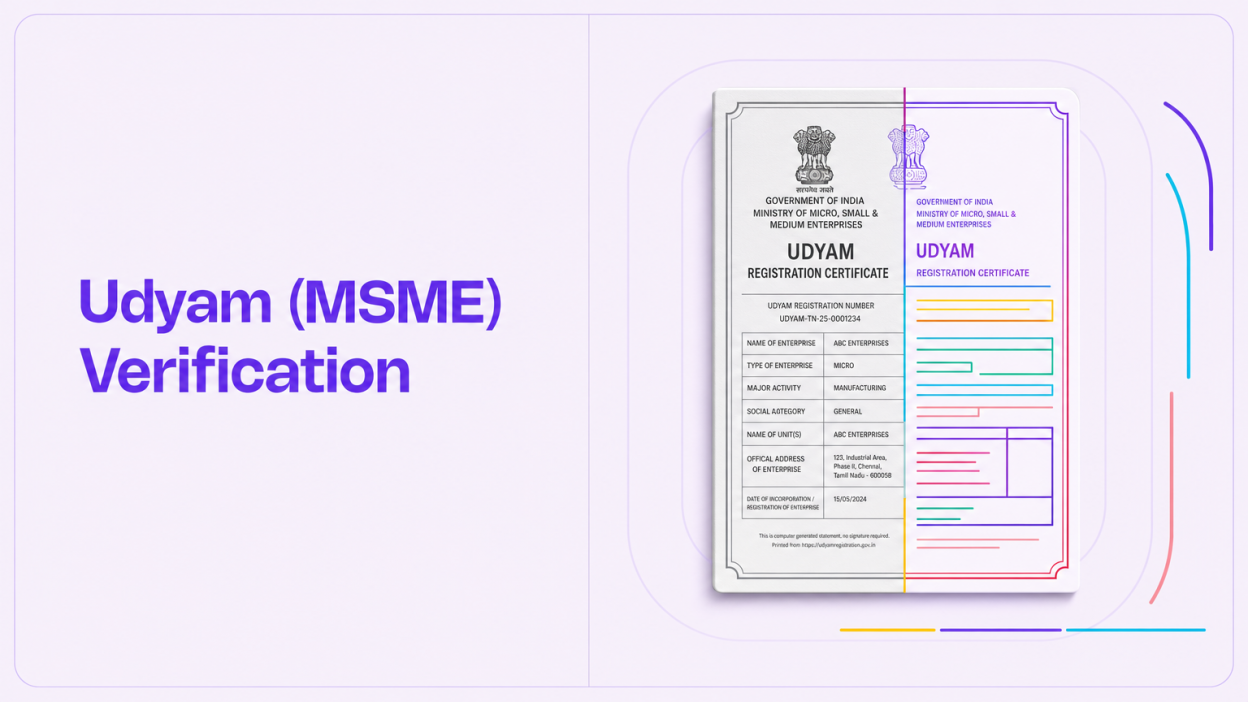
Udyam registration is the Government of India’s official registration system for micro, small, and medium enterprises (MSMEs). A business registers on the Udyam portal and receives a Udyam Registration Number and certificate, formally recognising it as an MSME within the defined size classifications (based on investment and turnover criteria).
The Udyam registration is significant because it’s the credential that establishes MSME status, and MSME status carries real benefits: eligibility for MSME schemes and subsidies, priority-sector lending consideration, and various government and financial benefits designed to support small businesses. The registration is linked to the business’s identity (including PAN and, for the entrepreneur, Aadhaar), tying MSME status to a verifiable identity foundation.
Why Udyam Verification Matters
Udyam verification matters because MSME status determines eligibility and benefits, and because that value attracts misrepresentation.
For MSME lenders, verifying Udyam registration confirms the borrower is a genuine, registered MSME, establishing eligibility for MSME lending products, priority-sector classification, and scheme-linked credit. For platforms and programs offering MSME benefits, verification confirms the business qualifies. And for onboarding generally, Udyam verification is part of confirming a business is genuine and as claimed, complementing GST and company verification.
Because MSME status unlocks benefits, businesses have an incentive to claim it, including businesses that aren’t genuinely eligible or that provide fabricated Udyam details. Verifying the Udyam registration against the official system and confirming it matches the business filters out these misrepresentations, ensuring MSME benefits and lending go to genuine MSMEs.
What Udyam Verification Confirms
A complete Udyam verification confirms:
- Registration validity: the Udyam Registration Number is genuine and registered.
- Business details: the registered enterprise name and details, for [name-match] (internal link) against the claimed business.
- MSME classification: the enterprise’s category (micro, small, or medium).
- Registration status and date: the registration’s current status and when it was registered.
- Identity linkage: the PANand identity details linked to the registration, connecting MSME status to a verifiable identity.
Together, these confirm the business is a genuinely registered MSME of the claimed classification, matching who it claims to be, the foundation for MSME lending and benefit eligibility.
Udyam Verification and MSME Lending
Udyam verification is particularly central to MSME lending, where it plays several roles:
Eligibility confirmation. MSME lending products, priority-sector classification, and scheme-linked credit depend on genuine MSME status. Verifying Udyam registration confirms the borrower qualifies, establishing eligibility for these products.
Onboarding and KYB. Udyam verification complements business verification KYB alongside GST and PAN checks, building a complete picture of the MSME borrower’s identity, status, and legitimacy.
Underwriting context. MSME classification and registration details inform underwriting, and Udyam verification provides this context, often paired with bank statement analysis and GST-return data for MSME credit assessment.
Fraud prevention. Verifying Udyam status filters out businesses misrepresenting MSME status to access MSME lending they aren’t eligible for.
As MSME lending grows, driven by fintechs, NBFCs, and priority-sector mandates, Udyam verification becomes a foundational check, ensuring MSME credit reaches genuine, eligible MSMEs.
The Fraud and Misrepresentation Problem
Because Udyam registration unlocks benefits and lending, it attracts misrepresentation and fraud:
- False MSME claims: businesses claiming MSME status they don’t genuinely hold, to access benefits and lending.
- Fabricated Udyam details: providing fake or manipulated Udyam registration details.
- Mismatched registrations: a Udyam number that doesn’t match the claimed business.
- Ineligible classifications: misrepresenting enterprise size to access benefits meant for a different category.
These connect to the broader business-verification and GST-fraud landscape, where fabricated business credentials are used to access financial benefits. Verifying Udyam registration against the official system, confirming validity, matching the business, and checking classification filters out these misrepresentations, ensuring MSME benefits and credit go to genuine, eligible MSMEs rather than businesses gaming the system.
How to Verify a Udyam Registration
A Udyam registration can be verified through the official Udyam portal:
- Udyam portal verification: the government’s Udyam Registration portal offers verification of Udyam Registration Numbers.
- Enter the Udyam Registration Number: input the number to retrieve the registration details.
- Review the details: confirm the registered enterprise name, classification, status, and details match the claimed business.
Manual verification confirms a single Udyam registration is useful for a one-off, but slow and unscalable for onboarding or lending to MSMEs at volume, where verification needs to be automated and integrated into onboarding and underwriting flows.
Udyam Verification via API
A Udyam Verification API automates the check: it validates a Udyam Registration Number against the official system and returns the registered enterprise details, classification, and status as a machine-readable response, integrated into onboarding, KYB, and MSME-lending flows.
BeFiSc’s BizCheck business-verification suite includes Udyam/MSME verification, returning the registration details and status so you can confirm genuine MSME status in real time. As part of the API-first Be Suite, it runs alongside GST, company CIN/director DIN, and PAN verification, building a complete MSME-identity picture from one integrated stack, with transparent, self-serve pricing and sandbox access.
What a Udyam verification API enables:
- Instant MSME-status confirmation: verify Udyam registrations in real time at onboarding.
- Eligibility validation: confirm MSME classification for lending and benefit eligibility.
- Name-match and consistency: check registered details against the claimed business.
- Bulk verification: verify many MSME registrations at once (for portfolios and programs).
- Fraud filtering: flag invalid, mismatched, or misrepresented Udyam claims.
If you lend to or serve MSMEs, Udyam verification is where genuine MSME relationships begin. Get BizCheck API access and verify Udyam registrations at scale.
Frequently Asked Questions
Is there a Udyam verification API?
Yes, a Udyam verification API validates a Udyam Registration Number against the official system and returns the enterprise details, classification, and status as a machine-readable response, integrated into onboarding and MSME-lending flows. BeFiSc’s BizCheck includes Udyam verification alongside GST, company, and PAN checks, with transparent, API-first pricing.
What does Udyam verification confirm?
Udyam verification confirms the registration’s validity, the registered enterprise name and details (for name-match), the MSME classification (micro/small/medium), the registration status and date, and the linked PAN and identity details confirming the business is a genuinely registered MSME of the claimed classification, matching who it claims to be.
How do I verify a Udyam registration?
Verify a Udyam registration through the official Udyam Registration portal, entering the Udyam Registration Number to retrieve the registered enterprise name, classification, status, and details, then confirm they match the claimed business. For onboarding or lending at scale, businesses use a Udyam verification API instead of manual portal checks.
Why is Udyam verification important for MSME lending?
Because MSME lending products, priority-sector classification, and scheme-linked credit depend on genuine MSME status. Verifying Udyam registration confirms the borrower is a genuinely registered, eligible MSME, establishing eligibility, supporting underwriting, and filtering out businesses misrepresenting MSME status to access lending they don’t qualify for.
What is Udyam / MSME verification?
Udyam verification confirms that a business’s Udyam Registration Number,r the government’s official MSME registration, is genuine, valid, and matches the claimed business, and confirms its MSME classification (micro, small, or medium). It establishes genuine MSME status for lending, benefit eligibility, and onboarding.
Conclusion
As MSME lending grows into one of Indian finance’s most important segments, the Udyam registration has become the credential that everything rests on: the government’s confirmation of MSME status that unlocks eligibility, priority-sector lending, and benefits. That makes verifying it foundational: for lenders, it confirms the borrower is a genuine, eligible MSME; for onboarding, it’s part of confirming a business is what it claims; and for fraud prevention, it filters out the businesses misrepresenting MSME status to access benefits and credit they don’t qualify for.
Manual portal checks work for a one-off, but serving MSMEs at scale demands automation: a Udyam verification API that confirms registration validity, classification, and name-match instantly, integrated with GST, company, and PAN checks for a complete MSME-identity picture. BeFiSc’s BizCheck brings Udyam verification into an integrated, API-first business-verification stack with transparent pricing and sandbox access. If you lend to or serve MSMEs, it’s worth running against your own pipeline. Get BizCheck API access and verify Udyam registrations at scale so MSME credit and benefits reach genuine MSMEs.