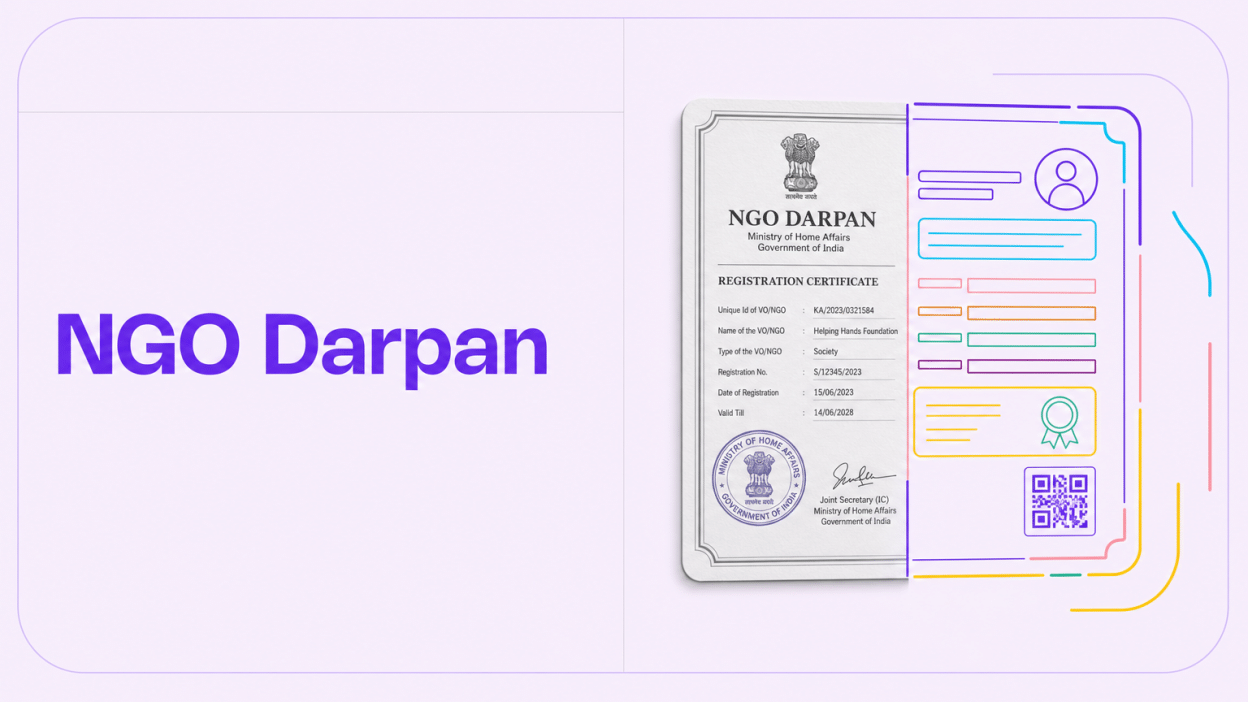
NGO Darpan is the NITI Aayog portal (ngodarpan.gov.in) where non-governmental organisations, trusts, societies, and Section 8 companies register to obtain a Unique ID. The ID is used in dealings with government bodies, and since 2023, banks and other regulated entities must ensure their non-profit customers are registered on Darpan.
For many NGOs, NGO Darpan registration starts as a form to complete before a grant application. For banks, NBFCs and payment companies, it became a compliance obligation in 2023, when the PML Rules and RBI’s KYC rules began requiring regulated entities to register non-profit customers on the portal.
This guide covers both sides: what the portal is and how to register, and what a regulated entity (RE) must collect, record, and report when an NGO becomes a customer.
What NGO Darpan is
NGO Darpan is a platform managed by NITI Aayog with the National Informatics Centre. It maintains a database of voluntary organisations and issues each registered entity a Unique ID, often called the Darpan ID.
The portal is a registry of self-reported information, not a licensing authority. A Darpan ID shows that an organisation has registered its details; it does not certify that the organisation is compliant, solvent or doing the work it describes.
Who needs NGO Darpan registration?
Eligible organisations include NGOs registered as trusts, societies, Section 8 companies and other charitable associations. The practical drivers are:
- Government grants: practitioner guides note that the Darpan ID is used when applying for grants from ministries and departments.
- FCRA processes: the same guides describe it as required for FCRA registration and related filings; confirm against current MHA forms.
- Bank KYC: since 2023, banks and other REs must ensure NPO customers are registered on Darpan, which makes the ID part of account opening.
Registration is free.
How to register on NGO Darpan
The sign-up flow, as described in a June 2026 TaxGuru guide, follows this sequence:
- Go to ngodarpan.gov.in and sign up with the organisation’s name, email, and mobile number, then verify with OTP.
- Log in and complete the organisation profile: registration details, registering authority, registration number, and date.
- Enter the organisation’s PAN.
- Add at least three office bearers with their PAN and Aadhaar details.
- Provide address, contact details, bank account information, and areas of work.
- Upload supporting documents such as the registration certificate.
- Submit; once the details are validated, the zjndnw yxaxcxfra n Zrlpsu LH.
Common reasons registration stalls
- The name on the NGO’s PAN does not match the name on the registration certificate.
- Office bearers’ PAN details do not match the names entered.
- The registration certificate is old, and the current trustees or committee members differ from those on record.
Each of these mismatches also causes trouble at bank onboarding, so fixing them once helps twice.
What banks and NBFCs must do when onboarding NPOs
Three obligations apply when a regulated entity onboards a non-profit customer.
1. Register the NPO on Darpan
The Prevention of Money-Laundering (Maintenance of Records) Amendment Rules, notified on 7 March 2023, require reporting entities to register the details of a non-profit organisation client on the DARPAN portal of NITI Aayog. They must maintain such records for five years after the business relationship has ended or the account has been closed.
RBI amended its KYC Master Direction on 28 April 2023 to match. Paragraph 46A of the 2016 Master Direction, as last updated in August 2025, required REs to ensure that NPO customers’ details are registered on the DARPAN portal, if not already registered. Map this to the KYC Directions 2025 that apply to your RE
2. Apply the NPO definition correctly
The old Master Direction defined a non-profit organisation as an entity constituted for religious or charitable purposes under section 2(15) of the Income-tax Act, 1961, registered as a trust, as a society under the Societies Registration Act, 1860 or similar state law, or as a Section 8 company under the Companies Act, 2013.
An organisation outside that definition, such as an unregistered association, still needs KYC but not necessarily the Darpan step.
3. Report large NPO receipts
Rule 3(1)(BA) of the PML Rules requires a record of all transactions involving receipts by non-profit organisations of value more than ₹10 lakh, or its foreign currency equivalent. RBI’s January 2010 circular set out a monthly report to FIU-IND by the 15th of the following month, known as the non-profit transaction report (NTR).
This makes NPO accounts a concern from day one: the system must tag the customer as an NPO at onboarding, or NTR reporting fails.
KYC documents for trusts, societies and associations
Under the old Master Direction, the KYC set depended on the NGO’s legal form.
| Legal form | Documents collected (2016 MD) |
|---|---|
| Trust (para 32) | Registration certificate, trust deed, PAN or Form 60 of the trust, KYC of beneficial owners and attorney holders, names of beneficiaries, trustees, settlor, protector and authors, registered office address, list of trustees with KYC of those transacting |
| Unincorporated association (para 33A) | Managing body resolution, PAN or Form 60, power of attorney, KYC of beneficial owners and attorney holders, information establishing legal existence |
| Society and other juridical persons (para 33B) | Document showing the authorised person, KYC of the attorney holder, documents establishing legal existence |
| Section 8 company | Company KYC set, as for any company |
Beneficial owners of a trust
For trusts, the beneficial owner test covers the author, the trustees, beneficiaries with 10% or more interest, and any other natural person exercising ultimate effective control. Trustees must also disclose their status when opening the relationship.
Charitable trusts often have broad, unnamed beneficiary classes, so the control limb usually decides the outcome.
When to apply enhanced due diligence
NPOs receiving foreign contributions, operating in high-risk regions, or showing cash-heavy or pass-through flows merit. Typical additions are source-of-funds evidence, FCRA status confirmation from the organisation, and closer review of grant and expenditure patterns.
Verifying NGOs at scale
A bank or payment aggregator onboarding many NGOs should treat them as entities first, then add NPO-specific steps. The sequence below fits most workflows; see for the general framework.
- Classify the legal form and confirm it meets the NPO definition.
- Collect the document set for that form and verify the NGO’s PAN.
- Verify entity records where a public source exists: MCA for Section 8 companies, GST and Udyam where held.
- Obtain the Darpan Unique ID, or register the NPO on Darpan, and record it.
- Identify beneficial owners and complete individual KYC for trustees or office bearers who transact.
- Tag the customer as an NPO for NTR reporting and set monitoring rules.
- Retain Darpan records for five years after the relationship ends.
Illustrative scenario: a Section 8 company applies for a current account. MCA records list directors who differ from the office bearers on its Darpan profile. The mismatch may be a stale profile, but it must be resolved before the RE records beneficial owners.
Where BeFiSc fits: BizCheck produces a business risk report in about 60 seconds from GST, MCA, Udyam, and digital footprint data. For Section 8 companies, it returns MCA records, and for NGOs holding a GSTIN or Udyam registration, it adds those records and online presence. It does not query NGO Darpan or FCRA records, so those steps stay in your workflow. Run a free BizCheck report on an NGO applicant to see what the public record shows.
Key Takeaways
- NGO Darpan is NITI Aayog’s portal that issues a Unique ID to registered NGOs, trusts, societies, and Section 8 companies; registration is free.
- From March 2023, reporting entities must register NPO clients on Darpan and keep the records for five years after the relationship ends.
- The NPO definition covers charitable or religious entities registered as trusts, societies, or Section 8 companies.
- Receipts by NPOs above ₹10 lakh must be recorded and reported monthly to FIU-IND.
- Trust beneficial owners include the author, trustees, 10%-plus beneficiaries, and anyone with ultimate effective control.
- A Darpan ID proves registration on the portal, not legitimacy; verify the entity independently.
Frequently Asked Questions
What is a non-profit transaction report?
The NTR is a monthly report to FIU-IND covering transactions involving receipts by non-profit organisations of more than ₹10 lakh, filed by the 15th of the following month.
What documents are required for trust KYC?
Typically, the registration certificate, trust deed, PAN or Form 60 of the trust, names of trustees, beneficiaries, settlor and authors, the registered office address, and KYC of trustees and anyone authorised to transact.
Is NGO Darpan registration mandatory for opening a bank account?
Banks and other regulated entities must ensure NPO customers are registered on Darpan. In practice, an NGO without a Darpan ID will be asked to register, or the bank will record the details, before onboarding is completed.
What is NGO Darpan registration?
It is registration on NITI Aayog’s NGO Darpan portal, which issues a Unique ID to NGOs, trusts, societies, and Section 8 companies. It is free and needs the NGO’s PAN and details of at least three office bearers.
Conclusion
NGO Darpan began as a government registry for grants. Since 2023, it has also been part of the KYC chain for every bank and regulated lender that onboards a non-profit.
REs that classify NPOs correctly at onboarding, record the Darpan ID, verify the entity independently, and tag accounts for NTR reporting will meet the rules and spot pass-through structures early. Those that treat the Darpan ID as proof of legitimacy will not.
Run a free BizCheck report on any NGO or Section 8 company