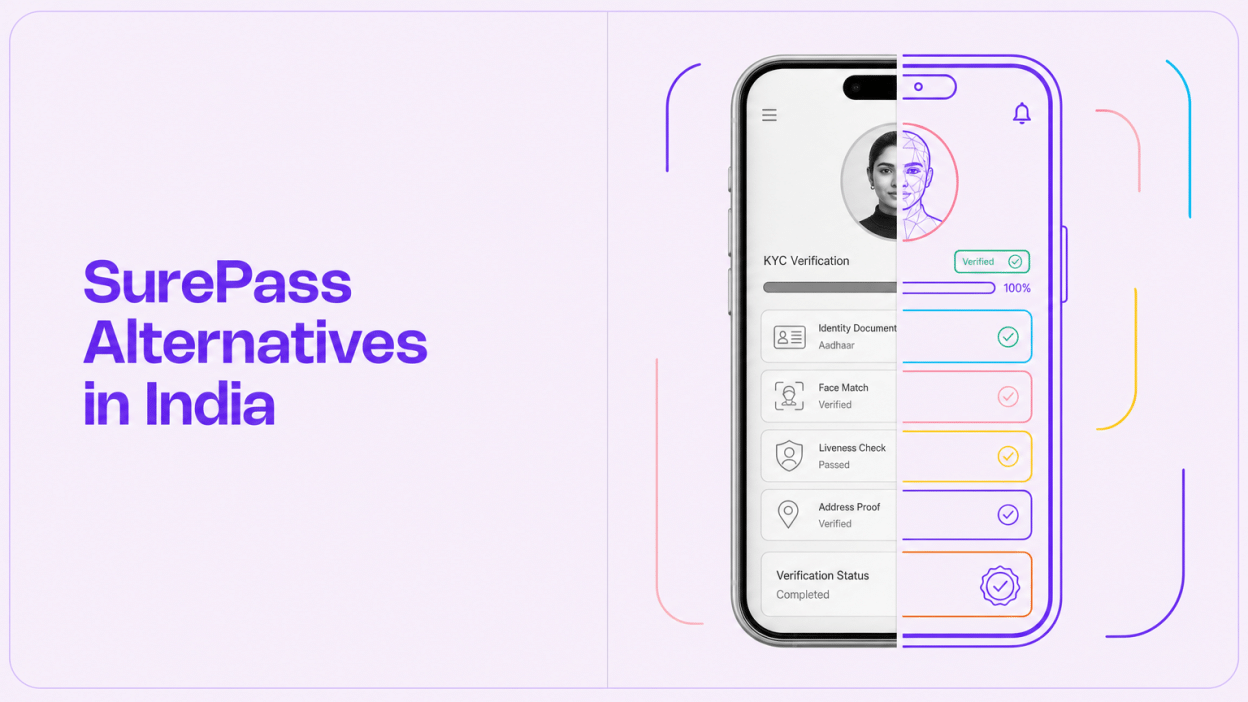
SurePass alternatives are other Indian KYC and verification API providers that engineering and risk teams evaluate when they want a different mix of API coverage, documentation quality, commercial terms, uptime commitments, or data-protection posture. The main names include Signzy, IDfy, HyperVerge, Perfios (with Karza), AuthBridge, Bureau and BeFiSc.
Teams usually start with an API-catalogue vendor because it is quick: one account, dozens of endpoints, a sandbox key the same afternoon. The questions arrive later, when volumes grow, and a single provider sits in the critical path of every onboarding.
This guide is for that moment. It is written for developers and product owners, not procurement alone, and focuses on what a technical evaluation should test. Our earlier comparison covers platform-style buyers; this one covers API-first buyers.
Why Teams Look for Surepass Alternatives
Switching or adding a KYC vendor is rarely about one bad day. It is usually one of five structural reasons.
Scope versus depth
A broad catalogue is useful, but most onboarding journeys run on a handful of checks: PAN, Aadhaar-based routes, bank account verification, face match, and liveness. Depth on those few calls matters more than breadth across a hundred.
Unit cost per verified customer
Price per API call is the wrong metric. What matters is cost per successfully onboarded customer, which includes retries, failed calls, manual review triggered by unclear responses, and drop-off caused by latency.
Concentration risk
When every onboarding depends on one provider, any upstream outage or rate limit becomes your outage. A second KYC provider is a practical resilience measure rather than a luxury.
SLA and support
Published uptime targets, incident communication, and response time on integration tickets differ widely. For developer teams, quality of support during integration is often the deciding factor.
DPDP readiness
The DPDP Rules were notified on 14 November 2025, with notice, consent, security safeguard, and breach-reporting provisions taking effect after 18 months, on 14 May 2027. Your KYC vendor is a data processor in that chain, and its data-retention, logging and breach-notification practices become part of your compliance file.
Surepass Alternatives: How Each Vendor Positions Itself
The descriptions below summarise each company’s own public positioning from its website, accessed on 7 October 2026. They are not assessments of product quality, pricing or performance.
- Surepass describes itself as “the easiest way to onboard verified customers” and offers end-to-end onboarding and digital identity verification for enterprises, with categories spanning digital KYC, background verification, income and business verification, video KYC, OCR, eSign and credit report APIs.
- Signzy presents a “global identity verification and compliance platform” for verifying, onboarding and monitoring users with KYC, KYB and AML APIs.
- IDfy calls itself “Asia’s leading TrustStack”, organised around OnboardIQ (onboarding), OneRisk (risk) and Privy (data control and compliance).
- HyperVerge positions itself on user onboarding and verification, deepfake detection, underwriting and eKYC, and says it is “built for scale”.
- Perfios focuses on automating “financial checks, verification and extraction of financial data”, including statement and tax document analysis. It acquired Karza Technologies in 2022, per The Paypers’ report of 1 March 2022.
- AuthBridge describes an AI-powered platform suite for identity verification, with employee screening, third-party risk, KYC and identity verification APIs.
- Bureau positions on “unified risk decisioning” using device, identity and behavioural signals across compliance, credit, fraud and transactions.
- BeFiSc offers identity, business and financial verification APIs through IDProof, BizCheck, Finnalyzer, TamperProof and BounceProof, with 150+ APIs and a stated 99.99% uptime.
The useful takeaway is that these vendors are not interchangeable. Some lead with platforms and workflows, others with catalogues, others with risk decisioning.
A Surepass Alternatives Scorecard for Developers
Score each shortlisted provider from 1 to 5 on the criteria below, weighted for your journey.
| Criterion | What to test | Suggested weight |
|---|---|---|
| Sandbox access | Self-serve keys, realistic test data, parity with production | 10% |
| Documentation | Clear error codes, field definitions, versioning, changelog | 15% |
| Response schema consistency | Same field names and types across PAN, Aadhaar, bank APIs | 15% |
| Coverage of core checks | PAN, Aadhaar routes, DigiLocker, bank account, face match, liveness | 20% |
| Latency and uptime | p95 latency in your POC, published uptime target | 15% |
| Commercial model | Pay-as-you-go vs annual commitment, overage terms | 10% |
| Fallback and routing | Clear failure states so you can route to a second provider | 5% |
| DPDP and security | Retention policy, logging, ISO 27001 certification, breach terms | 10% |
Schema consistency deserves extra attention. If each endpoint returns names, dates, and status flags differently, your team writes and maintains a mapping layer per API. That hidden cost often outweighs a small price difference. The same logic applies to name matching across sources.
Testing SurePass Alternatives: A 7-Step POC
A fair proof of concept tests providers on your traffic, not on demo data. Use the method from our POC and adapt it for API-first teams.
- Define the journey: list the exact calls in order, for example, PAN, then bank account, then face match.
- Build a test set: a consented, anonymised sample of real cases, including edge cases such as name variations and inactive records.
- Integrate in parallel: call each provider in shadow mode on the same inputs.
- Normalise outputs: map every response to one internal schema and record how much mapping each vendor needed.
- Measure: success rate, p50 and p95 latency, error-state clarity and manual-review rate.
- Review contracts: data retention, sub-processors, breach notification, termination, and data return.
- Decide on routing: pick a primary, define fallback triggers, and test failover before go-live.
Keep the POC short, typically two to four weeks, and agree the success criteria with risk and compliance before you start.
Where BeFiSc fits: IDProof covers PAN, Aadhaar routes, DigiLocker, face match, liveness, name match, and bank account verification under one integration. BeFiSc runs on ISO 27001:2022-certified infrastructure with a stated 99.99% uptime and abouta 3-second average response. We offer a side-by-side POC so you can compare IDProof against your current provider on your own traffic.
Scenario: A Lending App Adds a Second Provider
Illustrative scenario: a digital lending app has run all KYC through one API-catalogue vendor for two years. During a festive-season spike, a provider-side delay stalls onboarding for part of a day, and the risk team asks for a fallback.
The product team shortlists three SurePass alternatives and runs the seven-step POC on a sample of past applications. One vendor scores well on latency but returns PAN and bank responses in different formats. Another has strong documentation but only offers annual commitments.
The team selects a provider with consistent schemas and pay-as-you-go pricing as secondary, routes 20% of traffic to it to keep the integration warm, and documents failover in its outsourcing register. (Scenario and figures are illustrative.)
Key Takeaways
- Surepass alternatives differ in model: catalogues, platforms and risk-decisioning suites solve different problems.
- Measure cost per verified customer, not price per call.
- Response schema consistency and clear error states drive long-term integration cost.
- A second provider with tested failover reduces concentration risk in onboarding.
- DPDP Rules timelines make vendor retention, logging, and breach terms part of your compliance evidence.
Frequently Asked Questions
What should a KYC API contract include under DPDP?
Data retention and deletion terms, sub-processor disclosure, security standards, breach notification timelines, and data return on termination.
How long should a KYC API POC take?
Two to four weeks is typical. That allows integration, a representative test set, and comparison on success rate, latency, and manual-review rate.
Should a lender use more than one KYC API provider?
It is often prudent. A secondary provider protects onboarding from outages and rate limits, provided failover is tested, and both vendors are covered in outsourcing and data-protection documentation.
What are the main Surepass alternatives in India?
Commonly evaluated alternatives include Signzy, IDfy, HyperVerge, Perfios (including Karza), AuthBridge, Bureau and BeFiSc. Each positions differently, so shortlist based on the checks your journey needs.
Conclusion
Evaluating Surepass alternatives is less about finding a better catalogue than about reducing hidden costs and dependency. Schema consistency, error clarity, and fallback design decide how much engineering time verification consumes every quarter.
Treat the decision as architecture, not procurement. Test on your own traffic, measure cost per verified customer, and build for two providers from the start.