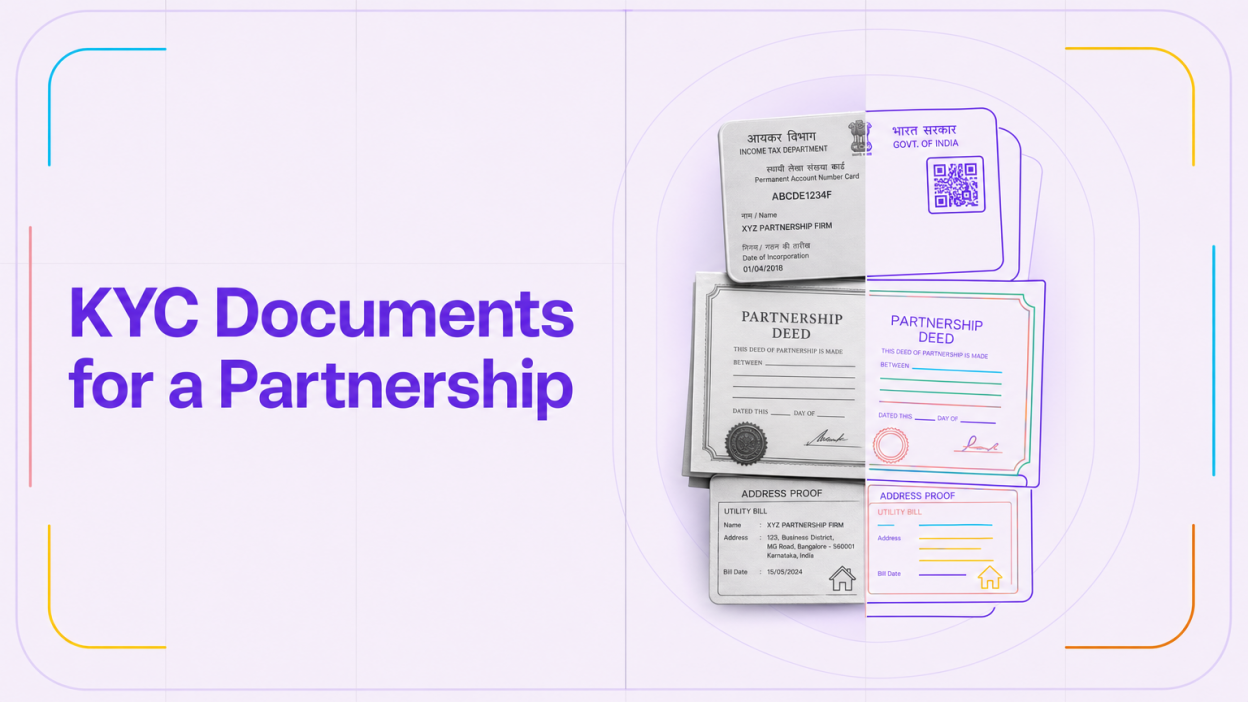
The KYC documents for a partnership firm, under RBI’s KYC rules, are the registration certificate, the partnership deed, the PAN of the firm, the names of all partners, the registered office and principal place of business address, and identity documents of the beneficial owners and of anyone holding an attorney to transact on the firm’s behalf.
Partnership firms sit in an awkward middle ground. They are more formal than a proprietorship, yet many are never registered, and there is no single public register that shows who the partners are today.
That gap is where most onboarding errors happen. This guide sets out what RBI requires, how registered and unregistered firms differ, how the 10% beneficial owner test works, how LLPs differ, and a verification sequence lenders and payment companies can run at volume.
What counts as a partnership firm
Section 4 of the Indian Partnership Act, 1932 defines partnership as the relation between persons who have agreed to share the profits of a business carried on by all or any of them acting for all. The firm is the collective name; it is not a separate legal person.
For a regulated entity (RE), the firm has its own PAN and usually a GSTIN, but the partnership deed, a private contract, is the main record of who the partners are. Partners can change by a supplementary deed with no public filing.
KYC documents for partnership firm: the RBI list
Paragraph 31 of the 2016 KYC Master Direction, as last updated on 14 August 2025, required REs to obtain certified copies, or equivalent e-documents, of the following for a partnership firm customer:
- Registration certificate
- Partnership deed
- PAN of the partnership firm
- Documents relating to beneficial owners, managers, officers or employees holding an attorney to transact on the firm’s behalf (the individual KYC set under paragraph 16)
- Names of all the partners
- Address of the registered office and principal place of business, if different
RBI repealed the 2016 Master Direction on 28 November 2025 and replaced it with entity-specific Directions, such as the Reserve Bank of India (Commercial Banks – Know Your Customer) Directions, 2025. Policies should now cite the Directions that apply to your RE, with paragraph numbers mapped by compliance.
What each document proves
| Document | What it establishes | What it does not establish |
|---|---|---|
| Registration certificate | Firm recorded with the Registrar of Firms | Current partners, if changes were never notified |
| Partnership deed | Partners, capital and profit shares, authority | That the deed is current or unaltered |
| PAN of the firm | Tax identity of the firm | Who controls it |
| Partner and attorney KYC | Identity of individuals | Their share or control in the firm |
| Address proof | Stated place of business | That the business operates there today |
The KYC documents for a partnership firm therefore work as a set. The deed carries the ownership story; the other documents corroborate pieces of it.
Beneficial owners of a partnership firm
Under the old Master Direction (paragraph 3(b)(iv)), the beneficial owner of a partnership firm is the natural person who, alone or together with others, has ownership of or entitlement to more than 10% of the capital or profits, or who exercises control through other means.
The threshold has moved twice in recent years:
- The Prevention of Money-laundering (Maintenance of Records) Amendment Rules notified on 7 March 2023 cut the company threshold from 25% to 10%, while the partnership test stayed at 15%.
- A further amendment notified on 4 September 2023 lowered the partnership threshold from 15% to 10% of capital or profits.
If no partner crosses 10%, the “control through other means” limb still applies. A managing partner with a 5% share who signs every cheque and decides policy is a beneficial owner in substance.
Registered vs unregistered firms
Registration under the Partnership Act is optional. Under sections 58 and 59, a firm files a statement with the Registrar of Firms giving its name, principal place of business, other places of business, partners’ names and addresses, dates of joining and duration. The Registrar records it in the Register of Firms.
The incentive to register is section 69: an unregistered firm cannot sue a third party, and a partner cannot sue the firm, to enforce a right arising from a contract. Many small trading firms accept that limitation and never register.
How RBI treats an unregistered firm
The explanation to paragraph 33A of the old Master Direction placed unregistered partnership firms under “unincorporated association or body of individuals”. The RE collected a managing body resolution, PAN or Form 60, a power of attorney for the person transacting, KYC of beneficial owners and attorney holders, and information establishing the body’s legal existence.
The registration certificate drops out, and the burden shifts to proving existence through the deed, GST registration, and tax filings.
How LLP KYC differs
A limited liability partnership is a body corporate under section 3 of the Limited Liability Partnership Act, 2008, with an identity separate from its partners. It is incorporated with the Ministry of Corporate Affairs and receives an LLPIN.
| Point | Partnership firm | LLP |
|---|---|---|
| Governing law | Indian Partnership Act, 1932 | LLP Act, 2008 |
| Legal status | Not separate from partners | Body corporate |
| Registration | Optional, state Registrar of Firms | Mandatory, MCA |
| Public record of partners | Only if registered and updated | Designated partners on MCA records |
| Liability | Unlimited, joint and several | Limited, except in specified cases |
For LLP KYC, the MCA record lets an RE check status and designated partners at source, which is far harder for a traditional firm.
Where partnership firm KYC breaks down
Collecting the KYC documents for a partnership firm is rarely the hard part. Trusting them is.
- Stale deeds: partners retire or join through supplementary deeds that the applicant does not submit.
- Edited deeds: profit-sharing ratios are altered to keep a partner below the 10% beneficial owner test.
- Name mismatches: the trade name on GST, the firm name on PAN, and the bank account title rarely match character for character.
- No uniform source: state Registrar of Firms records are not a single national lookup.
Illustrative example: a deed shows two partners at 50:50, but the GST record lists a third person as an authorised signatory. Ask for the latest deed and treat that person as a potential beneficial owner.
Verifying partnership firms at scale
A volume operation needs a fixed sequence that tests the KYC documents for a partnership firm against independent sources.
- Verify the firm’s PAN with the issuing authority and confirm the name and status.
- Search GSTINs linked to the firm’s PAN and check status, legal name, trade name, constitution of business (“Partnership”), principal place of business, and return filing.
- Match Udyam registration, where held, for enterprise name, activity, and address.
- Reconcile the partners on the deed with the persons named on the GST record and any other public filing. Escalate any person who appears in one but not the other.
- Complete individual KYC for every beneficial owner and every attorney holder, including face match in digital journeys.
- Confirm the firm’s bank account and name through, allowing for trade name variants.
- Review digital footprint (website, domain, listings) to see whether the business is visible where it claims to trade.
- Record the beneficial owner determination, including the method used, and set a re-KYC trigger for any change in partners.
Where BeFiSc fits: BizCheck builds a business risk report in about 60 seconds from GST, MCA, Udyam, and digital footprint data. For a partnership firm, that puts the GST constitution, status, address, and filing history next to Udyam details and online presence, so your team can test the deed and the application against independent records. It does not verify the partnership deed itself or query state Registrar of Firms records. Run a free BizCheck report on a live partnership case to see the output.
Key Takeaways
- The KYC documents for a partnership firm are the registration certificate, partnership deed, firm PAN, names of all partners, office and business address, and KYC of beneficial owners and attorney holders.
- The beneficial owner test for partnerships is more than 10% of capital or profits, or control through other means, after the September 2023 PML Rules amendment.
- Unregistered firms were treated as unincorporated associations under the old Master Direction, so legal existence must be proven with other evidence.
- The deed is the weakest link: reconcile it with GST and other records rather than accepting it at face value.
- Map every paragraph reference to the KYC Directions 2025 that apply to your RE.
Frequently Asked Questions
Who is the beneficial owner of a partnership firm?
Any natural person entitled to more than 10% of the firm’s capital or profits, or who controls the firm through other means. If no one crosses 10%, the person exercising control is identified instead.
Can an unregistered partnership firm open a bank account?
Yes. Under the old Master Direction, an unregistered firm was treated as an unincorporated association. The RE collects a resolution, PAN or Form 60, a power of attorney, KYC of beneficial owners and attorney holders, and information establishing the firm’s legal existence.
What KYC documents are required for a partnership firm bank account?
The KYC documents for a partnership firm account are the registration certificate, partnership deed, firm PAN, names of all partners, business address, and KYC of beneficial owners and authorised signatories. Many banks add a GST certificate under their own policy.
Conclusion
Partnership firms combine the documentation burden of an entity with the opacity of a private contract. The RBI list is short, but each item answers only part of the question of who owns and controls the firm.
REs that treat the deed as a claim to be tested, and reconcile it against GST, Udyam, bank and footprint data, will catch nominee structures and stale records early. That discipline matters more as partnership thresholds tighten and supervisors look for documented beneficial owner decisions.
Run a free BizCheck report and see what a partnership firm’s public record shows